|
 A great horned owl in Malheur National Wildlife Refuge in southeastern Oregon. Dusk in November is the best time of year to hear owls in the refuge. Learn more about owls by going to the Birding at Malheur National Wildlife Refuge webpage and entering “where can I see owls?” in the search field. You can also learn more about the bird populations and wildlife care center at the Bird Alliance of Oregon website.
|
|
What’s going on
30-second overview
|
|

2025 actuarial valuations and
what they mean for you
Most employer rates increasing, but
decreases may be on the horizon
 The scoop on 2027-29 rates
Average employer contribution rates are increasing somewhat for the 2027-29 biennium. Base rates actually decreased slightly, but net rates still had to increase moderately. (List of 2027-29 contribution rates (PDF).)
One of the main reasons this occurred is because many employer side accounts are ending in 2027. This ends 20-year (or so) rate reductions for about 140 employers. Another reason is greater-than-anticipated employer headcount growth.
Despite healthy market returns of 9.7% in 2025, the PERS Board is maintaining the 6.9% assumed rate that is used to calculate employer rates. By waiting to reduce the rate until the system reaches at least 90% funded status, the board strengthens rate stability and prioritizes long-term, dependable funding over short-term rate reductions.

The good news
According to actuarial modeling, if reality matches assumptions, PERS will be 100% funded by 2034.
On the way there, when the PERS funding ratio reaches 90%,* contribution rates should decrease based on the PERS Board’s rate collaring policy. This will also allow the redirect of member contributions to Employee Pension Stability Accounts (EPSA) to end at about the same time.
Regarding side accounts, for perspective, the expiration of side accounts in 2027 does not affect most PERS-participating employers. If you do not have a side account, your net contribution rates are not increasing. If your side account is not expiring next year, your 2027-29 rate still includes your active side account offset.
*Funding ratio including side accounts. According to the latest system-wide valuation, the PERS funded status with side accounts is 80%.
|
Your actuarial valuation
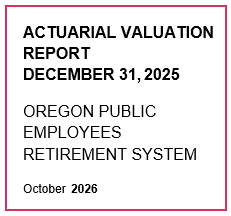
All the data that went into determining your 2027-29 rates are explained in your organization’s individual actuarial valuation report, which is posted on the Actuarial Valuations webpage in the “2025 Actuarial Valuation Reports” section.
To understand your valuation, read the Guide to Understanding Your Valuation: State and Local Government Rate Pool version, School Districts Pool version, or Independent Employers version. To ask questions about your valuation or request a consultation, email PERS Actuarial Services at actuarial.services@pers.oregon.gov.
Update on largest factors affecting 2027-29 rates
Investment returns
|

Return on market value of assets (MVA) was +9.68% compared to assumed 6.90% long-term average annual return.
Actual UAL decrease ($2.8 billion) was larger than expected.
Funded status excluding side accounts increased from 73% to 76%.
Side account offsets
Funds for many employer side accounts are projected to be exhausted in 2027.
- Employers without side accounts are unaffected by this dynamic.
- The size and level of side account offset vary significantly by employer.
Payroll size
System payroll increased more than 13% since the 12/31/2023 valuation.
Legislative changes
|

Senate Bill (SB) 849 reduced the 2025-27 School District Tier One/Tier Two UAL rate by 1.68%. (Read a brief summary of SB 849 on the PERS Legislation webpage.)
The preliminary 2027-29 SB 849 offset for schools is 1.37% of 2027-29 payroll. The final offset rate will likely be greater; it will be presented at the PERS Board meeting on April 2, 2027.
|
What is next
In December, Milliman will present contribution rate and funded status projections based on this valuation. That analysis will use the latest year-to-date investment return information at the time the projections are made. Get information about the December board meeting on the PERS Board meeting webpage.
Learn more
For complete details about Milliman’s 2027-29 system-wide valuation findings, read their Actuarial Valuation presentation (PDF). For an explanation of changes since the last actuarial valuation, read the 2027-29 Employer Rate Summary webpage.
|
|

Update on ‘major fraction of the month’
Effective in 2026, Senate Bill 851 (2025) (PDF) gave new meaning to the term “major fraction of the month.” This term is important because it determines:
- When a PERS member earns service credit for a calendar month.
- When a leave without pay (LWOP) is official, reportable to PERS, and impacts a member’s service credit for that month.
‘Major fraction of the month’ definitions

OLD DEFINITION
To earn service credit for a calendar month, a member had to perform service for at least 50 hours in a month (per Oregon Administrative Rule (OAR) 459-010-0014). To report LWOP, an unpaid leave had to equal 11 business days or more in a calendar month (OAR 459-005-0015).*
NEW DEFINITION
For both purposes (determining service credit and reportable LWOP), major fraction of a month is more than half the calendar days** in a calendar month.
|
How to count major fraction of a month
When determining a month of service credit
Per OAR 459-010-0014 (Tier One/Tier Two) and OAR 459-075-0150 (OPSRP), to receive service credit for a calendar month, a member must be employed in a qualifying or active service position for the major fraction of the month and be paid.
- For a month with 30 or 31 days, a major fraction of a month of qualifying employment is 16 or more calendar days. For example, employed from the 15th through the 30th is 16 days: service credit earned.
- For a month with 28 or 29 days, a major fraction of a month of qualifying employment is 15 or more calendar days. For example, employed from the 15th through the 28th is 14 days: no service credit earned.
When determining whether to report a leave without pay (LWOP)
As defined in OAR 459-005-0015, an employee’s LWOP must be reported to PERS when it (1) lasts the major fraction of the month, (2) is completely unpaid by the employer, and (3) is an official leave that they requested and the employer approved.
When counting LWOP days, include every calendar day between the first requested LWOP day and the last. Then determine if it is more than half the calendar days in the month:
- For a month with 30 or 31 days, report an LWOP of 16 or more calendar days.
- For a month with 28 or 29 days, report an LWOP of 15 or more calendar days.
Notes:
- An employee can have multiple separate LWOPs in one month. Add the total days; if together they equal more than half the calendar days, report all the LWOPs. If they equal half or fewer days in one calendar month, do not report them.
- A calendar month when a member is on LWOP does not earn service credit.
Learn more
*View the updates in OAR 459 Notice of Proposed Rulemaking (09/25/2025) (PDF).
**A workday is one calendar day, whether your employee works 8 hours or 24.
Quiz! To report or not to report?
Test your understanding of LWOP by taking the quiz in employer guide 11, Reporting a Leave, section “Reporting Wages, Termination, or Death During Leave,” subsection “Knowledge Test.”
|
|
|


Dear Rep,
I am a local government reporter, and work-period dates make my records suspend all the time. What am I doing wrong?
Signed, Daunted by Dates
Dear DAUNTED,
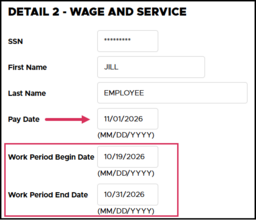
Employer reporters for local governments do have to enter work periods dates on their wage records; there is no way around it at this time.
This step must be done correctly or your record will suspend. That is why the Employer Service Center (ESC) provides resources to help you understand how to report wages within the constraints of work period dates. Plus you can always reach out to your assigned ESC representative for help.
In July 2026, ESC held a special webinar for local government employers called Local Government Employers: PERS Reporting Challenges. The materials are posted online for you to review at your convenience:
|
More information coming soon
Employer reporting guide 9, Reporting Wages for a Qualifying Employee (on the Employer Manuals & Guides webpage), is being expanded. The new version will include instructions for reporting lump sums and special payments for local government and non–local government employers. More information to come in next month’s Employer News.
|
|
|
Prioritizing emails from PERS
As we approach December 31 — a popular retirement date — keep an eye out for emails with a subject line that includes “benefit pending.”
All emails sent from PERS staff that require information or action from you have the same pattern of subject line:
- PERS employer number.
- Last name of employee.
- Employee PERS ID.
- The priority or action required, such as:
▪ No action.
▪ Action required.
▪ Response needed.
- The issue (as needed), such as:
▪ Missing wages.
▪ Employment question.
▪ Due date.
Samples
PERS, ER06000, Jones, A10101, Pending Benefit (or 12/1 ERD), Missing Wages (CH).
Line will show either Pending Benefit or a date like 12/1 ERD. The initials in parentheses are those of the PERS staff member working on the account.
PERS ER 06000 JONES A10101 Action Required/Missing Wages DUE 12/26
PERS ER 06000 JEFFERSON 101010 ACTION REQUIRED/retiree not terminated/URGENT
|
Learn PERS reporting
Beginner Employer Reporting 1
This is a live, 90-minute interactive class for beginner PERS-participating employers and employer reporters who would like a refresh on reporting basics.
Format: Online through GoTo Training.
Registration: Advance registration is required. Class size is limited.
Or go to the Employer Training webpage.
Upcoming classes:
▪ November 4 (8:30 a.m. – 10:00 a.m.)
▪ December 2 (8:30 a.m. – 10:00 a.m.)
|
|
|
Need help?
Contact the Employer Service Center to ask questions and get one-on-one reporting help.
|
|
|
|
|