|
 A northern flicker woodpecker (colaptes auratus) on a birch tree.
|
|
What’s going on
30-second overview
|
|
The PERS actuary’s system-wide actuarial valuation and individual employer valuations will be ready in December. Read a preliminary summary of the report and what it predicts for employer rates in 2027-29. ❖ For employer reporters, here is the lowdown on work-period-date fields. Find out which employers should not fill out those fields. ❖ Introducing an easy way to help new employees understand their PERS benefits package: the new Welcome to PERS website. ❖ Lastly, one of the beneficiary-designation options is going away next year. Read what you need to tell employees about beneficiary forms.
|
|
|
|

Summary of 2027-29 advisory valuation and what it means for you
Most employer rates are predicted to rise; system’s financial health is improving
PERS actuary Milliman’s 2025-27 system-wide advisory valuation, scheduled for release in early December, predicts minor contribution-rate increases for most employers for the 2027-29 biennium.
At the September PERS Board meeting (board-meeting packet (PDF)), Milliman actuaries presented a preview of the system-wide valuation in their Year-End Actuarial Valuation Reports presentation (PDF), which is summarized below.
For background on side-account expirations, jump to “Why are so many side accounts expiring in 2027?”
Why rates are predicted to increase
Investment returns
In 2024, the Oregon PERS Fund (OPERF) had lower-than-assumed investment returns of 5.71%. Employer rates are based on a long-term average return assumption of 6.9%.
If 2025 investment returns are near 6.90%, actual 2027-29 rate changes may be similar to those shown in the advisory employer reports, which will be available in early December.
If 2025 returns are below the assumed return, the actual 2027-29 rate increases could be larger than those shown in this year’s advisory employer reports.
Side account offsets
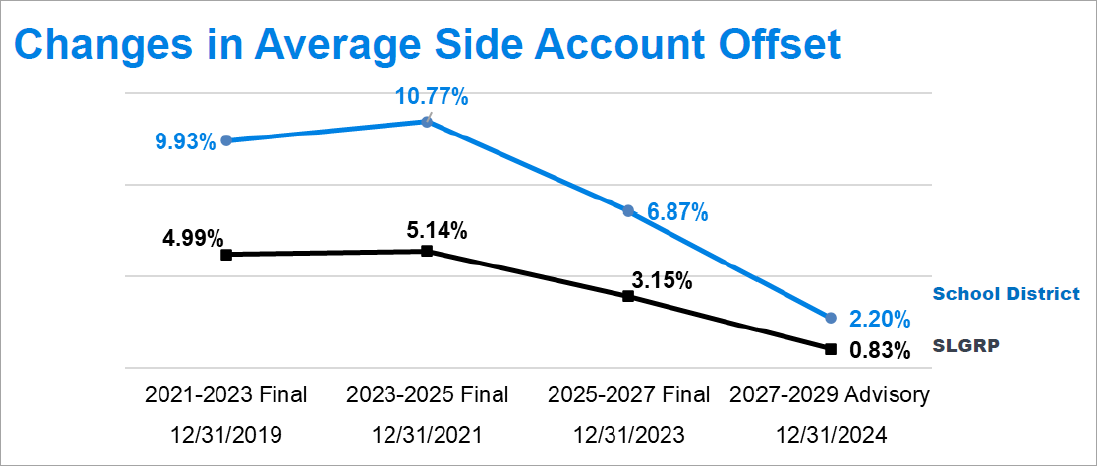
The average side-account offset decreased since the last rate-setting valuation. This is because of the scheduled expiration of many side account balances on December 31, 2027. This means that these balances will not provide those side-account holders a rate offset in the 2027-29 biennium. Learn more in “Why are so many side accounts expiring in 2027?” below.
Changes in average side account offset by pool
(Milliman chart from Year-End Actuarial Valuation Reports presentation (PDF))
Payroll size
The 2024 year-end valuation showed higher-than-assumed payroll growth. This increases employer costs (aka liabilities) more than predicted and, thus, more than your rate was calculated to be able to cover. The extra cost accelerates the spend-down of your side account balance using the offset rate currently in effect.
Reduced offset from member redirect
The valuation also forecasts fewer members contributing Individual Account Program (IAP) funds to their Employee Pension Stability Accounts (EPSA) because of not earning enough to reach the member redirect monthly salary threshold. This will reduce their employers’ member redirect offset.
System’s financial health is improving
Milliman reported to the PERS Board that assumption changes from this year’s experience study (PDF) decreased the PERS actuarial accrued liability by 0.9% ($1.0 billion).
The system’s funded status (excluding side accounts) increased slightly from 72% to 73%.
What is next
- This month, Milliman is preparing employers’ individual advisory valuation reports.
- After Milliman presents listings of employer-specific advisory 2027-29 contribution rates to the PERS Board at the board’s December 5, 2025, meeting, PERS will publish the reports on the Actuarial Valuations webpage. The Employer Service Center will notify employers that the reports are published so that you can download your report.
- Milliman will update the PERS long-term contribution rate and funded-status projections.
About advisory valuation reports
An advisory valuation is not used to set rates; instead, it has two purposes:
- To assess the health of the system between rate-setting years.
- To show employers what their rates would be if they were changed based on this valuation. This gives you a good idea of what your new rates might be in the next biennium, so you have time to prepare.
The system-wide and individual-employer advisory valuations will be released after they are presented at the PERS Board’s December meeting (PERS Board webpage). The system-wide valuation is based on the state of PERS assets and liabilities on 12/31/2024. Final 2027-29 rates will be based on assets and liabilities as of 12/31/2025, including actual full-year 2025 investment returns and the level of system payroll as of 12/31/2025.
|
|
|
Why are so many side accounts expiring in 2027?
In 2003, voters approved a ballot measure allowing the state to issue pension obligation bonds to improve the state of Oregon’s financial health. These bonds were used to fund more than $2 billion worth of side accounts that would pay down the unfunded actuarial liability (UAL) for several state agencies and reduce their PERS contribution rates.
When the side accounts opened on November 1, 2003, the state’s PERS rates dropped by 6.6%.
All agencies who were benefitting from the side accounts were obligated to make principal and interest payments on the pension obligation bonds for 24 years.
The side accounts also had an amortization schedule of 24 years. Transfers from the accounts would help pay the state’s PERS contributions until the accounts fully amortize in 2027.
Over this time, the side account offset has changed as needed; for the 2025-27 biennium, the state’s side account is providing a 3.62%-of-payroll rate offset. Once the side accounts close, the state’s collared net rate will go from 23.3% to an estimated 26.97%.
|
|

What to do with work-period dates
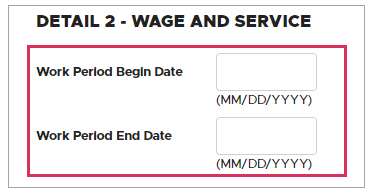
When you are reporting wages or a special payment on a Detail 2 record, you may wonder what to do with the work period fields. School employers and state agencies should not fill out those fields. Here is a quick review.
Who reports work periods?
Employer type
|
Work periods?
|
Requirements and tips
|
|
Schools, universities, and community colleges
|
NO
|
Do not fill out the work period fields; your record will suspend (i.e., not post). Leave both fields blank.
|
|
State agencies
|
NO
|
Do not fill out the work period fields; your record will suspend (i.e., not post). Leave both fields blank.
|
|
Local government organizations:
towns, cities, counties, municipalities, and special-purpose districts
|
YES
|
Work period dates are required.
Both dates must be in the same month. If a work period ends in the next month, create a second Detail 2 record. For instructions, go to the Detail 2 Wage and Service Fields quick-reference guide, section “For Local Governments: How to Use the Work Period Date Fields.”
TIPS
Split the hours and wages between the two records. Ensure that each record has a portion of the hours and wages and that, between the two records, the total wages and hours for the work period are reported.
Include both Detail 2 records in the same Regular report.
|
|
|
|
.

New PERS website for new employees
When your new employees want to understand their PERS benefits, you now have an easy-access, single source of information for them.
Announcing the Welcome to PERS website for new employees and PERS members. This new section of the PERS website is for new members and soon-to-be members of the Oregon Public Service Retirement Plan (OPSRP) Pension Program. (Tier One and Tier Two pension programs are closed to new members.)
On the site, members can learn about:
Retirement benefits — pension, Individual Account Program (IAP) account, and Oregon Savings Growth Plan (OSGP), if your organization participates.
Survivor benefits — option to leave benefits to a beneficiary.
Disability benefits — PERS benefits for members who become too sick or injured to work.
Online Member Services (OMS) portal — open the OMS flyer for log-in instructions.
Path to vesting and retirement — how to vest (i.e., be guaranteed to receive a pension); retirement eligibility based on PERS program and job classification.
Resources for employers
New employers can visit the Overview of PERS Benefits for Your Employees webpage. For detailed information, go to the Employers homepage and explore the webpages listed under the green tab “About PERS.” Also check out employer guide 1, Overview of PERS.
Getting to the website
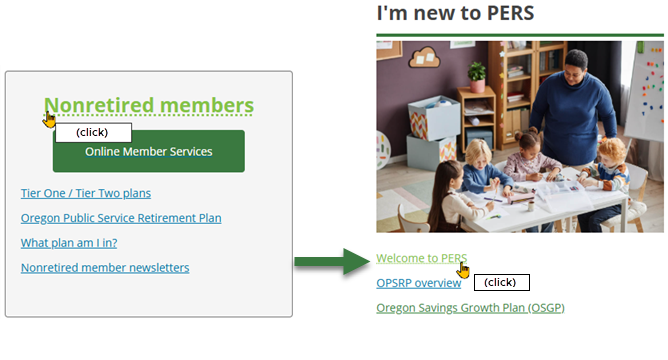
To help employees get to the page, share the Welcome to PERS website link, share the flyer below, or tell them to go to the PERS homepage, then the “Nonretired members” section. Then under “I’m new to PERS,” click “Welcome to PERS,” as illustrated below.
 Website flyer
To make it easy for your employees to access the site, print and post this Welcome to PERS website flyer where your employees can see it (and download a copy and email it to remote employees). It has a QR code that enables employees to go straight to the site through their phone camera.
|
|
|
.

Beneficiary option changing in 2026
‘Standard beneficiary designation’ no longer accepted January 1
PERS has simplified members’ beneficiary options effective January 1, 2026. The current beneficiary options of standard beneficiary and specific beneficiary will be limited to only the specific beneficiary designation starting next year. This will streamline and shorten the process of locating beneficiaries.
If you have beneficiary and retirement forms on hand for employees, here is what you need to know and tell your employees about preretirement beneficiary forms and retirement forms.
Preretirement beneficiary forms
Beneficiary forms published on the PERS website were revised last March to remove the standard beneficiary option. If you have forms on hand from before March 17, 2025 (the date is at the bottom of the form), replace them with the new versions linked below.
Individual Account Program (IAP) beneficiary for Tier One, Tier Two, and OPSRP members: IAP Pre-Retirement Designation of Beneficiary Packet.
Pension beneficiary for Tier One and Tier Two members: Tier One/Tier Two Preretirement Beneficiary Designation.
Pension beneficiary for OPSRP members: There is no form to designate a beneficiary for an OPSRP pension. PERS can only pay an OPSRP member’s benefit to a spouse or registered domestic partner.
IMPORTANT — A rejected form invalidates all previous beneficiary designations for that program (i.e., pension or IAP). The employee must complete and return a valid, current form.
|
Retirement beneficiary forms
Until December 31, employees may drop off retirement forms at PERS (see drop-off locations below) that have the standard beneficiary option selected. Starting January 1, retirement applicants may only choose the specific beneficiary option.
Pension and IAP beneficiaries for Tier One and Tier Two retirees: Tier One/Tier Two/IAP Retirement Application
Pension and IAP beneficiaries for OPSRP retirees: OPSRP-IAP Retirement Application
IMPORTANT — As of January 1, if an employee turns in a form to PERS with the standard beneficiary option chosen, PERS will reject it, and your employee will need to submit a new form.
|
Standard vs specific beneficiary designation
|
Specific designation — Available benefits are paid to one or more specifically named people or entities. Some options allow one or more alternates to receive your benefit if a primary beneficiary predeceases you.
|
Standard designation — Available benefits are paid to family members or entities in a predetermined order based on who is alive or existing when you die (e.g., spouse; if not alive or married, to children; if not alive, to parents; etc.).
No longer available in 2026. However, PERS will honor any valid standard designation already on file or received prior to January 1, 2026.
|
Retirement forms drop-off
|
PERS headquarters office
11410 SW 68th Parkway
Tigard, Oregon 97223
|
PERS Salem office
775 Summer Street NE, Suite
Salem, Oregon 97301-1280
|
|
|
Need help?
Contact the Employer Service Center to ask questions and get one-on-one reporting help.
|
|
|
|
|