Lower Umatilla Basin Groundwater Management Area Rule Making Updates
by Eric Orem, Board Member; edited by ODA staff
Efforts to reduce nitrate contamination in the Lower Umatilla Basin continue to move forward as the Oregon Department of Agriculture (ODA) provided an update on the status of current draft rules designed to protect groundwater quality. The rulemaking, presented to the Oregon Board of Agriculture on September 5, 2025, outlines new requirements for agricultural operations in the Lower Umatilla Groundwater Management Area (LUBGWMA).
The proposed rules focus on managing nitrogen inputs from farming practices, a key factor in the region’s nitrate contamination problem. According to ODA, nitrogen applied in excess of crop needs can accumulate in the soil and leach into groundwater, creating long-term risks for drinking water. The rules, therefore, aim to set clear standards for fertilizer application, irrigation practices, livestock management, and recordkeeping.
Among the core provisions, the rules prohibit applying fertilizer, fumigants, or pesticides in ways that pollute groundwater, including backflow into wells or on frozen or saturated soils. Farmers would be required to take soil samples before applying nitrogen, document application rates, soil moisture, and dates, and retain these records for at least five years. Irrigation would need to be matched carefully to soil moisture and crop demand to prevent nitrogen from moving into groundwater. Pasture management requirements would set stocking rates and require manure controls to avoid overgrazing and bare soils.
A major feature of the rule package is the Large Irrigated Acreage Program, which applies to farms with 500 or more acres. These operations would prepare and use Annual Nitrogen Plans to track fertilizer applications, calculate residual nitrogen at the end of each season, and adopt adaptive management practices when needed to capture excess nitrogen. ODA emphasized that the plans are an assessment tool rather than a strict compliance mechanism—growers must show they have a plan, but will not face penalties if their nitrogen use exceeds projections.
To measure the effectiveness of the new rules, ODA will track compliance through audits and farm inspections, and evaluate program participation rates and long-term nitrate levels in soil. However, the agency will not conduct a full evaluation of the Large Irrigated Acres Program until at least three growing seasons have passed. Similarly, residual soil nitrate monitoring will be phased in once enough data is available for scientific analysis.
ODA staff emphasized that agriculture is not only part of the challenge but also part of the solution. The new rules are designed to harness the growers' expertise and their stewardship of the land to reduce nitrogen losses and safeguard groundwater for future generations.
TIMELINE AND PUBLIC INPUT
Proposed rules are posted for public comment. The public comment period is currently open until December 22, 2025, at 5:00 PM PST, allowing farmers, local residents, and other partners to weigh in. Final adoption of the rules by the ODA Director is expected in late 2025 or early 2026.
There will be an informational hearing followed by a public comment hearing in person on December 15, 2025, from 5:30 PM to 7:00 PM at the SAGE Center in Boardman, OR. A virtual attendance option is available via MS Teams.
A virtual-only session will be held via MS Teams on December 16, 2025, from 5:30 PM to 6:30 PM.
Meeting materials, recordings, and further details are available on ODA’s rulemaking website at oda.direct/rulemaking
Top of page
Growing Leaders, Growing Food: Lost River FFA Farm-to-School Success
by Ellie Norris, Board Member
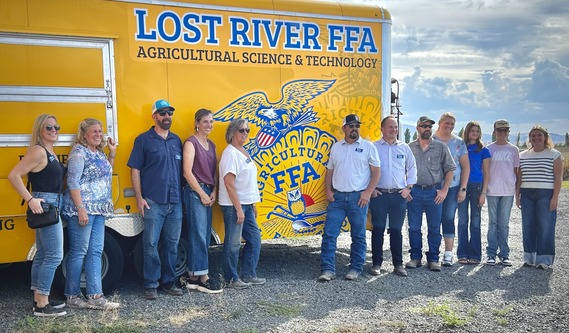 Board Members toured the school farm and FFA program at Lost River High School in Merrill, OR.
Situated in southern Klamath County, Lost River High School's Future Farmers of America (FFA) program has committed to turning classroom lessons into innovative, hands-on food system solutions. Their school farm, managed primarily by students in the FFA program, supplies meat, eggs, and produce to their school's cafeteria through Klamath County School District's broader Farm to School program.
FFA Advisor Meghan Miller, the driving force behind the school farm, has demonstrated incredible success with engaging students in the entire food production process. Students witness the hatching of eggs and participate in the raising of hogs and beef cattle to market size. She was also able to skillfully navigate the school's procurement policies and provide food to her own school's cafeteria. Her success serves as a model for future programs across the state.
At the Board of Agriculture's September 2025 meeting, they toured the school farm. They heard from current FFA chapter officers about their firsthand experience running it. Those students' confidence and knowledge were proof of Meghan Miller's commitment to educating and empowering our next generation of agriculture leaders.
Top of Page
Changes to the Wolf Depredation Grant Program
by Kirk Maag, Board Member
The Oregon legislature passed Oregon Senate Bill 777 during the 2025 Regular Session. SB 777 makes changes to the state’s wolf depredation compensation and financial assistance grant program (Grant Program)—a program established in 2011. The Grant Program was established to support the Oregon Wolf Conservation and Management Plan (Wolf Plan), which is administered by the Oregon Department of Fish and Wildlife (ODFW), by creating a cooperative program to reduce conflict between wolves and livestock.
At the September Board of Agriculture meeting, ODFW provided an update on the status of the Wolf Plan. The presentation included information regarding the Oregon wolf population, wolf-livestock conflict, livestock depredation, and depredation prevention.
Jonathan Sandau and Sunny Summers (ODA) then updated the Board on the history of the Grant Program and changes resulting from SB 777. The Grant Program is funded by the legislature and administered by ODA through grants to county-run programs. Grant funding can be used to pay for livestock or working dogs killed or injured by wolves, to pay those who use methods to mitigate livestock depredation, and to pay counties for running the program.
Key changes resulting from SB 777 include:
- Eliminating potential compensation for livestock or working dogs missing due to wolves
- Introducing a compensation multiplier of up to 3-5 times the animal’s market value (depending on animal type), with a cap of $25,000 per animal
- Requiring at least 50% of funds to be spent on prevention (up from 30%).
These changes are intended to increase support for prevention efforts and to increase compensation for confirmed and probable livestock injuries from wolves.
ODA held three informal listening sessions that informed the development of the rules implementing SB 777. Those included listening sessions in Prineville, La Grande, and Klamath Falls, with the Klamath Falls listening session occurring as part of the Board of Agriculture meeting. This allowed the Board to hear directly from those affected by wolf depredation and others interested in the effective implementation of SB 777.
Draft rules to implement SB 777 are available for public review and open for public comment. Virtual public comments will be accepted during a December 2, 2025, hearing. More information about the rule-making process can be found at oda.direct/Rulemaking.
Top of page
Klamath Project: Past, Present, and the Future
The Klamath Basin is a complex landscape where cultural, economic, and environmental needs intersect. From the Upper Basin’s ranchlands and present-day tribal homelands to the Lower Basin’s farms and wildlife refuges, communities across the region share a deep connection to and reliance on water. While the Board’s tour focused on the Klamath Project, it is important to recognize that the Upper Basin – including the Sprague and Williamson Rivers – faces unique challenges in habitat restoration, water quality, and water availability. The systems of the Upper Basin and the Klamath Project are closely interconnected, and this article highlights aspects of the Klamath Project that the Board learned during its September meeting.
Before touring the Klamath Project, Klamath Irrigation District’s Executive Director, Gene Souza, presented to the Board on the Klamath Basin's water rights history. Irrigation in the Klamath Basin supports several aspects of the local economy. In a recent economic analysis study prepared for Oregon State University’s Klamath Basin Research and Extension Center in 2023 by Highland Economics, LLC, Klamath Basin irrigation contributes more than $134 million in direct and indirect income to Klamath County alone (Highland Economics, LLC, 2023).
Today’s irrigation infrastructure in the Klamath Basin originated with the National Reclamation Act, which was passed in 1902. Work began in 1906 to drain lakes and wetland areas for cultivation by the Reclamation Service (now the Bureau of Reclamation) to increase irrigable acreage, creating what is now known as the Klamath Project. Today, the Project encompasses more than 240,000 irrigated acres. However, this re-engineering fundamentally altered an ecosystem that had for millennia supported the Klamath, Yurok, Karuk, and other regional Tribes, whose cultures and subsistence are deeply tied to the Basin’s fish and water. At its inception, Oregon and California ceded certain water rights and land title to the United States for the Project’s development.
Today, the United States holds the right to store water in Upper Klamath Lake. Still, the owners of the usage rights are the Project's patrons - the irrigation districts and individual landowners.
The Bureau of Reclamation’s management of the Project changed after court rulings and injunctions required its operations to comply with the Endangered Species Act (ESA) of 1973. Over time, a collision of legal frameworks brought the Basin's competing water needs into sharp conflict. This conflict is defined by three distinct legal pillars: the "time immemorial" water rights of the Klamath Tribes, which federal courts have recognized as the most senior in the basin; the contractual rights of farmers to receive water from the federal project; and the overriding mandate of the ESA to protect threatened and endangered species, including the basin's sucker fish (C'waam and Koptu) and coho salmon.
However, the ESA did not give authority to break previously existing contracts, including those with the patrons of the irrigation districts. During the severe drought of 2001, these competing legal obligations became irreconcilable, and operational changes, including a complete shutoff of irrigation water supply to Project irrigators in 2001, left Basin farms completely dry. The following year, low water flows and warm water in the lower Klamath River contributed to a massive die-off of over 33,000 adult salmon, devastating Tribal and commercial fisheries. Historically, water would evaporate from the marshlands and fields of the Basin, creating thunderstorms that recirculated water to the Sprague River Valley to the north, a tributary of Upper Klamath Lake. The combined impacts from drought and irrigation shutoffs severely disrupted these hydrologic systems.
Since 2001, irrigation water curtailment in the Basin has been frequent, and shortages have been exacerbated by ongoing drought and a changing climate. Most recently, irrigation water to the Project was shut off in 2021 and 2022. An ecosystem that had adapted to 120 years of irrigation was abruptly disrupted. Domestic wells throughout the Klamath Basin went dry; migratory bird populations experienced increased disease. Fields went dry, and equipment sat idle as Klamath Basin farmers braced for the long-lasting impacts of water curtailment.
Following a year of full irrigation water delivery, the Board toured the Project. Fields were lush, wetlands were brimming, and harvest was in full swing as the Board toured the Basin in early September. This scene of agricultural abundance stood in stark contrast to the fallow fields and dry canals of recent drought years.
Even so, competing water needs within the Basin continue to pose challenges to local communities. Anadromous fish, like the Chinook salmon, have returned to the Upper Basin via the newly undammed Klamath River. This milestone marks the beginning of a new era for the River. Dam removal along the Klamath River was originally part of the broader Klamath Basin Restoration Agreement (KBRA), a multi-party agreement aimed at sustaining the Klamath Basin’s water resources. Agreement partners included federal agencies, the states of Oregon and California, county governments in Oregon and California, irrigation districts, wildlife organizations, and three tribal nations – the Yurok, Karuk, and Klamath Tribes.
The KBRA embodied three goals: to restore and sustain natural production and provide for the harvest of fish species throughout the Basin; to establish reliable water and power supplies to sustain agricultural uses and National Wildlife Refuges; and to contribute to the public welfare and sustainability of all Klamath Basin communities. However, when the legislation for the KBRA failed to pass Congress before its 2016 expiration, dam removal was decoupled from the broader agreement and pursued separately under the Klamath Hydroelectric Settlement Agreement (KHSA). While the KHSA established timelines for dam removal, many of KBRA’s broader water, land, and habitat initiatives went unfunded.
Also signed in 2016, the Klamath Power and Facilities Agreement set conservation goals and stipulations for the Bureau of Reclamation to consider when it assumed operation of the Link River Dam and the Keno Dam. This agreement, too, lacked congressional authorization and funding. This continued to leave many water, land, and habitat issues unresolved that the broader KBRA had been designed to address.
In early 2025, the Klamath Basin Water Agreement Support Act of 2024 was signed into law, which authorized the Bureau of Reclamation to construct facilities to reduce fish entrainment and implement measures to restore basin watershed habitats, including tribal fishery resources held in trust by the federal government. Funding was not appropriated with this legislation – it merely allowed the Secretary of the Interior to “accept and expend non-Federal funds” to carry out the Act’s measures.
As Chinook salmon return to areas upstream of former dam sites, fish screens have yet to be installed on much of the Klamath Project’s irrigation infrastructure. In late October, the Klamath Drainage District (KDD) reported sightings of salmon in their irrigation canals (White, 2025). This development highlights a critical gap: the river was restored before the agricultural infrastructure could fully prepare for the return of fish. Without funding support for Klamath Basin agreements, irrigation districts are having to source funds for mitigation efforts independently.
As restoration continues, partners remain focused on balancing ecological recovery with the economic and cultural needs of those who depend on Klamath Basin waters. Ongoing threats to the Basin’s endangered Lost River and shortnose suckerfish (C’waam and Koptu), including water quality, habitat loss, and spread of disease and parasites, highlight the continued need for coordinated restoration and management efforts.
The Board was able to tour the Klamath Project after a year of full water delivery. Tour stops included the Link River Dam and sites within the Klamath Drainage District, where KDD manager Scott White showcased the District’s highly efficient recirculation system, which allows irrigation water to be reused during times of drought or water curtailment.
As the Board looks ahead to future water strategy development across the state of Oregon, Klamath serves as a powerful living example, navigating in real time the challenges and opportunities of balancing community water needs under increasing pressure from drought and climate change. Finding a durable balance between a new era for the river and a productive working landscape is the defining challenge for the next chapter in the Klamath Basin's long and complex story.
Sources:
Meeting recordings, presentations, and minutes can be found on the Board of Agriculture website here.
|