|
Your PIN: Invalid PIN
Please use our online consent form at:
oda.direct/JBconsent
If you experience trouble entering your PIN (listed at top of email), please try using Google Chrome or Safari web browsers, or typing in your PIN manually. If you having trouble using the link, please feel free to call or email and we will help you consent. The website link is not broken, but it seems some people are having difficulty accessing the site due to ad-blockers.
Your response for 2024 is required!
If you experience trouble entering your pin, please try using Google Chrome or Safari web browers.
This PIN is unique to your address and should not be shared. You can verify your address after entering the PIN above at oda.direct/JBconsent. Please respond as soon as possible to avoid further notices.
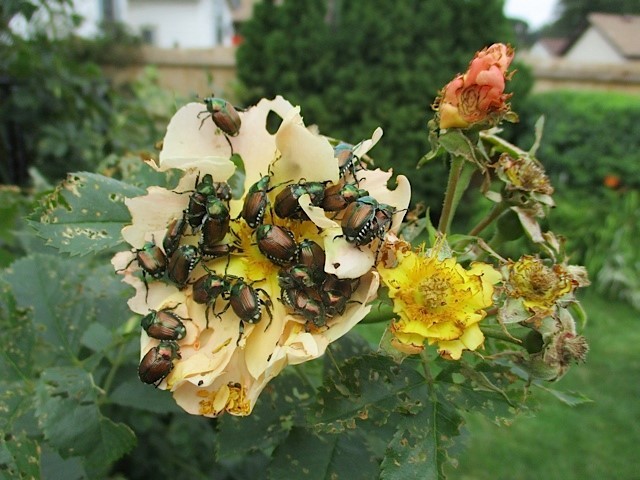 Japanese beetles feed on over 300 plant species, including roses. (Photo by Lisa Richardson)
Dear Resident,
In 2023, the Oregon Department of Agriculture (ODA) is continuing its multi-year effort to eradicate the Japanese beetle, an invasive and destructive insect pest. Thanks to your support and cooperation, we have had great success in reducing the Japanese beetle populations in Oregon, but more efforts are required. We ask all members of the community to continue their support in helping us the fight against this pest.
For information and updates on the 2023 Japanese beetle eradication, please click here.
Please take a moment to fill out the consent form (using the PIN at the top of the email) and allow ODA to apply a granular larvicide (Acelepryn® G) treatment to the ornamental planting beds and lawn of your property or residence. Treatment will be the same as treatments in 2023.
In areas with higher beetle density, we will be supplementing the granular treatment with a foliar application of Acelepryn® to target adult beetles.
Please provide your response by using the online consent form at oda.direct/jbconsent using your unique PIN found at the top of this email. For this project to be successful, it is critical that we receive a response as soon as possible.
If we do not we receive a response before our treatment dates this Spring, an administrative warrant from the circuit courts may be issued to allow ODA to treat the property.
Please fill out your consent form right away by clicking the link below:
Use the PIN found at the top of the email to access your consent form.
If you experience trouble entering your PIN (listed at top of email), please try using Google Chrome or Safari web browsers. If you having trouble using the link, please feel free to reach out to contact info above and we will help you consent. The website link is not broken, but it seems some people are having difficulty accessing the site due to ad-blockers.
Acelepryn® G is a targeted larvicide that kills certain pests in their larval state in the soil. This is a “reduced risk” pesticide and is not considered to be a health risk for humans, pets, wildlife and other insects that don’t go through a larvae stage in treatment areas (including pollinators) when applied correctly and according to label directions. Learn more about Japanese beetle and insecticide information from the Oregon Health Authority.
Acelepryn® is an insecticide that kills certain pests feeding on ornamental plants, shrubs and trees. This pesticide has the same active ingredient as the granular larvicide, and therefore the same minimal risks. For more information, view the Acelepryn® insecticide technical sheet.
Areas with lawns and ornamental planting beds within the treatment boundary are scheduled to receive a single granular treatment for Japanese beetle control in April, May, or June. Select areas with high beetle density will receive a supplementary foliar treatment in June, July or August of 2024.
All properties will be notified in advance of the application and regarding any changes in the planned schedule.
Treatment primarily consists of one granular larvicide treatment applied to all grass lawns and/or ornamental planting beds in areas where beetles were detected in 2023. The supplementary foliar treatment is used on ornamental trees, shrubs and plants and takes approximately 10-15 minutes per property.
Vegetable gardens, herb gardens, berry bushes and other edible plants will not be treated.
We will notify you at least 72 hours in advance before your property is treated.
The threat of Japanese beetle establishing in Oregon cannot be overstated. Japanese beetle is more than a nuisance and garden pest. An economic analysis completed by ODA concluded that farmers would face estimated costs of $43 million annually to combat Japanese beetle. Most of this cost would come from increased pesticide use. Restrictions on farming exports would reduce the marketability of Oregon’s specialty crops, hurting Oregon’s economy.
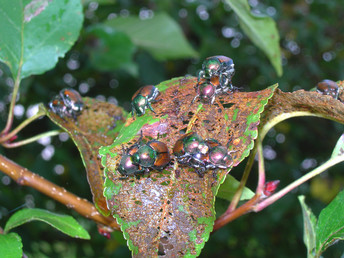 Japanese beetle damage. (Photo by Mike Reding)
Your prompt response is appreciated!
Thank you for your help in keeping Japanese beetle out of Oregon!
|