|
|
Greetings -
We’re now mid-way through October and our schools are in full swing! Homecomings, recitals, Friday night lights, and even those back-to-school sniffles are here to remind us that summer truly is in the rearview.
We’ve certainly started strong in our NWRESD schools. This fall, we had the highest-ever attendance at our Care and Connection events for students in our social emotional learning schools. It’s just wonderful to see so many families coming to school with their children, meeting their teachers, and sharing a meal as a learning community.
And since it’s October, state assessment data is out. By now you’ve all likely seen the data. If you haven’t, you can review every district in the state using NWRESD’s Oregon Schools Data Dashboard.
Because Oregon is one of the only states in the U.S. where the Legislature allows families to opt their children out of taking the statewide assessment, a significant percentage of students don’t take these annual tests. This renders the statewide assessment invalid in districts where participation rates are low and makes it very challenging to understand where improvements in curriculum and instruction efforts are necessary in our schools.
On the surface, our post-pandemic test scores appear to show that fewer Oregon students are meeting state standards compared to other states. However, the biggest change is not the number of students below state expectations, but the doubling of students who are not even taking the assessment! (See the table below.)
An accurate representation of our schools requires that we have significant participation from all student groups. For instance, two thirds of the students who opted out last year are white. When groups of students remove themselves from the data, it impacts not only our overall performance, but masks the severity of the racial and economic inequities that persist within our system. Despite some improvement in participation last year, the statewide results used to compare us to other states are still invalid as far too many students opted out.
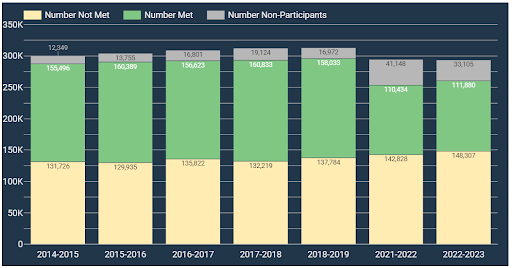 Image description: A stacked bar chart shows state-wide data from 2014-2023 of students who are meeting or not meeting benchmarks with the number of students who are not taking the tests.
I urge our educators and community members to question the all-too-common storyline that Oregon’s schools are comparatively less successful with our students based on these state assessment scores. Unfortunately, this damaging and demoralizing narrative is often repeated by the same folks who voted to allow students to opt out.
Regardless, far too many test-takers are performing below expectations in math and reading in Oregon. Across our four-county region, English Language Arts scores are about 12 percentage points below pre-pandemic levels and 9 points below in Math. Yet, there are bright spots in third-grade reading proficiency in districts that were below the regional average in 2021. Remember, these third graders were in kindergarten when the pandemic started and, while our educators worked extremely hard to reach all students in virtual environments, undoubtedly many children couldn’t get the care and attention they needed over their computers.
Shout-outs are in order for our educators in Knappa, Seaside and Gaston school districts where early reading scores rose 23, 14, and 11 percentage points, respectively.
Scappoose was already above the regional average before the pandemic and gained more than 12 points to have the highest percentage of third graders reading on level in the region. In Scappoose, 65% of third graders met the rigorous state standards in English Language Arts.
We recently sat down with Jen Stearns, the director of student achievement for the Scappoose School District, to ask her about her school district’s success.
Here’s a snippet of what she shared. Keep reading for the full interview.
“We use a frequent cycle of data-based decision-making to have open, candid conversations about literacy achievement at each grade level. We intervene early and strategically to help every student succeed. We have adopted a multitiered delivery model based on our students' needs. Our interventions target students reading below grade level and provide additional instruction. This instruction and curricular materials matches students’ specific needs with the goal of acceleration toward grade-level benchmarks.”
Huge applause to all the fantastic educators in Scappoose on their success.
There is certainly work to do to improve student learning in our region and across the state, especially as we recover from the worst years of the pandemic. Recent investments in early literacy programs championed by Governor Kotek show Oregon’s commitment to improve critical skills for our youth. I know our region’s educators - like the amazing Regional Teacher of the Year, Carissa Martos - are up for that challenge.
Be sure to read on to meet Carissa and don’t forget to check out our upcoming professional development opportunities and workshops aimed at improving student success in Northwest Oregon.
|
|
|
Enjoy the fall –
 Dan Goldman
Superintendent
|
|
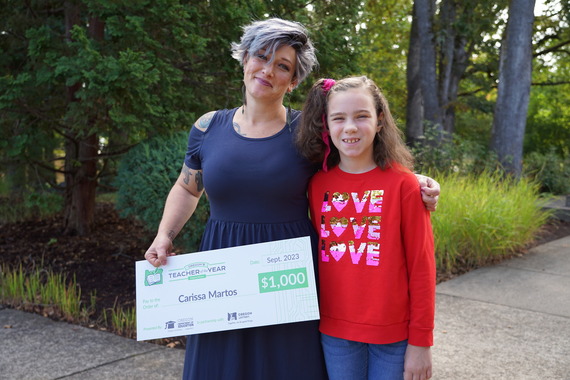 Carissa Martos, a teacher of the Deaf and Hard of Hearing, stands with her student, Jemma Bosotina, a fifth grader at Tom McCall Upper Elementary in Forest Grove, after winning Regional Teacher of the Year on Monday, Sept. 18. Carissa represents the Northwest Regional ESD region, which includes educators from Clatsop, Columbia, Tillamook and Washington counties. Photo by Tracey Goldner.
It’s usually classroom teachers who receive nominations for Oregon’s Teacher of the Year. But not all teachers lead classrooms.
So it came as a surprise to Carissa Martos when she was named one of the 2024 Regional Teachers of the Year on Sept. 18.
“What is going on?,” she asked quizzically as one of her students came into the room and presented her with an oversized check. As the initial surprise dissipated, she beamed. She later shared that you have to go back decades to find another teacher like her. 1983 is when Jean Hoem, a teacher of the Blind, took home the statewide recognition. But you won’t find a teacher exactly like her because, as far as she can tell, a teacher of the Deaf has never won the statewide award.
Carissa says she’s excited to have brought that representation and recognition of her field into the limelight.
|
|
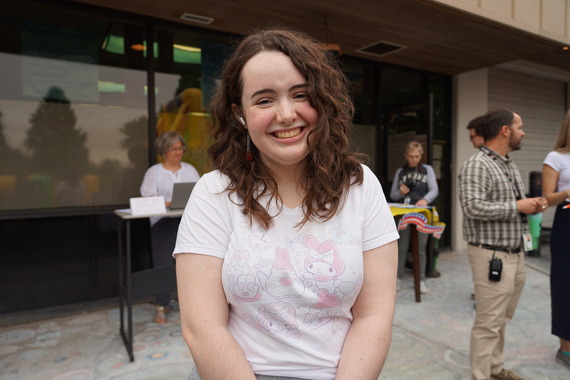 Hannah Freauf was excited to be back at Pacific Academy for Care and Connection Day after graduating from the social emotional learning school in June. She’s headed to Portland Community College this fall and credits Pacific Academy and her experiences there for setting her on a new trajectory. Photo by Tracey Goldner.
Hannah Freauf is unequivocal about the positive impact being a student at Pacific Academy has had on her life. As a freshman, she faced intense mental health challenges. That’s also when she found herself at Pacific Academy, a small social emotional learning school located in Beaverton and operated by Northwest Regional Education Service District.
“This school was really a turning point for me,” she says.
|
|
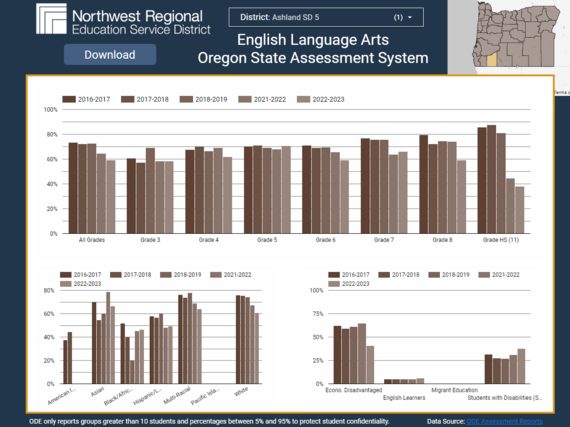
As you read above, the Oregon Department of Education recently released 2022-23 state assessment results. We’ve updated our Oregon Schools Data Dashboard with this data.
The dashboard offers a simple longitudinal view of your district’s ELA and Math results from pre-pandemic to last year. You can see trends by grade, race and federal programs.
|
|
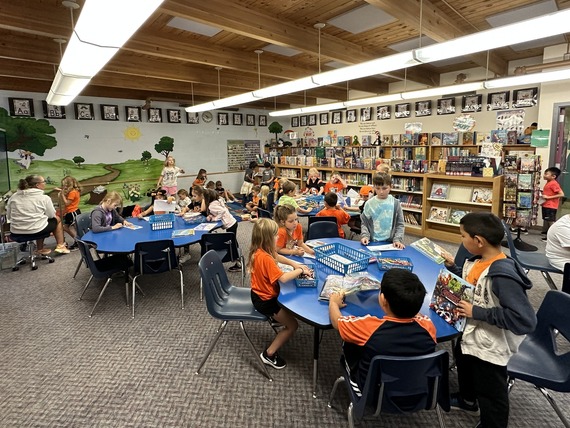 Students pick out books from the library at Grant Watts Elementary School. Photo by Paje Stelling.
The Scappoose School District has the highest percentage of third graders reading at grade level in the NWRESD region — an area that includes 20 school districts in Clatsop, Columbia, Tillamook and Washington counties.
We sat down (virtually) with Jen Stearns, the director of student achievement in Scappoose, to talk with her about how she and her team are improving students’ reading abilities.
"Supporting literacy is complex," Jen says. "There is no simple solution or one way to address learning to read. In Scappoose, we had to shift our thinking and approach our continuous improvement plan using systems thinking. As we explored solutions, we targeted multiple subsystems and all stakeholders."
|
|
Story Circle Training with Rose McGee
10/19/2023 9:30 am - 2:30 pm | NWRESD Regional Office in Hillsboro
The art of the story circle is woven in a tapestry of relevance, listening, sharing, and moving into the necessary actions needed for acquiring your individual and team goals. Come learn how to meaningfully connect with parents, students and community members.
Learn more and register.
codeORcreate Northwest
11/2-4/2023 | Virtual & Bob Chisholm Community Center in Seaside
High school teachers: Join us for a free weekend of coding that meets Oregon’s work-based learning standards. Our second annual codeORcreateNW brings high school students together with industry professionals for a fun weekend of website-building, app development or video game creation. Teams of up to five will come together to find solutions to various challenges and then present their final project to a panel of judges.
Learn more and register.
To stay updated with this event and more CCR news, subscribe to the quarterly newsletter.
Attendance Collaborative
11/9/2023 9 - 11 a.m. - NWRESD Regional Office in Hillsboro
This quarterly collaborative is for anyone involved with school- or district-level attendance initiatives. Join us to learn about attendance best practices and get Oregon law and senate bill updates. We’ll also have time for problem solving about how to maximize student learning. This is the place to bring all of our minds together.
Learn more and register.
Career Guidance Collaborative
11/14/2023 10 a.m. - 2 p.m. | NWRESD Regional Office in Hillsboro
NWRESD's Career and College Readiness team is introducing a collaborative for career guidance counselors, transition specialists, school to career specialists, career advisors, school counselors, and the like to come together to learn and collaborate on various projects and events. If you are interested in connecting with job-alike roles or if you want to see what others are doing in the region, register and learn more.
ASIST Suicide Prevention Training
11/30-12/1/2023 8 a.m. - 4 p.m. - NWRESD Regional Office in Hillsboro
This in-depth, two-day workshop will prepare participants to provide students with an evidence-based suicide first aid intervention. Participants will learn to recognize when someone could be having thoughts of suicide and work with them to create a plan that will support their immediate safety.
Learn more and register.
|
|
The Monthly Messenger is a monthly update for Northwest Regional Education Service District partners. Would you like to see your team's work featured? Email communications. |
|
|
|
|