|
|
May 2022
To our Early Learning Community:
Welcome to the May issue of the Early Learner 🌷! Thank you to everyone who joined me for the Early Learning Town Hall on April 20. A big thank you for all of your questions and comments. Here is what we heard from you and what we are working on right now.
Many of you said that finding affordable, high-quality preschool for 3- to 5-year-olds is important.
We agree. As we move forward in our commitment to supporting children in more inclusive and familiar environments, we want to be a partner in ensuring every family who wants it has access to a preschool experience for their child.
If you live in Clatsop, Columbia or Tillamook counties, you can find out more about the free preschool options available on our Free Preschool page. If you live in Washington County, you can find more information about the free preschool options on the Early Learning Washington County website.
Most but not all of these programs have income eligibility requirements. If you don’t meet those, the employment-related day care program (ERDC) is another option. This program helps working families pay for child care, including registration fees. ERDC is a subsidy program, which means you might need to pay part of the cost. Visit the ERDC website to learn more.
If you are interested in additional paid options, the Find Child Care Oregon website has fabulous resources, including information about the types of care available, what questions to ask and how to select a child care provider. You can also call 211 or 1-866-698-6155 or text the keyword “children” or “ninos” to 898211 to get more information.
Before you begin, be sure to reach out to your service provider. They can help you with your preschool or child care search.
Many of you said summer schedules are at the top of your priority list right now.
We hear you! Summer is quickly approaching, and we know how crucial it is to have options for kiddos to make progress and thrive during the summer months. We are in the process of expanding parent coaching, social groups and park and recreation program access to NWRESD families at MINIMAL or NO COST. Stay tuned for more information on summer schedules and options.
Some families with children who are experiencing autism spectrum disorders are interested in applied behavior analysis (ABA) strategies.
Our educators incorporate ABA strategies into our services when those strategies seem most appropriate to meet a child's needs, such as in our social academic intensive learning (SAIL) classrooms. In these classrooms, we use the strategies for teaching based on the autism research (STAR) curriculum.
ABA services or ABA as a specific model are arranged as private services through medical or insurance programs. Though we do not offer ABA services, we often partner with ABA programs that work with families so we can ensure consistency and continuity. If you are interested in those types of services for your child, please reach out and have a conversation with your child's service coordinator.
I hope you are finding ways to enjoy the longer days and more sunshine. Being outside, playing with our kids can be a source of stress relief from the chaos that life throws at us.
As always, I’m available if you have any questions. Please email Sabine Eaton at seaton@nwresd.k12.or.us or to get in touch.
|
|
|
In solidarity-
Johnna Timmes
Executive Director of Early Learning
|
|
|
P.S. Northwest Regional ESD is hiring! We have dozens of job openings across the region. If you are looking for a flexible schedule, we are also hiring substitute teachers and support staff. We offer a generous benefits package for full-time positions, including full medical benefits, generous leave, access to a pension and access to various tax-sheltered accounts. We are also proud of our continuous commitment to becoming an antiracist, multicultural organization. Visit our careers page.
 Join us for a weekly career night series, scheduled for every Wednesday from 4-7 p.m. throughout June. You can attend at either our Washington Service Center in Hillsboro or Clatsop Service Center in Seaside.
We will offer on-the-spot job interviews for all open positions (licensed and classified). No child care, no worries – we have activities planned for the kids. Refreshments will be provided. For additional accommodations, including language interpretation, please email humanresources@nwresd.k12.or.us.
Locations
Dates
All career nights will take place from 4 to 7 p.m.
- June 1
- June 8
- June 15
- June 22
- June 29
The 2022-23 student calendar is now available. This calendar includes program breaks and school closures for the Early Intervention and Early Childhood Special Education programs. There are digital and PDF versions available on the early learning events page.
|
|
 Let's Get Ready for Toilet Training
Welcome to the wonderful world of toilet training! We know the internet is full of ideas about how to tackle toilet training with your child. We’re here to cut through the noise and give you some time-tested tips to get you started. Of course every child is different. If you have specific questions about your child, please reach out to your child’s service coordinator. They are happy to help.
Before you start your journey, here some ideas to be more prepared:
- Make sure this is a good time for you and your family to take on toilet training. If someone in your family is starting a new job or expecting a baby or if your family is moving into a new place (or starting a recarpeting project 😆), it might be best to wait until your child is more settled. Toilet training takes time and focus, but it is well worth the effort.
- Do a little research. When does your child tend to go to the bathroom? Do they stay dry for most of the morning and go before lunch? When do they have a bowel movement? This information will give you some tips on planning trips to the toilet.
Once you’re ready to get started, follow these steps:
-
Plan a schedule and use a timer. It is too easy for everyone to get busy and miss a trip to the bathroom. Use your research from before to think about how long your child stays dry. Plan your trips just a little under that amount of time. For example, if your child stays dry for 90 minutes, then plan on making trips to the bathroom every 60 minutes.
-
Don’t ask, just let them know it is time to go to the bathroom. This is a big change for everyone and giving a choice could cause more struggles than success.
-
Make the time calm and pleasant. Have some books and songs ready. You are going to want to have your child sit long enough to relax and learn the messages their bodies are giving them about going to the bathroom. Sometimes a routine of one book and two songs will help.
-
Praise them for all the trying and the successes. When accidents happen, and they will happen, just remind them of where they are learning to “put their potty” and help them clean up. Punishment could set things back.
Good luck and remember to stick with it. If life gets too hectic or busy, it is okay to take a break and start back up when things settle down.
If you are an educational provider and have seen something that really works, please email communications@nwresd.k12.or.us to have your tip featured.
|
|
May is Better Hearing and Speech Month: Spotlight on Speech-Language Pathologists
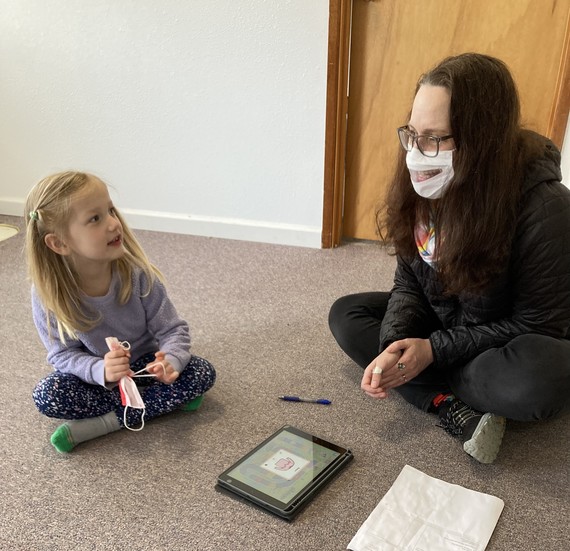 Caption: Iris Douglas, a speech-language pathologist, works with a child who is receiving services from Northwest Regional Education Service District. Photos courtesy of Iris Douglas.
Nationally, speech and language disorders are some of the most common disabilities for which young children receive special education services. These types of disorders can prevent children from communicating their wants and needs, socializing with friends or speaking clearly.
To address these and other issues, children with speech and language disorders typically work with a speech-language pathologist or a speech-language pathology assistant. These specialists are licensed health care professionals trained in speech and hearing sciences. Together, these children and their specialists work toward their specific learning goals.
Northwest Regional ESD has about 90 speech-language pathologists who work with children from birth to age 21. These specialists work with children and families who live in Clatsop, Columbia, Tillamook or Washington counties. Depending on their age, children receive services in child care or preschool settings, at home, in school or in play groups. Right now, more than 1,900 children 5 and under are receiving speech-language support from Northwest Regional ESD.
Children who work with speech-language pathologists can make tremendous gains through various types of interventions.
For example, children who communicate primarily using gestures or behaviors will work with a speech-language pathologist and other members of their learning team to learn how to sign and/or use a device such as a talking button or an iPad to help them communicate. This type of communication is called augmentative and alternative communication (AAC).
It is helpful for children with conditions such as cerebral palsy or Down syndrome, which can prevent children from being able to produce sounds that are understandable. That’s where alternative communication techniques come in. If a child doesn’t want to do something and can’t communicate that, they can easily become frustrated and overwhelmed by their inability to opt out. With alternative communication, that child would have a way to say no thanks instead of having a temper tantrum.
Children experiencing a stutter will learn techniques to reduce their stuttering, which helps them build their confidence and self-esteem. Our speech-language pathologists also teach their caregivers how to support their progress and reduce the stress and anxiety that is often caused by these types of speaking challenges.
Additionally, speech-language pathologists help children who have damage to their vocal cords due to intubation or voice overuse care for their voices and improve their voice quality.
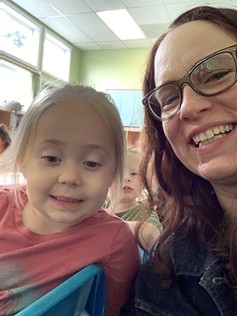
Iris Douglas is a speech-language pathologist who works on our Early Childhood Special Education team in Clatsop County.
She currently works with students and families in a variety of settings including community preschools and Head Start programs, which provide preschool for 3- to 5-year-olds.
“Part of what I love about this job is that I get to collaborate with such a variety of different people who support the well-being of children,” says Iris.
Caption: Iris Douglas, a speech-language pathologist, poses with one of her students.
|
Iris often works with parents; special education teachers; teachers of the Deaf and hard of hearing; teachers of the blind and visually impaired; instructional assistants; and other specialists including medical professionals, occupational therapists, school psychologists and audiologists.
Iris says she keeps the children at the forefront of everything she does. “What is always in the back of my head–whether I’m working with parents, teachers, typical peers, or the child receiving special education services–is, ‘how can we work together to help this child be the best little human they can be?’” she says.
When she is working she might appear focused on the technical skills of her job, like how to help a child form a speech sound, but she’s also monitoring what is happening for them behind the scenes. She tries to gauge their comfort and engagement levels.
“Learning should be fun and should always build on a child’s strengths,” she says. “My goal with the children I work with is to help them build their confidence and make it easier for them to connect with others.”
|
|
Early Intervention and Early Childhood Special Education Listening Session
Community preschool providers and Northwest Regional ESD Early Intervention and Early Childhood Special Education staff, come share your thoughts, hopes and concerns for the 2022-23 school year. We want to hear from you! Join us from 3:30 - 4:30 p.m. on May 24.
|
|
|
Our Early Learning programs support children, families and child care providers. Our Early Intervention and Early Childhood Special Education programs focus on children ages birth to 5 who are experiencing disabilities. These programs work with children and families who live in Clatsop, Columbia, Tillamook and Washington counties.
We also operate three programs that support child care providers and families in Clatsop, Columbia and Tillamook counties. Our Child Care Resource and Referral program works to strengthen the skills of child care providers and builds child care capacity in the region. The Northwest Parenting Hub offers classes and support to parents and families. Our Early Learning Hub works to ensure children are ready for kindergarten.
|
|
|
For families in Clatsop, Columbia, Tillamook and Washington counties
|
|
For families in Clatsop, Columbia and Tillamook counties
|
|
|
|
|