|
Interpretive Planning Work Moves Forward | A Conversation with Interpretive Planning Expert Dave Bucy | Landmark Legislation Exhibit Goes on the Road | Pacific Wonderland License Plate Sales Provides Funding |
Interpretive Planning Work Moves Forward 
The Interpretive Planning and Program Design Project will be completed over the next 12 months. Following are the first three steps in the interpretive development process:
Step 1: Laying the Groundwork - The focus is to gain familiarity with the context, the players, the stories and the possibilities.
Step 2: Initial Work Sessions - The initial work sessions with stakeholders, volunteers, and Visitor Services staff got the ball rolling by establish connections with the key players while making sure that everyone was familiar with the process, the products and the opportunities to be involved.
Step 3: Context Report - The report will focus on the conditions and circumstances within which the interpretive network must function.
It’s anticipated that the report will be completed by the end of June. The report will be used to formalize the interpretive plan.
Back to top
A Conversation with Interpretive Planning Expert Dave Bucy
“Working from the mandates of the History Gateway Strategic Plan, the primary interpretive goal has been identified: Increase participation in Oregon's democracy” Based on that goal, interpretive messages have been identified that will guide the development of the interpretive network. For example, for people to be willing to participate in Oregon's democracy, they have to believe the following key points:
- The quality of my life has been and continues to be shaped by what happens in Oregon's government.
- It is people [like me] that make a difference by shaping history in ways that make a difference in the quality of life we [I] enjoy.
- It is easy to get involved in Oregon's democracy.
The secondary interpretive goal is to:
"Increase interest in Oregon's history, and especially in the history of government”
The range of interest for those visiting the capitol will include every level from those who have no interest and are not coming to learn anything to those who are already an enthusiast. Rather than identifying a specific level of interest to be achieved or a minimum of additional actions related to history, the program will focus on motivating each visitor to go beyond what they were planning or willing to do in regards to learning about Oregon's government or history when they entered the doors.
- One approach to increase interest is to increase pride in the state. To that end, the interpretive program will communicate that Oregon has long been a fertile ground for ideas and innovation, resulting in groundbreaking achievements that affect people within and without the state.
- Another approach to generating interest is to foster the belief that knowing their history is of value in their lives. To that end the interpretive program will communicate that it is important and of value for you [me] to know Oregon's history.
- A good approach for generating interest by children in any aspect of their world is for them to understand that you/I can discover stories of the past by 'reading' it in the world around you.
Landmark Legislation Exhibit Goes on the Road
Oregon has repeatedly led the nation in creating, revising, and implementing laws shaping the quality of life for its citizens. The exhibit highlights groundbreaking legislation that Oregon has passed since statehood either by politician, legislative action or the public initiative process. Oregon’s Landmark Legislation exhibit originally commissioned for the Capitol will be traveling to the following locations in 2013, thanks to underwriting by a Library Services and Technology Act grant coordinated through the Oregon Historical Society:
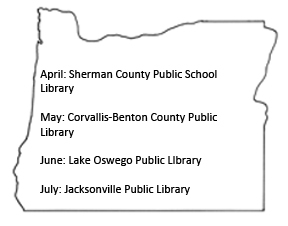
April: Sherman County Public School Library
May: Corvallis-Benton County Public Library
June: Lake Oswego Public Library
July: Jacksonville Public Library
Capitol Exhibit Sponsors: Oregon State Capitol Foundation, Samuel S. Johnson Foundation, The Ford Family Foundation and the Oregon Historical Society
Click here to explore the exhibit
Back to top
Pacific Wonderland License Plate Sales Provides Funding
The State Capitol History Center’s first phase will be primarily funded by sales of the special one-time reissue of 40,000 “retro commemorative” Pacific Wonderland license plates. Oregon schoolchildren created the original plate in 1959 in honor of Oregon’s 100th birthday, and the original plates were available until 1964. SB 961 dedicated sales of the commemorative license plate last session.

Reissued to honor Oregon’s 150th birthday, sales of the plates ($100 buys “Pacific Wonderland” as a permanent commemorative) support the Oregon Historical Society and the Foundation's Capitol History Center project. The plates are available through any DMV office or you can download the application form on DMV’s website and get the plates by mail.
Back to top
|


