|
Replies to this message are sent to an unmonitored mailbox.
To contact me, please click here: Rep.PamMarsh@oregonlegislature.gov
August 2026
Dear Friends and Neighbors,
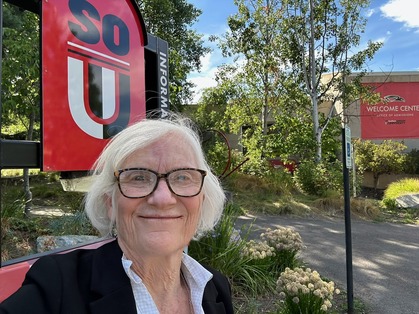
No matter what stage we are in our lives, the end of August always evokes sweet anticipation of the start of the school year. Here in southern Oregon, we are thinking a lot about stability of our education system from preschool to postgraduate studies. Challenges facing Southern Oregon University have alarmed the community and generated intense conversation about the importance of higher education.
I’ve heard from many residents with questions about higher ed funding and policy. This email provides an overview of the current headwinds and a summary (my own version) of how we got here and the legislative response in progress. It also includes a call to action if you want to follow the work—and I hope you do.
Of course, please email me if this provokes more questions or requests for information. I’m always glad to hear your thoughts, ideas, and skepticism. Feedback makes the work better.
My best,
 State Representative
Oregon House District 5 - Southern Jackson County
Oregon’s public postsecondary education institutions, including 17 community colleges and seven four-year universities, prepare thousands of Oregonians each year for promising careers, drive economic mobility, strengthen innovation that fuels our economy, and foster civic, cultural, and community vitality.
But Higher Ed in Oregon is facing fierce headwinds. Reasons are complex and include:
- Demographic shifts causing a sharp decline in the number of 18-year-olds
- Increasing personnel costs that outstrip the cost of living
- High cost of a four-year university degree that has caused students and their families to reevaluate the value of the investment
- Easy availability of online courses that are often cheaper and more convenient
- Stagnant state funding
- Cultural and social debate over the importance of education
These challenges are mirrored nationwide. Institutions across the country, especially small private colleges, are closing, merging, or undergoing acquisition at a rate of about one per week. Here in Oregon, Willamette and Pacific Universities initiated a merger last December.
The trends are alarming:
- By 2041, Oregon’s public K-12 school graduating class is expected to be 19% smaller than the graduating class of 2023, and 13% smaller than the graduating class of 2009.
- In the 1960s, the state provided 75% of the revenue for public universities. This dropped to about 60% by the 1990s and is just 28% today.
- A recent Gallup poll revealed that just 35% of Americans have confidence in higher education, which is down by half from just a few years ago.
In February 2026, Southern Oregon University announced that it had identified a $15 million hole in its budget that meant the university might be insolvent within months. In response, the Legislature allocated emergency funding to keep the university afloat. The university has since adopted a visionary Vitality Plan that will focus on reformatting the student experience while achieving long term institutional financial stability.
SOU is the first of Oregon’s public universities to face existential questions, but others are close behind. Portland State University is working to close a $35 million budget hole, and the University of Oregon is working on a $65 million gap.
A combination of past and current factors contributed to the current crisis:
-
Revenue challenges: Current revenue struggles can be traced back to the 1990s when property tax restructuring created a seismic shift in capacity to fund government programs. When the state was handed responsibility for K-12 funding, other programs that could raise revenue through fees (tuition) got short-changed. Subsequent efforts to look at higher ed lost momentum when the state experienced recession/budget crises.
-
Higher Ed system structure: During 2013-2015, the state dissolved the Oregon University System (OUS), a centralized higher education model with a Chancellor and State Board of Higher Education. Oregon moved to a new structure that allowed each institution to establish independent governing boards. The assumption was that independent regional universities with their own Boards of Trustees would be much more able to raise and manage funding. That has been challenging, particularly for regional institutions in smaller communities with fewer resources.
-
Focus on CTE: The passage of Measure 98 in 2016 shifted attention to Career and Technical Education including apprenticeships, high school skills training, and community colleges. The value of a four-year college education has been muted in this process. Oregon’s community colleges receive state funding that is proportionally much closer to the national norm than our universities currently do.
-
Legislative priorities: The K-12 system has largely dominated the legislature’s education agenda for the past ten years. All legislators have K-12 schools in their districts, along with vocal parents and school boards. The Student Success Act in 2019 represented a shining moment in the legislature's commitment to education, but colleges and universities weren’t included.
-
Federal priorities: Changes to federal policy have caused significant disruption in recent years, including reductions in research funding, elimination of Grad PLUS Loans, borrowing caps for some non-professional graduate degree programs, and changes to Public Service Loan Forgiveness program eligibility.
-
Cultural priorities: Skepticism about higher education reflects a cultural attitudinal shift about the value of the experience. As four-year degrees have grown more expensive, we frequently hear that higher ed isn’t a reasonable path for many students. We know the research reinforces the earning potential of a four-year degree, but that message isn’t being heard.
Recognizing the urgency of state action to stabilize our higher education system, in the 2026 legislative session the Legislature passed House Bill 4124, which instructs the Higher Education Coordinating Council (HECC) to study the higher ed system and recommend changes to ensure that the system is financially and operationally sustainable for the long term.
HECC is charged with ensuring that its recommendations:
- Support access to post-secondary education institutions for students across geographic locations, including rural communities and other underserved populations
- Fuel regional and statewide economic development and employment opportunities
- Improve the financial viability of each postsecondary education institution in Oregon and the postsecondary education system comprehensively, including by addressing projected enrollment, increased personnel costs, changes in federal law or priorities, and sector-specific inflationary costs
The study must:
- Evaluate the distinct objectives and missions of each category of post-secondary institution in consideration of several key variables identified in the bill
- Identify opportunities for collaboration, restructuring, or integration in the postsecondary system
To support this work, the bill allows but does not mandate consideration of other factors, including curriculum duplication or gaps; strategies to support economic development and workforce needs; funding strategies that foster collaboration or integration; and affordability metrics.
A preliminary report to the Legislature is due October 1, 2026, and the final report must be submitted by April 1, 2027.
We need to build a network of advocates who believe that higher education should be a priority for the legislature. Our college and university leaders need an army of business interests, citizens, students, and organizations reminding legislators that higher education is a conduit to economic mobility, boosts lifetime earnings, and fosters critical thinking, problem-solving, and civic engagement.
The 2027 legislative session will be crowded with a long list of complicated budget issues and policy choices. Legislators need to understand that advancing the HB 4124 recommendations must be one of the session’s success stories. If we defer the work, we risk significant damage to institutions that are vital to students, families, and regional economies. We have established a House Committee on Higher Education chaired by Rep Lisa Fragala to evaluate and act on recommendations and legislation. I have been appointed to serve on that committee.
My staff, colleagues, and I will be corresponding with advocates in the months ahead to keep them apprised of the work underway for HB 4124 and the evolving plans for advocacy in the 2027 session.
For more information or to join in Oregon Higher Ed advocacy, please complete the form at this link or email rep.pammarsh@oregonlegislature.gov.
Here are links to resources for better understanding the state of higher ed in Oregon and how to advocate for it:
Contact Rep Pam Marsh
Capitol Phone: 503-986-1405
District Phone: 541-282-4516
Capitol Address: 900 Court St. NE, H-474, Salem, Oregon 97301
Email: Rep.PamMarsh@oregonlegislature.gov
Website and e-Subscribe: http://www.oregonlegislature.gov/marsh
|