Hello Friends,
Across our state, the predictions of an intense wildfire season are coming to pass – lightning strikes have sparked wildfires over the last 2 weeks, including the Akawa Butte Fire near Sisters, which is currently the top priority fire in the nation with over 6,000 people under some level of evacuation status. My intense gratitude goes out to everyone who’s working so hard to protect our communities, including those in the Oregon fire service, our wildland partners, and crews from other states.
Read on for more updates on this year’s wildfire season, information about new efforts to improve healthcare in our community, how legislation we passed is holding data centers accountable for the power they use and keeping more money in Oregonians’ pockets, my thoughts on Trump’s attacks on elections, and more.
Wildfire season is in full swing in Oregon. A series of mid-month lightning storms have sparked wildfires across central, eastern and southern Oregon, and unfortunately, things are projected to get worse before we make it through the season.
Oregon’s peak wildfire season generally runs from July through September, and this year was expected to be particularly intense because of widespread drought conditions. Below-average winter snowfall, combined with record warmth that caused our limited snowpack to melt early, heightened the risk of severe wildfires.
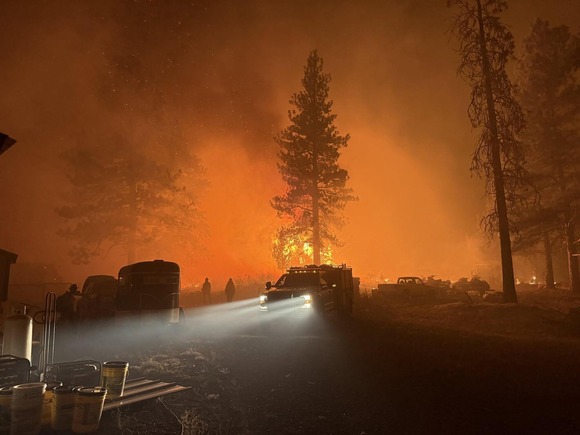 Crews provide structural protection for private residences in the path of the Akawa Butte Fire.
Over the last ten years, Oregon has averaged around 2,000 fires and 600,000 acres burned during our fire seasons (with significant variation by year). This year, we’ve already hit the 1,000 fire mark, with more than 1.1 million acres burned. That means we are in the middle of what could become another historic wildfire season.
In preparation for what was projected to be a worse than “normal” fire season, the Legislature invested $150 million in a new natural disaster fund, more than tripling the state's emergency wildfire reserve, and we created a dedicated account for federal wildfire reimbursements that the Department of Forestry can access as needed without the need to call a special legislative session.
Crews are working diligently in difficult conditions to contain the fires and protect our communities, and unfortunately, our in-state resources are fully committed to active fires. The Oregon Department of Forestry and the Oregon State Fire Marshal are doing everything they can to secure additional manpower as quickly as possible, but it’s a challenging set of circumstances. I deeply appreciate the dedication of the countless firefighters and state agencies who are working so hard right now.
Wildfire Tips
Wildfire season is far from over, and we all have a responsibility to do everything we can to prevent it from getting worse. I’m reminding every Oregonian to do their part to prevent human-caused wildfires. Avoid activities that pose serious risks like campfires, fireworks, smoking in vegetated areas, unsecured tow chains, driving or parking vehicles on dry grass, and using gas-powered equipment without spark arrestors.
Given the wildfire threat statewide, we must be prepared for anything, especially when planning outdoor activities:
-
Use TripCheck to plan your route and stay informed.
-
Register for local emergency alerts, understand evacuation procedures, and make sure you have the right gear and the appropriate amount of water at the ready.
-
You can find helpful safety tips on how to protect your home from wildfires and learn prevention techniques on Lane County’s webpage.
-
Lane County also has resources available for disaster and wildfire preparedness for residents and businesses.
Let’s all be sure to do our part to keep ourselves, our neighbors, and our beautiful state as safe as possible for the rest of summer.
Our experience as a community has been very challenging, but it is not necessarily an anomaly—the entire healthcare ecosystem is struggling right now. COVID-19 pushed our healthcare workforce to the breaking point and strained our supply chains. Local providers have merged with or sold to larger entities that could shoulder increased costs, leaving patients with fewer options for care and providers with fewer places to practice. And of course, Trump’s “Big Beautiful Bill”, which slashes Medicaid funding, strips healthcare nearly to the bone, and threatens to make it a luxury that only a privileged few can access or afford (you can read more about those impacts in a previous newsletter here).
All of that to say, our healthcare system is facing unprecedented challenges that can’t be solved overnight. But we can and should do what we can to stabilize health care in our community in the short term and develop strategies for a sustainable and responsive system for the future.
Starting in June, elected leaders, healthcare providers and administrators, and first responders have been meeting biweekly to address growing pressures on local emergency departments and the broader health care system in Lane County. The Lane County Community Care Coalition meetings have brought experts and stakeholders together to ensure we’re all working on the critical issues facing our region.
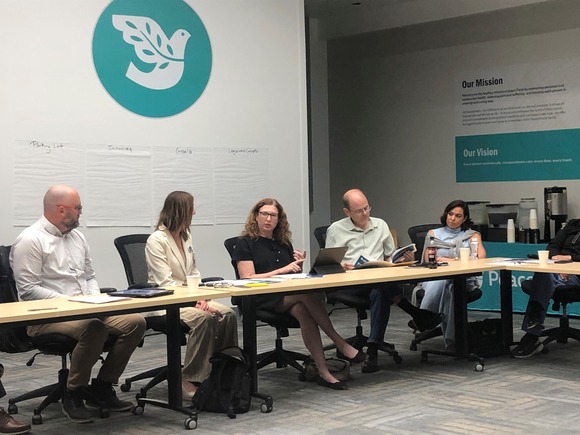 Meeting with community leaders and stakeholders.
Some of these strategies are focused on challenges that are more specific to our region—preventing further reductions in providers in our community; reducing unnecessary wait times for EMS in our emergency rooms; and strengthening our behavioral health system so Oregonians in crisis can get appropriate care without overtaxing our ERs.
But they’re also looking at the bigger picture—how do we compensate providers so that they have the resources they need to keep care locally-controlled; how do we ensure Coordinated Care Organizations have the infrastructure they need to keep care available in communities across the state; how do we collectively navigate the chaos and confusion coming out of the Trump administration so that Oregonians can continue to access the care they need?
These conversations are critical to identifying what is working, what isn’t working, and how to build a foundation for change. These will be big topics the Legislature will need to take on in the 2027 session and beyond, and I’m incredibly grateful that we have a dedicated group of experts coming together to look at every side of the problem. I’m excited to take what we’ve learned back to Salem in 2027.
Last year, House Democrats passed HB 3546, also known as the POWER Act, to make sure that data centers pay their fair share for grid upgrades and energy, rather than passing those costs onto working households and small businesses.
This legislation is already delivering real savings for Oregonians. Earlier this month, the Oregon Public Utility Commission approved a new rate structure for Portland General Electric that increases data center rates by 29% and cuts rates for residential and commercial customers.
I’m proud of the work that led to the passage of the POWER Act, but there is more progress to be made—as our state’s energy needs evolve, I’m committed to making Oregon more affordable for working families across the state and holding large energy users accountable.
President Trump recently delivered a prime-time speech repeating false claims about the integrity of American elections. He is once again casting doubt on the electoral process ahead of the November midterm elections. While the administration has pursued a series of bills and executive orders affecting election administration at the federal level, the U.S. Constitution gives states primary responsibility for running elections.
Here in Oregon, voters can remain confident that our elections are secure, accurate, and transparent. Oregon has been a national leader in vote-by-mail for nearly 30 years—we have combined broad voter access with strong security measures, including daily voter roll updates, signature verification for every ballot, paper ballots that can be audited and recounted, and vote-tallying machines that are never connected to the internet. Counties also conduct public testing of election equipment, preserve and audit ballots after every election, and welcome public observation of ballot counting. Thanks to these safeguards and the dedicated work of state and local election officials, Oregonians can trust that every eligible vote will be counted fairly this November.
School Funding
Oregon's K–12 funding is built around a system that combines state money with local property tax revenue. For state funding, the Oregon Department of Education distributes money to districts according to a formula designed to be responsive to the needs that different types of students have. Over time, that formula has struggled to adequately reflect the diverse and changing needs of districts and students around the state. There is growing momentum to rework it in the upcoming biennium. I shared some thoughts on this topic in this article published in The Oregonian.
H.R. 1
Across Oregon, Donald Trump’s “Big Ugly Bill” is pushing families off food assistance and their health coverage, while forcing the state to spend hundreds of millions of dollars to keep people afloat. This article provides a good recap of the impact on our state and how we got here.
Beat the heat and smoke at free local cooling centers
If you or a loved are struggling to beat the heat or avoid wildfire smoke, you can find helpful safety tips and locate free community cooling spaces on Lane County’s webpage.
You can also learn how to reduce wildfire smoke exposure on the county’s webpage, and check the air quality in your neighborhood here.
Summer Lunches for Oregon Kids
When school lets out for the summer, thousands of Oregon children lose access to daily school meals. For many families, these meals are essential to keeping their kids nourished. In response, Oregon hosts summer meal sites all over the state for kids aged 1-18. Families can find a site near them by calling 2-1-1, texting FOOD or COMIDA to 304-304, or visiting this website.
In our area, Food for Lane County is offering free lunches Monday-Friday until August 21st for children and teens 18 and younger. Good sites administered by Food for Lane County can be found in Eugene, Springfield, Junction City, Veneta, Thurston, and Creswell – click here to find a site year you (meals must be eaten on-site to ensure food safety). Visit Food for Lane County’s website for more information or to learn about its Rural Grab-n-Go expansion program.
Whether in session or out, I encourage you to stay engaged and reach out for assistance navigating state government or to share your thoughts on the issues that matter most to you.
 Capitol Phone: 503-986-1414
Capitol Address: 900 Court St. NE, H-271, Salem, Oregon 97301
Email: Rep.JulieFahey@oregonlegislature.gov
Website: http://www.oregonlegislature.gov/fahey
|