|
Replies to this message are sent to an unmonitored mailbox.
To contact me, please click here: Rep.MarkOwens@oregonlegislature.gov
Friends and Neighbors,
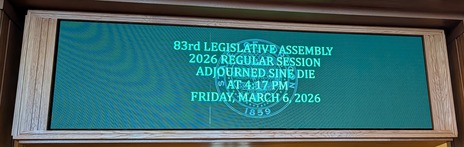
The 2026 legislative session adjourned Sine Die on Friday, March 6 at 4:17 PM, bringing another fast-paced session to a close. The final days in the Capitol are always intense, with long hours, last-minute negotiations, and difficult decisions as we work to finish the state budget and remaining legislation.
Two issues that drew significant attention in the closing days were SB 1599, dealing with the timing of the transportation tax referendum, and SB 1501, the proposal related to renovations at the Moda Center. Both sparked considerable discussion about priorities, process, and how decisions made in Salem impact communities across Oregon.
Below are highlights from the session, along with my weekly video and updates on legislation and investments that will benefit House District 60.
Serving as your State Representative is an honor I take seriously. While the legislative session has ended, the work continues during the interim as I meet with community members, farmers, ranchers, educators, and businesses across the district.
As always, please don’t hesitate to reach out to my office with questions, concerns, or ideas. Hearing from you helps ensure that the decisions made in Salem reflect the needs of rural and frontier Oregon.
Thank you for the opportunity to serve.
Be safe,
My Final Moments with Mark for the 2026 Short Session
Despite a challenging budget year, we were able to secure several important investments that directly benefit communities across House District 60.
-
FFA funding maintained with no reductions, continuing support for one of the most important youth leadership programs in rural Oregon.
-
$3 million for the R3 Workforce Housing project, helping address workforce housing needs in eastern Oregon.
-
$3 million for Vale water infrastructure, supporting critical upgrades that help ensure reliable water systems for the community.
-
$1 million for wolf depredation compensation, helping ranchers recover losses caused by wolf predation.
-
$550,000 per biennium per fairground, a raise on the current lottery cap
These investments support our local economy, strengthen rural infrastructure, and help sustain the agricultural communities that are the backbone of eastern Oregon.
As the 2026 legislative session came to a close on March 6, several important bills were debated in the final days. Below are updates on some of the key pieces of legislation we worked on this session.
SB 1599 became one of the most debated bills in the final days of session. The issue centers around the timing of the transportation tax referendum that voters referred to the ballot.
Negotiations among the caucuses initially moved the bill to a date certain vote, based on information that the Secretary of State would not be able to move the referendum after February 25. As often happens in the Capitol, timelines and expectations changed.
Ultimately, it appears the courts may determine the outcome. Several lawsuits have already been filed, and we will see how the judicial process unfolds.
HB 4145 was another bill that generated significant discussion. A Senate amendment would delay implementation of Measure 114 until 2028.
Second Amendment advocates have encouraged support for this approach because it allows the ongoing legal challenges surrounding Measure 114 to continue through the Oregon Supreme Court, where many believe the issue should ultimately be resolved.
HB 4049 focused on groundwater management in the Harney Basin. After many meetings and discussions with local stakeholders, we asked the Oregon Water Resources Department to update its memo outlining the path forward.
That memo is still being finalized and will include a public process. Once it becomes available, I will be sure to share it. I believe this update reflects the intent of the legislation and supports continued voluntary agreements in the basin.
HB 4002 proposed limiting the number of bills legislators can request during a long legislative session. Like many proposals late in session, the bill ultimately became political and did not move forward this year.
However, Representative Evans and I had a productive conversation about the concept and plan to continue working together to bring a revised proposal forward during the 2027 session.
HB 4105 focused on establishing more predictable harvest levels in state forests. While the bill will not move forward this session, I plan to continue working with stakeholders and bring the issue back for consideration in 2027.
One of the final votes this session involves HB 1501, which would help finance upgrades to the Moda Center as part of a potential sale of the Portland Trail Blazers, with the goal of keeping the team in Oregon for the next 20 years.
This proposal relies on general obligation bonds, and I spent time considering how this investment relates to the communities I represent. In rural and frontier Oregon, our community gathering spaces are often our county fairgrounds.
As part of this discussion, we secured an adjustment to the lottery funding cap in SB 1601 so that county fairgrounds receive 1% of lottery funds, which should provide roughly $550,000 per biennium per fairground across the state. That represents a meaningful investment for rural communities.
Rangeland Fire Protection Associations (RFPAs) play a critical role in protecting rural communities across eastern Oregon. These volunteer groups of landowners help safeguard 17.7 million acres of private and public land, including nearly 6 million acres that would otherwise have little or no fire protection.
RFPAs are often the first on the scene when fires start in remote rangeland, bringing local knowledge of terrain, access roads, and conditions that can make the difference between catching a fire early or watching it grow into a large incident.

During the 2025 legislative session, I worked alongside the Oregon Department of Forestry, the Governor and RFPA leaders to pass House Bill 3349, which helps support these volunteers by allowing surplus firefighting equipment, vehicles, radios, and gear to be transferred directly to RFPAs and by providing $1 million in funding to support their work.
This investment recognizes what rural communities have long known: local volunteers are a vital part of Oregon’s wildfire response system.
You can read the full RFPA newsletter here.
|
Did you know the State of Oregon may be holding money that belongs to you or your family?
Through the Oregon Unclaimed Property Program, the State Treasury safeguards funds such as uncashed checks, forgotten bank accounts, security deposits, insurance payouts, and other assets that businesses or organizations were unable to return to their rightful owners. After a period of inactivity, those funds are transferred to the state until they can be claimed.
Oregon currently holds nearly $1 billion in unclaimed funds, and searching for your name is free and only takes a minute.
🔎 Check to see if you or someone you know has unclaimed funds:
https://unclaimed.oregon.gov/
Make sure you’re deducting only “qualified” overtime compensation
There are new federal rules related to taxes on overtime compensation that have caused some confusion. “Qualified overtime compensation” is overtime compensation paid to someone that exceeds the regular rate at which they are normally paid, and it does not apply to all overtime.
For example, if a person is paid at “one and one-half times” or “time-and-a-half” their regular rate for an hour of overtime work, it is the “half” portion of the overtime rate that is “qualified overtime compensation.” To determine the new deduction on the federal return and corresponding subtraction on the Oregon return, most people can take the total amount of overtime pay they received and divide it by three to calculate their deduction (one third of their total overtime). You can avoid delays in getting your refund by making sure to only deduct the correct amount of qualifying overtime pay.
This IRS Factsheet provides additional information about the deduction for qualified overtime compensation. DOR may contact taxpayers to ask for additional information about how they calculated their deduction.
Free tax help is available
Oregonians have several free options available to file their tax return electronically. Free tax preparation services are available for low- to moderate-income taxpayers through AARP and CASH Oregon. United Way also offers free tax help through their MyFreeTaxes program. GetYourRefund.org is a new option this year for those with income up to $89,000 and Direct File Oregon is available regardless of income level. Visit the Department of Revenue website to take advantage of the software and free offers and get more information about free tax preparation services.
You must file a return to get your kicker – Use the Kicker Calculator
The kicker is a refundable credit that will either increase a taxpayer's Oregon state income tax refund or decrease the amount of state taxes they owe. It is not sent to taxpayers separately as a check. Taxpayers may use the “What’s My Kicker?” Calculator to determine their credit.
Only taxpayers who filed a tax year 2024 return and file a tax year 2025 return can receive a kicker. The credit is a percentage of Oregon personal income tax liability for the 2024 tax year.
Track your tax refund – Where’s My Refund?
Taxpayers can check the status of their refund on an e-filed return by using the department’s Where’s My Refund? tool. The Department of Revenue recommends that taxpayers wait at least one week after filing an electronic return before using the Where’s My Refund tool. Paper-filed returns won’t show up in the tool until paper-processing begins in late March.
Under House rules governing state-funded communications, legislative offices are not allowed to distribute newsletters during certain election-year periods. The first blackout period runs March 20 through May 20, 2026.
As a result, this will likely be my final legislative newsletter until after May 20. In the meantime, please feel free to reach out to my office using the phone number or email below if you need assistance or have questions.
Capitol Phone: 503-986-1460
Capitol Address: 900 Court St NE, H-475, Salem, OR 97301
Capitol Email: Rep.MarkOwens@oregonlegislature.gov
Capitol Website: http://www.oregonlegislature.gov/owens
|