|
Below is an update on legislative activity from the past week at the Capitol, along with relevant information and resources I hope you find helpful.
- Shelly
🚨URGENT ACTION ALERT🚨:
DEMOCRATS PLAYING POLITICS WITH OUR ELECTIONS
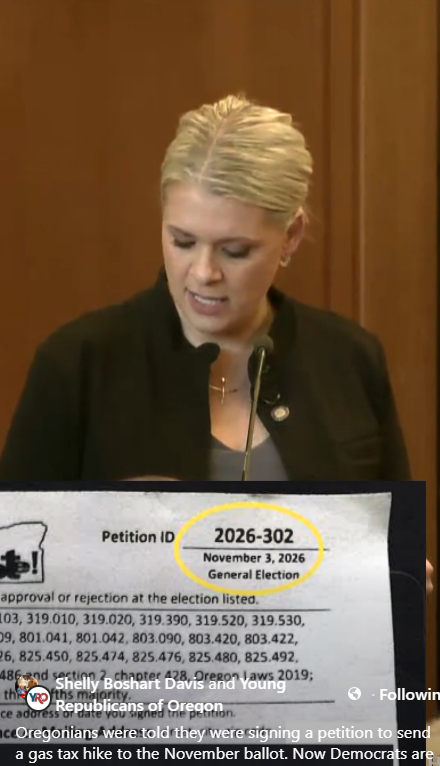
I am one of the more than 250,000 Oregonians who signed the referendum petition on Kotek's gas tax hike last year. When Oregonians signed that petition, the signature sheet clearly stated the measure would be voted on at the General Election on November 3, 2026. That representation mattered.
Watch my entire speech on the House floor about this issue here.
Now Democrats are trying to protect themselves by pulling a bait-and-switch on every voter who signed that petition by trying to move the election from the high-turnout November election to a low-turnout May election. This is just a political stunt for Democrats to try to escape the consequences of their own actions and not want to appear on the same ballot as the tax referendum. It's pure politics. Nothing more.
They are rigging the process. And only you can stop them.
Democrats just released their bill to change the election date and have scheduled public hearings on the bill for Monday and Wednesday.
The Monday hearing on SB 1599 is at 1:00 p.m.
✅Sign up to testify LIVE, in-person or online here - click on 'Register to Testify'
✅Sign up to submit written testimony here.
There will be another hearing on Wednesday, but the links to testify have not been published yet.
Your signature on the petition was critical. Now, your voice is needed to protect the integrity of that process.
2026 SHORT SESSION KICKS OFF:
WEEK ONE RECAP
Short sessions always fly by. Committee agendas were released last Friday, and my staff and I quickly realized we were in for a wild ride. So buckle up, grab your popcorn, here are several key pieces of legislation we discussed in week one.
FEDERAL RESPONSE PACKAGE
The Democrat caucus announced its "Federal Response Package" earlier this month. A majority of this package includes provisions that will further disrupt Federal Law Enforcement efforts across the State.
Several bills regarding immigration enforcement were debated in committees this week. Instead of tackling genuine accountability concerns, lawmakers are squandering taxpayer dollars on proposals that duplicate existing Oregon statutes or attempt to solve nonissues.
-
HB 4079 would direct school districts to adopt a response plan for when immigration officers enter the premises. ICE does not target schools. DHS said that there have been no arrests made on campus, although officers would be allowed to do so if a felon were to flee into a school or if a child sex offender were working there as an employee. In these situations, an arrest would be handled delicately and in the interest of protecting the safety of students.
-
HB 4138 would require law enforcement agencies operating in Oregon to implement policies to ensure the officer is easily identifiable. DHS says that this would put agents' lives at risk. According to the federal agency, ICE agents are facing a 1,150% increase in assaults and an 8,000% increase in death threats. ICE is targeting highly sophisticated gangs and criminal networks. These entities will target agents, their spouses, and their children if they are identifiable.
-
HB 4111 would create a civil course of action against federal law enforcement agents or law enforcement from another state. While the bill makes token exceptions, such as when "the release of sufficient identification may compromise the integrity of an authorized investigation," prosecutors will find ways around this broad language and target law enforcement when they feel it is politically expedient. Officers should be able to focus on their jobs instead of being worried about being repeatedly slapped with a lawsuit.
While there is a broad consensus that violent criminals without legal status should be deported to their home countries, accountability must be pursued without resorting to polarizing rhetoric that incites fear and contributes to further violence. This session's proposals are driven by politics, not solutions, and do nothing to resolve the real problems on our streets.
MEASURE 114 REVISIONS:
The Legislature discussed a bill that would update Oregon's firearm permit, transfer, and large-capacity magazine (LCM) laws, and modify other key provisions of Ballot Measure 114 (2022). The measure, which included aggressive regulations on the purchase and transfer of firearms, is currently being challenged in court. Since voters approved it, the legislature has continued to debate its implementation.
Key components of HB 4145:
• Updates where and how Oregonians may apply for a permit to purchase a firearm and adds a new eligibility requirement.
• Extends the deadline for permit decisions from 30 to 60 days, giving permit agents more time to approve applications or issue written denials.
• Increases the maximum fees for initial permits and renewals, including a specified portion for State Police background checks.
• Delays the permit-to-purchase requirement for firearm transfers until January 1, 2028.
• Creates an exemption from permit requirements for certain active and retired law enforcement officers.
• Requires any legal challenge to the Act to be filed in Marion County Circuit Court.
This bill does not resolve the constitutional problems with Measure 114 - in fact, it does the opposite. HB 4145 adds new barriers to firearm ownership, but not in the way proponents might suggest.
By increasing training requirements and permit fees, the bill would disproportionately impact lower-income and working Oregonians - effectively making lawful firearm ownership out of reach for many people who lack the time or financial resources to comply with increased regulations. By requiring that all legal challenges to the Act be filed exclusively in Marion County, lawmakers are creating yet another barrier for Oregonians who cannot afford the time, travel, or expense of pursuing a lengthy legal process far from where they live.
Read my testimony against the bill here.
STANDING UP FOR FFA AND AG EDUCATION
This week, the Joint Ways and Means Committee heard public testimony on various agency budget cuts. I submitted testimony against their proposal to cut FFA and agriculture education programs. Read that here.
FIGHTING FOR FARMERS
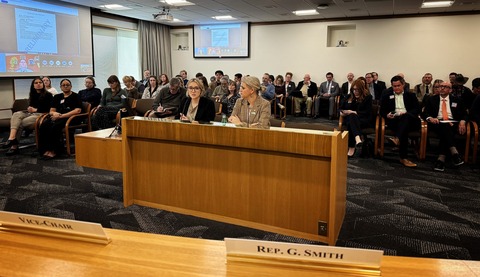
This week, the House Committee on Revenue held a public hearing on my bill, HB 4130, to ensure all agricultural buildings are taxed the same across the state. Right now, some farmers' land beneath their buildings is being taxed as industrial land, not farmland. HB 4130 fixed that to ensure that all farmers are on a level playing field and receive the tax treatment they deserve.
Listen to my testimony here.
REVENUE FORECAST IS MORE OPTIMISTIC THAN EXPECTED
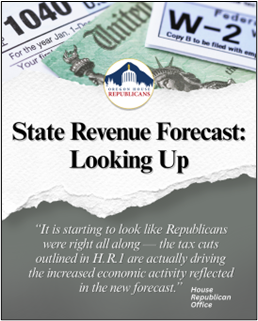
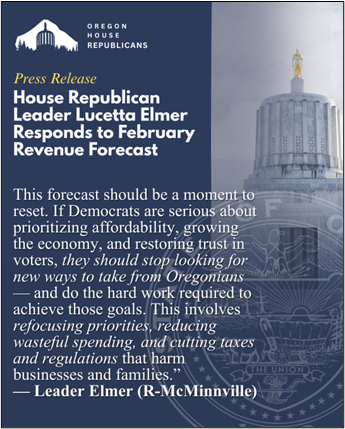
On Wednesday, Oregon's State Economists presented their quarterly revenue forecast before the Senate Committee on Finance and Revenue. Despite the majority party's concerns that H.R. 1, the federal budget bill, would add $888 million to the deficit, the forecast instead showed an atypical surplus of $198 million. While the state budget remains in deficit, economic growth has begun to narrow that gap.
It is starting to look like Republicans were right all along — the tax cuts outlined in H.R.1 are actually driving the increased economic activity reflected in the new forecast.
Nationally, economic activity is picking up. Real GDP growth is projected to firm to 2.1% by 2026, supported by 2.7% growth in the first half of this year. Inflation is expected to rise modestly to 2.7%, a less severe pickup than previously feared. Perhaps more importantly, recession risks are down, and federal projections are becoming increasingly optimistic.
On the other hand, Oregon is far from out of the woods. While the national economy continues to recover from the pandemic, Oregon is trailing behind. The February forecast is optimistic, and Oregon appears to be closing the gap relative to the national trend. However, Democrats are discussing a partial disconnect from the federal tax code.
This would essentially negate the progress made over this quarter. If Oregon decides to prioritize its already-bloated budget and reject the tax cuts in H.R.1, it would essentially reverse the benefits from H.R.1.
Negotiations are ongoing, but my office will continue to provide updates. Hopefully, the majority will recognize this positive trend and pull back from their disconnect proposal.
When Democrats released their session priorities earlier this month, they claimed to be committed to prioritizing affordability, growing the economy, and restoring voters' trust. If this is truly the case, we will not see them move ahead with a disconnect.
Responsible governance would look like enacting policies that keep money in the hands of Oregonians rather than prioritizing the State's budget. That is what H.R.1 did, and we can see that it's working.
Oregonians are voting with their feet, fleeing high costs and Democrat-driven policies that make our State increasingly unlivable for families and hostile to businesses. A new DHM Research survey commissioned by Oregon Business & Industry reveals grim realities: 73% rate the economy as poor—up from 60% in 2021—with nearly half struggling to cover essentials like groceries, healthcare, utilities, and housing, while just 26% believe Oregon is headed in the right direction.
 |
Deaths outnumber births, population growth scraped a measly 0.2% last year - among the nation's slowest - thanks solely to international migration masking a net domestic exodus of over 113,000 residents, many to lower-tax Washington. Businesses echo the despair, with leaders citing an 82% tax burden spike in Portland metro since 2019 alongside excessive regulations as key culprits in job losses and relocations, turning our "Silicon Forest" into a Silicon Exodus. Even the Trail Blazers' future in Portland hangs by a thread, as owners demand $600 million in public bonds, hotel taxes, and Clean Energy Fund cash amid legislative foot-dragging. To make things worse,
|
As the 2026 short session kicks off, the Democrat supermajority - flush with control of the governorship and both chambers - unveils plans to worsen the bleed, like Senate Bill 1507 to take away federal tax relief by axing deductions for car loan interest, small business stock profits, and equipment write-offs, aiming to claw back $342 million at families' and firms' expense. This isn't leadership; it's the same playbook that sparked manufacturing recessions, sawmill closures, and Intel layoffs - prioritizing California-style spending sprees over Oregon workers. Just this week, Roseboro Forest Products announced 146 layoffs at their Riddle facility in Southern Oregon.
Oregon capped 2025 with outright job losses - the first annual drop in private-sector employment since the Great Recession - while the unemployment rate climbed to 5.2%, up nearly a full point from 2024 and outpacing national trends amid manufacturing's 5%+ plunge and widespread cutbacks.
DOR: The 2026 Oregon Kicker
From the Oregon Department of Revenue:
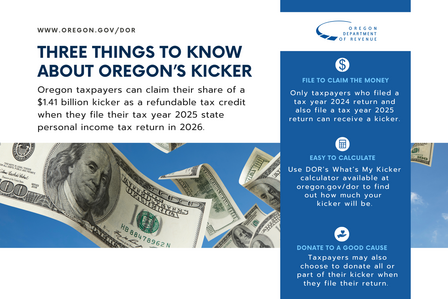
Oregon taxpayers can claim their share of this year’s $1.4 billion kicker. The IRS and the state began processing e-filed 2025 state income tax returns on January 26, 2026.
You must file a return to get your kicker – Use the Kicker Calculator
The kicker is a refundable credit that will either increase a taxpayer's Oregon state income tax refund or decrease the amount of state taxes they owe. It is not sent to taxpayers separately as a check. Taxpayers may use the “What’s My Kicker? Calulator” to determine their credit.
Only taxpayers who filed a tax year 2024 return and file a tax year 2025 return can receive a kicker. The credit is a percentage of Oregon personal income tax liability for the 2024 tax year.
Electronic filing is faster—especially in 2026
On average, taxpayers who e-file their returns and request their refund via direct deposit receive their refund within two weeks. E-filed returns will be processed in the order they are received, with the first refunds expected to be issued February 15. For paper filed returns, refunds will not start being issued until early April.
Due to the delayed receipt of tax forms and information from the IRS in late 2025, processing of paper-filed Oregon personal income tax returns will be delayed until late March, a process that has historically begun in February.
The delay in paper return processing means the department won’t be able to tell taxpayers who file paper returns, that their return has been received until paper return processing starts at the end of March. Also, information on paper-filed returns won’t be available in the “Where’s My Refund?” tool until that time.
Free e-filing options open January 26 Oregon residents who normally mail their tax return to the department should consider using Direct File Oregon, a free filing option available through Revenue Online, or other online tax preparation software, to receive their refund—and their kicker—sooner.
Free guided tax preparation is available from several companies for taxpayers that meet income requirements. Using links from the department’s website ensures that both taxpayers’ federal and state return will be filed for free.
All electronic filing software options approved for filing Oregon personal income tax returns can be found on the Electronic filing page of the agency’s website.
Free and low-cost tax help
Free tax preparation services are available for low- to moderate-income taxpayers through AARP and CASH Oregon. United Way also offers free tax help through their MyFreeTaxes program. Visit the Department of Revenue website to take advantage of the software and free offers and get more information about free tax preparation services.
OREGON FARM BUREAU at the CAPITOL
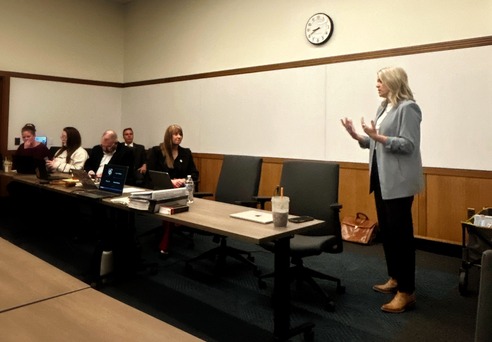
Earlier this week, I had the pleasure of speaking with Oregon Farm Bureau as we look ahead to the 2026 Legislative Session. We discussed key issues affecting farmers and rural communities. I also highlighted two bills I’m working on.
Grateful for OFB’s engagement and the chance to discuss practical solutions that support our farmers, strengthen rural communities, and protect working families across Oregon.
During the 2026 legislative session my office will continue to keep you updated and informed - and is always at your service. Please don’t hesitate to reach out to my office if you have any community event announcements, legislative questions, or concerns.
Talk soon,

Capitol Phone: 503-986-1415
Capitol Address: 900 Court St NE, H-389, Salem, OR 97301
Email: Rep.ShellyBoshartDavis@oregonlegislature.gov
Website: http://www.oregonlegislature.gov/boshartdavis

|