|
Replies to this message are sent to an unmonitored mailbox.
To contact me, please click here: Rep.AnnaScharf@oregonlegislature.gov
Dear Friends,
Week 1 of the Legislative Short session is officially in the books! Since things move fast, many things were “teed up” before the opening ceremonial gavel fell. Each member was allotted two legislative bills for the Session and these bills had to be pre-session filed by January 16th to be First Read on the first day of session, February 2nd. However, because of the short timelines the Speaker's Office issued an advisory bill referral list, which is the committee assignment for each specific bill. Upon the advisory bill referral list, committees then issued advisory agendas. In other words, the committee agendas were not official but were a heads up to the committee members of the potential bills headed their way. As the vice-chair for two committees and a member of a third this session, this was good news for me because I could get to work preparing for both offense and defense on bills over the weekend before session even started.
Session began on Monday the 2nd with House Floor Session, the adopting of House Chamber Rules and the First Readings of bills, and this is where the games begin!
The House Committee on Judiciary met that afternoon and wasted no time. They jumped right in with several controversial bills. Many Oregonians wanted to submit testimony, but weren't able to until a few hours before the committee began because until the bills were First Read, the Oregon Legislative Information System (OLIS) was not capable of uploading testimony. You can see the chaos this created: an advisory scheduled public hearing on controversial bills with no way to submit testimony until just a few hours before. Not the transparent public process voters deserve. Not the topics a 35-day short session should be taking up either.
The week proceeded in what you might call a chaotic state, but that is just what Short Session has become. Fast, furious and full of overly complex issues that do not belong in a short session. As always, my office will do its best to keep you updated as session progresses over the next few weeks. For now, please see below for information on some of the bills highlighted this week.
Thank you for your continued support. Feel free to reach out to my office with questions or concerns.
Sincerely,
 Anna Scharf
State Representative - HD 23

THE BAD and THE UGLY
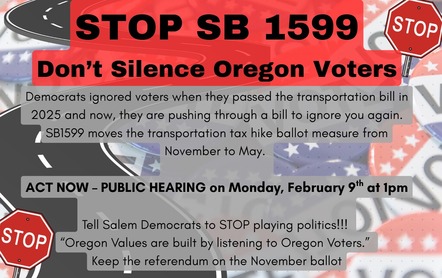
SB 1599 - Election Date Change
This bill is purely politically motivated. The petition to place the gas tax, the vehicle fee increases, and the DOUBLING of the payroll tax, CLEARLY stated that it would be on the Nov. 2026 General election ballot. So why do the Democrats want it on the May primary ballot? It is simple politics. Because almost all of them are running unopposed in the primary. It is better for them if it appears on the May ballot than next to them on the November ballot when voter will remember who voted FOR the tax increase; the Democrat NOT the Republican candidate when they are making their choice on what they want to see in 2027
HB 4145 - Firearm Permit Changes
Ballot Measure (BM) 114 passed by the voters in 2022. It required anyone purchasing a firearm to take a firearm safety training course and obtain a permit, banned large capacity magazines (more than 10 rounds), and closed the “Charleston loophole,” which allowed firearm transfers to go forward if a background check had not been completed after three days. Lawsuits were filed challenging the constitutionality and because of that, it remains on hold while the case proceeds.
This bill does not resolve the Constitutional problems with Measure 114 - in fact, it does the opposite. HB 4145 adds new barriers to firearm ownership by increasing training requirements and permit fees. The bill would disproportionately impact lower-income and working Oregonians - effectively making lawful firearm ownership out of reach for many people who lack the time or financial resources to comply with increased regulations. In addition, the bill requires that all legal challenges be filed exclusively in Marion County, creating yet another barrier for Oregonians who cannot afford the time, travel, or expense of pursuing a lengthy legal process far from where they live and possibly clogging up the Marion County court system.
Also of note, it is almost identical to HB 3075 which did not pass in the 2025 Legislative Session. HB 4145:
- Exempts current and past law enforcement officers from the large capacity magazine ban, aligning with federal law.
- Increases permit fees from $65 to $150, renewal fees increase from $50 to $115.
- Extends the deadline for permit decisions from 30 to 60 days, giving permit agents more time to approve applications or issue written denials. Permit database exempt from public records request(s).
- Requires any legal challenge to the Act to be filed in Marion County Circuit Court.
- Permit process delayed until January 1, 2028.
This bill had a public hearing on 2/2 in the House Committee on Judiciary. It must move out of Committee by 2/16
HB 4125 & SJR 201 - Kicker Theft – Your $$ is always the solution
Each session, there are bills aimed at stealing your kicker. This session is no different. However, HB4125 doesn't outright steal your kicker, it "reframes" how the surplus revenue is estimated and managed. In other words, it steals your kicker by changing the revenue formula/calculation. This bill had a public hearing on 2/2 in the House Committee on Revenue. To the contrary, SJR201 proposes amending the Oregon Constitution to require a portion of the surplus revenue that would otherwise be returned to personal income taxpayers to be used for funding public K-12 education, community colleges and wildfire prevention and suppression, if the revenue exceeds a certain threshold. At least this bill, if passed would go to the voters. The bill has not yet been scheduled for a hearing.
Oregon Democrats respond to Federal law enforcement
The Democrat caucus announced its "Federal Response Package" earlier this month. A majority of this package includes provisions that will further disrupt legal Federal Law Enforcement efforts across the State.
Several bills regarding immigration enforcement were debated in committees this week. Instead of tackling genuine accountability concerns, lawmakers are squandering taxpayer dollars on proposals that duplicate existing Oregon statutes or attempt to solve nonissues.
-
HB 4079 would direct school districts to adopt a response plan for when immigration officers enter the premises. ICE does not target schools. DHS said that there have been no arrests made on any campus, although officers would be allowed to do so if a felon were to flee into a school or if a child sex offender were working there as an employee. In these situations, an arrest would be handled delicately and in the interest of protecting the safety of students.
-
HB 4138 would require law enforcement agencies operating in Oregon to implement policies to ensure the officer is easily identifiable. DHS says that this would put agents' lives at risk. According to the federal agency, ICE agents are facing increased assaults and increases in death threats. ICE is targeting highly sophisticated gangs and criminal networks. These entities will target agents, their spouses, and their children if they are identifiable. I introduced a bill in 2025 that would have escalated the penalties for criminals who wore masks to conceal their identities making it difficult for law enforcement to identify and prosecute them. Think of all the people that vandalized the Portland State University Library causing millions of dollars in damage and who were wearing masks only to conceal their identity. That bill did not even receive a hearing. Masks are OK for criminals
-
HB 4111 Most of the activities in the bill are already contained in statute with respect to discrimination and BOLI does not ask about immigration status when investigating discrimination complaints. In addition, the bill talks about employers questioning employees when they change their immigration status. This could possibly put employers in a position of violating Federal I-9 forms and other legal processes since these are called out already in statute and there are laws about employers’ liability for validation of employment documents.
Violent criminals without legal status should be deported to their home countries, but Oregon’s expansion of sanctuary status from its original bipartisan intent in 1987 has gone much further than many voters ever intended. Accountability of Federal authorities when enforcing Federal laws should be pursued without resorting to polarizing rhetoric and proposals that are driven by politics rather than by real solutions. The Supremacy Clause in the US Constitution, Article VI, Clause 2, cannot just be ignored and certainly by just turning up the tension in bills such as these we do nothing to resolve the real problems on our streets
HB 4015 - Disconnect from the Federal Tax Code
During the 2025 Legislative session, the majority party happily believed that connecting to the Federal tax code was good for Oregonians, and as we do every year, we voted on a bill to connect to the Federal tax codes. Now, however, they believe the answer to Oregon's funding crisis is HB 4015, which disconnects from the federal tax code. The intent behind the bill is to close the corporate tax loopholes and expand the Earned Income Tax Credit (which only impacts around 200,000 Oregonians). Oh, and within the same bill, the majority party also wants to tap into the Rainy Day fund to "rebalance" the budget.
So, guess what, all the new benefits contained in the Federal tax code including no tax on tips or no tax on overtime, are GONE for your State taxes. Disconnecting from the Feds is actually a major tax burden for individuals AND businesses. I’m not buying what they are selling and neither should you. The Federal tax code changes are NOT what is causing the problem in Oregon….heck, they haven’t even taken effect! What has taken effect…40+ years of bad policy and one party decision making
THE GOOD - yes, there is some good
HB 4115 - Background Checks
I'm very excited to Co-Chief HB 4115 with Rep. Nancy Nathanson (D-Eugene). This bill SAVES government money while also supporting caregivers in long-term care, disability services and behavioral health. The concept behind the bill is to improve our background check process. HB 4115 removes the long wait times, extends the re-check time to align with many other states, and provides portability between similar work settings for caregivers. This is a win-win situation for our providers, clients, and the state. This bill received a public hearing on 2/3 in the House Committee on Behavioral Health. You can watch my testimony here.
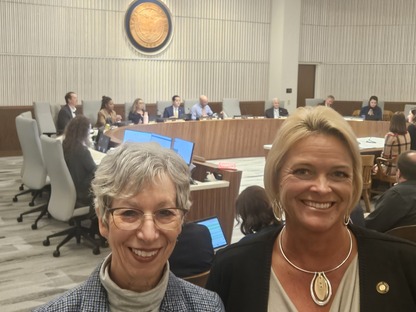
Pictured with Rep. Nancy Nathanson after our testimony for the public hearing.

HB 4129 - Hidden Gas Tax Cap
Rep. Shelly Boshart Davis (R-Albany) introduced this bill and I knew I immediately had to sign on in support. You know this little gas tax sticker you see on every time you fill up your tank? → → →
Did you know you are paying up to $0.22 MORE per gallon that isn't listed on there?
It's called Oregon's Low Carbon Fuel Standard (also called Oregon's Clean Fuels Program [CFP]), and it's a hidden gas tax you are paying every time you fill up. In essence, you're paying extra because of policies passed in Salem that limit the kinds of fuels that can be sold in Oregon.
Studies estimate that this program costs you an extra $0.22 cents per gallon. While DEQ’s claims that number is closer to $0.08, those costs are being directly passed on to families and small businesses. You ever wonder why the West Coast always has higher gas prices? This is why.
When the Legislature first adopted Clean Fuel standards, they wrote into statute a specific target: by 2025, fuel sold in the state needed to have 10% lower carbon intensity than it did in 2015. But former Governor Kate Brown, now Tina Kotek, and her DEQ pushed those numbers even higher through Executive Order 20-04 and as a result it will push gas prices even higher.
Oregon consistently has one of the highest gas prices in the nation, and Kotek's new December executive order, EO25-29, sets a new benchmark. She wants fuel to have a 50% lower carbon intensity by 2040. That's impossible with current technology. Guess who is going to pay for their unobtainable climate dreams. You are - at the gas pump.
HB 4129 would cap the program at its original 10% target, roll back the extra reductions imposed by liberal executive orders and bar further expansions unless the Legislature explicitly votes for them – putting accountability back where it belongs.
|
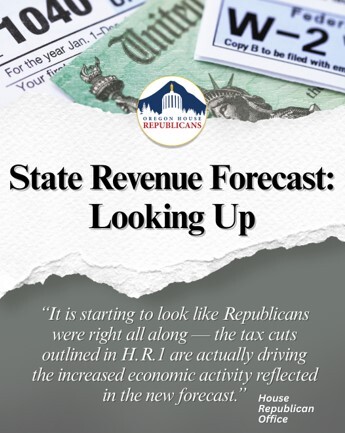
The Quarterly Revenue Forecast was released this week, which showed rising revenues and a lagging economy.
Despite the majority party’s concerns that H.R. 1, the federal budget bill, would add $888 million to the deficit, the forecast instead showed an atypical surplus of $198 million. While the state budget remains in a deficit, economic growth has begun to narrow that gap.
It is starting to look like Republicans were right all along — the tax cuts outlined in H.R.1 are actually driving the increased economic activity reflected in the new forecast.
Nationally, economic activity is picking up. Real GDP growth is projected to firm to 2.1% by 2026, supported by 2.7% growth in the first half of this year. Inflation is expected to rise modestly to 2.7%, a less severe pickup than previously feared. Perhaps more importantly, recession risks are down, and federal projections are becoming increasingly optimistic.
On the other hand, while the national economy continues to grow, Oregon is sliding backward. Personal income tax collections are declining, unemployment remains above the national average at 5.2% (The US national average is 4.4%), and population growth has flatlined. With the cost of living already being too high, the last thing Oregonians need is to disconnect from the Federal tax code as this will negatively affect our middle-class families the most.
Oregon Business and Industries just released the results of a voter survey. When they asked Oregonians what concerns they have within the State, voters blamed high taxes and excessive regulations for Oregon’s sluggish economy. Fifty two percent think Oregon’s economic growth rate is slower than the national average (it is). When they were asked to explain the slow growth, 23% mentioned high taxes and 21% mentioned excessive regulations. No other reasons were cited as often.
This survey is a great example as to why we should not be considering a federal disconnect or any kicker changes. It also points to a need to seriously look at regulation rollbacks to attract new business and retain current businesses unless we want this trend to continue.
|
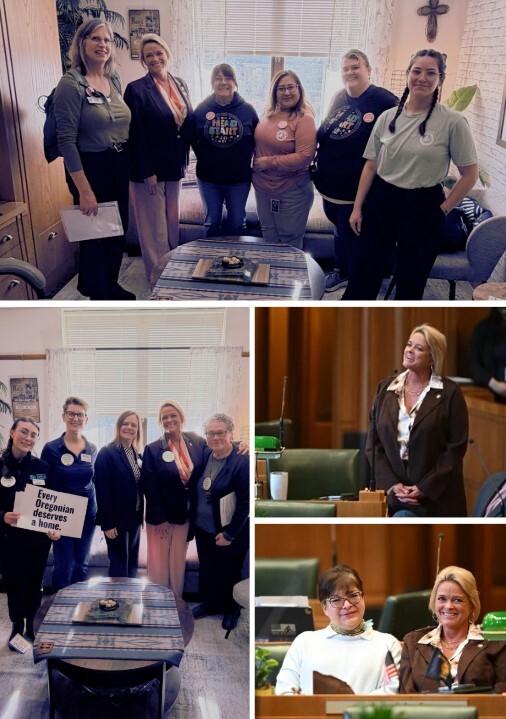 |
I had the honor of hosting State Rep. Annessa Hartman's (D-Gladstone) mother at my desk on the House Floor during Opening Ceremonies. Rep. Hartman has been battling cervical cancer since the fall, and has been very public with her cancer journey. She introduced HB 4135 this session Designating March 4th of each year as HPV Awareness Day. I am honored to be a Chief Sponsor on the bill with her. She has announced that she will not be seeking re-election, and as her Vice- Chair on the Human Service Committee, I will miss serving and working with her. It has been an honor working with someone so dedicated to children and families and working with someone who puts solutions over politics.
Constituent meetings during week 1 included but were not limited to, the opportunity to meet with Habitat for Humanity and Salem Housing Authority advocates, and Yamhill County Head Start. I also spoke to the Board of Directors from Oregon Farm Bureau who were there advocating all things ag, but there was too much talk and no time for photos. I so greatly appreciate the advocacy of constituents in the building and learning about issues that are important to you!
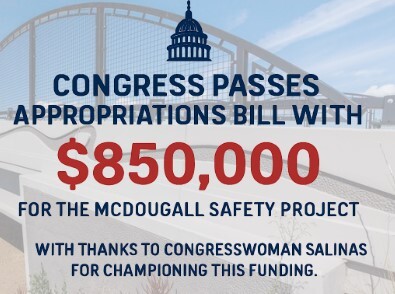
In January, I made a trip to Washington DC with Sen. Starr, Rep. Elmer, Yamhill County Commissioner Johnston and the Mayors from Newberg and McMinnville to meet with our Oregon Congressional members, White House staff and the US Dept. of Transportation staff to advocate for Federal funding for completion of the Newberg Dundee Bypass.
Our trip was not wasted, because we received federal funding in the appropriations bill! This is great news for our community! There is still work to be done as the needed funding for the completion of the Bypass is over $400M, but the immediate funding for the McDougall safety project is greatly appreciated.
|
The Oregon Seed Council announced the opening of its 2026 scholarship application process and will be offering three college scholarships this year in the amounts of $2,000, $1,000 and $500. Apply today.
Capitol Phone: 503-986-1423
Capitol Address: 900 Court St NE, H-387, Salem, OR 97301
Email: Rep.AnnaScharf@oregonlegislature.gov
Website: https://www.oregonlegislature.gov/scharf
|