|
Replies to this message are sent to an unmonitored mailbox.
To contact me, please click here: Rep.DarinHarbick@oregonlegislature.gov
Hello friends,
January moved quickly, and I wanted to share a few highlights from the work I’ve been doing—both at the Capitol and back home in the district—as we prepare for the short session in February.
January 13–15: Legislative Days
I spent three full legislative days at the Capitol getting a clear picture of what bills are coming down the pipeline for the February short session. A lot of listening, a lot of note-taking, and plenty of conversations about where things are headed. This is the behind-the-scenes work that sets the tone before the gavels really start swinging.
I also met with fellow legislators and lobbyists to keep momentum going on my two bills and help push them across the finish line. These early conversations matter, and January was about making sure everything is lined up before session begins.
Going to a Town Hall to Hear Our Federal Lawmakers
(You Can’t Make This Up)
Kail and I attended a town hall at Thurston High School featuring Senator Jeff Merkley and Congresswoman Val Hoyle. The event was less about sharing new policy ideas and more about rallying the crowd against anything coming from the federal government that doesn’t align with their views.
That tone was captured in a moment that spoke for itself. Senator Merkley stated—without joking—that he would like to see the new Capitol ballroom destroyed with a plunger and that he wanted to be the one to push the button. It was one of those comments that leaves you pausing, looking around the room, and thinking… Did he really just say that?
January 22: Public Meeting on Our Lakes
Back home, my chief-of-staff (COS) and I, attended the U.S. Army Corps of Engineers public meeting for the Fall Creek, Dexter, Lookout Point, and Hills Creek Lakes Master Plan scoping process. I spoke directly with a fish biologist about lake drawdowns and how they affect recreation, dam operations, and the financial impact on our local businesses.
When water levels are drawn down too far during the summer months, it limits recreational use and hurts communities that rely on tourism and outdoor access. Public input is strongly encouraged, and comments are being accepted through February 23, 2026.
You can email comments to: CENWP-WVP-Master-Plan-Updates@usace.army.mil
 
Touring Life Flight in Cottage Grove
My COS and I also had the opportunity to tour the Life Flight facility in Cottage Grove. This base plays a critical role in emergency response for our district, yet it is currently the only Life Flight facility in Oregon without a hangar to protect its helicopter.
Because the aircraft is stored outside, weather conditions common in the Willamette Valley—rain, ice, and prolonged moisture—cause increased wear, higher maintenance costs of approximately $200,000 more per year than other Life Flight facilities, and more frequent downtime. That downtime directly affects response times when our communities need help most. One of my Capitol project requests will be to fund a hangar so this helicopter can be protected, fully operational, and ready to respond quickly when lives are on the line.
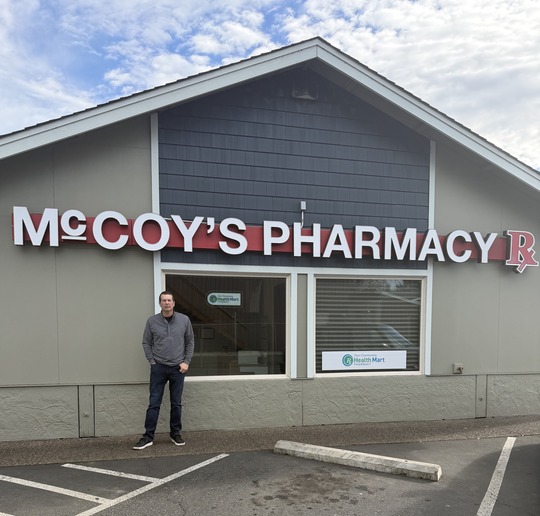
As the short legislative session starts today, legislators are allowed to introduce two bills. Here are the two bills I am presenting that I believe will help rural Lane county and the state of Oregon:
HB 4048- Oregon’s Rural Practioner Tax Credit (RPTC) is designed to recruit and retain essential healthcare providers in rural and frontier communities. Currently, eligible providers include physicians, nurse practitioners, physician assistants, dentists, optometrists, podiatrists, and certified nurse anesthetists. One critical provider is missing: rural pharmacists.
Rural Pharmacists are a cornerstone of the healthcare delivery system, yet they are excluded from the RPTC—even as rural pharmacy access in Oregon reaches crisis levels.
- In 2023 alone, 36 pharmacies closed statewide, with additional closures in 2024.
- 23 of Oregon’s 36 counties have fewer than two pharmacies per 10,000 residents.
- Oregon ranks 2nd worst in the nation for pharmacy access, according to Associated Press analysis.
- Independent, community pharmacies are the most vulnerable and lack the financial buffers of large chains.
Rural pharmacists dispense and manage medications, serve large numbers of Oregon Health Plan patients, and help prevent medication errors, ER visits, and costly hospital readmissions. When prescriptions cannot be filled locally, health outcomes worsen and costs rise for the state. Adding rural pharmacists to the list of eligible providers under the Rural Practitioner Tax Credit would allow qualifying rural pharmacists to access up to $5,000 annually - providing meaningful relief that helps improve medication access, retain workers in rural communities, and increase economic stability in smaller Oregon cities
HB 4028- Commercial insurance companies and Medicaid coordinated care organizations have a long and well documented history of restricting coverage for behavioral health services, reducing investment in care and limiting member access to affordable treatment. The effect is evident as Oregon consistently ranks among the worst in prevalence of mental illness and access to behavioral health care.
The 2026 Behavioral Health Protection Bill offers an opportunity to build on 2025’s progress by combining HB 2029 (2025) proactive audit reforms with HB 3725 (2025) strategies to strengthen behavioral health parity. By design the 2026 Behavioral Health Protection Bill does not reinvent the wheel; it uses proven concepts with no added state cost, yet delivers substantial impact for Oregon behavioral health providers and consumers. The bill is designed to reduce the power imbalances between insurers and behavioral health providers by:
- Increasing transparency from insurers by requiring them to identify the medical management practice being applied, its purpose, and whether it may trigger an audit or clawback.
- Reducing the insurer clawback window from the currently allowed 36 months to 12 months.
- Creating a timeframe of 180 days for insurers and CCOs to complete an audit of paid claims.
- Creating a timeframe of 30 days for insurers to complete pre-payment audits.
- Disallowing clawbacks from insurers based solely on "clerical errors," allowing providers to make corrections within 30 days instead of effectively punishing them for administrative mistakes.
- Allowing providers who owe insurers to pay on a repayment plan over three years, replacing current Oregon law which allows insurers to claw back payments after a mere 30 days.
- Extending Behavioral Health Parity reporting to expose manipulative tactics portrayed as medical management, such as Coding Advisor Programs, that target behavioral health providers for billing common services by accusing them of “potentially erroneous billing.”
If you would like to see the other bills I am a regular sponsor of click here.
Also, if there are any bills you would like me to support or sign on as a sponsor, please send my office an email.
##
Here are a few important news headlines that I want you to also be aware of:
LEGISLATURE CANNOT REPEAL REFERRED TRANSPORTATION TAX ACCORDING TO 90-YEAR-OLD LEGAL OPINION
A 1935 Oregon Attorney General opinion confirms that once Oregonians invoke their constitutional right to referendum, the Legislature has no authority to repeal the measure before voters have their say. That precedent directly contradicts Governor Tina Kotek’s recent call for lawmakers to repeal her signature transportation tax package after more than 250,000 Oregonians signed a petition demanding a vote.
The Oregon Constitution is clear that the power of referendum is reserved to the people, and once a measure qualifies through signature verification, the Secretary of State has a duty to place it before voters.
It is concerning that it took investigative reporting to bring attention to decisions that appear to deviate from established state policy and practice. Oregonians followed the constitutional process to request a vote, and they deserve transparency, adherence to the law, and leaders who respect the role of voters in deciding major tax policy.
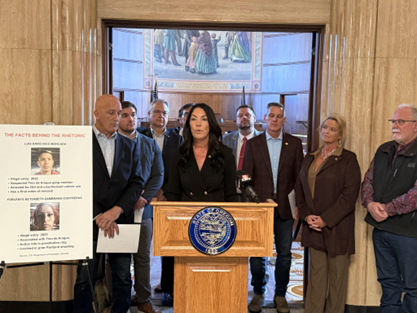
HOUSE REPUBLICANS CONDEMN DEMOCRAT LEADERS’ ANTI-ICE RESPONSE TO PORTLAND SHOOTING
On Sunday, House and Senate Republicans called out state and local leaders for politicizing an active investigation, inflaming fear, and undermining law enforcement before all the facts of Thursday's federal officer-involved shooting in Portland were released.
We now know that the individuals involved were not an innocent married couple. According to federal authorities, they were unlawfully present in the country, connected to a violent gang, and involved in a prostitution ring operating here in Oregon.
That information was publicly available before a Thursday press conference held by the Governor, the Portland Mayor, members of the City Council, and state legislators. Yet none of those facts were shared with the public at that time.
Instead, we watched as federal law enforcement officers were publicly condemned, compared to secret police, and portrayed as threats to the community while critical facts were withheld.
That kind of rhetoric does not make communities safer, it makes them more divided, more anxious, and less trusting of the institutions meant to protect them.
As Republicans, we believe in the rule of law and accountability at every level of government. We support law enforcement at the local, state, and federal level, because the men and women who serve do dangerous work on behalf of all of us.
Violent criminal organizations do not respect city boundaries, state lines, or political narratives. When law enforcement officers act to protect life and public safety, they deserve due process, not instant condemnation.
Criminals who exploit our communities should know this: Oregon is not a safe haven for violence, trafficking, or organized crime.
And elected officials should remember this: Leadership means lowering the temperature and telling the truth, even when it’s uncomfortable and putting public safety above politics.
NOTABLE BILLS THAT BECAME LAW IN 2026
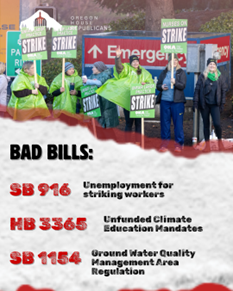
The previous long session was hectic. With transportation funding dominating headlines, other notable legislation slipped through the cracks. From unemployment benefits for striking workers to unfunded climate curriculum, here are a few bills that became law on Jan. 1 that will negatively impact Oregonians.
SB 916: Unemployment Benefits for Striking Workers — This bill allows striking public and private employees to collect up to 10 weeks of unemployment pay after two weeks on the picket line. Oregon is the first state in the nation to allow public employees to receive unemployment benefits while on strike. The superintendents of Oregon’s largest school districts wrote to lawmakers to oppose the bill because it could cost their districts millions of dollars. All this bill does is reward powerful unions that fund Democratic campaigns.
HB 3365: Unfunded Climate Education Mandates — This bill directs the State Board of Education to ensure that academic content standards for core subjects include “sufficient” instruction on the causes and effects of climate change and strategies to respond to such. Climate change is already mandatory in health, science, and social studies curricula. Not only is this redundant, but it is also another unfunded mandate that school districts can not afford.
SB 1154: Ground Water Quality Management Area Regulation — This bill created a tiered regulatory system to prevent and manage groundwater quality areas. Republicans were able to secure an amendment to the bill that provides legal clarity to rural communities dealing with water quality issues. However, the bill leaves the door open for future mandates on how and when Oregonians can use water for ranching and agriculture.
FINAL LEGISLATIVE DAYS TELL US WHAT TO EXPECT FOR 2026 SHORT SESSION
Sales tax proposed — The concept of a sales tax is not a foreign one to the Oregon legislature, though it is holistically unpopular. A bill was proposed for the short session that aims to reduce taxes imposed under various tax programs and phase in a sales tax in their stead. The concept, in theory, is not a bad one. A sales tax would help stabilize Oregon’s revenue, but Democrats clearly see this as just another way to bloat their budget. There would need to be massive income and property tax cuts for this to even be close to a good idea for Oregon.
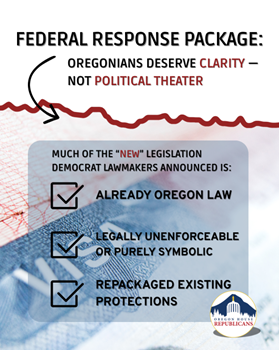
Constrictive immigration policy — On Wednesday, Democrats held a press conference where they unveiled their “Federal Response Package.” While this package touched on federal tax code disconnects and preventing the sale of public lands, the package largely revolved around immigration. Included in the package were bills to introduce training standards in workplaces relating to ICE inspections, require schools to inform parents when there has been ICE activity on campus, and prevent Oregon businesses and agencies from purchasing from organizations that are associated with deportation efforts. President Trump recently decreed that all sanctuary states would no longer receive federal funding, beginning Feb. 1. The “Federal Response Package” seems to be the state’s response to such federal action. It will be interesting to watch how this plays out in the 2026 session.
 |
A backtrack on transportation to save face — On Jan. 7, Governor Kotek called for a complete repeal of the $4.3 billion transportation tax and spend package after facing backlash and a successful ballot referral effort. Despite championing and pushing the bill through a grueling special session, Kotek would rather repeal the whole bill — including accountability and oversight provisions — than run on the same ticket as a grossly unpopular tax hike. It is more than likely that we see this on the 2026 session agenda.
The upcoming session is turning out to be heavy on resolutions, light on solutions. Instead of curating effective legislation, Salem politicians default to boards and task forces to address constituents’ concerns.
GET INVOLVED
Register to testify!
- If there is a bill you are particularly passionate about, you can register to testify either in support or opposition to the bill.
- Advance registration is required! Registration closes 30 minutes before the hearing is scheduled to begin.
- To register, go to https://olis.oregonlegislature.gov/liz/2025R1, select the “Bills” icon on the top right corner of your page, enter the bill number, and select “Register to Testify.” Or, call 1-833-588-4500.
- You will want to fill out the “Public Testimony Registration Form.”
- You will receive an email confirmation with an option to join Microsoft Teams if you can not testify in person.
Submit a Written Testimony!
- If you prefer not to testify in person, you can also submit written testimony in support or opposition to a bill.
- To submit written testimony, follow the same steps as you would to register to testify in front of the committee, but you will select “Submit Testimony” and fill out the “Written Testimony Submission Form.”
- Written testimony must be submitted up to 48 hours after the committee meeting start time.
Testifying on a bill gives you a voice in Oregon’s legislature. The voice of the people is the cornerstone of democracy! Let yours be heard today.
As always, thank you for staying engaged, asking questions, and being part of the process. I work for you, and I appreciate hearing from you.
Warm regards,
Darin Harbick
Capitol Phone: 503-986-1412
Capitol Address: 900 Court St. NE, H-376, Salem, Oregon 97301
Email: Rep.DarinHarbick@oregonlegislature.gov
Website: https://www.oregonlegislature.gov/harbick
|