|
Replies to this message are sent to an unmonitored mailbox.
To contact me, please click here: Rep.LucettaElmer@oregonlegislature.gov
Hello Friends,
With each new year comes challenges, but also opportunities. Trials, but also triumphs. Concerns, but also optimism. Though we are just a few weeks into 2026, January has already brought a lot of government activity. As your State Representative, I am committed to fighting for Oregonians through all that 2026 will bring.
House Republicans Provide Counter-Narrative to Democrats' Response to Portland Shooting
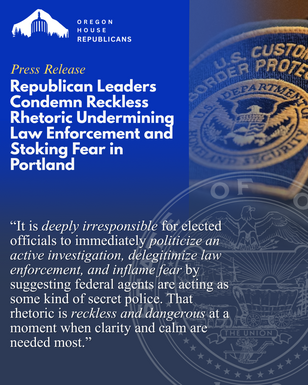
This past weekend, a few days after two gang-affiliated, illegal immigrants were shot by a Border Patrol Agent in Portland, Republican Leaders held a press conference to condemn Democrats’ response to the incident.
Immediately following the shooting, Democratic lawmakers presented a united force and pushed rhetoric that undermined law enforcement and evoked fear. I, along with my fellow House and Senate Republicans pushed back, arguing for calm and clarity in light of the ongoing investigation.
It is irresponsible for elected officials to immediately politicize current events in a manner that stokes fear and has the potential to influence an ongoing investigation. While it is essential to hold bad actors accountable when they do arise, pushing an overarching narrative that Federal Agents are some sort of secret police is reckless and encourages further acts of violence.
Republicans support law enforcement at every level — we stand with the men and women who put their lives on the line every day to protect our communities. I will never side with drug dealers, sex traffickers, or gang members over the officers sworn to uphold the law.
Until we see the conclusion of this investigation, I will proceed with skepticism and caution — and I would encourage my colleagues on the other side of the aisle to do the same.
|
Legislature Cannot Repeal Referred Transportation Tax According to 90-Year-Old Legal Opinion

A 1935 Oregon Attorney General opinion confirms that once Oregonians invoke their constitutional right to referendum, the Legislature has no authority to repeal the measure before voters have their say. That precedent directly contradicts Governor Tina Kotek’s recent call for lawmakers to repeal her signature transportation tax package after more than 250,000 Oregonians signed a petition demanding a vote.
At first glance, it can sound reasonable when the Governor says, “Let’s just repeal the bill.” So people ask: Why wouldn’t Republicans want that?
The answer comes down to voter power, fairness, and consequences.
Why This Measure Must Stay on the Ballot
Thousands of Oregonians signed a referendum petition because they wanted a direct vote on the new transportation tax. Under Oregon’s Constitution, that signature guarantees voters the final say — not politicians behind closed doors.
Repealing the law now would cancel that vote and weaken the referendum process for everyone. A repeal is not the same as a public vote: it removes voter choice, avoids public accountability, and sets a dangerous precedent that future citizen-led referendums can simply be erased.
Keeping this measure on the ballot protects the voice of the people. Regardless of where you stand on the tax itself, Oregonians followed the rules and earned the right to decide.
|
Notable Bills That Became Law in 2026
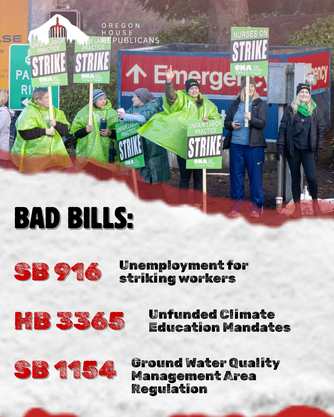
The previous long session was hectic. With transportation funding dominating headlines, other notable legislation slipped through the cracks. From unemployment benefits for striking workers to unfunded climate curriculum, here are a few bills that became law on Jan. 1 that will negatively impact Oregonians.
SB 916: Unemployment Benefits for Striking Workers — This bill allows striking public and private employees to collect up to 10 weeks of unemployment pay after two weeks on the picket line. Oregon is the first state in the nation to allow public employees to receive unemployment benefits while on strike. The Superintendents of Oregon’s largest school districts wrote to lawmakers to oppose the bill because it could cost their districts millions of dollars. All this bill does is reward powerful unions that fund Democratic campaigns.
HB 3365: Unfunded Climate Education Mandates — This bill directs the State Board of Education to ensure that academic content standards for core subjects include “sufficient” instruction on the causes and effects of climate change and strategies to respond to such. Climate change is already mandatory in health, science, and social studies curricula. Not only is this redundant, but it is also another unfunded mandate that school districts can not afford.
SB 1154: Ground Water Quality Management Area Regulation — This bill created a tiered regulatory system to prevent and manage groundwater quality areas. Republicans were able to secure an amendment to the bill that provides legal clarity to rural communities dealing with water quality issues. However, the bill leaves the door open for future mandates on how and when Oregonians can use water for ranching and agriculture.
|
Final Legislative Days Tell Us What to Expect for 2026 Short Session
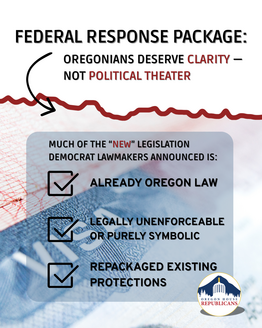
Constrictive immigration policy — On Wednesday, Democrats held a press conference where they unveiled their “Federal Response Package.” While this package touched on federal tax code disconnects and preventing the sale of public lands, the package largely revolved around immigration. Included in the package were bills to introduce training standards in workplaces relating to ICE inspections, require schools to inform parents when there has been ICE activity on campus, and prevent Oregon businesses and agencies from purchasing from organizations that are associated with deportation efforts. President Trump recently decreed that all sanctuary states would no longer receive federal funding, beginning Feb. 1. The “Federal Response Package” seems to be the state’s response to such federal action. But here’s what’s important to know:
- Much of what’s being described is already Oregon law.
- Several proposals are legally unenforceable or purely symbolic.
- And others simply repackage existing protections as something new.
Oregon already has strong anti-discrimination laws, limits on state cooperation with federal immigration enforcement, protections for students, and clear rules governing state data and public funds. If there are gaps in the law, let’s debate them honestly. If there are real threats, let’s address them responsibly. But Oregonians should never be misled into believing we’re starting from zero — or that press conferences equal progress. Our focus remains where it belongs: real solutions, constitutional guardrails, and public trust. We can protect people and tell the truth at the same time.
|
Sales tax proposed — The concept of a sales tax is not a foreign one to the Oregon Legislature, though it is holistically unpopular. A bill was proposed for the short session that aims to reduce taxes imposed under various tax programs and replace them with a sales tax. The concept, in theory, is not a bad one. A sales tax would help stabilize Oregon’s revenue, but Democrats clearly see this as just another way to bloat their budget. There would need to be massive income and property tax cuts for this to even be close to a good idea for Oregon.

A backtrack on transportation to save face — On Jan. 7, Governor Kotek called for a complete repeal of the $4.3 billion transportation tax and spend package after facing backlash and a successful ballot referral effort. Despite championing and pushing the bill through a grueling special session, Kotek would rather repeal the whole bill — including accountability and oversight provisions — than run on the same ballot as a grossly unpopular tax hike. It is more than likely that we see this on the 2026 session agenda.
The upcoming session is turning out to be heavy on resolutions, light on solutions. Instead of curating effective legislation, Salem politicians default to boards and task forces to address constituents’ concerns.
|
State Audit Shows Measure 110 Failed to Help Oregonians Struggling With Addiction
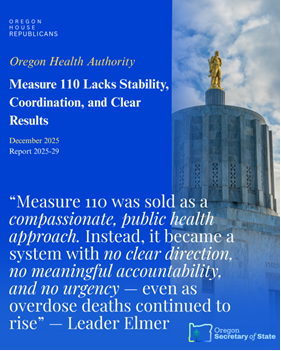
Recently, the Secretary of State’s office released an audit confirming what too many Oregon families have already lived through: Measure 110 failed to deliver on its promise to help people struggling with addiction, and the state failed to provide the leadership and oversight needed to prevent that failure.
Measure 110, which aimed to replace the criminalization of substance use disorder with a public health approach, was sold as a compassionate, public health approach. Instead, it became a system with no clear direction, no meaningful accountability, and no urgency — even as overdose deaths continued to rise. In 2023 alone, more than 1,700 Oregonians died from drug overdoses. While overdose deaths declined in nearly every other state, Oregon fell further behind.
The audit makes clear that the Oregon Health Authority lacked stability, coordination, and measurable goals. Funds were distributed without consistent oversight, data were insufficient to show whether programs were working, and services were not integrated into Oregon’s broader behavioral health system. The result was wasted time, wasted resources, and lives lost that did not need to be.
This was not a failure of compassion — it was a failure of leadership.
Oregonians expect their government to act when policies aren’t working, especially when lives are on the line. Instead, warning signs were ignored, repeated requests for improvement went unanswered, and accountability was absent.
We owe it to families, first responders, and people battling addiction to do better. A public-health approach must be focused on saving lives, getting people into treatment, and delivering results — not protecting a broken system. Oregonians deserve urgency, transparency, and leadership that is willing to admit when something isn’t working and course-correct immediately.
Rep. Mannix to Introduce Bill That Enhances Safety for Survivors of Stalking and Domestic Violence

January is Stalking Awareness Month. Data shows 1 in 3 women and 1 in 6 men experience stalking in their lifetime, often by someone they know. More than twice as many victims are stalked with technology as without.
Stalking is a significant risk factor for lethal violence, particularly in intimate partner relationships. 76% of women murdered by their current or former intimate partners were stalked by their killers within the 12 months prior to the murder.
Next month, my colleague Representative Kevin Mannix (R-Salem) will be introducing a bill that speeds up investigations of stalking and domestic violence cases by requiring all communications companies (any internet service provider, cellular, or digital communications company) doing business in Oregon to respond to search warrants within 48 hours of receiving a report. Right now, companies can take several weeks or months to respond.
The bill – Kristil’s Law – was created in honor of a Colorado woman who was murdered by her husband in 2023. Kristil Krug was a married mom of three living in a Denver suburb who was stalked by her husband, impersonating another man. For months, he terrorized her using fake emails, burner phones and online harassment before ultimately taking her life in the garage of their home in December 2023.
Kristil’s cousin, Becky Ivanhoff, is a former Deputy District Attorney in Lane County, Oregon, where she focused on domestic violence cases. While she is also working on legislation in Colorado, Oregon would likely be the first state to pass this type of law. Her hope is that it will become a model nationwide.
You can watch KATU’s interview with Rep. Mannix and Becky Ivanhoff when it airs Friday at katu.com
|
Yamhill Community Care: A Local Success Story with Proven Results
Since Oregon launched the coordinated care organization (CCO) model in 2013 to deliver Medicaid services, Yamhill Community Care (YCCO) has achieved 100% or more of its quality dollars every single year—an accomplishment unmatched by any other CCO in the state. This is one of the few examples of the state tracking results of what it spends money on, and the results are clear: our community has gone above and beyond expectations.
YCCO was founded by our community and currently serves about 35,000 Oregon Health Plan members across Yamhill, Polk, and Washington counties. Its performance reflects community providers’ excellence in preventive care, behavioral health, child wellness, and chronic disease management. Over 12 years, YCCO has achieved an average of 110% quality pool distribution; dollars above 100% represent achievement of certain “challenge pool” measures.
Importantly, this success is not happening in Portland. It is happening here. YCCO’s locally governed, independent care delivery model ensures that Medicaid dollars stay in the community. Nearly 90% of incentive funds are reinvested directly into local clinics and providers through value-based payments, with the remainder supporting prevention efforts like youth mental health and childcare workforce development.
YCCO’s record demonstrates that locally led care delivers outstanding results. Congratulations YCCO!
Enter the 2026 Oregon Civics Bee By Feb. 3rd!
This year, the United States will celebrate its 250th birthday. Oregon middle-schoolers have a unique way to celebrate. All 6th, 7th and 8th graders are invited to participate in the third annual Oregon Civics Bee, which will culminate June 12, 2026, in a quiz-style competition held in the House Chamber of the Oregon State Capitol. The winner will be invited to participate in the National Civics Bee® in Washington, D.C.
To participate, students must submit a short, four-paragraph essay identifying a community problem and proposing a solution. A panel of judges will select finalists to participate in regional competitions, and top performers in regional bees will be invited to participate in the Oregon Civics Bee. Oregon Secretary of State Tobias Read will emcee. The top three finishers in the Oregon Civics Bee will receive cash prizes, including $1,000 for the winner.
To learn more about the contest – including application and essay guidance and a toolkit for teachers – please visit the Oregon Civics Bee website here.
The essay submission deadline is midnight on Feb. 3.
|

Dolly Parton's Birthday Party!
 Yours truly,
 Representative Lucetta Elmer
House District 24
Capitol Phone: 503-986-1424
Capitol Address: 900 Court St. NE, H-395, Salem, Oregon 97301
Email: Rep.LucettaElmer@oregonlegislature.gov
Website: https://www.oregonlegislature.gov/elmer
|