|
Replies to this message are sent to an unmonitored mailbox.
To contact me, please click here: Rep.EdDiehl@oregonlegislature.gov
Friends,
The Army Corps of Engineers is moving forward with plans for a deep drawdown of Detroit Lake, and the implications for our Santiam communities are significant. I want to ensure you have the facts, understand the risks, and know what I’m doing to protect the people who rely on the North Santiam every day.
Just the Facts
The Army Corps of Engineers is planning a deep drawdown of Detroit Lake as part of a federal effort to help restore threatened Upper Willamette River (UWR) Spring Chinook Salmon and Winter Steelhead. The Corps is taking public comment through January 13th at willamette.eis@usace.army.mil, and I strongly encourage Santiam-area residents to make their voices heard.
This drawdown is being driven by the Endangered Species Act (ESA), a federal court injunction, and a 2024 Biological Opinion (BiOp) issued by NOAA Fisheries. Unlike the disastrous Green Peter Reservoir drawdown—mandated directly by the court—the Corps has more flexibility in shaping how the Detroit drawdown will occur. Beginning in 2026, the Corps plans to “stair-step” Detroit Reservoir slightly lower each fall until it reaches a level about 55 feet below normal winter pool and about 30 feet lower than the lake has ever been drawn before. It will remain at that depth for roughly two weeks to test whether juvenile salmon will pass downstream through the regulating outlet and survive the journey to the ocean. In theory, these fish would later return as adults and be transported above the dam to spawn—helping rebuild endangered salmon populations.
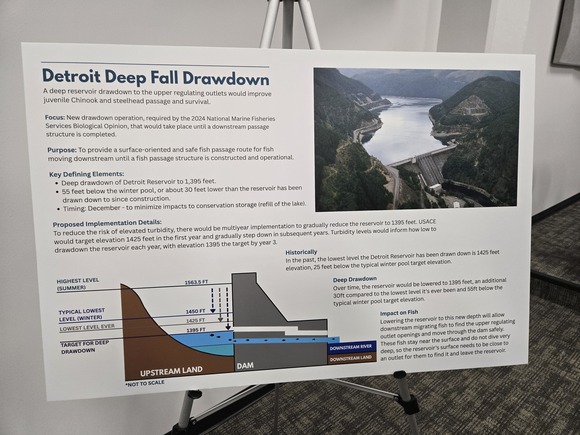 A Federal Mandate the Demands a Strong Local Response
Over the last several months I have met repeatedly with the Corps, the City of Stayton, leaders in Detroit and Salem, and local water experts. I fully support the letters of concern submitted by the City of Stayton and the Detroit Lake Foundation. I also attended three Corps open-house meetings—in Detroit, in Salem, and most recently in Stayton—and at my request we held a joint meeting on December 16th with Corps leadership, the City of Stayton, Senator Girod, and others.
Before I address the path forward, I want to be clear about the context. The Corps is operating under a federal court injunction because the court found they had violated the ESA by allowing Willamette Valley dams to harm fish and had failed, for years—since a 2008 Biological Opinion—to complete legally required fish-passage improvements. The Corps did not challenge those BiOps, and I believe they should have. I also believe there are deeper motives at work among some drawdown advocates, and I will address those concerns in a future update, along with the growing push to eliminate hydropower operations at certain dams.
For now, I want to focus on how this proposal impacts the Santiam community—and what we must insist upon moving forward.
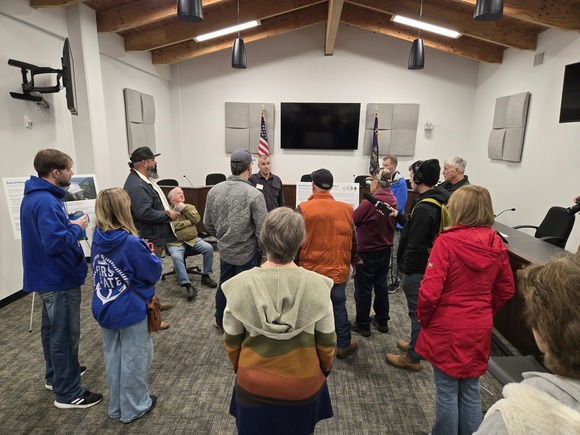 Recreation Impacts Will Be Minimal
Importantly, the planned two-week deep drawdown is scheduled after the reservoir has already reached its normal low point for the season and after all marinas and boat ramps have already closed for the year. The drawdown itself should not affect Detroit Lake’s summer recreation season, which is vital to the Santiam economy.
A Real Risk: Drinking Water for the Santiam Canyon
The far greater concern is turbidity—the amount and type of sediment released downstream during a deep drawdown. Stayton and Salem rely on slow sand filtration systems that work exceptionally well with clear mountain rivers but cannot handle high sediment loads. Even relatively low turbidity, like what we see after heavy rains, can clog these filters and force the cities to bypass them and rely on emergency reserves. Those reserves last only a few days. And while Salem has limited backup systems in place, Stayton does not.
Deep drawdowns release a type of fine, powder-like sediment that behaves very differently from what we see after a heavy rain. This fine material can permanently damage slow sand filtration beds, requiring the complete replacement of sand and gravel layers—a process that can leave Stayton without drinking water for weeks. That scenario is simply unacceptable.
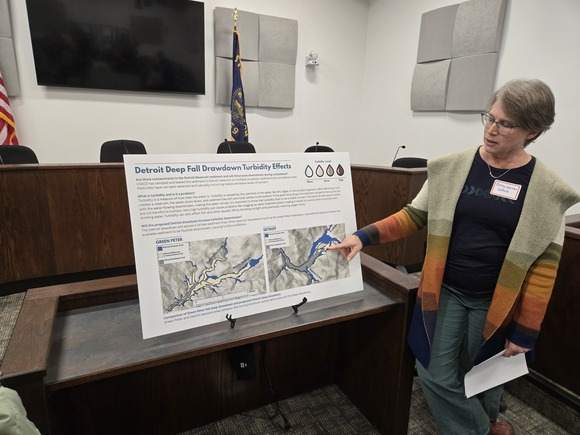 The Corps Must Get This Right
The challenge for the Corps—and for our cities—is to design in implement a plan that draws the reservoir down slowly, monitors turbidity continuously, and maintains operations within the limits the filtration systems can safely handle. Failure is not an option. The science on slow sand filtration is clear, and the cities’ concerns are justified. If the Corps cannot guarantee that Stayton will not lose drinking water, then they must pause the drawdown and work with Congress to either:
-
Re-evaluate the drawdown requirement,
-
Modernize the ESA, or
-
Fully fund a redundant drinking-water system for Stayton and Salem.
A Major Flaw in the Draft Supplemental EIS
I am also deeply concerned that the recently released Draft Supplemental Environmental Impact Statement (EIS) makes no mention of slow sand filtration systems or their known sensitivity to fine sediment. This omission undermines the credibility of the entire analysis. Frankly, the EIS spends more time worrying about the northwest pond turtle than the drinking water for 200,000 Oregonians. We should not move forward with any drawdown until the Corps revises the EIS to address how fine sediment will impact the drinking-water systems on the North Santiam.
 My Next Steps
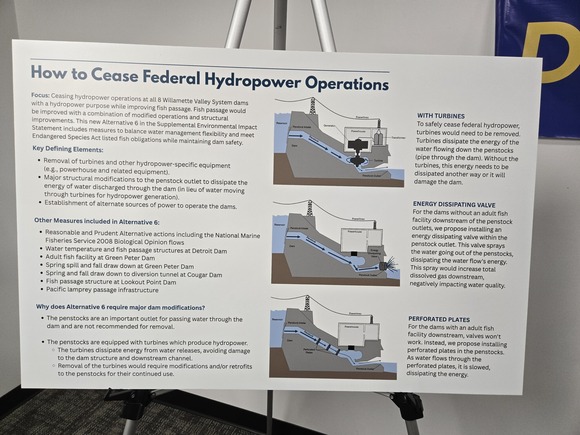
I am drafting a letter to the Trump Administration urging them to halt the Detroit drawdown until these issues are resolved. I am also calling for a comprehensive modernization of the Endangered Species Act. We can and should protect some species, but we must do so in a way that does not steamroll rural communities or jeopardize essential public services like drinking water. The Spotted Owl debacle proved that ESA directives can destroy entire industries and towns while failing to deliver recovery—and the Santiam Canyon cannot be sacrificed again under the same flawed approach.
I will continue fighting for a responsible, science-based approach that works for the people who call the Santiam home.
Thank you for staying engaged as we work to protect the rights and livelihoods of Oregonians. I will continue fighting for the issues that matter most to House District 17 and keeping you informed every step of the way. Stay tuned for more updates.
In Liberty,

Representative Ed Diehl
House District 17

Capitol Phone: 503-986-1417
Capitol Address: 900 Court St. NE, H-378, Salem, Oregon 97301
Email: Rep.EdDiehl@oregonlegislature.gov
Website: https://www.oregonlegislature.gov/diehl
|