|
Replies to this message are sent to an unmonitored mailbox.
To contact me, please click here: Rep.Farrah.Chaichi@oregonlegislature.gov
Happy Holidays House District 35 residents,
With the shorter days, colder weather, and limited amount of sunlight, we are reminded every day that winter is officially here. The end of the year is also a time of reflection, checking in on our relatives, hopefully having some time off work to rest, and thinking about the year ahead.
This newsletter is a little bit longer because there are a lot of policy decisions coming next year. I want to share with you all a first glance at the policies that I plan to introduce in the upcoming February Short Session. You also will find a discussion of the impacts the State of Oregon is facing due to H.R. 1, the One Big Awful Bill that Republicans passed earlier this year. Towards the end of the newsletter are important community resources for immigrants and information for staying warm during the winter months.
Each Oregon State Legislator is allowed just two policy bills during the Short Session. This is because the Short Session only runs for about 35 days. Compared to Long Sessions, which last approximately 6 months, Short Sessions are very fast, and it would be absolutely impossible to have the appropriate time to study, deliberate, and vote on all of the policy issues that are covered during a Long Session.
My team and I believe that it is a top priority for our community and for our state to strengthen and reaffirm Oregon’s historic Sanctuary Promise Act. In February 2026, I will be introducing the Law Enforcement, Accountability, and Visibility Act, a.k.a the “LEAVe Us Alone” Act.
This bill is a direct response to the scary, unjust, and downright illegal abuse and harassment that Immigration and Customs Enforcement (ICE) and other Federal law enforcement officers have perpetrated on the people of Oregon.
It is blatantly obvious that the current Administration continues to disregard human rights, the rule of law, our basic freedoms, and the U.S. Constitution. Instance after instance, human beings, many of whom are American citizens or are legally living in the United States, are being snatched out of their cars, disappeared off the streets, or harassed in their neighborhoods by masked, military agents.
Frankly, I AM SICK OF IT, and so is our community. I will not stand for it, neither will Oregon, and neither should you. I was elected to office to serve the beautiful State of Oregon, and it's incredible people - ALL of its people - regardless of age, gender, income, race, or immigration status. The “LEAVe Us Alone” Act, developed in partnership with frontline community advocates with lived experience, standardizes the “no masking and identification” policy that was originally passed in HB 3355 in 2021.
My message to our immigrant neighbors and immigrants across Oregon is: We Stand With You and We Will Fight for You! Last week, I attended a presentation hosted by ACLU, Centro Cultural, and the Portland Immigrant Rights Coalition (PIRC) for Mayors and Elected Officials across the tri-county area to coordinate our response to the authoritarian attacks on vulnerable members of our community. The last slide in the presentation reminded me of our LEAVA bill, because in sets in place new polices that BUILD a safer community here in Oregon, while fighting against the dangerous policies of the current Administration.
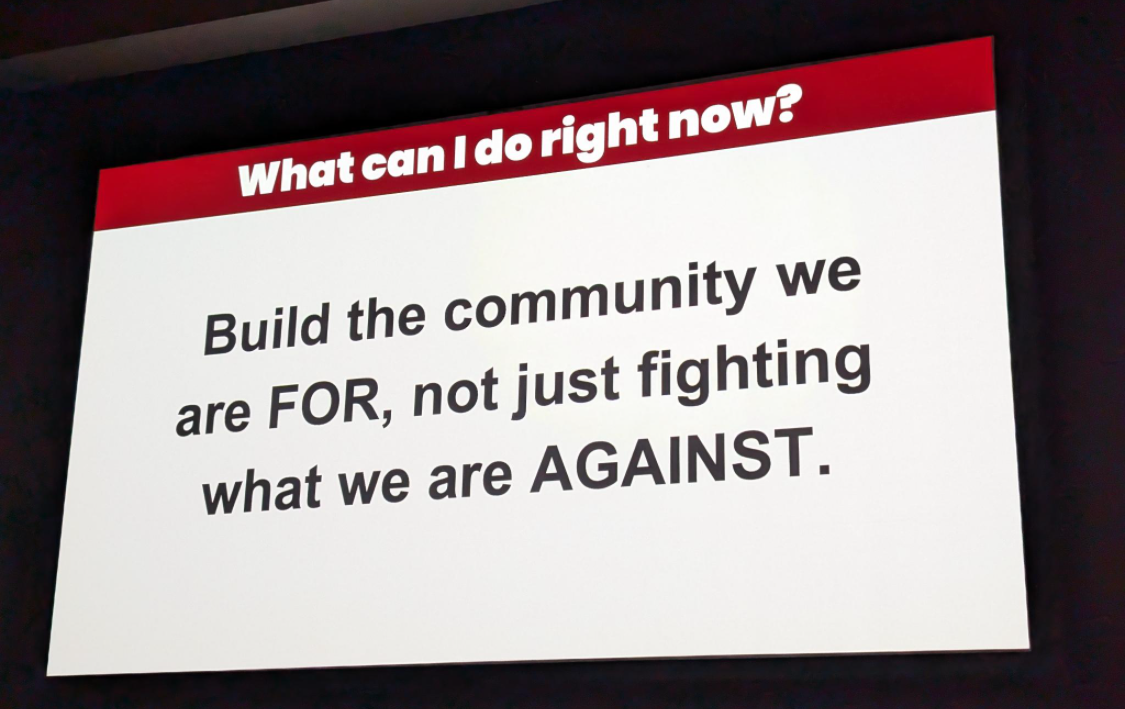 Slide from the ACLU, Centro Cultural, and PIRC presentation last week
 Photo Credit: Compassionate Oregon
Ryan’s Law, or the "Cannabis in Hospice” Act, is a policy solution that was brought to me by my Chief of Staff and a community member who lost his son Ryan to cancer and who was denied access to medical marijuana care leaving him disconnected from his young children and loved ones in his final days.
In Hospice care, the primary goal is not curative treatment but enhancing the quality of life for individuals facing terminal illnesses. Rather than limiting the medications that patients can access in these difficult situations, the Cannabis in Hospice Act would expand options for patients in Oregon.
Patients and doctors have said for years that cannabis can improve the quality of life, relieve symptoms with minimal burden, facilitate connection and mental function, and offer fewer side effects to some patients. I am excited to move this bill forward in the Short Session with the help of our community advocates and the Oregon Health Authority. The goal is for this law to be implemented in the summer of 2026 in specific residential facilities that are designated for hospice, palliative, and end of life care.
If you have questions or feedback on any of these policy ideas, please feel free to reach out to our office. I look forward to keeping you all updated on the status of these bills as we get closer to the Short Session.
The State Budget relies on income taxes from businesses and individuals, property taxes, the Oregon Lottery and money from the Federal government. This is how it works in many states. It is why we pay both Federal and State taxes. We live in a country that has multiple systems of governance who are responsible for serving the public interest in different ways.
Your city will typically pave the roads, your county can run a homelessness shelter or a health clinic, the state manages your licenses and permits, and the federal government funds your social security. Of course this is an over-simplification, but in general, it is important to remember that government services cost money, and we, as citizens, pay the government for those services. We have every right to demand that those services be more accessible, be of a higher quality, and be efficiently provided, but we can’t get out of the fact that we have to pay taxes.
The current disaster that my colleagues and I face in the Oregon State Legislature is that the Trump Administration has blown a gigantic hole in Oregon’s budget. Just look at this image below:
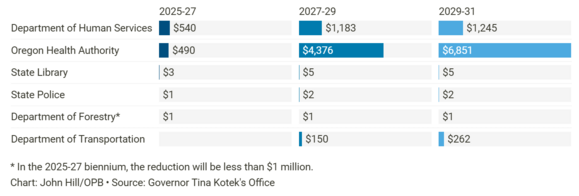 All numbers shown above are in millions of dollars, and represent the amount of money that the State of Oregon will need to give to those agencies to “backfill” the funding taken away from their current programs. In total, this comes out to $1.4 billion in the 2025-27 budget, $5.7 billion in the 2027-29 budget, and $8.4 billion in the 2029-31 budget.
This data comes from a preliminary and comprehensive analysis by the State of Oregon’s Chief Financial Officer who forecasted what effects Trump’s One Big Beautiful Bill will have on the life-saving, healthcare, food, and other programs that we rely on here in Oregon. In September of this year, the Governor asked each and every State agency - from the Fish and Wildlife Department to the Secretary of State - to work with our legislative fiscal office (LFO) to game out reduction scenarios. The Governor recommended planning to reduce ALL agency budgets by 2.5% or 5% to try and respond to the $1.4 billion Oregon lost for this current budget cycle (2025-2027).
Let’s be clear here: the Republican-supported law (H.R. 1) is fundamentally unfair, will hurt millions of people, and is fiscally irresponsible. It will shift enormous costs to state and local governments for programs that have always been federally funded just to give $4.5 trillion in tax cuts to the rich and well-connected.
However, what I will NOT support is a “cuts only agenda”. We have heard some leaders in Oregon throw up their hands and say “I guess we need to tighten our belts.” My question is “WHO needs to tighten their belts?” The working class, the low-income, the veterans, the houseless, the seniors, the immigrants, the vulnerable, our kids?
Billionaires keep winning in our country and it needs to stop NOW. Republicans’ Big Awful Bill, which passed earlier this year, gave early Christmas presents to the wealthy, gave coal to the middle class, and is stealing food and healthcare from everyone else.
We MUST take revenue-raising measures and disconnect from new federal tax codes in the very near future to fight back against the Republican's "billionaires win, families lose” agenda. There will have to be hard discussions about where Oregon can make up ground through progressive taxes that don’t add extra burden to the hard-working Oregonians that live paycheck-to-paycheck.
 Photo Credit: Department of Human Services
Despite the terror that Federal Immigration officers have inflicted on us here in Oregon,we have seen Oregonians come together - at all levels of government. I am proud to see that our Governor, our Attorney General, our Congressional Delegation, county commissioners, and city leaders are standing together against Trump’s mass deportation agenda.
Earlier this year the Governor created the Office of Immigrant and Refugee Advancement (OIRA) to bring community partners and other leaders together, guide leaders with clear information, and advocate for immigrant and refugee communities. I highly encourage you to sign up to their monthly newsletter to get timely and accurate information and resources directly from their office.
The timing for OIRA could not have been more important. Statewide data shows at least 329 arrests in October, with no signs of slowing in November. One of our colleagues in the Oregon State Legislature, Lesly Muñoz, has shared her own struggle to keep her community safe after another report confirmed more than 30 people were detained during a single operation in Woodburn on October 30.
The decisions made by the current Federal Administration are directly responsible for this. The One Big Beautiful Bill (H.R. 1) directs $170 billion toward enforcement and border operations, including funds to hire 10,000 new ICE officers and $45 billion to build new detention centers. Congress has also made strict changes to SNAP, which have removed food support for about 3,000 immigrants and refugees living in Oregon. Furthermore, the suspension of the federal refugee admissions program has disrupted arrivals, created uncertainty for families in the resettlement process, removed access to key programs that help new arrivals meet basic needs and rebuild their lives. This puts added stress on resettlement agencies, faith partners, and community groups who support families through financial hardship and instability after displacement. Finally, H.R. 1 allows ICE agents to examine children for tattoos and markings, which risks the safety and wellbeing of children in immigrant and mixed status households. Oregon has about 44,900 citizen children living with at least one undocumented parent.
Right now, parents are keeping their children home from school because they do not feel safe leaving the house. Families are avoiding food programs because they worry their information will get into the wrong hands. Latino owned businesses are seeing fewer customers as many families fear going out for dinner. Immigrant families and people of color are being grabbed off the street, detained at their work sites, being pulled out of their cars, and taken to detention facilities. I had to use the PIRC Hotline (1-888-622-1510) for the first time last month when I was walking my dog outside my apartment and found a truck with its window smashed in left behind from the abduction of a construction worker on an affordable housing project.
As I said earlier in this newsletter, there is no more hiding what the President’s priorities are - billions of dollars for ICE and rich people, fear and suffering for ordinary people. OIRA will continue to track enforcement activity and follow federal policy changes that affect Oregon communities. With evidence of rising detentions across Oregon, it is more important than ever to have quick, easy, and frequent access to resources like ODHS programs, legal service providers, and community partners. I also want to thank the City of Beaverton and Washington County for coordinating their responses at the local level.
In the resources below, you will find clear and relevant information so that you and your community know where to turn and how to stay connected to support networks throughout Oregon. Oregon belongs to all of us, and now is the time to defend it.
 Photo Credit: The Dougy Center
Earlier in November, my team went to see the future home of Dougy Center West, or “Malcolm’s House”. We wanted to hear more about Dougy’s work and their plans to expand those critical services to the Westside so they can be accessed by many more children and families.
When someone close to you dies or has an advanced serious illness, it can often feel like no one understands what you’re going through. Dougy Center provides connection, support, and resources to children, teens, young adults, and families who are grieving.
Founded in 1982, Dougy Center was the first organization of its kind in the United States and has grown to become the gold-standard of practice for child-centered peer support. Since its founding, Dougy Center has provided direct services to more than 65,000 people in the Portland area.
In our community, 1 in 13 children will have a parent or sibling die before they turn 18. Dougy Center serves these children, teens, young adults, and their adult family members through grief support groups in Portland, Canby, and Beaverton. Groups are ongoing and families are never charged a fee for Dougy Center’s services.
Because the need for Dougy Center’s services is growing — with more families on its waitlist than ever before — Dougy Center is working to expand its reach with a dedicated home on Portland’s west side.
In addition, Dougy Center provides hundreds of resources, including tip sheets, activities, articles, podcast episodes, and more — all at no cost — on their website. Dougy Center’s staff answers thousands of calls from people in crisis and trains nearly 10,000 grief professionals each year.
Learn more about Dougy Center’s grief support for children and families, and find resources at https://www.dougy.org/
 Photo Credit: Washington County
It is definitely winter time folks. Snow, ice, wind, and other winter weather can lead to a variety of dangers. Not everyone is prepared for this. I know I am not! That is why I use the Public Alerts Website for safety tips and other important emergency information.
During extreme cold weather events, winter warming shelters are sometimes opened to help protect people who don’t have access to shelter and people who lose heating in their homes. Contact 211info or visit the Washington County website to find resources near you.
A huge reason for why we made it illegal for utilities to raise electricity rates and disconnect people from their electricity during the winter months is because heating your home is a life-saving and essential need. Staying warm in the winter is not a luxury for only those who can afford it. Both PGE and Pacific Power have low-income utility assistance programs that are easy to apply for online.
And if you need additional help paying your energy bills or weatherizing your home, contact 211info to see if assistance is available from the county or other local non-profits in your area.
Community Resources
Please reach out to my office at any time for legislative or constituent matters. My staff and I are committed to serving the constituents of HD 35 and you can reach us at: Rep.FarrahChaichi@oregonlegislature.gov or 503.986.1435.
To keep up with my office, consider following me on Facebook or Instagram.
Thank you again for subscribing to my newsletter and for reading the frequent news and updates from our office. Please encourage your neighbors and friends in our district to subscribe to this newsletter, if they seem interested. I am honored and grateful for the opportunity to represent you in the Oregon State Legislature.
In Solidarity,
 Representative Farrah Chaichi
House District 35
Capitol Phone: 503-986-1435
Capitol Address: 900 Court St. NE, H-478, Salem, Oregon 97301
Email: Rep.Farrah.Chaichi@oregonlegislature.gov
Website: https://www.oregonlegislature.gov/chaichi
Facebook: https://www.facebook.com/RepresentativeFarrahChaichi/
Twitter: https://twitter.com/FarrahChaichi
| 

