|
If you're having trouble viewing this message, please visit my legislative web page at http://www.oregonlegislature.gov/prozanski/, click "News and Information" on the left.
Dear friends,
No doubt you've seen a lot in the news about Portland and Chicago recently. As we prepare this e-bulletin, Oregonians await a ruling by a three-judge panel of the U.S. Court of Appeals for the Ninth Circuit as to whether President Trump can deploy Oregon National Guard troops to the streets of Portland. No matter how they rule, I expect the losing litigant to request that the full Ninth Circuit take up the matter.
Per reputable accounts and actual conditions on the ground, protests at the Portland ICE building have been mostly peaceful. At any given time, there are a handful of protesters — occupying less than one city block — standing up for members of their community. Nearby residents continue to enjoy coffee shops, peaceful parks and bike paths. President Trump's depiction of Portland as "war ravaged" is untethered from reality.
Despite the facts, the president continues to use inflammatory rhetoric demonizing Oregon's biggest city in trying to justify his objective of deploying troops. Federal agents have employed aggressive, likely unconstitutional tactics against nonviolent protesters. Secretary of Homeland Security Kristi Noem paid an unannounced visit to Portland last week. Instead of engaging local media or offering a truthful account, she invited right-wing influencers to spin tales and she spoke only to Fox News, backing her boss's false narrative. Secretary Noem didn't even inform Oregon's Governor that she was coming to our state. Fortunately, Governor Kotek "reached out" and managed a 20-minute, cordial but frank conversation with the secretary.
The Portland Police Bureau has made clear that they have the situation under control. Last week, Federal Judge Karin Immergut, a Trump appointee, blocked deployment of Oregon National Guard troops with a temporary restraining order. President Trump then attempted (and failed) to work around this court order by deploying federalized members of the California National Guard to Portland. Judge Immergut had none of it; she then entered a second restraining order to block any National Guard troops from being deployed to the city. You can read her full opinion, here.
No president in the history of the United States has sent the National Guard across state lines, much less against the governors' wishes. Oregon is standing up to this administration's unprecedented overreach by challenging it in court. We have the right to self-govern in state matters.
Meanwhile in Salem, the Legislature adjourned its special session on October 1 after finally passing a transportation package. The Senate also confirmed a slate of appointments by the Governor. (Here's a link to my September newsletter in which I laid out provisions of the transportation package and its necessity.)
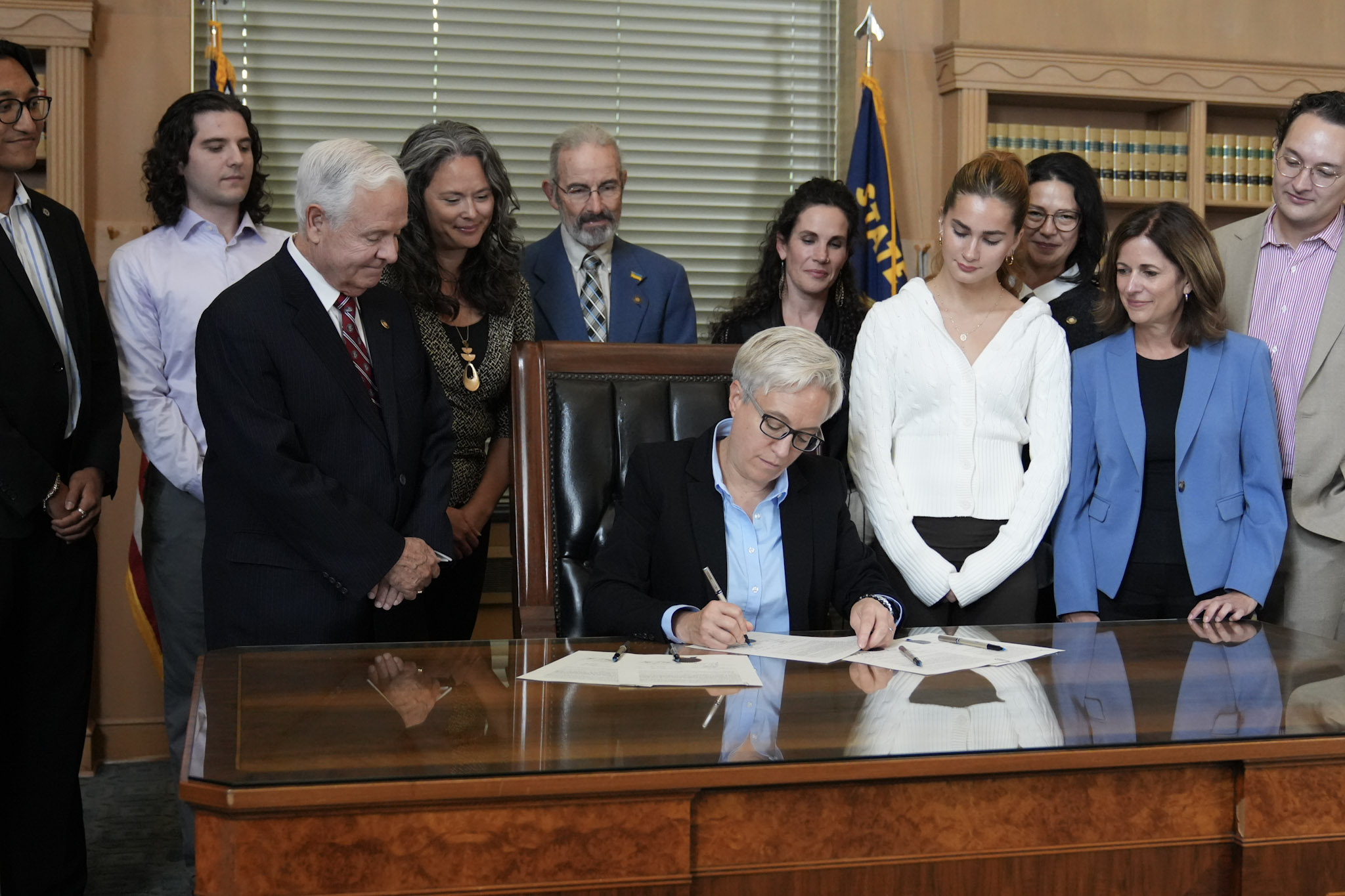
On September 29, after voting on the transportation package, I joined advocates, my colleague Representative Kevin Mannix (R-Salem), and Governor Kotek for a signing ceremony of SB 180 (pictured below), a measure to protect good faith disclosures of sexual assault from defamation lawsuits.
Below you will find information on:
- Resources for Oregonians Impacted by the Federal Shutdown
- Session Accomplishments: Housing and Homelessness
- Springfield DMV Services by Appointment Only
- ODVA Accepting Proposals for Veteran Services Grant Program
- Halloween Traffic Safety Tips
I hope this information is helpful and informative for you or someone you know. As always, feel free to share your comments, questions or concerns with me by phone, mail or e-mail.

Resources for Oregonians Impacted by the Federal Shutdown
The ongoing federal shutdown has impacted workers, employers, and contractors in Oregon. The Oregon Employment Department (OED) can assist in several ways, from providing Unemployment Insurance (UI) benefits to impacted workers to helping businesses through its WorkShare program.
Unemployment Benefits
The following links can help individuals navigate how to apply for unemployment insurance (UI) benefits and job-seeking services provided by OED:
UI is a complex program. Applying for benefits can create plenty of questions. Different rules apply to some federal workers. OED has specific guidance available on its website, and customer service staff are specially trained for situations like this. OED advises affected workers to apply for benefits, even if they are not sure they're eligible.
Business Impacts
Some Oregon businesses may also be impacted by the federal shutdown. Another OED-administered program, called WorkShare, can help these businesses retain their skilled employees during work slowdowns and shortages. The WorkShare program provides an alternative for employers and workers who may be facing a layoff situation through partial unemployment insurance benefits that supplement workers' reduced wages.
Once enrolled, an employer can quickly use the program if needed, but there is no obligation. Weekly webinars are offered to help businesses apply for and navigate the program. To learn more, visit oregonworkshare.org or call 503-947-1800.
Session Accomplishments: Housing and Homelessness
Following the 2025 Legislative Session, I'm sharing in-depth summaries of bills passed by subject area. Below is a comprehensive listing of accomplishments related to housing and homelessness — by Senate/House bill and in numeric order:
Senate Bills
SB 32 - Public Housing Data Transparency Required on State Website: This legislation requires the Oregon Housing and Community Services Department to maintain on its website all information it holds about publicly supported housing, specifically: expiration dates of the affordability restrictions, number of housing units, type and source of rental assistance, income eligibility levels, and current status of any preservation efforts.
SB 586 - New Rules for Termination Notices Tied to Property Sale: This legislation provides that if a landlord is terminating the tenancy based on a purchase offer, the notice period can be reduced to not less than 60 days prior to the designated termination date if the landlord provides written evidence of the accepted purchase offer and at the time of notice, the landlord pays the tenant an amount equal to one month's periodic rent, plus any additional amount required. It clarifies that for a fixed-term tenancy, termination by the landlord can only occur once the fixed term has expired. SB 586 specifies that a notice must be given not less than 90 days prior to the date designated as the termination date. It requires written evidence of a purchase offer accompany the notice to tenant. The measure takes effect on 91st day following adjournment sine die.
SB 684 - Expands Tax Exemption and Loan Support for Mixed-Income Housing: A loan program and a property tax exemption under this legislation can help finance the development of housing created for a mix of income levels, with units offered at market rents and subsidized for moderate and low incomes. Multifamily housing financed by the measure's Mixed Income Public Development Loan Fund must be maintained as affordable for at least 30 years. An existing tax exemption on housing authorities' lower-income housing properties is expanded under SB 684 to also apply to housing authorities' mixed-income developments.
SB 814 - Rental Assistance Expanded for Youth Exiting Care or Custody: This legislation expands eligibility for the long-term rental assistance program implemented by the Oregon Housing and Community Services (OHCS) Department to include individuals under 25 years of age who are or recently have been residing in a child care center or confined in a correctional facility. SB 814 directs OHCS to consult with the Oregon Youth Authority in addition to other entities in designing the program.
SB 830 - Supporting Safe, Affordable Septic Solutions: This legislation expands and updates Oregon's septic financial assistance program to include grants, loans, and other tools that help families and small businesses repair or replace failing systems. The bill prioritizes support for low- and moderate-income households and aims to protect public health, housing stability, and water quality.
SB 967 - Improvement Projects in Urban Fringe Areas Gain Coordination Rules: This legislation gives local governments an additional tool for financing infrastructure expansion, specifically for projects in unincorporated areas within an urban growth boundary. It allows cities to enter into agreements with interested landowners to establish Local Improvement Districts. LIDs let groups of property owners share in the cost of infrastructure development collectively instead of individually financing roads, sidewalks, or stormwater systems.
SB 974 - Deadlines for Plan Reviews; Design Review Rules Updated: Regulatory delays can slow down or derail development of housing. This legislation helps quicken the pace by creating deadlines for local governments to review land-use applications and engineering plans. It also eases design requirements on single-family home developments. It limits the authority of local governments in urban areas to set standards on aesthetic style or landscaping, while maintaining standards on size, fire codes, and safety regulations.
House Bills
HB 2087 - Extending a Down-Payment Tax Benefit: This legislation covers several tax benefits, including extending a tax deduction for first-time homebuyers saving for a down payment. The program lets people lower their taxable income by the amount they save each year in a first-time homebuyer savings account, up to $50,000 over 10 years.
HB 2134 - Early Termination Allowed for Tenants After Non-renewal Notice: This legislation allows a tenant in a fixed-term tenancy to terminate their rental agreement early, provided they provide at least 30 days' written notice to the landlord, if their landlord has already given them the required 90-day notice that the tenancy will not continue past the fixed term. It prohibits landlords from collecting any fees or unpaid rent that would have accrued after the date designated in the termination notice by the tenant and the tenant returns possession of the premises. HB 2134 applies to fixed-term rental agreements entered into on or after the effective date of the measure.
HB 2138 - Expands Middle Housing Access: Oregon needs more housing for people of all ages, wages, and stages of life. It allows for denser styles like duplexes, triplexes, and "cottage clusters" in more areas. Middle housing, as these dwellings are known, must be permitted in unincorporated urban areas, and HB 2138 prohibits private restrictions, like homeowner association rules, from barring middle housing or accessory dwelling units. The bill also eases land division, public notice, and appeals processes.
HB 2347 - Land Use, Housing Standards, and Tribal Support Modernized: This legislation authorizes the Department of Land Conservation and Development to provide technical assistance and grants to federally recognized Indian Tribes and to local governments. It prohibits local governments from applying different standards to manufactured housing than those imposed on comparable site-built dwellings. It also clarifies that local governments may plan for urbanization, including adjacent urbanizable areas, through intergovernmental agreements, and it specifies the criteria for determining when applications for permits, limited land use decisions, or zone changes are complete. In addition, HB 2347 allows the Department of Land Conservation and Development to set deadlines for cities to submit housing reports, and updates housing terminology by replacing "single-family" and "multifamily" with "single-unit" and "multiunit."
HB 2356 - Automatic Metro District Annexation for City Annexed UGB Lands: This legislation establishes that when a city within the urban growth boundary (UGB) of a metropolitan service district annexes territory, and that territory is within the UGB of the district, the territory is annexed to the district without any further process. This provision applies to lands annexed by a city on or after the effective date of HB 2356.
HB 2698 - Statewide Homeownership Goal and Public Tracking Dashboard: Established Home ownership is a time-tested means of building generational wealth and promoting long- term economic stability. This legislation sets a statewide goal for homeownership and creates a publicly available dashboard to track the state's progress toward the rate, set at 65 percent by 2030.
HB 2964 - Loan Program Created for Affordable Housing Predevelopment Costs: This legislation creates a loan program to fund the predevelopment costs of new housing projects and requires the new housing to remain affordable for low-income households.
HB 3034 - Housing Department Takes Lead on Emergency Housing Fund Policy: This legislation directs the Housing and Community Services Department (instead of the Oregon Housing Stability Council) to develop policy for the use of funds in the Emergency Housing Account.
HB 3054 - Stabilizes Rent in Large Mobile Home Parks and Marinas: About 40 percent of people who own a manufactured home don’t own the land it sits on, leaving them vulnerable to the rent rising on spaces in manufactured home parks. This legislation gives these homeowners some relief, limiting the maximum allowable rent increase on spaces at mobile home parks and floating home marinas to six percent a year beginning in 2026. HB 3054 does not apply to parks with 30 or fewer spaces and has exceptions for rent increased to finance repairing, replacing, and upgrading park infrastructure. For those projects, a community of residents can vote to approve an increase of up to 12 percent. The bill also prohibits a landlord from requiring interior inspections or aesthetic or cosmetic improvements of home as a condition for purchase.
HB 3144 - Ban on Manufactured Home Restrictions; Dispute Resolution Grants: Extended by this legislation, new planned communities must allow prefabricated or manufactured homes to occupy single-family lots just as traditionally built homes can. State law already required local governments to permit prefabricated and manufactured homes, but homeowner associations had retained the option to ban them. HB 3144 applies to new subdivisions and their rules, known as "restrictive covenants." The bill also extends through January 2, 2031, a grant program for resolving tenant-landlord disputes amid low-income facilities, and for the Manufactured and Marina Communities Dispute Resolution Advisory Committee program.
HB 3378 - Landlords Must Provide Physical Access and Secure Locks to Tenants: This legislation requires residential landlords to offer an alternative method of accessing the dwelling unit — such as an access code, fob, key card, or another physical key — other than software on tenant-owned phones or other electronic devices for a dwelling to be considered habitable. It directs landlords to provide working locks for all dwelling entrances and latches for all windows that allow access to the dwelling unit.
HB 3505 - No Local Fees for Residential Fire Sprinkler System Installation: This legislation prohibits local governments from imposing or increasing a system development charge for the installation of a National Fire Protection Association 13D residential fire sprinkler system, or for the difference between the increased capacity of a water meter required by the fire sprinkler system and the capacity of the water meter that would be required for the dwelling without the fire sprinkler system installed.
HB 3521 - Deposit Collection Limited Until Approval; Quick Return Required for Rejections: House Bill 3521 allows a landlord to collect a deposit only after they have approved the prospective tenant's application and requires that the deposit to be returned within five business days if the applicant discovers significant habitability issues that lead to the rejection of the rental agreement or if the landlord fails to execute the agreement.
HB 3522 - Landlords Can Issue 24-Hour Notice to Remove Squatters: This legislation allows property owners and landlords to reclaim premises from squatters by providing a 24-hour written notice to vacate. It ensures that the notice does not grant any legal occupancy rights to the squatter and classifies remaining on the property after the notice period as unlawful holding by force. HB 3522 also requires this 24-hour notice to be included in eviction complaint forms filed in county circuit courts and clarifies that such actions are subject to standard court and sheriff fees.
HB 3746 - Construction Defect Claims Reformed with Inspection Milestones: This legislation reforms the process for handling construction defect claims, particularly for homeowners associations (HOAs) and condominium associations. It sets time limits within which a homeowners or condominium association may bring a tort claim for construction defects. HB 3746 also mandates independent inspections for moisture intrusion at two key milestones, two years and six years after substantial completion, and requires the developer to provide inspection results to the association.
HB 5011 - Housing and Community Services Investments: This legislation invests more than $200 million for homeless shelters and more than $87 million for rental assistance.
Springfield DMV Services by Appointment Only
Beginning October 13, the Springfield DMV field office will require appointments and no longer serve drop-ins. This change is part of a pilot program that DMV is undertaking to offer more consistent and predictable service for customers.
Customers can book an appointment online on DMV2U, show up at their designated time, and be certain they'll be served efficiently. New appointments are continually updated on DMV2U, so DMV recommend that folks check back frequently. You can also call DMV Customer Assistance agents at 503-945-5000 for assistance during business hours.
As a reminder: DMV also offers more than 20 services online, including license renewals, vehicle registration, and address changes.
ODVA Accepting Proposals for Veteran Services Grant Program
The Oregon Department of Veterans' Affairs (ODVA) is accepting proposals for a new round of Veteran Services Grant (VSG) funding aimed at expanding outreach and services available to veterans throughout Oregon's rural, urban and Tribal communities. The 2025 Legislature approved $972,653 to fund organizations that provide direct services at no cost to veterans. The VSG program awards grants up to $250,000 to organizations through a competitive grant process.
The purpose of VSG is to fund eligible proposals that help improve outcomes in areas such as health or behavioral health care, housing security and homelessness, employment opportunities or stability, education and training opportunities, transportation accessibility and availability, or other critical services within a community, region, or statewide basis. Organizations eligible to apply for this grant include Tribal, regional or local governments, Oregon quasi-public agencies, Oregon intergovernmental entities formed under Oregon Revised Statute 190, and private nonprofit organizations designated as a federal 501(c)(3), 501 (c)(19) or 501(c)(23) tax-exempt organizations with at least a one-year operational history.
The 2025 VSG application window closes at midnight on October 13, 2025. For more information about this grant or to apply, click here or contact ODVA Grants Coordinator, Brenna Bandstra, at brenna.bandstra@odva.oregon.gov or 971-388-8204.
Halloween Traffic Safety Tips
The Oregon State Police (OSP) remind you to watch for trick-or-treaters when driving in neighborhoods or going to a party on Halloween night, October 31. OSP encourages parents to:
- Dress children in bright costumes. Use reflective tape or stickers on dark costumes.
- Apply face paint or cosmetics appropriate for children directly to the face. It is safer than a loose-fitting mask that can obstruct a child's vision.
-
If a mask is worn, cut the eyeholes large enough for full vision.
- Have children carry flashlights or glow sticks to improve their visibility.
- Secure hats so they will not slip over children's eyes.
- Remind children to cross streets only at intersections.
- Teach children to stop and look for cars, looking to the left, right and left again before crossing, and then to keep looking both ways for cars while they cross.
- Teach children to never dart into a street or cross a street from between parked cars.
|