|
If you're having trouble viewing this message, please visit my legislative web page at http://www.oregonlegislature.gov/prozanski/, click "News and Information" on the left.
Dear friends,
The special legislative session that started on August 29 and is ongoing is a challenging one. The transportation funding package put forward by Governor Kotek and amended in the House of Representatives awaits Senate action. My colleague, Senator Chris Gorsek, is recovering from complications related to a recent medical procedure. As such, the Senate will reconvene on September 17 for consideration of House Bills 3991 and 3992 to provide critical funding for Oregon road safety and agency accountability.
Since the special session is still ongoing, senators are still receiving per diem pay even though we're not actually in the Capitol on a daily basis. (This is because the controlling statute requires these payments to be made when the Legislature is in regular or special session.) A member does have the authority to either donate those payments back to the state or donate them to a charitable entity. Due to the massive federal cuts to food and nutrition programs called for in the recently passed federal bill, HR 1 — President Trump's "Big, Beautiful Bill" — I have decided to donate my per diem payments for those days to Food for Lane County (FLC). This is one small way I can help FLC provide nutritious food to reduce hunger in our county.
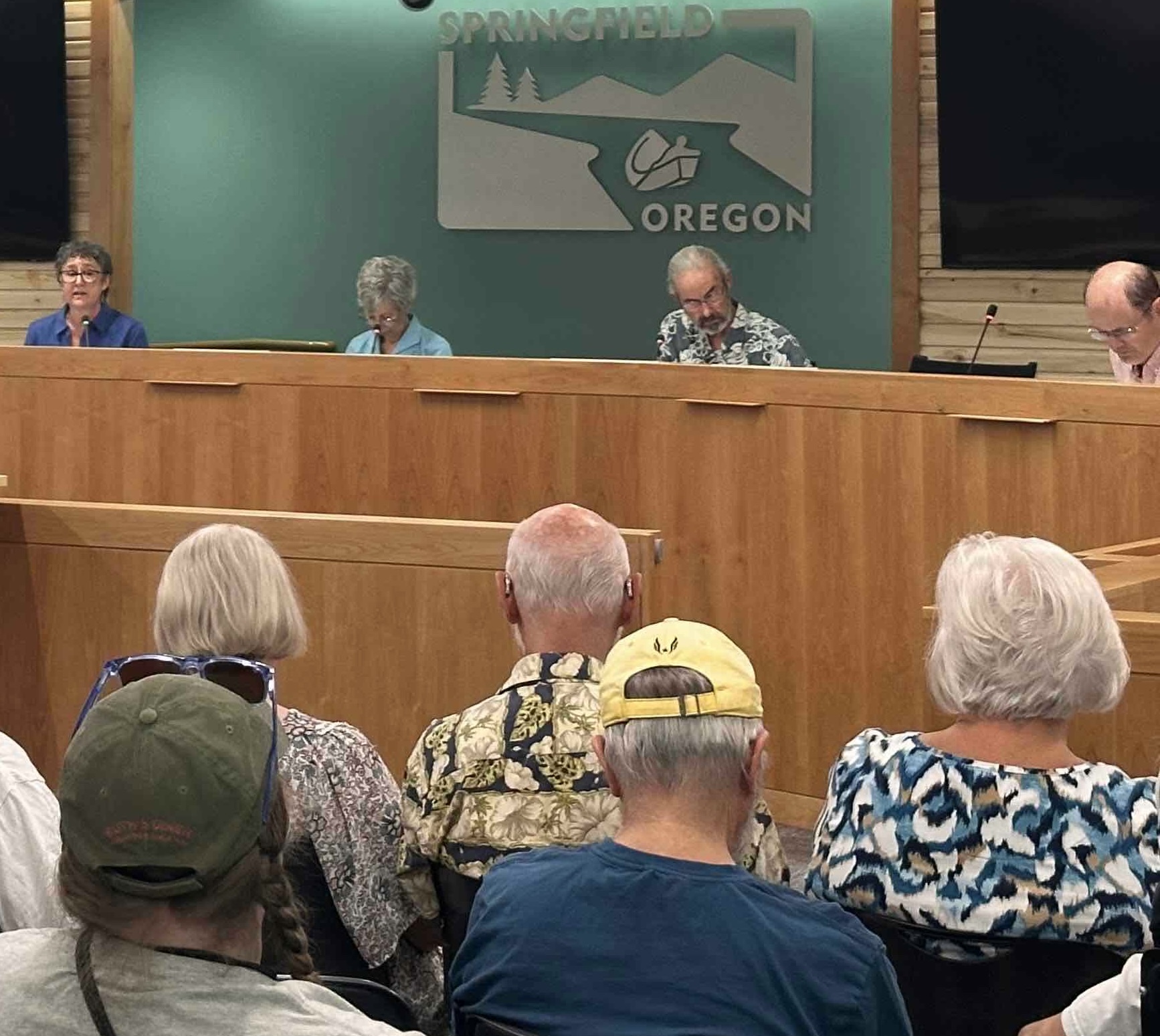
Thanks to everyone who attended the joint legislative town hall on August 23! More than 125 folks joined Representatives Nathanson, Fragala and me with thoughtful questions on a sunny Saturday. Unfortunately, Speaker Fahey and Representative Lively contracted Covid and weren't able to attend. Senator Manning was representing Oregon at a trade mission in Ireland. We discussed the special session, recapped the 2025 regular session (that concluded in June), and exchanged ideas on how your state elected leaders can protect Oregonians from erosion of rights happening at the federal level.
Pictured: Rep. Lisa Fragala (left), Rep. Nancy Nathanson, Mayor Sean VanGordon (right) and me at the joint legislative town hall on August 23.
Hot on the heels of special session, the first set of pre-scheduled "legislative days" for the 2025 interim will take place September 29 - October 1. This is an opportunity for committees to hold informational hearings and begin discussions on bill concepts for the 2026 short session. The Senate Judiciary Committee, which I chair, plans to meet jointly with the House Judiciary Committee. The Senate will also meet for consideration of the Governor's appointments to various boards and commissions. You can review committee agendas (once posted) and watch live proceedings using the Online Legislative Information System (OLIS).
As we transition back into the school year during September, please remember to use extra caution in and around school zones. Also, please use caution in work zones as many projects enter a "home stretch" for the season. Too many flaggers get hit, injured or killed each year.
Below you will find information on:
- September Revenue Forecast
- Special Session: Transportation Package
- Session Accomplishments: Public Safety and Justice
- City of Eugene Receives State Grant for Clear Lake Road Project
I hope this information is helpful and informative for you or someone you know. As always, feel free to share your comments, questions or concerns with me by phone, mail or e-mail.

September Revenue Forecast
The latest revenue forecast was released at a joint meeting of the Senate and House Revenue Committees by the Oregon Office of Economic Analysis (OEA). Below is a summary of the forecast. Trump's tax cuts for the rich continue to jeopardize the state budget for education, economic development, wildfire prevention, and other crucial programs. His tariffs continue to drive inflation, raising costs of everyday goods and threaten good-paying jobs. I'll continue to stand strong with Oregon workers, families, vulnerable communities, and small businesses despite this massive federal attack on the prosperity of our state.
Revenue Outlook
2025-27 Net General Fund revenue is $34.93 billion, down $621.1 million from the Close of Session forecast. 2023-2025 General Fund net resources are now $35.2 billion versus May's projection of $35.42 billion, a decrease of $224.4 million. Lottery revenue for the 2025-27 biennium is down $109.2 million from the May 2025 forecast.
Reserve accounts as of August are $1.01 billion (Education Stability Fund) and $1.91
billion (Rainy Day Fund). The projected ending balances for the 2025-2027 biennium are as follows: Education Stability Fund ($1.26 billion) and Rainy Day Fund ($2.15 billion).
Kicker Outlook
A personal kicker of $1.41 billion is projected for 2025-2027. Corporate tax revenue of
$921.6 million is projected to be dedicated to K-12 education spending in 2025-2027.
OEA Economic Outlook
The overall economic forecast reflects continued national growth and a sharp deceleration in Oregon's labor market. Our employment fell short of expectations in the second quarter of 2025, and the unemployment rate rose to 5 percent, up from 4.6 percent in the May 2025 forecast. Personal income growth came in above forecast, with second-quarter income data up 3.6 percent from May projections.
Population growth is expected to remain modest, averaging 0.4 percent annually through 2035. Oregon's labor market conditions look fragile, reflecting a slow growth environment.
OEA Corporate Activity Tax (CAT) Projections
Anticipated revenues for the current biennium (25-27) are down $4.3 million to $3.07 billion. For 2027-2029, projected revenue is now $3.47 billion, up $39.8 million from May.
Special Session: Transportation Package
To start, let me try to frame the issue: The Legislature met for it's regular "long session," starting in January this year, to approve a two-year budget and address major issues, including the state's transportation needs. Our session included legislation that aimed to secure funding for the Oregon Department of Transportation (ODOT) though a transportation funding package that ultimately "died" on the final daydue to political brinksmanship. As a result, ODOT is facing an acute budget shortfall that will require severe operational cuts, resulting in hundreds of layoffs as well as reduced core transportation and maintenance services for both state and local communities.
As part of these reductions, ODOT plans to close 12 maintenance facilities statewide, which will slow response times for emergencies and weather-related maintenance. Governor Kotek directed ODOT to delay the first round of layoffs from now until mid-October to allow time to identify funding solutions and give impacted staff time to make contingency plans. Without securing additional revenue during the special session (set to reconvene on September 17), these layoffs and a second round scheduled for January 2026 will move forward.
The current version of the package being considered during special session includes increases to fuel taxes, revisions to weight-mile tax tables and flat fee rates, increases to passenger vehicle registration fees and title fees, and includes a requirement that plug-in electric and hybrid vehicles participate in the road usage charge program. The measure also increases the statewide employee payroll tax that provides funding for transit services throughout the state.
The Interim Joint Committee on Transportation Funding (JCTF) held a public hearing on Monday, August 2. Getting down to details (the following synopsis was put together by the Senate Majority Office):
Strengthens ODOT oversight
The package requires Oregon's Secretary of State's Audits Division to conduct biennial performance audits of ODOT related to both the State Highway Fund and capital projects. It also requires the results to be presented to the Legislature.
Authorizes the Governor to appoint ODOT Director
The package transfers authority to appoint and remove the ODOT Director, subject to the Senate confirmation, from the Oregon Transportation Commission (OTC) to the Governor.
Expands JCTF role in reviewing major project funding
The package modifies responsibilities of JCTF by adding the review of scope, schedule, changes, and budget updates of major projects on quarterly basis. It also requires cities or counties proposing unfunded scope expansions to highway projects to seek OTC approval. If approved, OTC must report to JCTF, which may recommend future funding.
Requires LPRO to audit ODOT's operations
The package requires the Legislative Policy and Research Office (LPRO) director to contract professional services for a performance audit of the operations of ODOT and how the agency addresses recommendations from the management review conducted per SB 5550 (2025).
Requires legislative action if the HCAS is out of balance
The package specifies that the Highway Cost Allocation Study (HCAS) must include an examination of the most recent study period to determine the results accuracy. It further specifies that, beginning January 1, 2030, if the Legislature does not take action to achieve an equity ratio less than 1.05 between light and heavy vehicles within 120 days of receiving the HCAS report, the Department of Administrative Services shall adopt rules that lower the per-mile rates and/or fuel tax to achieve an equity ratio of 1.045.
Increases motor vehicle fuel tax
The package increases the fuel tax from 40 cents to 46 cents a gallon, effective January 1, 2026.
Increases vehicle registration fees
The package increases vehicle registration fees as follows:
- From $43 to $85 for passenger vehicles;
- From $63 to $105 for utility or light trailers;
- From $44 to $86 for mopeds or motorcycles; and
- From $63 to $105 for low-speed vehicles and for medium-speed electric vehicles.
Increases vehicle title fees
The package increases new title fees for passenger vehicle from $77 to $216.
Specifies distribution of the increased fuel tax, registration fee, and title fee revenue
The package requires additional revenue from the tax and fee increases from sections 16-19 to be distributed as follows: 50 percent to ODOT, 30 percent to counties, and 20 percent to cities. It specifies that 1.37 percent of the counties' 30 percent share be allocated to small counties (those with fewer than 200,000 registered vehicles), based on ratio of road miles maintained by each county to its number of registered vehicles.
Increases the employee payroll tax for transit funding
Increases the employee payroll tax from 0.1 percent to 0.2 percent, effective January 1, 2026, for distribution through the Statewide Transportation Improvement Fund. Notably, it reverts the employee payroll tax from 0.2 percent to 0.1 percent effective July 1, 2027.
Modifies the Road Usage Charge program
The package repeals Road Usage Charge program (RUC) enrollment effective July 1, 2027, for used electric vehicles; January 1, 2028, for new electric vehicles; and July 1, 2028, for hybrid electric vehicles. Charges electric and hybrid vehicles a per-mile rate equal to 5 percent of the per-gallon fuel tax rate at the time of assessment. There will also be an alternate flat fee for participation in RUC of $340 per year.
Repeals toll program from statues
The package repeals the toll program established by House Bill 2017 (2017).
Increases funding for roadside rest areas
The package increases the annual July 1 allocation from the State Highway Fund to the Travel Information Council for roadside rest area management, maintenance, improvement, and development from $9.16 million to $12.16 million.
When all is said and done, this transportation package is about safety and accountability. It assures that snow is plowed, rockslides are prevented, potholes are fixed, and people can catch a reliable bus. ODOT must be held to high standards for project delivery and transparency. Under this package, new safeguards will be in place to ensure greater oversight to address shortcomings at the agency.
That's how we ensure this investment keeps people safe. It also protects services by retaining frontline workers who keep our roads and bridges safe. It addressed fairness by spreading our road costs fairly, making sure everyone — including EVs and hybrids — pay their fair share
Finally, it's notable that as the Legislature navigates this critical need, a member of the House Republicans chose to switch parties and register as a Democrat. You might consider giving a recent post he wrote about transportation funding a read.
Session Accomplishments: Public Safety and Justice
Following the 2024 short Legislative Session, I'm sharing in-depth summaries of bills passed by subject area. Below is a comprehensive listing of accomplishments related to public safety and justice — by Senate/House bill and in numeric order:
Senate Bills
SB 97 - Boosting Family Law Services Through Local Fee Adjustments: This legislation supports mediation in family court and other approaches proven to lower stress and trauma for children involved in disputes. It allows counties to raise marriage license and domestic partnership registration fees (up to $35) and use the revenues locally to fund domestic relations services — including conciliation and mediation. With an emergency clause, SB 97 took effect immediately upon signature.
SB 98 - Refining Mandamus & Appellate Court Procedures: This legislation streamlines Oregon court processes by amending writ of mandamus procedures. It allows filing an alternative writ without needing a return, permits the State Court Administrator to issue peremptory writs without proof of service, and consolidates appellate judgments with writ decisions. These changes reduce procedural burdens and accelerate judicial review.
SB 102 - Protecting Federal Home Loan Bank Collateral Rights: This legislation ensures courts cannot block Federal Home Loan Banks (FHLBs) from exercising their rights to collateral pledged by an insurer-member undergoing a delinquency proceeding. It also requires a receiver to comply with FHLB collateral claims, mandates FHLB repurchase of excess capital stock, and prohibits receivers from voiding security agreements, except when fraud is involved. An emergency clause made these provisions effective upon passage.
SB 147 - Expanding Consumer Protections in Insurance Claims: This legislation adds violations of Oregon's Insurance Code — such as unfair denial or delay of claims — as unlawful trade practices under the Unlawful Trade Practices Act. The bill allows consumers and the Attorney General to pursue civil and equitable relief against insurers and requires the Department of Consumer and Business Services to review proposed enforcement actions. Exemptions include legal advice and insurance agent activities.
SB 170 - Strengthening Penalties for Repeat Occupational Assault Offenders: Workers in Oregon deserve to carry out their jobs without physical harm, and certainly without suffering assaults. I introduced this legislation to strengthen penalties on people who commit workplace violence repeatedly. It makes assault in the fourth degree a more serious crime when the victim is assaulted while performing their job duties and the defendant has assaulted others while at work or because of a victim's occupation. Aimed at deterring repeat violence against workers across professions, this law reinforces protections for employees in vulnerable roles and promotes safer working environments throughout Oregon.
SB 180 - Protecting Survivors Who Speak Out: This legislation strengthens protections for individuals who report incidents of sexual assault, harassment, or discrimination. It stipulates that defamation claims against such individuals must demonstrate malice, provided the individual had a reasonable belief that the misconduct occurred. The bill also permits defendants in these defamation actions to file special motions to strike the claims and allows for the recovery of attorney fees and the imposition of sanctions against plaintiffs who initiate such retaliatory lawsuits.
SB 243 - Community Safety Firearms Act: Oregon has more gun deaths per capita than New York, New Jersey, California or the state of Washington. I championed this legislation to prohibit rapid-fire devices, also known as "bump stocks," that convert semi-automatic weapons into fully automatic firearms. It also lets local governments decide whether to restrict firearms in highly sensitive portions of their public buildings. SB 243 aims to reduce violent crime, prevent mass shootings, and improve safety in critical public spaces.
SB 470 - Protecting Guest Privacy in Temporary Lodging: I introduced this legislation to establish a cause of action for invasion of personal privacy against transient lodging providers or intermediaries who — without consent — capture, make, store, transfer, transmit, or broadcast visual images or audio recordings of guests in private spaces within transient lodging under their control. The legislation allows guests to seek compensatory damages and reasonable attorney fees, reinforcing privacy protections in accommodations such as hotels and vacation rentals.
SB 537 - Preventing Health Care Workplace Violence: This legislation aims to prevent workplace violence against health care workers in hospitals and home care settings. It addresses the high rates of assault, with emergency staff facing exceedingly high rates of workplace violence compared to other industries. SB 537 includes reporting, safety measures, and worker protections to improve safety and support for health care workers across the state.
SB 548 - Oregon Bans Child Marriage: This legislation raises the minimum legal marriage age in Oregon to 18, eliminating the previous exception that allowed 17-year-olds to marry with parental consent. This change aims to protect minors from potential exploitation and aligns Oregon with a growing number of states prohibiting child marriage.
SB 599 - Protecting Tenants from Immigration-Based Discrimination: This legislation prohibits landlords from inquiring about or disclosing a tenant's or applicant's immigration or citizenship status. It also bars landlords from rejecting applicants based on the type of identification provided with applications, and it spells out multiple forms of ID landlords must accept: Social Security cards, birth certificates, green cards, travel and immigration visas, taxpayer ID number cards from the IRS, passports, driver licenses, other government IDs, and reasonably verifiable nongovernment IDs.
SB 710 - Requiring Trauma-Informed Training for Oregon Judges: Survivors of sexual assault deserve a court experience of protection, not further harm. This legislation requires that judges learn to recognize abuse dynamics, handle cases with sensitivity, and make genuinely informed decisions in complex cases. It empowers Oregon's chief justice to set minimum continuing education standards for Oregon judges, including mandatory training on domestic violence, sexual assault, stalking, and related issues. The education must be evidence-based and trauma-informed to better equip judges in handling sensitive cases involving interpersonal violence. It also requires a compliance report by 2027 to the Legislature.
SB 959 - Cracking Down on Signal Jammers Used in Burglaries: I introduced this legislation to address the growing threat of criminals using signal jammers to disable alarm systems during burglaries. SB 959 classifies such jammers as burglary tools under Oregon law, making it a crime to possess them with intent to commit theft or unlawful entry. Additionally, it exempts alarm system manufacturers from certain right-to-repair requirements, ensuring that security systems remain tamper-resistant. This bill enhances protections for homes and businesses against sophisticated break-in tactics.
SB 1191 - Protecting the Right to Inform Others of Their Rights: This legislation ensures that individuals cannot be criminally charged for informing others of their civil or constitutional rights. It amends existing statutes to clarify that such acts do not constitute obstruction of governmental or judicial administration, refusal to assist a peace officer, or interference with a peace officer or parole and probation officer. SB 1191 reinforces the right to share information about legal rights without fear of prosecution.
SJM 2 - Urging Congress to Stabilize the Crime Victims Fund: This joint memorial urges the U.S. Congress to enact legislation addressing the funding crisis in the federal Crime Victims Fund (CVF). The memorial highlights the significant decline in the CVF's balance, which threatens the sustainability of essential victim assistance programs nationwide. It supports the proposed Crime Victims Fund Stabilization Act of 2024, aiming to redirect certain federal penalties into the CVF to ensure continued support for services aiding crime victims.
House Bills
HB 2005 - Reforming Oregon's Civil Commitment Laws: This legislation, which I was proud to help champion, updates Oregon's civil commitment laws, refining when and how individuals with mental illness may be committed for treatment. It clarifies key definitions, strengthens court procedures, and allows treatment diversion before hearings. HB 2005 also sets new rules for health facility stays and community restoration. It impacts both the Oregon Health Authority and Public Defense Commission, with expected increases in caseloads and funding needs to support improved care, oversight, and legal representation for vulnerable individuals.
HB 2008 - Protecting Minors from Targeted Ad Tracking: Tech companies and data brokers have made a multibillion-dollar business out of collecting and selling the information that is generated when people use the internet or carry their smartphones anywhere. This legislation strengthens privacy protections around this data, banning the sale of data on children. It also prohibits targeted advertising to minors under 16 based on their personal data or precise geolocation. HB 2008 also strengthens consumer consent protections by requiring clear opt‑out tools and limits the processing of sensitive personal data, ensuring privacy safeguards for young Oregonians.
HB 2119 - Associational Standing to Challenge Oregon Tax Rules: This legislation grants associations and organizations the legal right to bring declaratory relief actions in Oregon Tax Court on behalf of their members. The change removes a significant barrier by enabling groups to challenge tax laws collectively — improving access to the courts and reducing individual costs.
HB 2299 - Combating Deepfake "Revenge Porn" in Oregon: This legislation strengthens Oregon's laws against non-consensual intimate image distribution
by expanding the definition to include AI‑generated deepfakes. The bill creates first- and second‑degree offenses, elevating the crime to a felony for repeated violations and extending protections to all victims of intimate-image abuse.
HB 2306 - Modernizing Local Court Services & Fees: This legislation allows any county to create a justice of the peace district that includes its county seat. It increases small claims limits in circuit and justice courts to $15,000, indexed annually to CPI, and raises marriage solemnization fees, also CPI-adjusted. The bill also empowers justice courts to verify defendant addresses via the Law Enforcement Data System.
HB 2456 - Expanding Survivor Access to Sexual Assault Care: This legislation broadens the SAVE (Sexual Assault Victims' Emergency) Fund to cover all medical assessments — whether or not evidence is collected — for sexual assault survivors, removing financial barriers to critical post-assault care.
HB 2460 - Modernizing Appeals from Justice & Municipal Courts: This legislation streamlines and standardizes the process for appealing decisions from justice and municipal courts that aren’t courts of record. The bill updates procedural rules — including timelines, content requirements, and uniform forms — to enhance accessibility and ensure fair treatment for individuals seeking appeal.
HB 2471 - Refining Oregon’s Insanity Defense Standard: This legislation clarifies Oregon's "guilty except for insanity" (GEI) statute by adding important legal benchmarks: at the time of the offense, the defendant must lack substantial capacity to understand the wrongfulness of their actions due to a qualifying mental disorder — not due to voluntary intoxication or non-qualifying disorders. It also explicitly excludes primary reliance on intoxication or non-qualifying conditions. The bill was declared an emergency and took effect immediately.
HB 2975 - Clarifying Domestic Violence Pleadings in Oregon Courts: This legislation ensures that labeling a criminal offense as involving domestic violence — whether included in charging documents, admissions, or judicial findings — does not count as an extra element requiring separate punishment. This clarification preserves the ability to convict on overlapping charges without risk of merger, promoting clearer prosecutions in domestic violence cases.
HB 3194 - Holding Landowners Accountable for Unregistered, Unsafe Farmworker Camps: This legislation strengthens protections for workers living in farmworker camps by holding landowners liable if they know or should have known about unregistered or unsafe housing on their property. It targets illegal cannabis operations that exploit workers by providing substandard living conditions, such as makeshift shelters without water or sanitation. Landowners may avoid liability if they can prove they leased to a properly registered and licensed camp operator.
HB 3605 - Empowering Consumers Against Door-to-Door Deception: This legislation classifies violations of Oregon's Home Solicitation Sales Act as unlawful trade practices, making it easier for consumers to sue deceptive door-to-door salespeople and allowing the Attorney General to enforce penalties. The change strengthens protections for vulnerable Oregonians from high-pressure in-home sales tactics.
HB 3875 - Protecting Drivers from Data Tracking: Modern cars collect massive amounts of data with onboard sensors, microphones, and cameras, as well as the phones and devices drivers connect to their cars. House Bill 3875 requires all automakers to comply with state legal protections for consumer data. They must honor consumer requests to delete personal data, give consumers a copy of your data, or stop selling it or using it for targeted advertising.
City of Eugene Receives State Grant for Clear Lake Road Project
Congratulations to the City of Eugene for being awarded $6 million in Oregon Lottery Revenue Bond proceeds for its Clear Lake Road Economic Development Infrastructure project. To learn more about the project, click here.
|