|
Hello Senate District 19 and beyond,
It's been a difficult week for many of us in the greater Portland region seeing the news that President Trump has decided to federalize Oregon National Guard troops to patrol Oregon city streets.
Let me say what many of us who live near the South Waterfront already know: There is no need to send federal troops to Portland. The protests we have seen at the ICE facility in recent months have been overwhelmingly peaceful. It is our Constitutional right to protest and I have full confidence in the Portland Police Bureau to do its job and help keep the peace.
It is clear that President Trump is trying to incite violence in Portland. Despite Governor Tina Kotek clearly and strongly telling the president that Oregon is peaceful and that we don't want or need troops, he continues to spread falsehoods about the Rose City.
I encourage all Oregonians to remain calm and not take the bait.
Before this presidency, it would be unthinkable for an American president to send troops to multiple American cities for dubious or downright untrue reasons. I'm proud of Portland: it is a beautiful city with a vibrant art scene, world-class restaurants, and countless parks and green spaces. It doesn't need federal troops on the streets.
One of the main tasks for legislators during interim legislative committee days this week was trying to grasp the widespread harm that federal budget cuts from H.R. 1 will have in Oregon.
We already know that Oregon will lose $15 billion in federal funds over the next six years, which will be devastating for smaller communities that rely on federal dollars, as well as have a significant broader economic impact. We also know that Oregon is down nearly $900 million in state revenue this budget cycle as a result of tax changes, which means we will need to rebalance the budget with much less money to go around.
As far as who benefits from the Trump/Republican cuts, according to the nonpartisan Congressional Budget Office, overwhelmingly the richest Americans will pay less, while our neighbors who rely on Medicaid or food assistance are going to be harmed.
Committee hearings this week made the impacts clear: 95% of the cuts are related to food assistance and Medicaid, which means many Oregonians are going to be hungrier, sicker, and poorer than they were before H.R. 1.
Beyond the harm to individuals, there are going to be ripple effects: less Medicaid dollars means rural hospitals are more likely to close, reduced food assistance means grocery stores are at risk of shuttering. And if, for example, a grocery store closes, it doesn't just impact that community or that business; the producer who grows the food and the distributor who brings it to market will also have their bottom lines impacted.
Looking toward the next session, legislators are going to need to have hard conversations about what are the core and mandatory requirements of government and how to perform those duties as cost-effectively as possible. We also need to recognize that federal money is federal money — if President Trump and Congressional Republicans decide to take it away, we can't get it back.
Oregon did a great job over the recent decades taking advantage of social benefits offered by the federal government at little cost to the state. The Affordable Care Act, for example: the federal government offered to pay 90% of the costs for people on Medicaid through the ACA, and Oregon took full advantage.
We are now in a situation where the federal government is pulling back on these promises, while saddling the states with requirements to add layers of government bureaucracy that come at a high cost.
The scope and scale of H.R. 1 and the negative impacts it will have on Oregonians is starting to come into focus, and we will need to be all hands on deck to protect Oregon in the coming months.
On Monday, the Senate passed House Bill 3991 and House Bill 3992, preserving the safety of Oregon's roads and keep Oregon's economy running by protecting the jobs of 500 essential ODOT maintenance workers.
These hardworking Oregonians are responsible for snowplowing highways, maintaining bridges, filling potholes, painting pavement markings and fog lines, clearing vehicle collisions, making roads passable after wildfires, and generally keeping the state's roads and bridges safe.
Without these workers providing critical safety and maintenance services, Oregonians wouldn't be able to access health care, take kids to school, travel to jobs, or see everything our state has to offer.
The legislation also:
- Implements new oversight and accountability of ODOT to ensure the agency is spending public money appropriately.
- Begins the process of modernizing transportation funding and moving the state away from reliance on the gas tax.
- Ensures that hybrid and electric vehicle drivers pay their fair share for the damage their vehicles do to the roads.
- Prevents deep cuts to public transit services that many Oregonians rely on for daily life.
- Reduces administrative burdens on family-owned gas stations and truckers.
Oregon is one of many states faced with declining gas tax revenue due to more fuel efficient vehicles on the road. The stop-gap legislation was important and we must continue having conversations about how to build a better, safer, and cheaper transportation system that Oregonians can rely on.
In between committee hearings, meetings with my fellow Senators, and our work on the Senate floor, I was able to spend some time meeting with a group of student leaders from Portland Community College. We talked about the importance of public engagement in the legislative process and how best to make their voices heard on the issues they are passionate about.
When I worked at Portland Community College, I launched the legislative internship program as a way to connect students to their state government and a potential career in public service. All these years later, I'm thrilled that students are still benefiting and learning about public service and the Oregon Legislature through PCC.
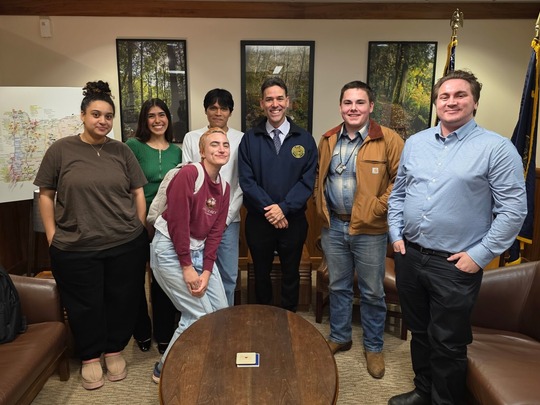 It's always inspiring to meet with college students who are interested in a career in public service.
After years of not being able to access the majority of the 1938 portion of the Oregon Capitol Building, this week several iconic areas of the building were again visible for the first time. These include the Senate lobby, the Senate grand staircase, and — most grand of all — the incredible rotunda of the Capitol Building.
Workers with the CAMS Project painstakingly restored the rotunda, patching cracks, touching up the murals to match the original paint, and cleaning after years of dirt and grime build-up. Behind the walls they also seismically secured the rotunda after discovering it wasn't fully secure from the damage it received from the 1993 Scotts Mills earthquake.
The CAMS project is in the final stretch, eyeing completion next year with a brand new concourse level replacing the old basement, improved public access and additional hearing rooms and meeting places for the public to engage with their democracy.
I hope everyone in Oregon can experience the Capitol as it fully reopens. Some of my favorite memories of the space are when choirs visit during the holiday season and fill the rotunda with caroling.
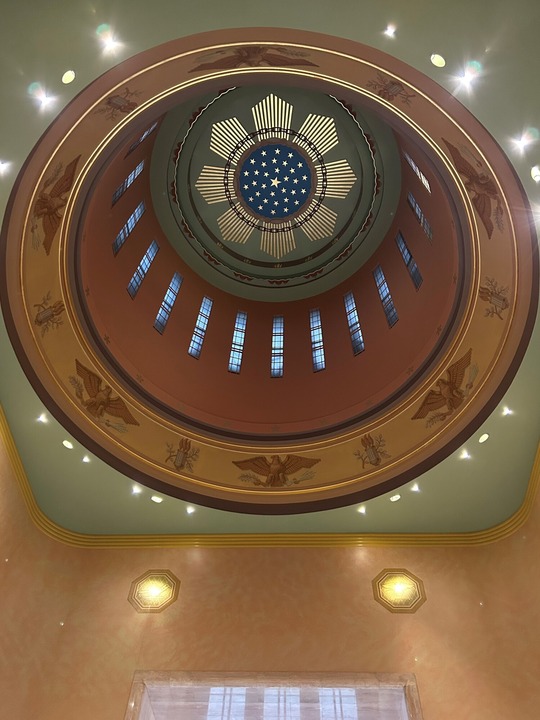 It's been years since we were able to see the Oregon Capitol rotunda, and it has never looked better.
The Oregonian: Oregon gov says Trump troop deployment could cost taxpayers up to $10M
Oregon Gov. Tina Kotek says the looming federal troop deployment in Portland could cost as much as $10 million in taxpayer dollars.
Statesman Journal: Oregon Bureau of Labor and Industries lifting income threshold for wage claims
The Oregon Bureau of Labor and Industries is lifting its income threshold on wage claims a year after it first implemented the limit amid a growing backlog of cases.
Oregon Capital Chronicle: One eastern Oregon clinic is a health care ‘lifeline.’ Medicaid cuts threaten its existence
When Planned Parenthood Columbia Willamette opened a health center in eastern Oregon in 2023, it did so expecting that Idaho’s looming abortion ban would force patients to travel to Oregon for care. Two years later, that foresight proved right.
OPB: Test scores are out for Oregon schools: 4 takeaways on how students are doing
It’s that time again: The results from Oregon’s state tests in English, math and science are out. And for the first time since the pandemic, things are looking up.
Replies to this message are sent to an unmonitored mailbox.
If you would like to contact the Senate President's Office, send an email or call and either myself or a staff member will assist you. If you are a constituent coming to Salem and want to arrange a meeting, I'm always happy to meet, so please let us know well in advance as my schedule fills up quickly.
email: Sen.RobWagner@OregonLegislature.gov
phone: 503-986-1600
address: 900 Court St NE, S-201, Salem, OR, 97301
website: http://www.oregonlegislature.gov/wagner
|