* “I am only one, but still I am one. I cannot do everything, but still I can do something; And because I cannot do everything I will not refuse to do the something that I can do.”
—Helen Keller
Replies to this message are sent to an unmonitored mailbox.
To contact me, please click here: Sen.JeffGolden@oregonlegislature.gov
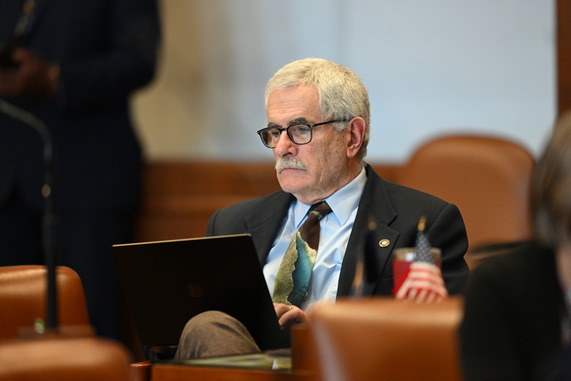
Oregon Senate Floor, 4/3/2025
We’re deep into the home stretch in Salem. The last possible day of the session, based on constitutional limitation, is next Sunday, June 29. Legislative staff have started the traditional betting on what day we’ll actually adjourn. The guesses seem to be clustering from Wednesday to Friday, but we may well run into the weekend to finish the last big pieces.
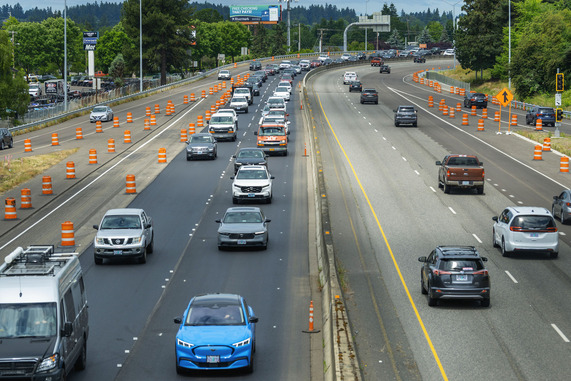
The biggest of those pieces is a new transportation package, the first since 2017, which has been the mainstage show for most of the session. To the annoyance of interested legislators, the basic bill, HB 2025, came out only last week. There have been a few revisions in the past couple days, but this summary article is accurate.
Photo from the Oregon Department of Transportation
Most Republicans seeing this package for the first time focus on how much money it asks from Oregonians. Most Democrats look at it and ask if it meets our core responsibility for making sure the state has a functional transportation system, one that can get us where we need to go safely and affordably, now and into the future.
I had an email exchange today that framed the different perspectives. A conservative friend wrote to ask me to vote against any bill that raised taxes. I used a slow time on the Senate floor today to answer her:
There is no question that the state hasn’t spent tax dollars as efficiently and effectively as we want. That holds true for every state government I know anything about, and certainly for the feds. And it’s our responsibility to do a better job demanding accountability for agency performance. One of the things the transportation bill does is build a rigorous structure to do that in ways we never have before.
So, yes, there are legitimate savings we should realize. Best I can tell, they are dwarfed by the real costs of salvaging our transportation infrastructure from decades of disinvestment and deferred maintenance---all the result of the political pressure to avoid taxes. This is one big chicken coming home to roost.
Example: the state has about 2500 bridges. Their expected usable lifespan is about 90 years. With current resources, we can do major work on a bridge every 900 years. Estimates are that passage of this bill might shorten that rotation to 500 years. No version of this bill will bring that down to the recommended 90 years.
And yes, the package has contents that I think are essential while you may not. Transit tops the list for me. This is a longer discussion, but I don’t see a functioning community or state ahead of us if we can’t offer people an acceptable alternative to single vehicle travel, one with a modest baseline of convenience and reliability. RVTD has made good progress in that direction, but is coming into serious crunch time. This bill increases the payroll tax from 1/10 of 1% to 3/10 of 1% over four years. What now costs someone making $4000/month about $4 every month will, four years from now, cost them $12. I understand that we might not agree on whether the need for this warrants that expense. I’ll just add that proposals for a higher increase, here and in other parts of the bill, was rejected.
In its current form I plan to vote for this bill. I know what people think about taxes, and how they’ve accelerated…I pay taxes, too. The main reasons for that acceleration, I think, are 1) the absence of a sales tax, which registers in people’s minds less heavily than other taxes because we pay them as we go, a little bit of the time, and 2) decades of kicking public costs down the road again and again and again, because lawmakers feared the impact of taxing a tax vote on their next election. There are so many policy areas where we’ve run out of road to kick the can down. Transportation is one of them. I believe I’d be shirking my basic governing responsibility, and letting down our kids and their kids, if I turned away from this package. I hope you’re doing well…
Because it raises taxes, HB 2025 needs a 3/5 majority to pass—18 of 30 Senators, 36 of 60 Representatives. I’ll be a yes—anything else would feel like joining the legion of legislators before me who let this hole get deeper and deeper because they didn’t want to take a tax vote. But as of right now, a week out from adjournment, no one can say how all this turns out.
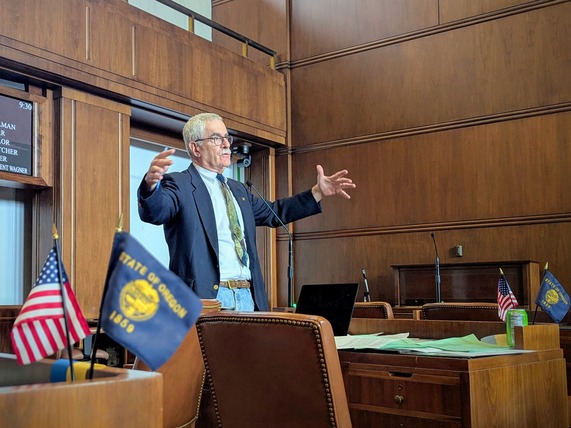
Senator Golden carrying HB 3054
This week saw a couple of satisfying wins. One was HB 3054, which narrowly passed the House on its way to the Senate Floor. My floor speech introducing it gave a rare chance to lay out the painful trap that has snared more and more manufactured home tenants over the years, and what this legislation can do about it. HB 3054 passed with 17 votes, one more than the bare minimum needed. Next step is the Governor’s desk for signature.
The other recent highlight was passing HB 3932, the latest and most consequential bill to protect beavers and put them to beneficial use for us. My floor speech gave me enough time to fully explain what this bill does, and why. While it doesn’t make an enormous change, it shifts our perspective on beavers from pests to a resource we can be grateful for. Big thanks to a lot of folks who’ve worked long and persistently to make that shift, and this legislation, happen.
Just yesterday, after a year of debate and speculation, the House Revenue Committee passed HB 3940, the only wildfire funding bill likely to come out of this session; yes, it amazes me too that something this basic and urgent would be this hard to fund.
In a move that was on nobody’s bingo card all session, the bill creates a 65-cent tax on a regular-sized container of synthetic nicotine products like Zyn. It will yield about $30 million per biennium. The bill matches that with about $30 million from interest off the state’s Rainy Day Fund, which is designed to be used only for serious emergencies.
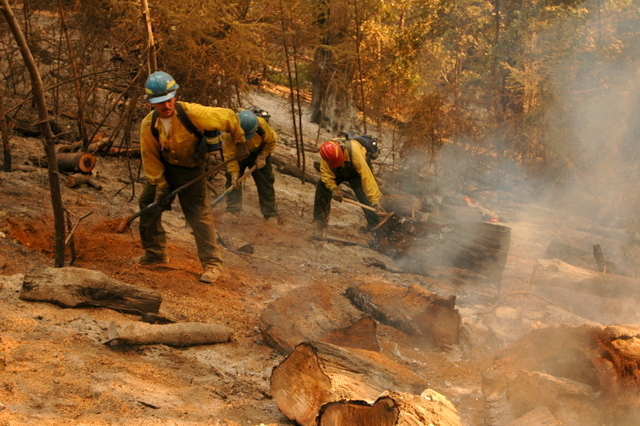
That $60 million total doesn’t come close to meeting our wildfire funding need. That would be at least $300 million per biennium for wildfire seasons equally intense as the mildest we’ve had in the last decade; $500 million is probably more realistic. HB 3940 is especially important to pass, though, because most of the revenue is dedicated to preventing fires and systematically lowering risk levels for fire-prone communities. That’s the vital function that we’ve almost completely defunded the last couple of years, because nearly every available dollar has been used up by suppressing mega-fires once they grow. Oregon summers will continue to be miserable until that changes, and HB 3940 could be that change.
Where will all the rest of the money, the money for suppression, come from? One way or another, $150 to 200 million will have to come out of the over-pressured General Fund. It’s wildly optimistic to think that will get us through the biennium. We’ll have to come back in the short session (or maybe in special session, as we desperately did in 2024) for more.
Which is to say, sadly enough, that we’re continuing to wing it. A core goal for this session was to use the recommendations of the workgroup that met for months last year to create a long-term, reliable funding base to protect our state from wildfire. That didn’t come close to happening. We have to learn from our missteps this session, and keep working until we get this done.
Photo from the Oregon Department of Forestry/Flickr
I’m disappointed that what I proposed as a cornerstone of that durable solution won’t come to pass. Using $1 Billion of the pending $1.65 Billion income tax kicker for a permanent trust fund would have produced $100 million in interest earnings every budget cycle, all to be used for wildfire. In its final form the proposal looked like this.
It takes a 2/3 vote to redirect any portion of the kicker to a different specific purpose. With our current roster, that would take support from at least two Republican Senators and four Republican Representatives. It was clear from the beginning that was a steep challenge—too steep, it turned out, to meet.
I took one final run at it early this week with this short Floor speech. Then I followed up with each of my Republican colleagues. They were all courteous…and unpersuaded. If there ever were a time they could vote to redirect the kicker, a couple said, this would be it. But that was too big an ‘if.’
I think it’s likely Oregon legislators will look back on 2025 as a singular moment that could have permanently made the wildfire funding challenge a lot easier, and wonder why we didn’t. If I’m around when that happens, I won’t have a good answer.
OK, here’s a small bill that gets you thinking about government’s proper role. HB 2522, requiring motorists to have their headlights on whenever they use windshield wipers (except for a very quick cleaning of the windshield) passed in the House by a 42-10 margin, with all 10 ‘no’ votes cast by Republicans. This week it came to us in the Senate Rules Committee with very little testimony. Those opposed were basically saying “we don’t need anymore nannying!”
I’ll admit being on what some call the “nanny state” side of arguments before. I’ve favored mandatory seatbelt and motorcycle helmet use because the data’s solid that they reduce injury and death and, importantly, the impacts can easily go beyond the individual user. Very often taxpayers pay some of the medical and clean-up costs associated with serious accidents, so in those examples I don’t buy the “It’s nobody’s business but my own” argument.
At the same time, restricting private behavior carries a burden of proof that you’re in some way improving protection of public health or safety. So I looked in the record for data that this bill would have that effect. I found one 14-year-old study that said there was evidence that this would reduce accidents, but it was subjective and inconclusive.
I get the premise here—headlights are likely to make oncoming cars easier to see in heavy rain, which is a good thing. At the same time, much of the rain we experience, especially in our part of the state, is more like a drizzle or sprinkle than a steady shower. Most of the time I use my wipers in the intermittent mode, where you get one wipe…every…few…seconds, because visibility’s pretty good. If this bill passes, we’ll likely have more than a few drivers violating the law in those conditions. I’d likely be one of them.
I ended up unwilling to vote for the bill. I’m curious, though: what do you think?
----------------------------------------------------------
I’ll get back to you soon with news on how these nearly-finished pieces turned out. Take care until then.
 Senator Jeff Golden, Oregon Senate District 3
Unemployment Insurance:
If you are experiencing difficulties accessing unemployment insurance, please contact our office by calling (503) 986-1703 or emailing sen.jeffgolden@oregonlegislature.gov
Food Assistance:
ACCESS operates 30+ food pantries in Jackson County, offering 3-5 days of meals for low-income residents.
Eligibility:
- Must live in Jackson County
- Meet USDA TEFAP Income Guidelines
- No ID or proof of income is required.
Legal Challenges to the Trump Administration's Actions:
- A comprehensive tracker by Just Security monitors the legal disputes against the Trump administration's executive orders and actions, covering areas like immigration, federal spending, and diversity programs. As of March 4, 2025, the tracker lists 96 active cases, providing case names, filing dates, summaries, and recent updates.
|