|
Replies to this message are sent to an unmonitored mailbox.
To contact me, please click here: Rep.BoomerWright@oregonlegislature.gov
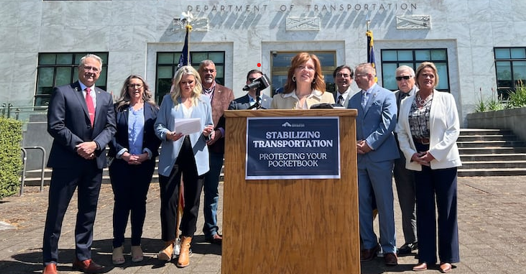 On Wednesday, my colleagues and I announced a transportation proposal that protects Oregonians’ pocketbooks at a time when they’re facing rising costs and tax hikes.
For years, ODOT has funded ideas instead of infrastructure. Our plan protects Oregon families from more tax increases by requiring ODOT to cut wasteful spending that does not align with core functions.
In identifying approximately $685 million in refocused spending, cost savings, and spending cuts, House Republicans commit to delivering functioning roads without asking Oregonians to pay more.
The proposal we unveiled prioritizes core functions of our Transportation Department, sidelines spending in non-essential programs and divisive agendas, protects federal transportation funding, and preserves critical road safety services.
Proposed Cuts to ODOT’s biennial budget for 2025-2027 include:
- Statewide Transportation Improvement Fund: $306.7 million
- Reallocate Vacancies: $68.3 million
- Lease Unused Office Space at ODOT Headquarters: $3.4 million
- Bicycle and Pedestrian Program: $47 million
- 3% Agency Staff: $40 million
- Passenger Rail: $38 million
- Vehicle Privilege Tax: $35 million
- Social Equity and Civil Rights Division: $24.9 million
In contrast, the Democrats’ plan adds a dozen new taxes, tax hikes, and fee increases that expand current non-essential spending that Oregonians simply cannot afford. Their plan will make it more expensive for families to drop their kids off at school, drive to work, and pick up groceries, while snubbing Oregonians’ call for accountability.
Their plan rewards an agency riddled with mismanagement, billion-dollar budget woes, and broken promises. As noted by the Oregonian Editorial Board in April, “burdening Oregonians with nearly $2 billion in new taxes while adopting policies that inflate costs for the benefit of longtime Democratic donors is flatly unconscionable.”
We reject the premise that if we don't make life more expensive for Oregonians, we can't fix potholes, plow the snow, or keep rural roads safe. Keeping our roads drivable and safe must be the Oregon Department of Transportation’s top priority.
House Republicans are responding to Oregonians who are increasingly frustrated by the cost of living and want to see their state government deliver and maintain safe roads for them. This proposal is an opportunity to be responsive to the needs of our state, hold government accountable, and set a clear vision for the role of the Oregon Department of Transportation.
House Republicans Transportation Stabilization Proposal May 6 Update.pdf
Important Tax Tracker: These are the top 13 Tax Bills of the Oregon 2025 Legislature that have had public hearing and may pass within the next 40 days with little notice or warning on when they will be up for a House or Senate vote. Please go to OregonWatchdog.com to get updated.
- Kicker tax refund theft (HB 1177)
- 3% property tax (SB 712)
- 8% beer-wine tax (HB 3197)
- 250% marriage fee hike (SB 97)
- 800% timber tax (HB 3489)
- Drink container tax (HB 3940)
- 4% tire tax (HB 3362)
- $122 million Google tax to fund newspapers (SB 686)
- $500 million Hospital-healthcare tax (HB 2010)
- Baseball stadium jock tax (SB 110)
- Double RV vehicle fee (HB 3902)
- OR Transportation Reinvestment Package (TRIP) …see below.
This year’s package – dubbed the Oregon Transportation Reinvestment Package, or TRIP – includes: (Taken from Oregon Democrats unveil ambitious road funding proposal. By Dirk VanderHart April 3, 2025)
- A staggered 20-cent increase to the state’s 40-cent-per-gallon gas tax. The tax would increase by 8 cents at the outset of next year, and another 4 cents in 2028, 2030, and 2032. It would be indexed to increase with inflation afterward.
- A new tax equal to 1% of the sale price of all cars sold in Oregon, new or used. McLain and Gorsek say Oregon is one of just five states without such a charge, which they call a “one-time system use fee.”
- A new “road usage charge” that electric and highly fuel-efficient vehicles would pay – either as a flat fee or based on actual miles driven in Oregon. Existing electric vehicles would be subject to that still-undefined charge beginning in July 2026. New EVs, plug-in hybrids and cars with fuel economy of 30 miles-per-gallon or better, would be added in subsequent years.
- A separate usage charge for delivery vehicles used by companies with at least 10 such vehicles. The fee is meant to impact corporate delivery services like Amazon, according to a summary.
- Tacking an additional $66 onto Oregon vehicle registration fees, which vary by automobile.
- Adding $90 to vehicle titling fees, which currently range from $90 to $190.
- Increasing the state’s weight-mile tax on heavy vehicles by 16.9%. Taken together with higher taxes and fees for light vehicles, this change would ensure large trucks are no longer paying more than their fair share of road costs. The framework also envisions a tax structure for heavy trucks that is far simpler than the current system.
- A 3% tax on tire sales that would send $25 million a year to rail operations, safe highway crossings for wildlife and improving salmon habitat. (4% per the base bill, HB 3362)
- An increase to an existing tax auto dealers pays for the “privilege” of selling cars in Oregon. The tax would be raised from 0.5% of the price of a vehicle to 0.8%.
- Adding $9.50 to an existing $15 tax on sales of new bicycles that cost at least $200. Funding from the tax goes to bike and pedestrian facilities.
- Increasing a tax dedicated to transit service that Oregon workers’ pay from their paychecks from 0.1% to 0.18%. That’s well under the 0.5% that transit agencies have pushed for recently.
In total, Democratic lawmakers say they are looking to raise an additional $1.5 billion every two years from existing taxes, and another $486 million via the new 1% tax on vehicle sales. They did not offer any notion of how much a new “road usage charge” on EVs, fuel-efficient gas vehicles and delivery trucks could yield.
-Rep. Boomer Wright: Don’t be misled, all taxes or fees will be passed onto consumers (YOU). The Government cannot tax the people into prosperity. Let the Democrats know you want to keep some money for your own family.
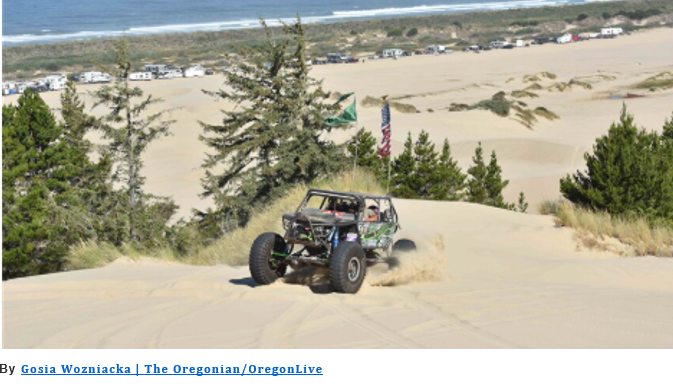 A national environmental nonprofit has asked a federal judge to protect threatened coastal martens from off-road vehicle events set for this summer in the Oregon Dunes National Recreation Area.
The Center for Biological Diversity filed for a temporary injunction late last week, seeking to stop the U.S. Forest Service from issuing permits for the gatherings.
Coastal martens, also known as Humboldt martens, are small carnivorous mammals related to otters and weasels. Fewer than 400 coastal martens remain in four highly isolated populations in Oregon and California, with approximately 71 martens living in Oregon’s dunes.
The group argues that the noisy, multi-day events – including UTV Takeover held annually in Coos Bay in June and DuneFest held in Winchester Bay in late July – wreak havoc on the animals and their habitat during periods when marten kits are still dependent on their mothers. The events draw thousands of people and vehicles and feature races, sand camping, night rides and other activities.
Organizers for both events did not reply to multiple emails seeking comment.
Last May, the U.S. Fish and Wildlife Service designated 1.2 million acres of critical habitat in northwestern California and southwestern Oregon – including 28,843 acres in the Oregon Dunes National Recreation Area (nearly the entire Oregon Dunes) – for martens.
Off-road vehicle use is allowed on designated routes and open riding areas established by the Forest Service in the Oregon dunes.
But it’s unclear why the U.S. Forest Service would continue to issue permits for large events despite the habitat designation, the center said. The federal agency declined to comment, citing the active litigation.
“Off-road vehicles have a place on the Oregon Dunes, but the Forest Service has to protect the key habitat and corridors that these incredibly imperiled little animals need to survive. We’re asking the court to step in and ensure that the dunes remain a place for both wildlife and people to enjoy,” said Tala DiBenedetto, carnivore conservation staff attorney at the center.
Coastal martens were thought to be extinct until they were rediscovered in the late 1990s in Northern California. The center first petitioned the federal government to protect coastal martens nearly 15 years ago. After multiple lawsuits by the center, martens were listed as threatened in 2020.
The center’s current lawsuit argues that the Forest Service has failed to comply with the Endangered Species Act, the National Environmental Policy Act and the agency’s own mandates set out in land-management plans for the Siuslaw National Forest and Oregon Dunes National Recreation Area.
 The two bills were approved 56-0 in the House and 25-4 in the Senate. House Republican Leader Christine Drazan was among the sponsors of House Bill 2007, which revises the Summer Learning Grant program to focus on literacy. Another sponsor was Republican Rep. Boomer Wright, Reedsport, who attended Wednesday’s ceremony. The Summer Reading program will fund 3 years of summer-learning grants for approximately 70 school districts.
Rep. Wright submitted HB 3361 which would allow summer school learning for all 197 school districts. Unfortunately, HB 3361 was not given a work session and died in committee.
|