|
Replies to this message are sent to an unmonitored mailbox.
To contact me, please click here: Rep.MarkOwens@oregonlegislature.gov
Dear Friends and Neighbors,
As we wrap up another full week in Salem, I want to take a moment to share updates on the issues I’m hearing about most from House District 60—budget priorities, transportation funding, flood recovery in Harney County, and water policy that actually makes sense for rural Oregonians.
We’ve just completed the final Joint Ways and Means Community Budget Hearing in Klamath Falls. I’m grateful to every single person who took time to travel, testify, and tell your story—especially those coming from rural and frontier communities. Your voices are making a difference.
There’s still a lot of work ahead. The May Revenue Forecast will shape what’s possible in our budget, and I’m continuing to push for common-sense solutions that protect essential services, hold agencies accountable, and avoid asking more from taxpayers already feeling the pinch.
Below, you’ll find updates on several bills I’m working on, including HB 3372A, which fixes an outdated well-use law, and HB 3328, which helps provide law enforcement funding for Grant County. You’ll also find a recap on transportation proposals and the ongoing work to bring emergency relief to flood-impacted families in Harney County and my weekly Moments with Mark video.
As always, thank you for staying involved and informed.
Stay safe,
Last week I traveled to Klamath Falls for the final Joint Ways and Means Community Budget Hearing. Over the last few months, Oregonians across the state have shown up to share what matters most to their communities, and I want to say thank you.Whether you testified in person or submitted written comments—your voice matters. These conversations help shape how we prioritize Oregon’s budget.
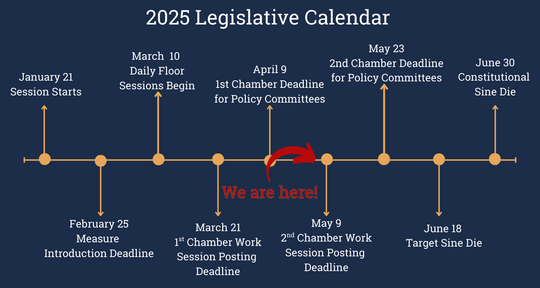
As we head toward the May 14 Revenue Forecast, we’ll have a clearer picture of what’s financially possible. Tough decisions are coming, and I’ll continue to fight for a budget that reflects the needs of rural Oregon and respects taxpayer dollars.
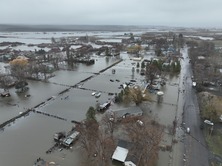
We are still seeing significant impacts from flooding in Harney County, affecting residents in Burns and the Burns Paiute Tribe. Many homes remain without functioning wastewater systems, and damage to property and infrastructure continues to affect daily life.
|
I’ve met with the Co-Chairs of the Ways and Means Committee to discuss emergency funding options, and we are actively working to address both the immediate needs and long-term solutions. Our goal is not just recovery—but resilience. We want to prevent future disasters from having the same devastating impact.
As lawmakers begin shaping a new transportation package, I want to be clear about where I stand: I will not support increasing the gas tax or registration costs—while serious issues of waste and mismanagement persist in our agencies.
House Republicans are proposing common-sense adjustments to ODOT’s 2025–2027 budget that would protect core services like snow removal, road maintenance, and rural access without raising taxes or fees. These cuts include:
• Statewide Transportation Improvement Fund: $306.7 million
• Reallocate Vacancies: $68.3 million
• Lease Unused Office Space at ODOT Headquarters: $55.9 million
• Bicycle and Pedestrian Program: $47 million
• 3% Agency Staff: $40 million
• Passenger Rail: $38 million
• Vehicle Privilege Tax: $35 million
• Social Equity and Civil Rights Division: $24.9 million
This is a responsible first step to ensure our resources are being used effectively.
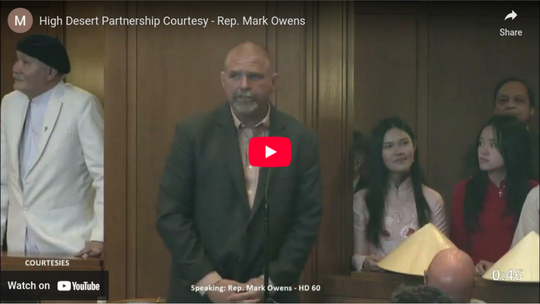
A special thank you to the High Desert Partnership for visiting the Capitol and sharing your work with fellow legislators. Your commitment to collaborative, community-based solutions in Eastern Oregon is deeply appreciated.
Fixing Oregon’s Domestic Well Law – HB 3372 A
How many of us have stopped at a roadside stand to buy a bouquet of fresh flowers, visited a local farmers market, or picked up a few homegrown vegetables from a neighbor? Chances are, the person selling those goods—your neighbor, a family member, or a local farmer—was unknowingly breaking the law if they were using a domestic well and growing on less than half an acre without a water right.
House Bill 3372 A gives us the opportunity to fix this. It updates a conflicting interpretation of Oregon law that doesn’t reflect how small-scale, sustainable agriculture actually works in our communities today.
Under current law, you can legally use up to 5,000 gallons of water per day from a domestic well to water your lawn or a non-commercial garden on less than half an acre. But if you grow a few vegetables and want to take them to the farmers market—or sell flowers from a small stand at the end of your driveway—that’s considered commercial use, and under current interpretations, it's illegal without a water right.
In spring of 2024, the Oregon Water Resources Department confirmed that anyone using a domestic well for commercial gardening—even on a very small scale—needed a water right. This interpretation meant that many everyday activities like selling garden vegetables, herbs, or flowers from home could put Oregonians out of compliance with the law.
HB 3372 A corrects this by allowing the use of up to 3,000 gallons per day from a domestic well for commercial gardens on ½ acre or less—bringing fairness, clarity, and support for small producers.
Because of conflicting interpretations between the Oregon Department of Justice and Legislative Counsel, I believe this legislative fix is necessary for clear and consistent application of the law.
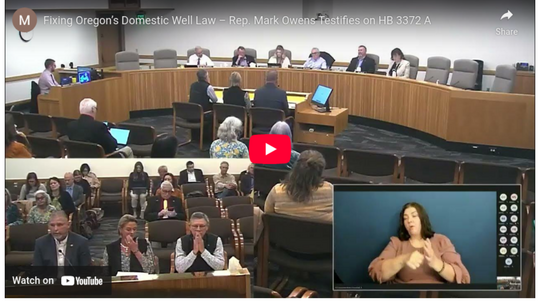
I’m grateful to everyone who has provided feedback on this legislation. You can watch my testimony before the Senate Natural Resources Committee, where I walk through the intent and need for HB 3372 A.
This is about fairness. It's about responsible water use. And it’s about supporting the local food systems, small businesses, and rural Oregonians who make our communities stronger.
House Bill 2170 has now passed both the House and the Senate with bipartisan support. This important legislation gives the Oregon Department of Fish and Wildlife (ODFW) additional authority and flexibility to work with local governments

and service districts to protect our waterways from invasive species like quagga mussels, which pose a serious threat to ecosystems, agriculture, and recreation across the state. This legislation will provide additional help to the Owyhee River area.
Quagga Mussel
Photo courtesy of Jeffrey Herod, USFWS
|
House Bill 3103 is a common-sense, no-surprises approach to how Oregon manages its state forestlands.
The bill passed unanimously out of the House Committee and is now under consideration in the Ways and Means Committee. If passed, HB 3103 will:
-
Require the State Forester to establish and publish sustainable harvest levels on state forests
-
Develop a modern timber inventory model to better track forest conditions
-
Ensure timber harvests support timber-dependent communities
-
Improve transparency and accountability in how the state manages public forestlands
Let me be clear—this bill does not increase harvest levels. What it does is provide local mills and forestry businesses the predictability they need to operate and invest with confidence. When the state says it will harvest a certain amount, it needs to follow through.
The bottom line: this is about good governance, responsible stewardship, and standing up for rural economies that depend on stable forest management.
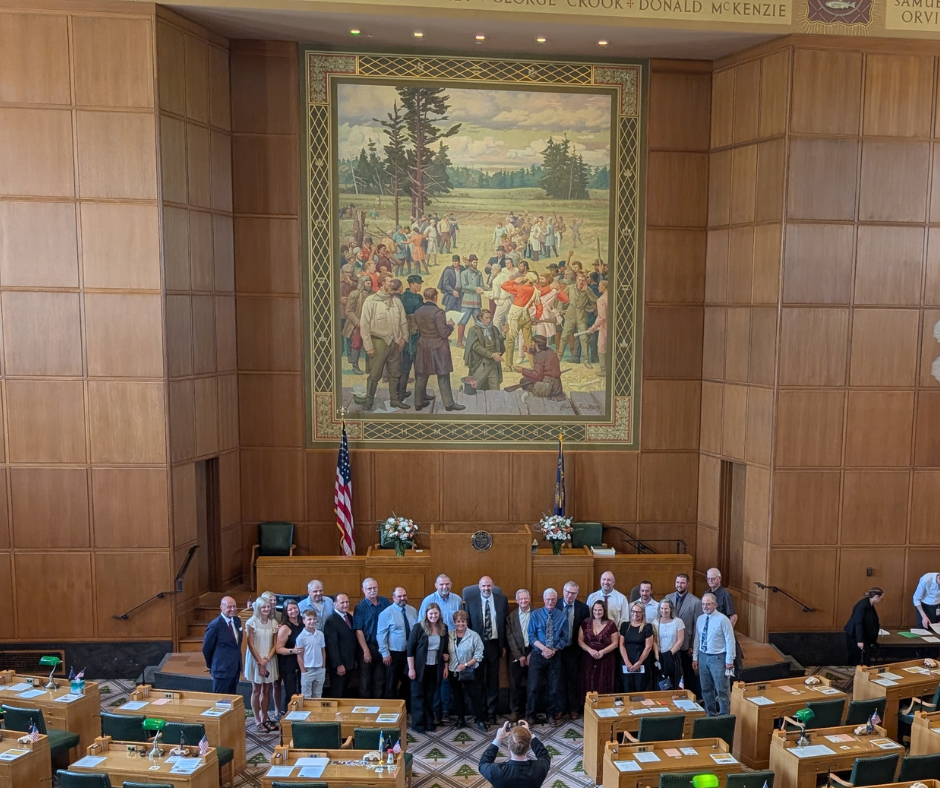
I want to thank the Associated Oregon Loggers for visiting the Capitol this week to learn more about the details of this bill.
Associated Oregon Loggers visiting the House Chamber
HB 3328: Supporting Law Enforcement in Grant County
This session, I have been working on House Bill 3328, which allows Grant County to be included under existing statute that provides SRS Title III funding to support patrol services for the county.
This is about making sure our rural counties have the same tools and resources as others when it comes to public safety and law enforcement coverage.
While the bill won’t take effect until January 2026, it lays the groundwork now so Grant County can plan and prepare.
Visitor Services will be offering two school tour options during this legislative session (February 10 to May 31).
On-site school tour option:
- Monday through Friday, 10:30 a.m.
- Tour guides will take students to the House and Senate Chamber, explain the legislative process, share information about the building, and engage students in an educational activity. Tour takes 75 minutes.
- Due to limited space only one classroom (4th grade and above,) consisting of up to 30 students and their chaperones, can be accommodated per day. Groups are booked first come, first served. If the group has multiple classes, then they would need to schedule multiple days, or do the virtual tour option, below.
-
Link for the on-site tour request form.
Virtual tour option:
- Tuesday and Wednesday, 9:15 a.m. and 10:15 a.m.
- Tour guide will share the virtual tour via TEAMS and answer questions for up to three classrooms (100 students) per school, per time slot. The virtual tour is 45 minutes long.
-
Link for the virtual tour request form.
You may also reach out to Visitor Services at 503-986-1388 or email visitor.services@oregonlegislature.gov to book a school tour.
Capitol Phone: 503-986-1460
Capitol Address: 900 Court St NE, H-475, Salem, OR 97301
Capitol Email: Rep.MarkOwens@oregonlegislature.gov
Capitol Website: http://www.oregonlegislature.gov/owens
|