|
Replies to this message are sent to an unmonitored mailbox.
To contact me, please click here: Rep.BoomerWright@oregonlegislature.gov
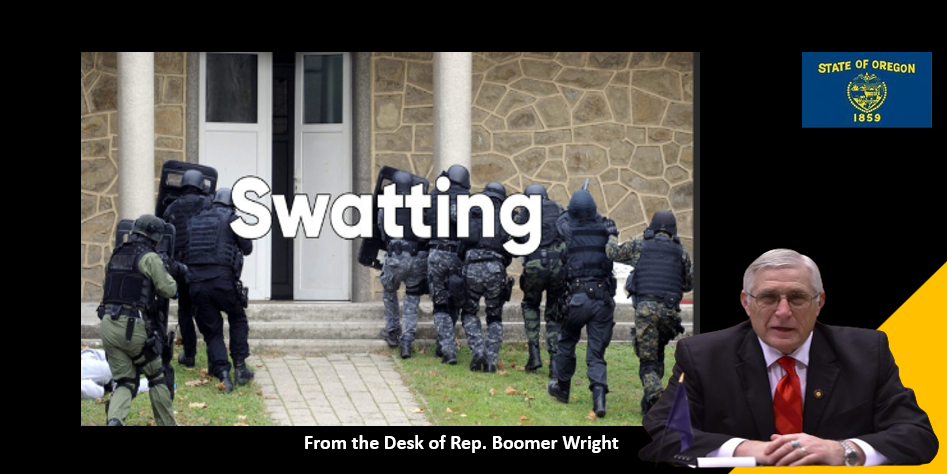
Earlier last week, hundreds of students, teachers, and their families panicked after an active shooter threat was made at Silverton High School. The school went into lockdown and police officers from multiple agencies arrived at the scene, only to determine it was a prank, also known as ‘swatting.’
FOX12: Silverton High School cancels Friday classes, events after 2 ‘swatting’ incidents
Swatting occurs when someone makes a false emergency report to send law enforcement—often a SWAT team—to an unsuspecting person’s home, school, or place of worship. What some may see as a prank can quickly become deadly.
According to the Educator’s School Safety Network, there was a 546% increase in the number of false active shooter reports from the year 2018/2019 to the year 2022/2023, in which there were more than 446 false reports.
Representative Darcey Edwards from Banks, introduced HB 3935 this session that would make swatting a felony in Oregon, bringing real consequences to those who abuse our emergency systems and put lives at risk. Currently in Oregon, making a false report is considered a Class A misdemeanor, punishable by 10-30 days in jail.
In addition to the upgraded felony charge, House Bill 3935 would make swatting punishable by 5-10 years in jail and/or a $125,000-$250,000 fine, or both.
HB 3935, that died in committee just two days prior to the swatting incident in Silverton, which has renewed support for this concept.
As a priority bill, Rep. Wright is introducing a new swatting bill (HB 3969) with Rep. Edwards. HB 3969 will carry forth the same upgraded felony charges for swatting punishable by 5-10 years in jail and/or a $125,000-$250,000 fine, or both.
We owe it to our schools and communities to act. HB 3969 is a commonsense, bipartisan solution to a growing public safety threat.
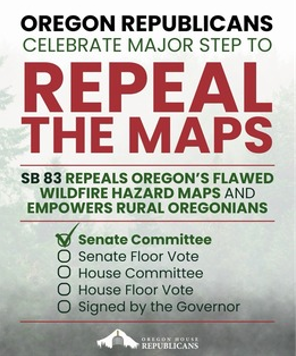
On Tuesday, the Oregon Senate passed Senate Bill 83, which repeals the state’s wildfire hazard map and removes the strict regulations that came with it. This bill closely mirrors legislation that my colleagues and I introduced with House Bill 3944. This is a big win for rural Oregonians who have fought against these costly and unfair mandates.
The bill now moves to the House of Representatives for consideration, and I stand ready to ditch these terrible maps and restore property rights for rural Oregonians.
SB 83 reflects legislation introduced by House Republicans (HB 3944) and focuses on repealing costly and ineffective mandates, supporting voluntary wildfire readiness, and investing in defensible space, forest thinning, and local response programs
This is real relief for homeowners—and real respect for rural communities.
 |
|
Oregon House of Representatives received a visit from Western Oregon University this week. Rep. Wright got a photo with Wolfie, the mascot for the Western Oregon Wolves. |
 By Oregon Property Owners Association April 10, 2025
As the 2025 Legislative Session progresses, we’ve just crossed an important milestone: the first chamber deadline. This signifies that all bills had to pass out of their chamber of origin – either the House or the Senate – to remain active and advance through the legislative process. For property owners, this is a pivotal moment as it determines which proposals are alive or dead for the rest of the Session.
Looking ahead, the next major deadline is the second chamber cutoff on May 23rd, where bills must pass through the opposite chamber to continue toward becoming law. With this timeline in mind, it’s critical for property owners to stay informed and engaged.
Before we get into the nitty-gritty on what is alive and dead, we want to take a moment to congratulate property owners for making their voices heard this, Session. Politically, the odds are stacked in the favor of NIMBYs, defenders of the status quo, and no-compromise-activists, yet the list of “wins” for private property owners is much longer than it should be.
Everyone loves an underdog story and Oregon’s rural property owners are holding the line against bad policies and attacks on private property rights. These results are a testament to the power of grassroots and what happens when folks stay engaged and use their voices effectively!
Wins for Oregon Property Owners So Far
As of the first chamber deadline, property owners have celebrated several key victories. These achievements reflect the collective power of OPOA supporters, homeowners, and rural Oregonians during this crucial legislative session.
Bills we OPPOSED and killed:
(DEAD) SB 79 – Prohibited a county from approving new dwelling or replacement dwelling permits on land zoned for farm or forest use that was in high-wildfire areas, groundwater-restricted areas, land with wildlife habitat, land designated as a “wildlife corridor,” and land considered “high-value” farmland.
(DEAD) SB 78 – Limited the size of replacement dwellings on resource lands, adding an extra barrier to rebuilding homes lost to disaster or decay.
(DEAD) SB 77 – Added significant restrictions on home businesses sited on lands zoned for resource uses and in urbanized areas under county control.
(DEAD) SB 73– Prevented lands that were of such poor quality they did not meet the definition of “farmland” from being rezoned for higher or better use, preserving them as open space.
(DEAD) HB 3062– Required local governments to map “sensitive” areas within cities and then mandate a public health impacts analysis and public health hearings before any industrial, manufacturing, shipping, car repair, recycling, animal processing, or food processing activity could be permitted within 1,000 feet of the “sensitive” area.
(DEAD) HB 3013 – Drastically changed standing requirements to allow third parties to “enforce” LUBA decisions in a way that wrongly disincentivized the construction of important, needed housing developments and other quasi-judicial land use applications.
(DEAD) HB 3906 – Allows a utility to submit a land use application on private property they do not own and have not even begun the condemnation process on. This bill would have allowed utilities to skip the normal condemnation process, devalue private property, and skirt their responsibilities for providing just compensation to property owners.
Bills we SUPPORT and are pushing up the hill:
(ALIVE) SB 83 – Repeals the state wildfire map and accompanying defensible space and home hardening requirements. Restores local control and leaves in place key funding for wildfire mitigation and community preparedness.
(ALIVE) SB 974 – Streamlines and expedites the approval process for housing projects on lands zoned or planned for residential use inside UGBs. This bill is a critical step in solving our housing crisis and increasing housing production in our cities.
(ALIVE) HB 3858 – Corrects an alarming LUBA opinion that declares potentially countless units of land as “illegal” thus preventing property owners from being able to improve or sell their land. HB 3858 clarifies that when a piece of land is split to create a new legal unit of land, the leftover portion of the original land kept by the property owners is still considered legal, even if it’s not specifically described in legal documents like deeds or sales contracts that establish the new plot.
(ALIVE) HB 2950– What started as a very concerning bill is now a very exciting bill thanks to efforts by OPOA and the Oregon Homebuilders Association. HB 2950 has been amended to require the LCDC to rewrite Statewide Planning Goal 1 (Public Involvement) and to specifically consider “Limiting exploitation that leads to litigation or unreasonable delay to quasi-judicial land use applications and decisions.”
Bills Property Owners Need to Watch
Despite notable victories, several bills of concern remain active and will require continued attention as they face the next chamber deadline.
Key challenges include:
(OPPOSE UNLESS AMENDED) SB 1154 –Makes sweeping changes to how the state manages areas with impaired groundwater. Includes limitations on homes and structures in these areas, as well creates new authority for DEQ to enter property without landowner consent. See our blog post on this bill HERE.
(OPPOSE) SB 1153 – Imposes new limitations on “water transfers” thus freezing property owners’ ability to obtain or manage water rights in most of the state. See our blog post on this bill HERE.
(OPPOSE) SB 427– Also imposes new limitations on “water transfers” thus freezing property owners’ ability to obtain or manage water rights in most of the state. See our blog post on this bill HERE.
(WATCH) SB 74 – Changes the law of “navigability” to grant Department of State Lands (DSL) the authority assert title over private property when rivers change their normal course. OPOA worked to improve this bill with the -6 amendment and will be keeping an eye on this concept. You can read our blog post on this bill HERE.
(WATCH) SB 165 – Grants DSL authority to assert title over historically filled lands in cities in perpetuity. OPOA worked to improve this bill with the -3 amendment to reduce the timeframe to only the next 3 years and will be keeping an eye on this concept.
|