|
Replies to this message are sent to an unmonitored mailbox.
To contact me, please click here: Rep.RickLewis@oregonlegislature.gov
Dear Friends and Neighbors,
Today closed out the third full week of the 2025 session. We are all hands-on deck and moving full speed ahead. Committees continue to receive information from state agencies are holding public hearings and work sessions to move bills to the floor for votes.
New bills are still being introduced, and we are holding House floor sessions twice weekly on Tuesday and Thursdays. February 25th will mark the session’s measure introduction deadline. Moving forward, that means legislators have a limited number of bills they can submit as priority bills for the remainder of the session. The measures that flood in before this deadline will add to the already all-time-high number of bills that were pre-session filed in a single regular session to date.
We will see a significant number of bills make their way to the floor over the next several weeks and House members are prepared for daily floor sessions beginning on March 10th. From there, March 21st is our next session deadline for bills to be posted for a work session and voted out of committee on or before April 9 to remain viable. An exception exists for measures assigned to the Rules, Revenue, Joint Ways and Means and Joint Transportation Committees. Those committees remain open until end of session and are not subject to the chamber deadlines.
Some bills will likely pique your interest in terms of their potential impacts on your family budget, your community’s safety and livability - or may simply not align with your personal values. This is where your voice is critical in letting us know your views on the issues that matter most to you. There are a number of ways for Oregonians to get involved in the legislative process. Take a look at my “Citizen Engagement” section at the end of this newsletter to learn how.
Thank you for following my updates. I welcome your input and encourage you to contact my office for help in navigating the legislative process or if you need assistance with matters involving state government. We are here to listen and to serve.
Sincerely,
 Rick Lewis
State Representative
House District 18
Oregon’s Christmas Tree District
In this Issue:
View Previous Newsletters Here
The work of the House Committee On Emergency Management, General Government, and Veterans is fully underway, meeting two days per week on Tuesday and Thursdays.
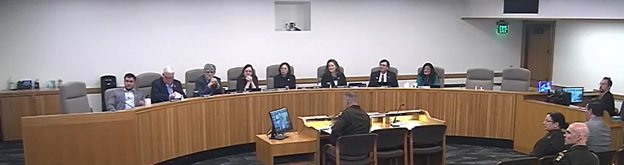
To date, we have held six committee meetings and heard overviews and updates from state agencies responsible for providing, public safety, emergency management, and veterans services to Oregonians. The committee has held public hearings on seven bills and moved four of those unanimously out of committee as follows:
HB 2341 Adds Email for Oregon Department of Veteran Affairs (ODVA) Notifications

This is a housekeeping measure introduced at the request of the Governor. It adds a uniformed service member's or veteran's e-mail address to the information that the Director of Human Services, Early Learning System Director, Director of Transportation and Director of the Oregon Health Authority are required to provide to the Director of Veterans' Affairs. This is to make sure more veterans are provided with benefit information. Email information can only be shared with the permission of the veteran or service member.
|
HB 2386 Veterans’ Cremains
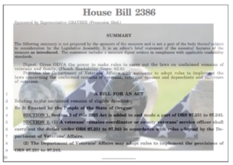
I am a proud sponsor of this measure that is a technical fix to HB 2147 passed in the 2023 session. The measure transfers the authority from the Mortuary Board to ODVA, to allow them to create rules to carry out the laws on unclaimed remains of veterans and their family members. The fix is to ensure that cremains of veterans that have been held in mortuaries – often for decades – are properly honored.
|
HB 2581 State Resilience Officer Duties
Expands the duties of the State Resilience Officer.
HCR 2 Firefighters Per and Polyfluoroalkyl Substances (PFAS)
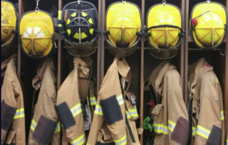
Declares a commitment to the health and safety of firefighters and to finding an urgent solution to the problem of firefighting personal protective gear that contains cancer-causing chemicals.
|
As of my January 25th legislative update, we had 110 bills assigned. Since that time, our workload has increased to 141 bills, and more are expected to be added in the coming weeks.
The committee also held public hearings on three other bills for which I am a sponsor as follows:
HB 3150 Would establish an income tax credit for volunteer firefighters. (Lewis Regular Sponsor)
HB 3110 Directs public buildings to transition from displaying flags manufactured of flammable materials to flags manufactured of flame-retardant materials by July 4, 2026. (Lewis Regular Sponsor)
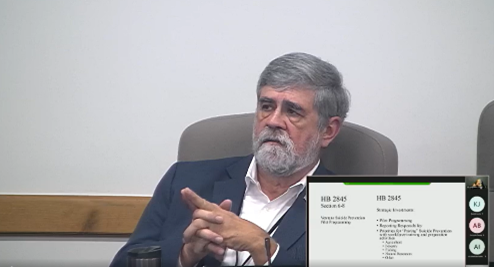
HB 2845 Requires ODVA to create more positions and hire staff to create pilot programs on suicide prevention and workforce training. (Lewis Co-Chief Sponsor)
|
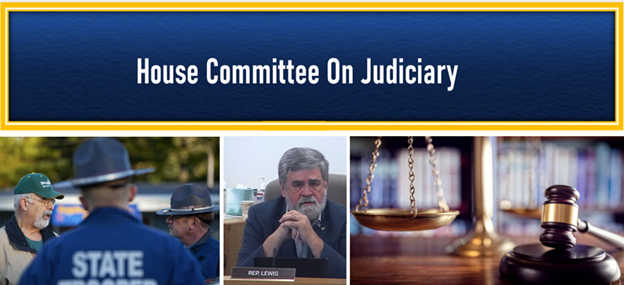
The House Committee on Judiciary meets four days a week Monday-Thursday and has convened 10 meetings to date. We have held multiple informational meetings to receive overviews and hear the legislative priorities from various agencies responsible for administering Oregon’s public safety and judicial services.
HB 2464 was the first bill to be passed out of this committee. It is known as the session’s “reviser’s bill,” It is a simple bill that makes nonsubstantive and technical changes in Oregon law to maintain accuracy. It corrects grammar, punctuation and conforms language to existing statutes and legislative style.
We also passed HB 2935, directing the Oregon Criminal Justice Commission to study pretrial release and include certain data in the study and provide that to the legislature. The committee held public hearings on two bills for which I am a sponsor, HB 3198 requiring the Department of Justice to study missing and murdered indigenous people, and HB 3196 appropriating moneys to the Department of Justice to backfill reductions in federal Victims of Crime Act (VOCA) grants that were announced by the federal government in March, 2024.
As of my January 25th legislative update, we had 206 bills assigned. Since that time, our workload has increased to 221 bills, and more are expected to be added in the coming weeks, although many will not move.
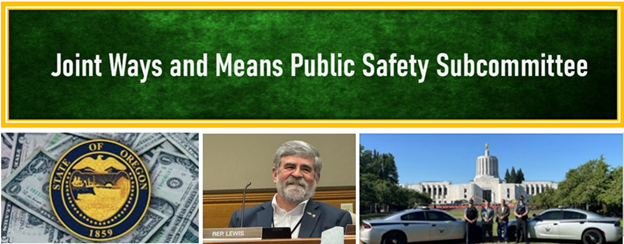
The Joint Committee On Ways and Means Subcommittee On Public Safety meets four days a week, Monday-Thursday and has held eight committee meetings to date.
Our initial meeting included the Department of Administrative Services, Office of Economic Analysis preliminary overview of the criminal justice budget forecasts for corrections, youth corrections and public defense. This overview laid the groundwork and outlined the processes and procedures for the forecasting. They will return again after the May Revenue and Economic Forecast to give us a final update.
The committee held several informational meetings to hear from the Judicial Department, Criminal Justice Commission (for which I serve on as a member), the District Attorneys Association, Public Defense Commission, Department of Justice, and the Department of Public Safety Standards and Training. We also held work sessions for the approval of three federal grant applications.
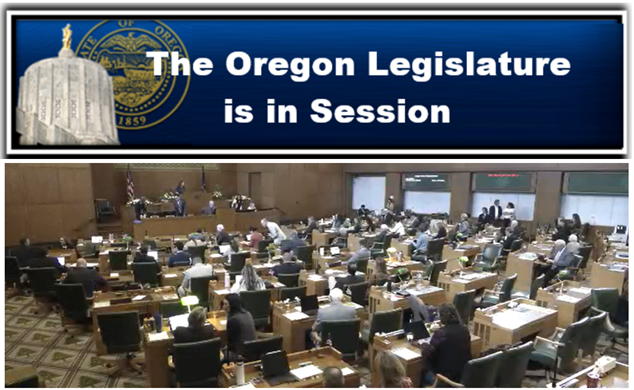
More bills were introduced this week to be assigned to committees and we are seeing our first bills make their way to the floor for votes.
On Thursday, members took their first floor votes and passed three policy measures, one for which I am a sponsor. These bills came to the floor from the two policy committees I serve on as covered in the “Committee Highlights” section above.

HB 2341 Email add for ODVA Notifications
HB 2386 Veterans’ Cremains - ODVA rules/laws authority (Lewis Sponsor)
HB 2464 Statutes Accuracy “revisors bill”.
The measures are on their way to the Senate for further consideration.
On January 23, I was appointed by the Speaker of the House to serve on the Juvenile Justice Policy Commission (pursuant to HB 2320 (2023), adding to my many public safety related duties outside of committee assignments There are three core duties of the Commission, which are defined in HB 2320.

First, the Commission shall analyze the juvenile justice system at the state and local levels and across branches of government in Oregon to provide recommendations for improvements in law, policy, practice, and appropriation to improve public safety, youth outcomes, and system disparities. The Commission shall oversee data-driven and qualitative analysis in nine areas that are outlined in the law.
Second, the Commission may then use these analyses for a variety of actions, such as recommending legislation, assessing the impact of current legislation, develop training and materials for state agencies, and overseeing funding for pilot projects and other initiatives.
Third, the Commission must provide a report to the Legislative Assembly by September 1st of every even-numbered year. To begin fulfilling these duties, the Commission plans on receiving technical assistance on national trends and best practices in juvenile justice policy development. This assistance will expand the Commission’s knowledge of juvenile justice policy and guide them in the identification of up to five key areas of juvenile justice policy to prioritize. Some areas currently being considered include points of system entry, dually involved youth, gun violence, minimum age for prosecution, and the impact of drug possession sentencing changes (HB 4002).
I look forward to being a part of the Commission's important work in evaluating Oregon’s Juvenile Justice policy and this opportunity to address the many shortcomings of the most recent reforms that took place in 2019 with HB 1008.
HB 1008 (2019) which reformed Oregon’s juvenile justice system, had significant implications for crime victims. While the bill aimed to provide greater rehabilitative opportunities for youth offenders, some victims and their families expressed concerns about reduced accountability and the potential for retraumatization. By eliminating the automatic transfer of certain juveniles to adult court, HB 1008 meant that some victims of serious crimes might not see the stricter sentences traditionally associated with adult prosecutions. However, the bill also emphasized restorative justice principles, which can give victims a greater role in the justice process through victim offender dialogue and tailored support services.
The long-term impact of these changes continues to be evaluated, particularly in terms of victim satisfaction, perceptions of justice, and community safety. Fundamentally, I believe that HB 1008 has weakened the Juvenile Justice System by making it harder to hold the most dangerous offenders truly accountable, left victims unheard and made our communities less safe. I opposed this measure in 2019 Regular Session with a “no” vote in committee and “no” vote on the House floor. I supported a referral to Oregon voters of this broad juvenile justice reform bill that rolled back critical elements of Measure 11 (1994).
A recent opinion piece published in the Oregonian is illustrative of some of unfortunate outcomes of HB 1008 victims have experienced.
January 26, 2025 – The Oregonian
Opinion: Oregon Youth Authority failures, juvenile justice flaws pose a public safety crisis - oregonlive.com
|
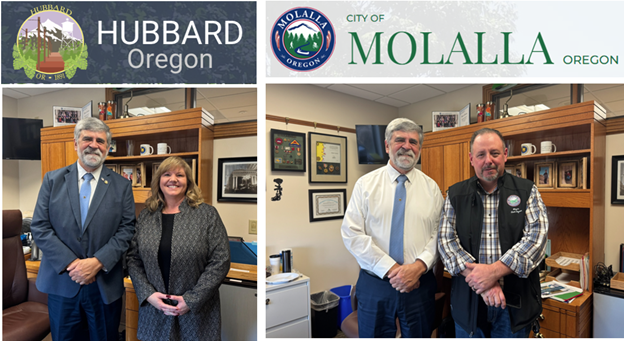
City Day at the Capitol brought local governmental leaders to meet with legislators to advocate for their cities and the League of Oregon City’s top legislative priorities.
I had the pleasure of meeting with House District 18’s very own, Shawn Waite, Hubbard City Administrator and Molalla Mayor, Scott Keyser. Thank you both for visiting and sharing the vision and the needs of your communities with me. I look forward to working with you!

Oregon Credit Unions serve 2.3 million Oregonians. That means more than half the state’s population have chosen credit unions as their financial services partners. It was my pleasure to visit with constituents and credit union representatives from the district who came to share their legislative priorities.
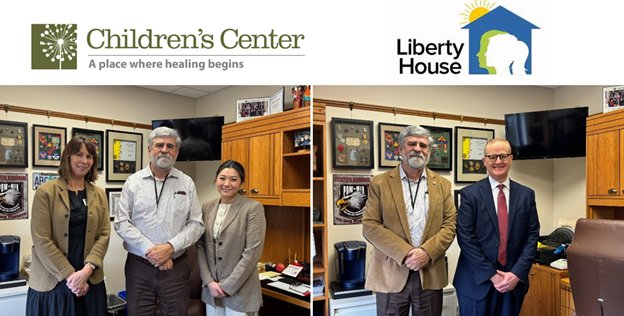
I greatly appreciated the opportunity to visit with Clackamas and Marion County Child Advocacy Center (CAC) leaders this week and lend my support for HB 3196 aimed to preserve the critical safety net of services for victims of sexual abuse and domestic violence.
You can learn more about House District 18 CAC’s by clicking on the links below.
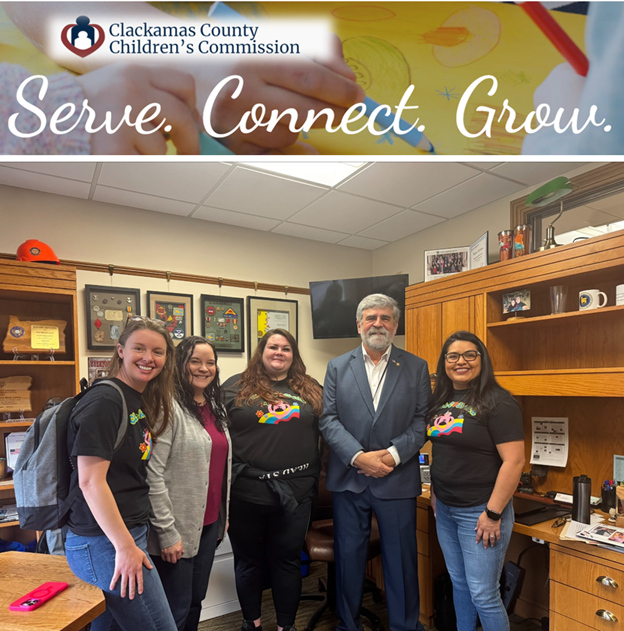
Thank you to the parents and staff from the Clackamas County Children’s Commission for taking the time to visit with me during your day at the Capitol. I appreciate you sharing your experiences and the work being done in our communities to support the growth of healthy children and families, positive parenting, and school readiness.
On January 29th, family, friends, members of the legislature, community leaders, and members of the public gathered to remember the life and legacy of Senate President Peter Courtney in a celebration of life ceremony at the Oregon State Capitol. Godspeed to a remarkable public servant and a giant in Oregon politics.
Watch the Celebration of Life
 |


On Monday, January 27, the Internal Revenue Service (IRS) and Oregon Department of Revenue (DOR) begin accepting returns for the 2024 tax year. The department provided the following suggestions for taxpayers to help assist in efficient processing of returns and avoiding common errors that may delay a refund:
File electronically, and request a direct deposit On average, taxpayers who e-file their returns and request their refund via direct deposit receive their refund two weeks sooner than those who file paper returns and request paper refund checks. The department will begin to issue refunds on February 15.
Gather all tax records before filing Taxpayers should wait to file until they have all their tax records, including Form W-2s from their employers and Form 1099s reporting other income.
Use Revenue Online Revenue Online (ROL) is Oregon’s internet tax portal and is the best way to communicate with the department. Taxpayers who don’t have an account can sign up on the DOR website. New users will be asked to verify their identity and may do so through ROL.
Download Form 1099-G DOR no longer mails taxpayers Form 1099-G, which reports the amount of refunds, credits, or other offsets of personal income, statewide transit individual tax, TriMet transit self-employment tax, or Lane transit self-employment tax during the previous year. People who itemized deductions on their tax year 2023 federal income tax return will need a Form 1099-G to file their tax year 2024 return. Those taxpayers can view and download their Form 1099-G through Revenue Online.
Free filing options Taxpayers may use a combination of free electronic filing options available through the IRS and DOR. See IRS Direct File and Direct File Oregon Taxpayers are encouraged to use the IRS Eligibility Checker to see if they qualify to file directly with the IRS and the state.
Earned Income Tax Credit The Earned Income Tax Credit (EITC) is a federal tax credit for people for making up to $66,819 in 2023. Families may be eligible for a maximum refundable credit of $7,830 on their federal tax return, and a maximum Oregon Earned Income Credit (EIC) of $940 on their state tax return. Certain taxpayers without children may also be eligible for these credits.
Individuals may qualify for the EITC, the Oregon EIC, and other credits, even if they are not required to file. To receive the refundable credits, however, they must file a federal and state tax return.
Free and low-cost tax help Free tax preparation services are available for low- to moderate-income taxpayers through AARP and CASH Oregon. United Way also offers free tax help through their MyFreeTaxes program. Visit the DOR website to for more information about free tax preparation services. The department offers an interactive map to help taxpayers find an assistance center near them.
Free tax help clinics at local libraries Volunteers from the Oregon Department of Revenue will be traveling to local libraries in 18 different communities across the state in February, March, and April to assist taxpayers who are eligible to use IRS Direct File and Direct File Oregon to complete their returns. Dates, times, and addresses for each clinic can be found on the Free Direct File assistance at local libraries webpage.
|
It’s the time of year for mother nature to threaten snow and cold weather in various regions of the state. With that, I am passing along some helpful resources and reminders to help you with safety planning on the road and at home.

Trip Check before you travel on the roads, check road conditions and closures on TripCheck.com or call 511
|
Free warming shelters near you can be found using this 211 search tool. You may also call 211 or 1-866-698-6155 or TTY: dial 711 and call 1-866-698-6155, 24/7.

Older adults and people with disabilities can call their local Aging and Disability Resource Connection (ADRC) office to find resources for shelter, energy assistance and other kinds of help for cold weather. Find your local ADRC office here, or call 855-673-2372. Additional resources may be available at your local Aging and People with Disabilities (APD) or Area Agency on Aging (AAA) office serving older adults and people with disabilities. Find your local APD or AAA office using this search tool.
|
Food safety during a power outage fact sheet and video.

If you need help paying your utility bills, call 211 or visit this webpage for a list of programs in your area.
|
Learn where to sign up for emergency alerts at gov.
|
|
 |
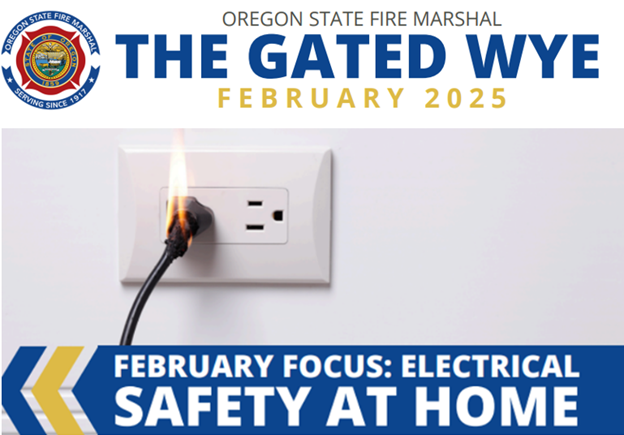
In February, the Oregon State Fire Marshal (OSFM) is focused on promoting electrical fire safety. Each year in Oregon, firefighters are called to home fires sparked by an electrical issue. OSFM offers tips for fire home safety in this month’s issue of the Gated Wye here.
- Avoid pinching cords between walls and furniture. Do not run electrical cords under carpets or across doorways.
- Avoid electrical overload. Consider having an electrician install additional wall outlets where you need them and add a breaker if needed.
- Electrical work should be done by a qualified professional. Read the manufacturer's instructions before operating any electrical or heating equipment or appliances.
- Replace items (appliances) with cracked or damaged electrical cords, broken plugs, or loose connections.
- Plug appliances (portable space heaters, refrigerators, stoves, washers, dryers, etc.) directly into a wall outlet and never into a power strip or extension cord.
- Extension cords are for temporary use only.
- Make sure you have working smoke alarms on every level of your home (including the basement), inside each bedroom, and in the hallway outside each bedroom.
- Make sure you have working carbon monoxide alarms on every level of your home with bedrooms, inside each bedroom, and in the hallway outside each bedroom.
ALL YOU NEED TO KNOW – CLICK BELOW
Capitol Phone: 503-986-1418
Capitol Address: 900 Court St. NE, H-385, Salem, Oregon 97301
Email: Rep.RickLewis@oregonlegislature.gov
Website: http://www.oregonlegislature.gov/lewis
|