|
Replies to this message are sent to an unmonitored mailbox.
To contact me, please click here: Rep.EdDiehl@oregonlegislature.gov
What do you call it when your liabilities exceed your assets? In the world most Oregonians live in, it's called insolvency—you're broke. But in the public employee pension world, they give it a fancy name: Unfunded Actuarial Accrued Liability.
Oregon's Public Employee Retirement System (PERS) owes far more in pension payments than it has in assets, and this gap keeps growing. In 2014, the unfunded liability was $12 billion. By the end of 2023, it had doubled to $24 billion, with total liabilities reaching $106 billion.
The bill I’m presenting, HB2571, aims to reverse or at least slow down this troubling trend. The Public Pension Protection Act ensures that Oregon’s public pension plans always act in the fiduciary best interests of taxpayers and pensioners. This is a basic, common-sense standard—one that aligns with the expectations Oregonians already have for their personal retirement plans.
The root of the problem lies in the structure of PERS, which, for the most part, is a "defined benefit plan." This means retiree payments are guaranteed by taxpayers, regardless of how much the fund earns through investments. For years (with some exceptions), PERS has been paying out more than it earns, causing the unfunded liability to grow.
By contrast, most Oregonians with retirement savings have a "defined contribution plan," like a 401(k). These plans depend on individual contributions and investment performance—you get out what you put in, plus any earned interest.
HB2571 is also necessary because two other bills—SB681 in the Senate and HB2200 in the House—propose directing the Treasury to prioritize Environmental, Social, and Governance (ESG) type investing over financial returns.
-
SB681 would impose a moratorium on fossil fuel investments.
-
HB2200 pushes for a "carbon-free" investment fund by 2050.
ESG investing such as this focuses on factors like carbon intensity, employee diversity, and political donations—none of which are directly tied to the fiduciary responsibility of maximizing returns for taxpayers and pensioners.
It’s impossible to implement these ESG-driven bills without violating fiduciary duties, which require investments to prioritize financial risk and returns. This isn’t just theoretical—recent court rulings, such as one against American Airlines, have shown that ESG-focused investing can be deemed disloyal and harmful to beneficiaries. Read more about the case here.
HB2571 addresses this by requiring that pension funds be invested solely based on financial risk and return. It doesn’t ban ESG investments outright or mandate fossil fuel investments; it simply ensures the fund is managed for the best possible financial outcome. This is exactly what pensioners and taxpayers deserve and expect.
Proponents of ESG legislation claim their bills don’t conflict with fiduciary duties. But if that were true, why would new laws be needed? The Treasury already has the authority to make investments in the fiduciary interest of the fund, ESG or otherwise. In my opinion these bills are designed to provide political cover for shifting investment priorities that may risk the integrity of the fund.
If PERS were financially healthy, this debate might be academic. But it’s not. If your personal finances looked like PERS, you’d be in bankruptcy court. Ignoring this crisis will only burden future generations with a growing taxpayer obligation.
We owe it to Oregon taxpayers, public employees, and retirees to pass HB2571. This bill protects pensioners, ensures the fiduciary integrity of PERS, and begins the process of making the system financially sound.
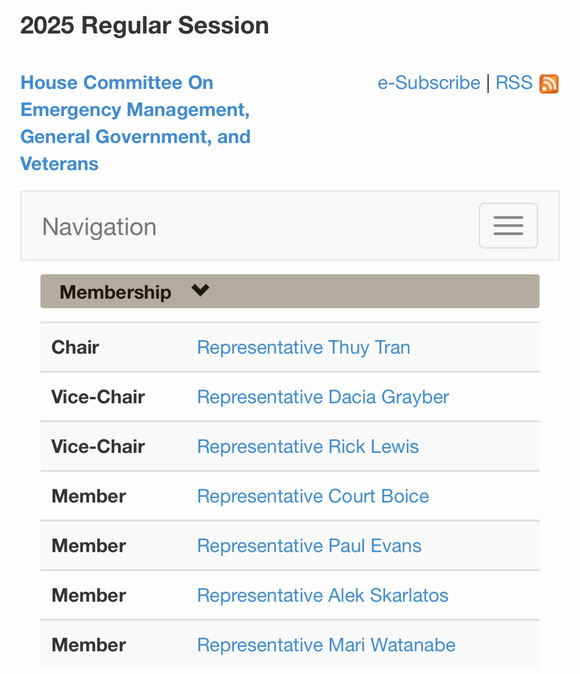
For HB2571, our immediate goal is to secure a hearing. We encourage you to contact Chair Thuy Tran and the other committee members, urging them to protect the interests of taxpayers and pensioners by providing a hearing.
With HB2200 already scheduled for a hearing, we urgently need individuals to submit testimony in opposition and reach out to the committee members.
Additionally, please reach out to other legislators to gather more sponsors for the bill. It’s crucial for the public to stay informed and engaged—attend hearings, spread the word, and make your voices heard to ensure taxpayer and pensioner interests are safeguarded.
Click the image below for the full list of committee members and contact information:
In Liberty,
 Representative Ed Diehl
House District 17

Capitol Phone: 503-986-1417
Capitol Address: 900 Court St. NE, H-378, Salem, Oregon 97301
Email: Rep.EdDiehl@oregonlegislature.gov
Website: https://www.oregonlegislature.gov/diehl
|