|
Replies to this message are sent to an unmonitored mailbox.
To contact me, please click here: Sen.MichaelDembrow@oregonlegislature.gov
October 27, 2024
 Dear Neighbors and Friends,
Well, we’re 11 days away from Election Day. Hope you’ve gotten your ballot in or will soon. I received mine on Friday the 18th and put it in the mail the following day. Received my text notice on Tuesday that it had been received. Easy-peasy. And, thanks to SB 861 (2019) (guess who was the lead sponsor?) I didn’t even have to hunt for a stamp.
As a Portland resident, this time I got to use ranked-choice voting for Portland’s mayor and new city council. For those of you outside of Portland who are wondering what a ranked-choice ballot looks like, here’s the one for my district before I filled it out.
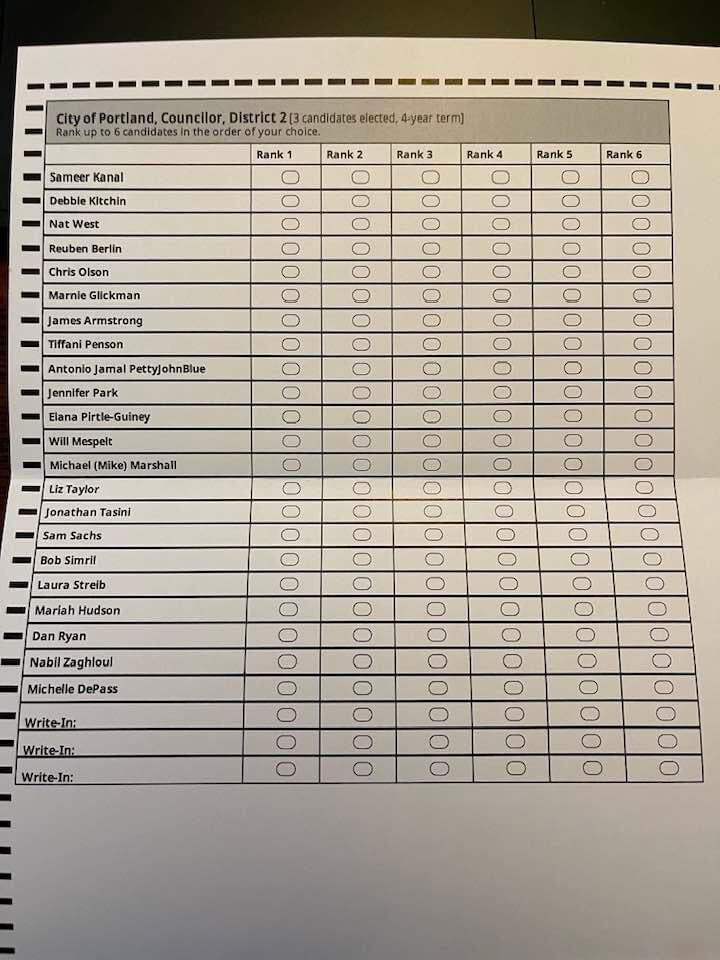 Under the new system, each of Portland’s four districts will now be represented by three councilors. Mine is District 2 (North/NE Portland). Twenty-two District 2 residents are running for the three seats. Under the ranked-choice voting system, I needed to decide which were my top six choices and rank them in order of preference. That took some thought, and generated some regrets because there were more than six people who I felt could do the job well (we’ve been lucky in attracting good people to run).
Once I had determined my order of preference, filling out the ballot actually turned out to be very easy.
I look forward to seeing the results and debriefing on lessons learned from this first go-around. It will be very interesting to see the mix of individuals and individual backgrounds that wind up prevailing in the end.
Moving on to rest of the newsletter, you’ll see that most of it is dedicated to the work of a national task force that I’ve been part of, this one focused on post-secondary education and the need to better coordinate state and federal action. I hope that the results and recommendations coming out of it will help open up new and more successful opportunities for current and future students.
You’ll also find links to a number of articles of interest on a variety of topics.
And a reminder about Saturday’s constituent coffee.
Please do let me know if you have any questions or comments about anything in this newsletter.
Next Constituent Coffee November 2
Saturday, November 2, is the first Saturday in November, and that means time for another constituent coffee.
For this one we’ll be back (with coffee and cookies) at the Hollywood Senior Center, 1820 NE 40th Avenue (from 9 am to 10:30 am).
We’ll again have a zoom option for the meeting to accommodate those who cannot be there in person. (Register for Zoom access here)
I’ll catch you up on the latest actions being taken in preparation for the next session. And of course I look forward to hearing your priorities and concerns, as well as your thoughts about what I should be focusing on during my final months in office.
Hope to see you there!
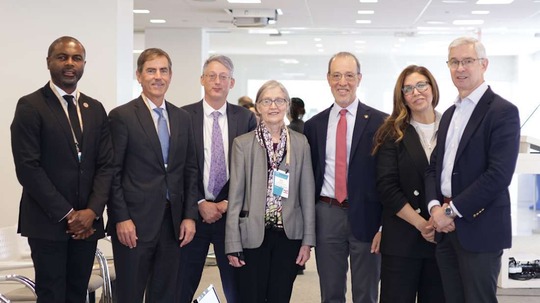 Members of the NCSL Higher Education Task Force and Event Panelists. From L to R: Rep. La Shawn K. Ford (Illinois), Sen. Briggs Hopson (Mississippi), U.S. Department of Education Under Secretary James Kvaal, Sen. Co-Chair Ann Millner (Utah), Co-Chair Sen. Michael Dembrow (Oregon), Cheryl Oldham (Bipartisan Policy Center), and Mark Becker (Association of Public Land-Grant Universities)
NCSL Rolls Out Report from the Task Force on Higher Education
It’s been my honor over the last two years to serve as Co-Chair of the National Conference of State Legislatures’ Task Force on Higher Education Affordability and Student Outcomes. NCSL is a scrupulously bipartisan organization, and all of its standing committees and task forces are co-chaired by a Democrat and a Republican legislator. My Republican counterpart was Senator Ann Millner from Utah. Ann has chaired and been a member of Utah’s Education and Education Budget committees, and before coming to the Utah Legislature she was President of Weber State University. It turned out to be a productive and very collegial partnership.
The Task Force—the first convened by NCSL since 2006—was provoked in large part by the crisis in student loan debt, which has skyrocketed over the last two decades. As a result of partisan disagreements, it has been that long since Congress has reauthorized the Higher Education Act. In the meantime, we state lawmakers find ourselves having to deal with the effects of a flawed student loan system, inadequate access to data about student and institutional performance, and a lack of productive cooperation between the federal government and the states.
While undergraduate student debt has leveled off and even declined over the last ten years, graduate student debt has soared. Yet we in the states are desperate for more healthcare professionals, educators, social workers, behavioral health workers and others who need advanced degrees. Much of the undergraduate debt is held by students who never completed their degrees and consequently find themselves in the worst of worlds, with the highest likelihood of going into default. And in many cases the biggest challenge to affordability, especially for older students, is no longer tuition; rather it’s in meeting the basic needs of food and housing, healthcare, and textbooks.
NCSL believed—and Senator Millner and I agreed—that it was time to bring together a bipartisan group of legislators to show that productive dialogue and agreements could be had. NCSL selected legislators and a few committee staff from 32 different states to be on the task force. Nearly all the legislators were chairs of education or high education policy and/or budget committees.
At the end of the day, that decision turned out to be a really good thing for the task force. No matter our party or individual ideological inclinations, as Chairs we struggle with the same core focus: how to make post-secondary education (college, university, apprenticeships, and other advanced training) more accessible and affordable for our constituents, how to remove barriers and create pathways to success. Rather than allow ourselves to be distracted by the divisive social issues that are dominating the political discourse now, we kept our focus on the core, key concerns that we shared.
The result of this nearly 2-year effort was a report that was publicly released on October 10th during several meetings in Washington, D.C. Senator Millner and I, along with a couple of our taskforce colleagues, presented the report to media, the Undersecretary of Education, nonprofits, higher education organizations, and lead Democratic and Republic staffers for the House and Senate education committees. Senator Millner, NCSL’s Austin Reid, and I then had a follow-up meeting with the Secretary of Education to discuss next steps (which may or may not include me, as my time in the Legislature comes to an end).
Here's a press release from NCSL on the report and the rollout.
Here’s the introductory letter prefacing the report from Senator Millner and me.
Here’s an overview of the report’s findings and recommendations.
Here are links to the report’s various sections:
- Final Report in Brief
-
Part 1: Trends in Higher Education: Understanding Policy and Outcomes
-
Part 2: The State-Federal Relationship in Higher Education
-
Part 3: A State-Led Strategy for Enhancing the Value of Degrees
Here’s a writeup on the report and the release from Inside Higher Education.
And one from the Iowa Capital Dispatch. (One of our Task Force members was from Iowa.)
Additional Links of Interest
- The CDC’s Advisory Committee on Immunization Practices (ACIP) is now recommending that Americans over the age of 65 and those with immunocompromised conditions receive additional COVID vaccines. This is the result of increasing numbers of older Americans being hospitalized for the disease as the efficacy of the vaccine wanes over time. Here’s the notice from the Oregon Health Authority.
- And further explanation from the Washington Post’s Dr. Leona Wen.
- Fentanyl overdose deaths are down in parts of the country where the fentanyl crisis started earlier. But in those areas in the West (like Oregon) where it struck during or after the pandemic, we are still seeing increases, with the biggest increase by far in Alaska. Here’s reporting from Stateline, an online news source that focuses on state issues.
- As we look back on this year’s wildfire season, we have to recognize the unusual degree to which the fires did NOT occur in woodlands. Rather, nearly 2/3 of the fires were on Eastern Oregon rangelands, the result of climate-change-induced heat and drought and the proliferation of non-native invasive grasses that are much more vulnerable to fire. Here's an article from the Capital Chronicle that sheds more light on this shift.
- Changing grazing and rangeland practices may be a way to reduce the risk of the above-mentioned rangeland fires. A recent article in Inlander provides an example from the Pacific Northwest.
- Speaking of climate change, the recently released "State of the Climate Report," whose lead author is a professor of forestry at OSU, shows in stark terms the extent of the impact on our natural systems. However, as OPB points out in its reporting on the report, it also argues that this is a time for action, not despair.
- One of the biggest challenges in moving away from burning fossil fuels to reduce climate-altering emissions is a lack of electricity transmission capacity. Permitting and building expensive new transmission lines is an ongoing challenge. However, building new lines is not the only tool we can use; we can also improve the lines we already have. I recently signed onto a legislative letter calling on the Federal Energy Regulatory Commission (FERC) to do just that. You can read about it here.
- One of the recurring natural-resource controversies of the last few years has been over what to do with the Elliott State Forest, as it was faced with declining timber revenues due to endangered species protections. The idea of using it largely for carbon sequestration and earning revenue from the carbon offsets market has been under consideration for quite some time. That strategy has just been finalized and approved by the State Land Board. You can read about it here.
- Here’s more on the history of forest sequestration providing a source of revenue, the first in a four-part series by the Capital Chronicle’s Alex Baumhardt.
- Here’s the second part of Alex’s series, focusing on benefits for small landowners
-
And the third, focusing on the pluses and minuses of carbon sequestration markets, including for tribes.
- And, finally, the fourth, focusing on how carbon markets could offer a middle road in the divide over forest management.
- The Biden-Harris administration just reported that the number of Americans who have been able to have their student loans forgiven thanks to the Public Service Loan Forgiveness Program has reached a million. This program, created by Congress in 2007, was so riddled with implementation problems prior to the current administration that only 7,000 students had seen the balances of their loans discharged. Despite having met the requirements of making monthly payments for ten years and working in the public sector, the remaining graduates found themselves in a perpetual limbo. Unlike some of the other efforts by the administration to extend loan forgiveness more broadly to those with student loan debt that have run into legal challenges brought by Republican state attorneys-general, this one was authorized by Congress and could only be halted by Congressional action.
- The Oregonian’s Sami Edge has written another excellent portrait of Oregon students. This one focuses on Asian-American students of different ethnicities, who are often lumped together as “Asian,” but who have very different experiences and stories to tell. The article also references a bill request that I’ve submitted on behalf of the Oregon Commission on Asian-American and Pacific Islander Affairs (OCAPIA) that would improve our ability to collect data and understand in a more granular fashion the needs of different ethnicities.
|
IMPORTANT DATES PRIOR TO 2025 LEGISLATIVE SESSION
|
|
Nov. 5 (Tues.)
|
General Election
|
|
Nov. 20 (Wed.)
|
Revenue Forecast
|
|
Dec. 4 (Wed.)
|
Legislative Counsel returns drafts for presession filing.
|
|
Dec. 10-12 (Tues. – Thurs.)
|
December Legislative Days
|
|
Dec. 13 (Fri.)
|
Deadline to submit LC drafts to Chief Clerk of the House or Secretary of the Senate for pre-session filing.
|
|
Jan. 13 (Mon.)
|
January Organizational Days
- Adopt rules
- Elect officers
- Introduce pre-session filed bills
- Convening & Swearing In
- Member & Staff Trainings
|
|
Jan. 21 (Tues.)
|
2025 Legislative Session Begins
(Constitutional sine die--end of session: June 28th, 2025)
|
Until next time,
 Senator Michael Dembrow
District 23
email: Sen.MichaelDembrow@oregonlegislature.gov
web: www.senatordembrow.com
mail: 900 Court St NE, S-407, Salem, OR, 97301
| 

