|
Replies to this message are sent to an unmonitored mailbox.
To contact me, please click here: Sen.MichaelDembrow@oregonlegislature.gov
September 10, 2024
Dear Neighbors and Friends,
Hope you’re enjoying these September days, as the weather begins to moderate to more normal conditions.
In fact, next Saturday is looking to be a perfect day for the 2024 BIKE TOWN HALL! More on that below.
In this newsletter you’ll also find the latest update on wildfire conditions around the state, as well as some more details about the ongoing analysis and deliberations over education funding. More on this Thursday and Friday’s stops on the Transportation Road Show (in Bend and The Dalles). A little on a couple of the ballot measures up for consideration in November. The authorization and release of the new Novovax COVID booster. And a few final links of interest.
Please do let me know if anything in this newsletter provokes any questions, concerns, or suggestions. All the best to you and your loved ones.
Coming Saturday: BIKE TOWN HALL
It’s time for the Fifteenth (my very last as a legislator) SD 23 Bike Town Hall. It will be Saturday, September 14, 12:30-4:00 p.m.
All three SD 23 legislators (Reps Khanh Pham, Thuy Tran, and I) will be there, and I believe we’ll be joined by HD 46 Representative-elect Willy Chotzen for his first bike town hall.
This year’s bike town hall will cover neighborhoods in HD 45, the northern half of SD 23. It will feature a fun, social group bike ride starting in the Montavilla neihborhood. .As usual, we’ll be making a number stops to get a better sense of both the challenges and the successes occurring in those communities. Stops and speakers along the route will highlight education, climate, transportation, equity, and housing with a local emphasis at sites throughout our neighborhoods. Among the stops, we’ll be stopping at Vestal Elementary School to hear from parents about Safe Routes to School and other parent-led initiatives, and I’ll be providing an update on education funding.
I’m proud that we’ve been able to arrange these bike town halls for 15 of the 16 years that I’ve been in office, as HD 45 representative and SD 23 senator (we had to skip 2020 because of COVID). It was the brainchild of one of my first staffers, Alex Berke, who saw it as a way for us to bring constituents together, take the traditional town hall outdoors, meet with community activists, and see first-hand what was going on in a chunk of the district. Together with my SD 23 colleagues at the time, Senator Jackie Dingfelder and Rep Ben Cannon (HD 46), we tried it, and it worked! And it has kept on working.
Hope you can join us for this one! You can RSVP here.

Wildfire Season: A Tense Time
With several days of high temperatures, a number of new spot fires, and moderate east winds kicking in, these next few days will be critical for Oregon. It’s a tense, volatile time.
Legislators did receive a somewhat optimistic email update from the wildfire leaders on Friday with many details. They pointed out the benefits of the increased moisture and cooler temperatures that marked the previous couple of weeks. However, they cautioned us that the increased temperatures and drier conditions projected for the weekend could bring trouble.
They were right. Legislators learned in a briefing yesterday afternoon that there were more than 1,000 lightning strikes over the weekend, and Oregon I currently experiencing 24 large fires. Even worse, our neighbors in Washington, Idaho, and California (especially in Southern California) are being hit hard as well, limiting the resources available to fight the fires and support the firefighters.
The biggest challenge right now is the Rail Ridge Fire in Central Oregon east of Prineville. It began with a lightning strike last week, blew up thanks to more lightning to cover 61,000 acres, then 83,000, and by last Thursday it was at 147,000 acres and was declared a Conflagration with 900 personnel attached to it. Dayville and Mt. Vernon are currently in Evacuation Level 3 status (Go Now). According to the wildfire leaders, “We’re still a long way from being out of the woods on this one.”
But there are many more. The closest to Portland remains the Whiskey Ridge fire just east of the Bull Run watershed near the location of the terrible Eagle Creek Fire from 2020 in the Gorge. It has been burning for a while now in very steep terrain, and remains just 25% contained. It “woke up” with the beginning of the September East winds. Interestingly, however, the scarred remains of the Eagle Creek Fire appear to be containing it, as there’s not enough green vegetation for it to really take off. Let’s hope that remains the case.
According to ODF and OSFM, today will be critical. Winds from the East in the Gorge are currently at around 35 mph and more lightning strikes are occurring. But starting later tonight and tomorrow, moisture is coming, and it’s projected to continue in much of the state to a degree that will be very helpful in getting us through the month.
But it all continues to be very volatile. As an example, during the briefing we were told that there were fires roughly in the vicinity of Sunriver outside Bend, an area of high population and obviously a potential concern. I asked if there was an evacuation order out for Sunriver and was told that no, that didn’t appear to be necessary. Late last night ODF contacted me to let me know that there was now a Level 1 order (Be Prepared to Evacuate) for Sunriver.
Fingers crossed that it doesn’t need to go to Level 2 or Level 3.
Here's the latest reporting from this morning’s Capital Chronicle.
And here’s the latest on the season from OPB.
And a national perspective from Stateline on the natural disaster challenges being faced all around the country.
And once again, here are some wildfire resources for you to follow:
You can follow the fire season here in Oregon in the ODF Wildfire Blog and the Oregon State Fire Marshal Blog.. For news about Oregon AND the entire Pacific Northwest, check out the Northwest Interagency Coordination Center blog, All three are updated each day.
Oregon Wildfire Response and Recovery also maintains a site that tracks evacuation orders in the state, providing daily numbers of those under Level 1, 2, and 3 orders.
The wildfires in Eastern and Central Oregon are creating serious air-quality problems throughout that region. Here's a new update on air quality from OPB.
Even when there is not a wildfire nearby, your region may be experiencing smoky conditions. You can track those conditions at Oregon Smoke.
K-12 Education Funding in Oregon: CSL
As I’ve mentioned in previous newsletters, we’re in the middle of taking some hard looks at education funding and spending in Oregon. The Senate, House, Governor’s Office, Department of Education, and different experts and advocates are all involved in a variety of ways. I believe that some of the changes (and hopefully improvements) will be seen immediately in the next legislative session, while others will be phased in over the coming years.
One of the immediate changes will be in how the “Current Service Level” (CSL) is calculated. I’ve written about that before, but let me explain again what this is. As part of the budget-building process, the different state agencies need to calculate just how much it would take to offer the same programs next biennium as are being offered now (excluding one-time federal or state grants, so not counting any temporary positions and adding a standard inflation factor). CSL is easier to calculate for most state agencies than it is for education, since the state does not control increases to the salaries of K-12 employees: those are determined by local school districts. Under our current system, those increases may be higher than the state is appropriating as part of CSL.
The methodology used for calculating Education CSL is being modified as a result of analysis led by the Governor and the Department. As a result of those changes, the CSL has been increased by $515 million, and presumably that will be reflected in the budget that the Governor sends to the Legislature for consideration. (It comes out in early December.) As I mentioned in the last newsletter, the likely big corporate kicker coming next year (currently estimated at $883 million) will make that easier.
But of course fully-funding the CSL and keeping us where we currently are is not necessarily where we need to be. Which takes us to the QEM.
K-12 Education Funding in Oregon: The Latest QEM Report
The Oregon Constitution requires the Legislature to fund K-12 education at a level that will ensure that quality goals are met. Quality and the means to ensure quality are determined by the Governor-appointed Quality Education Commission (QEC). Commission members are generally District or ESD administrators, teachers, university education faculty, and education advocates. They follow a model that was created back in 1999, known as the Quality Education Model (QEM).
At the same time, the Constitution anticipates that state revenues may not necessarily be adequate to fully fund the amount called for by the QEM. In that case, the Legislature needs to issue a report showing why the QEM amount cannot be fully funded (not surprisingly, it’s generally a function of other competing priorities, such as housing, corrections, pre-K/childcare, post-secondary education, and healthcare). It also needs to show the effects of not meeting the QEM-level appropriation. Here’s the actual language that the voters put into the Constitution in November 2000:
The Legislative Assembly shall appropriate in each biennium a sum of money sufficient to ensure that the state’s system of public education meets quality goals established by law, and publish a report that either demonstrates the appropriation is sufficient, or identifies the reasons for the insufficiency, its extent, and its impact on the ability of the state’s system of public education to meet those goals.
The appropriation has never been sufficient, but the gap was closing steadily prior to the pandemic, especially after passage of the Student Success Act, which put a tax on business activities (the Corporate Activities Tax) to add roughly a billion dollars a year to K-12 funding. Then in 2022 the QEC dramatically increased its assessment of how much was needed, which dramatically increased the gap. This was understandable, given the effects of the pandemic (inflation, need for more student support), but for legislators it came as a shock and felt as if the goalposts were being moved without warning.
The QEC also asked that the Legislature fund an update to the model, which most observers agree was long overdue. The Legislative Committee charged with accepting the QEC report and sending it to the full Legislature with its own recommendations—Joint Committee on Public Education Appropriation (which I’ve sat on for the last couple of biennia) agreed that an overhaul of both the model and the entire QEM process is badly needed. I think most of us would agree that our schools need more funding, but we’re also concerned that those extra dollars may not go out to the students who need it the most.
As a result, I was able to include funding for a comprehensive study by outside experts as part of the 2024 omnibus education bill (Section 12 of SB 1552) . It will, I hope, lead to the overhaul needed next biennium. More on that below.
In the meantime, though, the QEC was obliged to produce one final report on how the current appropriation (the 2023-2025 budget) meets the levels called for by the existing model. They completed that report last month. It shows that the Legislature did manage to start closing the gap again, thanks to big increases in school funding (by just under a billion dollars) during the last long session. However, under the existing model, a nearly 10% funding gap remains.
Here’s the Executive Summary of the Report. And here’s the full report.
Here are its key findings, taken directly from the report:
▪ The funding gap between the state’s proposed 2025-27 Current Service Level (CSL) and the fully implemented QEM as a percentage of total K-12 school funding is the smallest amount in the history of the QEM.
▪ The Governor’s Office and DAS partnered to ensure consistent CSL determination, contributing to better system alignment and additional funding for Oregon’s schools.
▪ For the upcoming 2025-27 biennium, the QEM estimates that it will require a State School Fund (SSF) investment of $12.705 billion and Student Success Act (SSA) transfer of $822 million, for a total Full QEM model projection of $13.526 billion. This is $2.252 billion more than the $11.275 billion investment the state forecasts to maintain the current service level provided during the 2023-25 biennium. This is a 9.9% gap in comparison to total public K-12 funding ($22.849 billion).
▪ Due to tax revenue barriers and decreased prioritization of K-12 public education funding over the past 25 years, Oregon is projected to fund its K-12 system close to two billion dollars less per biennium than is needed to run a system of effective schools.
▪ According to US Census data from 2022, Oregon ranked 13th in state-sourced per pupil funding. If Oregon were to fund its schools at the level recommended in this report, our national ranking would rise to 6th. Oregon ranked 18th in state-sourced per-pupil funding in 1999, when the first Full Implementation QEM projection was conducted.
▪ The Full Implementation of the QEM is not aspirational. It is attainable. There are several important funding needs that are not represented in the 2024 Full QEM. The Commission continues to analyze new inputs for future integration in the model, including, but not limited to, transitioning to a 180-day school year.
I will quibble with one thing in the fourth bullet: I think it’s wrong to say that the Legislature has decreased prioritization of K-12 public education. I have not seen that. As the report points out, our support of K-12 education has continued to rise and has in fact increased relative to other states during that period. It’s not that K-12 has been deprioritized. As the state budget has risen over the years, additional dollars have also needed to go to other important priorities: Pre-K/Childcare, Health Care, Mental Health and Addictions, Housing, and other elements of our social safety net. That doesn’t mean that K-12 is thereby less of a priority. Those are all investments that are also crucial to student success. I doubt that many school advocates want us to cut that funding.
However, I certainly agree with the main point in the fourth bullet: we have tax revenue barriers that are locked into the state constitution that prevent us from quickly closing the gap.
I do very much appreciate this QEM report, most likely the last in its current form, and the expertise, commitment, and hard work of those who produced it. They were very responsive to the concerns expressed by legislators. Now, on to next steps.
K-12 Education Funding in Oregon: Looking Forward
As I mentioned in some detail in the July 25th newsletter, the Legislature has contracted with the American Institutes for Research (AIR) to analyze Oregon’s methodology for education funding and spending, examine the relationship between funding/spending and student outcomes, examine the degree to which state dollars are getting to the students who need that support most, provide a national perspective, and make recommendations. Their resulting report will be finalized just prior to the 2025 legislative session.
A group of legislators, including the Chairs of the Senate and House Education committees and of the Ways and Means Education subcommittee met with the AIR experts working on this project to compare notes and expectations. We went over the tasks set forth in SB 1552:
- Review Oregon’s current public K-12 education funding formula
- Explore alternatives for funding adequate education for all public K-12 students
- Review and evaluate the efficacy and methodology of the Quality Education Model
- Identify trends and disparities in student performance before and after the 2019-2020 school year based on legislatively approved funding
- Establish a baseline for costs, programs, staffing, and facilities to provide adequate education opportunities
- Review the costs and funding for special education and related services
And they then provided us with details of what they expect to do over the next few months.
I’m glad to see this work happening, even though I of course won’t be part of it myself going forward. It should really help legislators and the Governor work through some difficult but very important decisions that will, I believe, lead to some crucial improvements in student success.
If you have any questions or observations on what you see in the plan, please do send them my way (quickly!).
Upcoming Transportation Sessions
The Joint Transportation Committee is continuing its “Road Show,” visiting locations around the state for first-hand briefings on transportation project needs and meeting with local folks to hear their priorities. Members of the Joint Committee on Transportation, along with other local legislators, are there to take testimony (in person and in writing) during those sessions. This is all in preparation for the 2025 legislative session’s deliberations over transportation funding as the current program is set to expire.
Here's a PowerPoint presentation from ODOT Director Kris Strickler that was delivered at the last stop (in Hermiston) that lays out the challenges we’re facing.
Seven more sessions are coming up over the next two months, six in-person and one a virtual session coinciding with Legislative Days at the end of September.
Here are the remaining dates:
- Bend - Thursday, September 12
- The Dalles - Friday, September 13
- Happy Valley - Thursday, September 26
- Hillsboro - Friday, September 27
Here’s the link to the Joint Committee's website. If you’re interested in reading some of the written testimony that has come in, go to the individual meeting dates and click on “Meeting Materials.”
Two Ballot Measures Coming
As is always the case here in Oregon during a General Election, we’ll have a number of state and local measures on the November ballot. It’s time for us all to start studying up. I want to mention two of them today—one a bipartisan referral from the Legislature, the other the product of an initiative petition. As you’ll see, I support the first and oppose the second.
Ballot Measure 116 is a constitutional amendment referred to the ballot by the Legislature in 2023 via SJR 34. SJR 34 It would create the Independent Public Service Compensation Commission to set salaries for statewide officials (Governor, Secretary of State, Treasurer, Attorney General, Labor Commissioner), justices and judges, district attorneys, and legislators. These are all currently set by the Legislature, which has made it a very political process with unfortunate consequences. The decision to send the matter of analyzing and setting compensation for these public servants to an independent body was jointly agreed to by Democratic and Republican leadership in the Senate—interestingly, at the same time that the walkout was underway. It was jointly carried on the floor by Democratic Leader Kate Lieber and Republican Leader Tim Knopp. It’s long overdue.
Ballot Measure 118, on the other hand, came from a group outside of Oregon that seeks to pursue a statewide experiment in Universal Basic Income. It would increase corporate taxes and distribute the proceeds equally to Oregon residents in the form of a check (at least initially estimated at $750). I would call this one well-intentioned but flawed. believe that any increases in business taxes need to be distributed in a way that could really make a difference for those who need it most. Most of my elected colleagues, starting with the Governor, and many progressive analysts agree. For a clear explanation of the problems with it from one of those progressive think tanks, check out this analysis from the Oregon Center for Public Policy.
Please let me know if you have any questions.
More On the COVID Front: Novovax Vaccine Also An Option
In the last newsletter I provided information and links on the approval and rollout of the new Moderna and Pfizer booster vaccines. At the time that I was writing it, the updated Novovax vaccine had not yet been approved. It now has been. Here's information about that vaccine's authorization and rollout as a potential COVID booster. Novovax does not use the mRNA methodology that's the basis of the Moderna and Pfizer vaccines, which makes it the preferred route for a number of people. You can read more about it in these links:
Additional Links of Interest
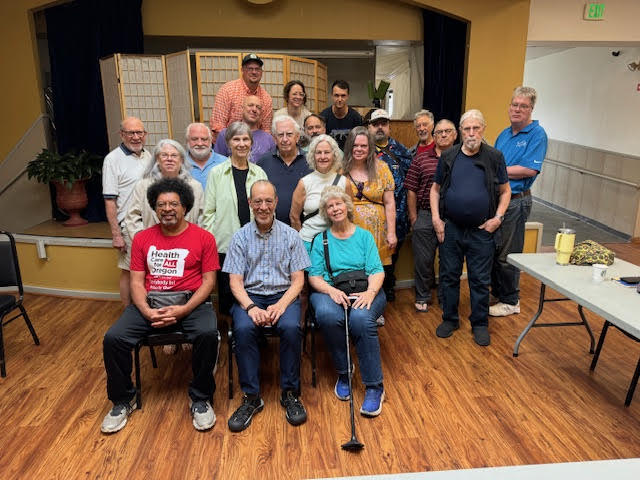 Saturday was my final constituent coffee. Here are a few of the stalwarts who stuck around at the end for a final photo. Thanks for taking it, Otto. Sorry I didn't get a photo of the Zoomers as well.
Until next time,
 Senator Michael Dembrow
District 23
email: Sen.MichaelDembrow@oregonlegislature.gov
web: www.senatordembrow.com
mail: 900 Court St NE, S-407, Salem, OR, 97301
| 

