|
Replies to this message are sent to an unmonitored mailbox.
To contact me, please click here: Rep.AnnaScharf@oregonlegislature.gov
Dear Friends,
I hope you all have a relaxing Labor Day weekend and a great start to the new school year. I can't believe summer is coming to an end and fall is just around the corner. It's been a very busy harvest season on the farm, and my time has also been filled with Legislative meetings and various tours and events in between normal farm activities. Summer went fast!
I've had several people reach out to me asking what my hours are at the Capitol during the interim. The Oregon Legislature claims to be a part time citizen legislature, but that is not my experience. When I was sworn in, Rep. Reschke (HD 55) said to me, “Welcome to your new parttime job, if you do it right, it will be full time.” He was correct. Serving HD 23, to the best of my abilities, is full time, and work I am proud to do.
Although much of the work I do is not physically in my State Capitol office, I am constantly taking virtual meetings, participating in community events and tours, and preparing legislation for the 2025 Legislative Session.
I also have full time staff, year-round, to ensure my office is always available to help. So, please reach out anytime with questions or concerns.
As a friendly reminder, the legislature is prohibited from sending official office newsletters during certain portions of the election cycle. So, this will be the last official newsletter for a few months until the General Election is complete.
The next Legislative Days will be at the end of September (23-25), which is also the pre-session bill filing deadline. In other words, any legislation my office will be introducing needs to be turned into Legislative Counsel (LC) to be pre-session filed by then. Otherwise, I will need to use one of my five priority bills to introduce legislation during the 2025 session.
As always, thank you for your support! Please reach out to my office with any questions you may have.
Sincerely,
 Anna Scharf
State Representative - HD 25
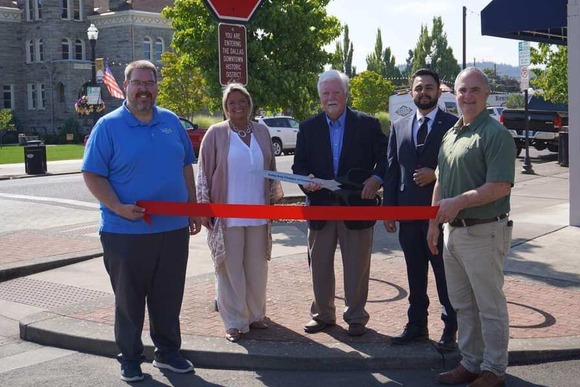 Pictured at the Dallas Historic District Ceremonies
-Celebrating the City of Dallas placement on the National Register of Historic Places-
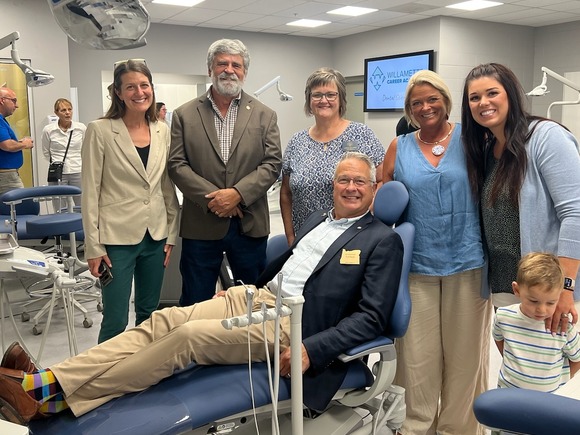 Pictured at the Willamette Career Academy
-Celebrating the launch of the Dental Program. Thank you DCI in Newberg, and the Spencer Family Foundation for the generosity that made this possible-

With recent news articles, my office has been receiving many questions about the Economic Equity Investment Program. Everything you need to know about this program is in the below bullet points:
- In the 2022 Session, the Oregon Legislature passed SB 1579, (I voted NO) which directed Business Oregon to implement the Economic Equity Investment Program to provide grants to organizations providing culturally responsive services. This includes grants for (a) Ownership of land, principal residences and other real property; (b) Entrepreneurship; (c) Business development; (d) Workforce development; and (e) Intergenerational wealth building, such as savings, investments and real property equity.
- In order to quality to be a recipient of those grants an individual, family, business or community must have a future risk due to any combination of two or more economic equity risk factors.
- The bill lists five separate economic risk factors:
- (a) Experience of discrimination because of race or ethnicity;
- (b) English language proficiency;
- (c) Citizenship status;
- (d) Socioeconomic status; or
- (e) Residence or operation in a rural location.
- Recently, Hacienda CDC, a recipient of funds under the Economic Equity Investment Program, has garnered attention due to advertising $30,000 grants for first-time homebuyers where Hacienda’s materials explicitly stated that as a condition for eligibility recipients could not be American Citizens.
-
Hacienda is now claiming that the produced materials were created by a consultant who incorrectly stated the eligibility requirements for the program and that U.S. Citizens who meet two or more of the economic equity risk factors would be eligible as stated in the law.
- Concerns were raised about the constitutionality of SB 1579 when it passed in 2022. A Legislative Counsel opinion regarding the constitutionality of the legislation which stated that “We believe that the awarding of grant moneys under section 2 (3) could give rise to a challenge under both the Equal Protection Clause and Article I, section 20, of the Oregon Constitution”.
- Bottom line, this is another example of how we need increased accountability in State agencies and how we need to reign in their ability to distributing money to nonprofit organizations with limited Legislative oversight.

The most recent quarterly revenue forecast was released this week, which you can review here. The forecast reveals that Oregon's economic situation remains delicate, with little growth, and consistent rates of inflation.
Despite modest revenue increases, the forecast underscores the need for cautious budgeting and prudent spending for the 2025 Legislative Session. Government throughout Oregon continues to expand while private industries struggle to keep up.
There are already whisperings of increased taxes coming our way for the upcoming session, which I remain adamantly opposed to. We can better balance our budget without increasing taxes. When money is tight for families, they re-evaluate their spending and cut out the unnecessary items. It is time for the state to do the same.

BM 118 increases the highest corporate minimum taxes (3% tax on Oregon-based business sales over $25M); distributes revenue to eligible individuals; state replaces reduced federal benefits. The Legislative Revenue Office has analyzed BM 118 and its findings can be found here.
There is both bipartisan opposition and bipartisan support for the measure. OPB, among other news outlets, have done articles regarding the history of this concept, you can read more here.
As this is a legislative account, I cannot ethically use any state resources to influence your vote on this BM. I only suggest, as I do with all ballot measures, that you do your thorough research to make an informed decision before you vote in November.
 Child Care Infrastructure Fund Accepting Applications on August 15 Business Oregon is pleased to announce that the application portal for the Child Care Infrastructure Program will be opening on Thursday, August 15, 2024. The Child Care Infrastructure Program provides financial assistance for childcare infrastructure activities.
Business Oregon is working with the Department of Early Learning and Care, other state agencies, and private and non-profit entities to implement this grant and loan program. This first round of funding will award a total of $10 million in grants to selected applicants.
Projects eligible under this program are restricted to fixed, immovable assets including new construction, repairs, renovations, modernizations, retrofitting, property acquisition and planning projects.
The application portal for the Child Care Infrastructure Program opens on Thursday, August 15, 2024, at 12:00 p.m. and closes on Monday, September 30, 2024, at 4:59 p.m. Access to the portal can be found on the Business Oregon Child Care Infrastructure webpage at www.oregon.gov/biz. Award decisions will be announced in November of 2024.
If you have questions or need technical assistance preparing the grant or completing the Child Care Infrastructure Program application, contact one of the Technical Assistance providers listed below.
First Children’s Finance Point of contact: Heidi Hagel-Braid Email: infoOregon@firstchildrensfinance.org
Northwest Native Chamber Point of contact: Amber Faist Email: CCIFSupport@nwnc.org

From ODFW for licensed hunters:
Like many hunters, ODFW is very concerned about this year’s record fire season and its impacts to wildlife, habitat and fall hunting opportunities.
ODFW understands hunters may have saved their points for years to draw a tag. We want them to have a quality hunt this year or the chance to delay hunting till a future year if fire has significantly impacted their hunt.
ODFW's commitment to hunters is that we will make decisions about offering reinstatement of points/refunding tags as soon as we have sufficient information to do so. This is a balancing act. A decision too far in advance of a hunt can be premature when closures are in flux. In some cases, primarily with larger “mega” fires, we can evaluate and make a decision within about two weeks of opening day based on the extent of the fire across a particular hunt unit, the duration of a hunt period, and decisions by public land managers. For other hunts, we may not know until after the hunting season ends.
ODFW staff are closely watching active fires and associated closures and evaluating how they will impact hunting. Public land managers also know the importance of hunting seasons and we are in close communication with USFS, BLM and others. Often, public land closures that were originally scheduled to be months long and covering large areas are substantially reduced in time for hunting seasons.
Factors we consider in making a decision to reinstate points include: proportion of hunt area burned, amount of accessible land, timing of reopening, length of the hunting season (with longer seasons offering more flexibility), and the severity of the burn/impact to big game. We also seek to balance providing hunting opportunity this year and a quality hunt for those with a tag while minimizing impacts on future draws. Hunters that are offered point reinstatement may still choose to go hunting that season (even just some hunters dropping out for the year helps balance hunter densities when there is a large closure).
The first widespread hunting seasons, archery deer and elk, open Saturday, Aug. 31. Fire-related closures are nothing new for archery hunters. We are hopeful that conditions will improve and areas will continue to reopen, if not by opening day, then well before the season closes on Sept. 29. Please be flexible with your hunting plans if you are able.
Currently, the units most impacted by wildfire are Silvies, Ochoco and Heppner. ODFW has reached out to archery deer and elk hunters with tags in these units to offer point reinstatement/tag refunds, as we did for pronghorn hunts.
Again, we are committed to being as proactive as we can be about communicating with hunters when their area has a substantial closure. A few things we ask of hunters:
- Be sure to have a valid email in our licensing system – email is the primary method we will use to contact you about point reinstatement/refunds. Check the email address listed in your ELS profile by logging into your account and checking Your Profile. Tell your hunting buddies, too!
- Be aware that deciding not to hunt because of fire related activity, without first hearing from ODFW, is not grounds for automatic points reinstatement. Partial closures to your hunt area, fire restrictions or inability to scout prior to the season are also not grounds for point reinstatement.
- Finally, know that once you go hunting and start using your tag, you are ineligible for a point reinstatement.
Visit our hunting and fire danger page for more information including places to check for fire closures.
If there are substantial closures in your hunt area, your hunt starts within two weeks and you have not heard from us, contact ODFW at (503) 947-6301 / ODFW.WildlifeInfo@odfw.oregon.gov or the regional field office where your hunt is to speak to an ODFW representative. If you call about a hunt that is weeks or months away, we are not likely to have a final determination on point reinstatement. Thank you for your patience and flexibility as fires on the landscape continue to impact hunting seasons in Oregon.
Capitol Phone: 503-986-1423
Capitol Address: 900 Court St NE, H-387, Salem, OR 97301
Email: Rep.AnnaScharf@oregonlegislature.gov
Website: https://www.oregonlegislature.gov/scharf
| 

