|
April 3, 2024
Dear Neighbors and Friends,
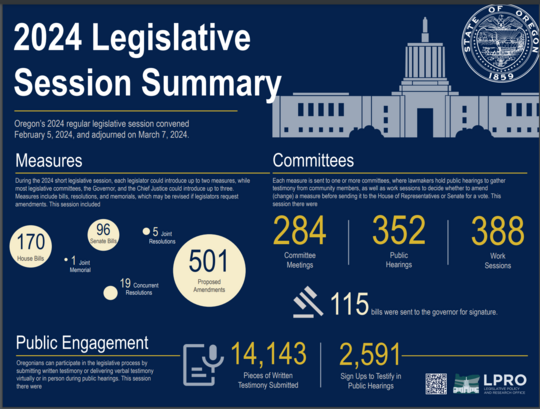 It’s been nearly a month since the Legislature adjourned sine die for the 2024 short session. The above graphic (which you can also see here) gives us a snapshot of the work done this session. As you can see, 115 bills passed and were sent to the Governor for her signature. So far, we haven’t received any indication that the Governor is planning to veto any of the bills that passed, so they should all be going into effect in the coming months. You’ll find some good resources about all the bills that passed (and those that didn’t) further down in tonight’s newsletter.
This coming Saturday is the first Saturday of the month, and that means it’s time for another SD 23 constituent coffee, this time back at the Hollywood Senior Center (with a zoom option as well). More details on that below.
Although I myself won’t be introducing any legislation in 2025, I’m spending my final months in office engaged in a number of work groups and task forces seeking to make recommendations on fixes to a number of problems. You can read about some of them in tonight’s newsletter.
I’ve also got updates for you on the new Unemployment Insurance computer system rocky rollout and the even rockier rollout of the new Federal FAFSA system.
Please do let me know if you have any questions about tonight’s newsletter.
It’s been nearly a month since the Legislature adjourned sine die for the 2024 short session. The above graphic (which you can also see here) gives us a snapshot of the work done this session. So far, we haven’t received any indication that the Governor is planning to veto any of the bills that passed, so they should all be going into effect in the coming months. You’ll find some good resources about all the bills that passed (and those that didn’t) further down in tonight’s newsletter.
This coming Saturday is the first Saturday of the month, and that means it’s time for another SD 23 constituent coffee, this time back at the Hollywood Senior Center (with a zoom option as well). More details on that below.
Although I myself won’t be introducing any legislation in 2025, I’m spending my final months in office engaged in a number of work groups and task forces seeking to make recommendations on fixes to a number of problems. You can read about some of them in tonight’s newsletter.
I’ve also got updates for you on the new Unemployment Insurance computer system rocky rollout and the even rockier rollout of the new Federal FAFSA system.
Please do let me know if you have any questions about tonight’s newsletter.
Coming This Saturday: April Constituent Coffee
Our next constituent coffee will be the first Saturday of April, 6.
This being an even-numbered month, we’ll be back (with coffee and cookies) at the Hollywood Senior Center, 1820 NE 40th Avenue (from 9 am to 10:30 am).
We’ll also have a zoom option for the meeting to accommodate those who cannot be there in person. (Register for Zoom access here)
This will be the first coffee after the 2024 session and will be a chance for us to discuss the highlights of the short session—both the accomplishments and the frustrations. It’s been nearly a month since sine die, so it’s a little easier now to put it all in perspective. It’ll also allow me to hear your priorities and recommendations for me to develop legislation in my final months in office.
Hope to see you there!
Looking Back at the 2024 Session
Even before the gavel had dropped to end the 2024 session, the eager beavers at the Legislative Policy and Research Office (LPRO) were already at work compiling their 2024 Legislative Summary Reports. They are now available online.
This is a great resource for anyone researching what Legislators accomplished—or tried unsuccessfully to accomplish—in terms of new policy or changes to existing policy during the session. These reports summarize policy measures that received public hearings during the 2024 Regular Legislative Session, including bills, memorials, and resolutions. Measure summaries are organized into chapters by policy areas and by subtopics.
These summaries relate to policy, not appropriations. You can find the summary of the 2024 end-of-session budget bill here.
Here are the 16 policy issue areas:
Addiction and Community Safety Response
Behavioral Health & Health Care
Business & Consumer Protection
Civil Law
Courts
Criminal Justice
Education & Early Childhood
Emergency Preparedness
Energy & Environment
General Government & Elections
Housing, Development, & Homelessness
Human Services
Labor and Employment
Natural Resources
Transportation & Infrastructure
Veterans
You can click on any of the policy areas to read the new legislative summary reports. As you’ll see, within each issue area you’ll find a number of subtopics. Very interesting and very useful.
But there’s more!!! New this year, LPRO has created an interactive dashboard to give you an at-a-glance view of policy measures! The dashboard allows users to explore measures by policy areas and subtopics, learn whether or not the measures were enacted, or view measures by the chamber of origin. You can also use the search feature to find measures by words in the summaries or bill numbers. Try it out!
LPRO’s general Summary of Legislation web page is here. The page is set up for browsing by policy topic for this year's and previous years' summaries.
Hope you find these resources useful. Let me know if you have any questions as you delve into them.
Looking Ahead: Update on Task Forces and Work Groups
Yes, work preparing for the 2025 session is already underway. Individual legislators are already thinking about bringing back legislation that didn’t make it in the short session, considering requests from constituents and advocates, and researching additional areas of need. However, much of the prep work (and arguably the most potentially successful) is happening in a more organized manner through task forces and work groups.
Both task forces and work groups are designed to research and resolve thorny policy conflicts. They bring together legislators and advocates on different sides of an issue and try to work things out in advance of the session. Task forces are created through legislation and are more formal in nature: their meetings are analogous to committee meetings and must be conducted in public, with agendas and livestreams posted online, and their membership is specified in the legislation. They tend to come with a price tag, which ultimately causes many of them to fail. Their passage does signify a degree of legislative approval. Work groups, on the other hand, are more informal creations of legislative committees and allow for much more flexibility. I’ve had a lot of experience with both and have had success with both. Actually, many work groups have been the result of taskforce legislation that didn’t pass, but frame the charge and membership of the workgroup. That can be a very productive model as well.
We currently have four task forces underway, all of which were created via legislation from the 2023 session. Here they are (you can click on them to go to their websites):
Of those, I’m chairing or co-chairing the two that were created by SB 283, the 2023 Educator Omnibus Bill: the Task Force on Statewide Educator Salary Schedules and the Task Force on Substitute Teachers.
They will soon be joined by six new taskforces as a result of legislation passed during the short session:
-
SB 1503 Task Force on Community Safety and Firearm Suicide Prevention
-
SB 1579 Task Force on County Child Abuse Multidisciplinary Teams
-
SB 1585 Task Forceon Additional Food Choices for Supplemental Nutrition Assistance Program (SNAP) Recipients
-
HB 4001 Task Force on Specialty Courts
-
HB 4002 Task Force on Regional Behavioral Health Accountability
-
HB 4002 Task Force on Behavioral Health Care Worker Safety.
Once these task forces get going, you’ll find links to their webpages under the “Committee” tab on OLIS.oregonlegislature.gov.
An additional five bills creating task forces did NOT pass during the short session. Some of them at least will become work groups during the interim:
-
SB 1560 Task Force on Compassionate Medical Release: This will be a Senate Judiciary work group that I’ll be chairing and is currently getting organized.
-
HB 4067 Task Force on Electric Micromobility Vehicles
-
HB 4071 Task Force on Health Professional Licensing Modernization.
-
HB 4075 Task Forceon Funding Public Safety
-
HB 4078 Task force to review student data systems in use in Oregon
There are likely many more workgroups already underway or envisioned. During my final months in office, I’m currently involved with a couple more:
-
Workgroup on Oregon’s Bottle Bill: This Senate Energy and Environment Committee workgroup is examining the incorporation of glass wine and liquor containers into the state’s deposit system.
-
Workgroup on Guardianships and Conservatorships: This Senate Judiciary Committee workgroup is working on modernizing Oregon’s system of guardianships/conservatorships and bringing them in line with national best practices.
-
Workgroup on Chronic Absenteeism in Schools: This Senate Education Committee workgroup is actually being co-chaired by Representative Hoa Nguyen and my committee vice-chair, Senator Suzanne Weber. The problem of absenteeism and its harmful effects is a topic that is much in the news these days, though our work on putting this workgroup together started last year. The workgroup will be supported by committee staff and by my own chief of staff, Emory Mort.
More On the Problem of Chronic Absenteeism
As I mentioned above, this is a topic that has suddenly been the topic of extensive news coverage lately. Chronic absenteeism (defined as students missing 10% or more of schools days in a given school year) is not a new problem, but it’s a problem that was heightened dramatically by the pandemic and seems to be closely tied to the learning loss that we see among children coming out of the pandemic. Oregon has always been a state with below average attendance rates, but we are now even worse.
You can find a good introduction to the problem and efforts in an article that appeared in last week's New York Times.. It includes data for all 50 states, based on data from the American Enterprise Institute. John Horvick from DHM Research used a data tool included in the Times article to create a district-by-district analysis for Oregon. district-by-district analyses for Oregon. (Thanks, John.)
OPB's Natalie Pate did the same in an excellent follow-up article, using numbers provided by the Oregon Department of Education, and the numbers look even worse. Some rural districts are reporting absenteeism rates over 50%. The state’s most recent annual report card shows about 38% of students statewide were chronically absent in 2022-23. According to the reporting, the ones missing the most classes are students who identify as nonbinary, who are experiencing homelessness and who have disabilities.
The Chronic Absenteeism workgroup will be examining both the causes and effects of this problem, along with best practices in efforts to address it. It’s not clear yet if we’ll see legislation and budget requests coming out of it. I’ll keep you abreast of its work.
Shifting to the New Unemployment Insurance Data System
You probably remember the deep difficulties that we faced during the pandemic as a result of the Oregon Employment Department’s outdated computer system and the necessity of modernizing it. Well, that process has finally been completed, and the new system (called “Frances Online”) is now in its fourth week. As seems always to be the case with these big computer system updates, the transition has been somewhat rocky. While most claimants are successfully using Frances Online to file their claims, others have had difficulties. Our office has been fielding some desperate requests from several constituents, and have fortunately been able to help them get their problems resolved. (Thanks Emory!)
We just received an update from Jeannine Beatrice, Deputy Director at the Department. It includes a couple of good resources for those of you who are having problems or know someone who is. As always, please reach out if you’re having difficulties.
FAFSA WOES
And speaking of computer transition woes, we’re undergoing another big one at the national level. It has to do with the Free Application for Federal Student Aid (FAFSA), the form that parents or students must fill out to see if the student qualifies for various forms of need-based aid, such as the PELL grant, work-student, federal loans, or state programs. Filling it out has traditionally been a real struggle for most families, and people have been calling for simplification for years. Finally, during the Trump administration, Congress passed a law creating a process for FAFSA simplification that would automatically connect the form to the applicant’s IRS file, which would produce most of the info automatically. A great concept, but again a rocky rollout. The automatic connection to IRS, itself a very complicated system, turned out to have many bugs. The process should have been completed and error-tested last summer, but difficulties and delays have meant that it’s still not entirely error-proof. Colleges and universities are only now getting the information on individual students, way after their normal timelines, and errors are still popping up.
On the positive side, the new form does appear to be much easier and faster to fill out. The challenge is over what comes next, i.e., after the applicant submits it (or in many cases tries to unsuccessfully) for processing.
I was on a call last week with the Secretary of Education’s office and learned that the Department has created a ,"FAFSA College Support Strategy," which is designed to help colleges and universities get through this difficult transitional year. They believe that all schools should be able to issue their award letters by the end of the month if not sooner.
Still, this is at least a month later than normal. Normally, most universities would already be sending out acceptance and award letters to students with a deadline of early May for students to decide where they want to go. As a result of the delays, many universities have been pushing back this date to allow more time. That’s true for our public universities here in Oregon. Here’s what I know at this point:
- UO and OSU extended their deadlines to June 1st
- PSU’s date was already June 15th, so they didn’t have to change anything
- SOU date was June 1st so they didn’t change anything
- EOU doesn’t have a priority deadline
- OHSU is not using a deadline this year
- OIT pushed their date of March 1st to March 15th (I assume they extended, but haven’t heard.)
- WOU extended their date from February 1st, to March 1stthen again to April 1st (they’re noting students who’ve said they had problems filing and will review them to see if they were impacted by the deadline)
For background on the FAFSA woes, here’s a good piece from the Washington Post.
Aside from the headaches that this transition has created for institutions and for families, we’re seeing another negative effect: a serious reduction in the number of FAFSAs submitted: a number of students and their families may just be giving up and writing this year off. If that indeed turns out to be the case, that would be terrible for a number of reasons.
Here's a table showing you how Oregon stacks up against other states in terms of FAFSAs received so far. As you’ll see, we’re down 23% from our number at this time last year; that’s actually better than most.
Expect a big media push from the U.S. Department of Education the week of April 15th, encouraging people that it’s not too late and they will still have many options to receive financial aid for next year. This is also true for current and continuing students who need to complete the process to continue to receive financial aid next year.
Here are the PowerPoint slides from last week’s meeting that I and my fellow Education legislative leaders had with the US Dept of Education..
I’ll let you know when I learn more.
Best,
 Senator Michael Dembrow
District 23
email: Sen.MichaelDembrow@oregonlegislature.gov
web: www.senatordembrow.com
mail: 900 Court St NE, S-407, Salem, OR, 97301
| 

