2024 Legislative Session Recap
House District 9,
As you may have heard, the Legislature recently adjourned "Sine Die" which concluded our work for the 2024 Legislative (Short) Session. This will be my last official legislative newsletter for some time as we are now entering what is called a "blackout period" during the election season from March 22nd through May 21st where official communications cannot be sent out.
Note: My staff and I will still be accessible during this time. Please do not hesitate to reach out.
Continue reading below for an update on the major bills passed during the session and other key topics.

Major Legislation Passed During Session
Below is an update on several critical pieces of legislation that passed in the Oregon Legislature during the 2024 Legislative Session.
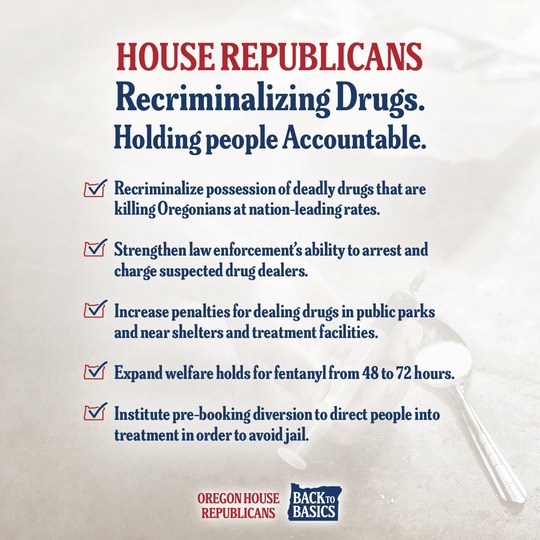
House Bill 4002 - Measure 110
When we began the session, we knew a top priority would be addressing Measure 110 which decriminalized hard drugs in Oregon. While I supported and would have preferred House Bill 4036, the House Republican proposal which would have implemented a stronger solution, I did support House Bill 4002A - the Legislative Majority's proposal to fix Measure 110. I believe this bill is the first step in a long and difficult journey of getting our state back on track.
You can read my entire statement on this here.
House Bill 4080 - Offshore Wind
I have been vocal in my opposition to offshore wind in Oregon. The Legislature was tasked with defining a state policy on offshore wind and energy within House Bill 4080. Unfortunately, there was little compromise on this across the aisle. As drafted, I believe this will make offshore wind projects virtually unattainable for small open-shop local subcontractors to pursue.
I spoke on this bill on the House Floor. You can read my speech below.
Colleagues, I and a majority of my coastal constituents, have major concerns about offshore wind energy farms along our majestic and pristine coastline. The projected areas where wind turbines may be placed are located on some of Oregon’s most productive fishing grounds. That is a grave concern.
It is possible that this project would result in a boost for the entire economy in our coastal region that is sorely needed due to the loss of many of our coastal economic interests. Closures of our federal forests, state forests like the Elliott, loss of timber and mill jobs, less than abundant fish in our rivers for our fisheries, closure of our correctional facility ending many family wage jobs, closures to parts of our beaches and sand dunes due to environmental concerns costing tourism jobs, and the list goes on. I don’t believe supporting one industry, wind energy, at the cost of eliminating another, our fisheries, is justified.
In addition, I worry that HB 4080 and the imposition of labor standards above and beyond the federal requirements, the very coastal contractors who could benefit from these projects will be cut out. The labor standards in this bill require that a contractor either be a registered training agent, or sign a project labor agreement and labor peace agreement. While these might not seem onerous at first look, they really do have the impact of excluding particularly open shop contractors from bidding on these projects. And many of our contractors on the coast are open shop contractors.
Meeting the registered training agent requirement is more difficult for open-shop contractors since there are fewer training programs for open shop contractors than for union contractors, and very few on the coast. For these open shop contractors, it’s not as simple as just “signing up.” If these programs don’t already exist, there is significant time and effort that goes into setting up these programs, and it can take several years to get the training program up and going. It’s not a quick process, or an easy process. It requires the dedication of both financial and administrative resources, often from small contractors who have less of these resources. So, while it is possible for open shop contractors to become training agents, it is much more difficult for them than for union contractors, who have the training system set up through the union itself. Don’t get me wrong, I have total respect for our skilled union workers across Oregon. I also have total respect for an open and fair access to coastal jobs.
If we want our WHOLE local economy to be able to benefit from these offshore wind projects, we need to make sure that we aren’t excluding folks from these opportunities. The bill proponents estimate 45,000-66,000 construction jobs as a result of these projects. We on the coast want as many as possible to go to our hard-working union and non-union folks living on the coast. We should stay with the federal requirements and a fair playing field for contractors. Given the difficulty for smaller open-shop contractors to meet these Oregon standards, this bill won’t allow all to benefit from these projects, and because of that, I will be a no on this bill.
House Bill 4160 - Oregon's Student Protection Law
I was proud to sponsor House Bill 4160 or “Oregon’s Student Protection Law,” which passed both the House and the Senate. This legislation is designed to reduce the opportunity for predatory sexual behavior by educators who work with children. Under current law, a “student” remains a student only 90 days after graduation/leaving the school. House Bill 4160 extends that protection to students for a full year after graduation/leaving the school.
House Bill 4156 - Modernizing Oregon's Anti-Stalking Law
I was also proud to sponsor House Bill 4156 or the "Modernization of Oregon's Anti-Stalking Law" which passed in both the House and the Senate. This legislation broadens the scope of Oregon's existing stalking law to cover many new kinds of electronic and internet harassment, including efforts to damage a victim’s identity and credit rating.
House Bill 4024 - Campaign Finance
Limiting campaign finance contributions in Oregon has long been a topic of conversation. This session the Legislature passed campaign finance reform via House Bill 4024. This bill puts limits on campaign contributions and increases transparency. This new law will cap individual contributors to giving candidates $3,300 per election – or $6,600 to a candidate who runs in both the primary and general elections. Individuals could also give up to $10,000 per two-year election cycle to multicandidate committees.
Funding Secured For House District 9
It was an honor to sponsor Senate Bill 1530 which passed both the House and the Senate and secured $1.9 million for the City of Florence for critically needed sewage and water infrastructure. The City of Florence submitted three potential projects that it would like to complete with the help of state money and was awarded money for one of the projects.
You can listen to my interview about this funding win on KCST Radio here.
I was also able to help secure $900,000 for the City of North Bend for their capital improvement project. I will continue to work on securing funding for additional infrastructure projects needed throughout our district.
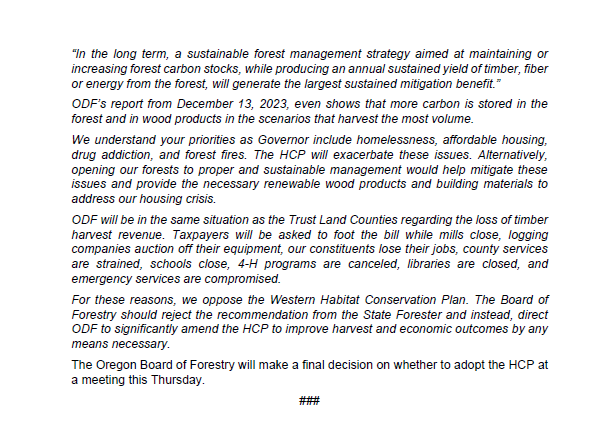
Habitat Conservation Plan
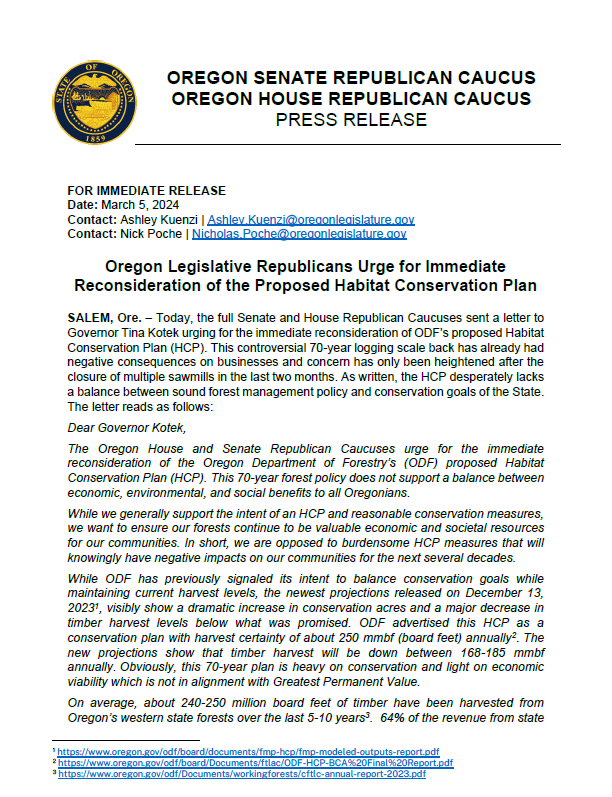
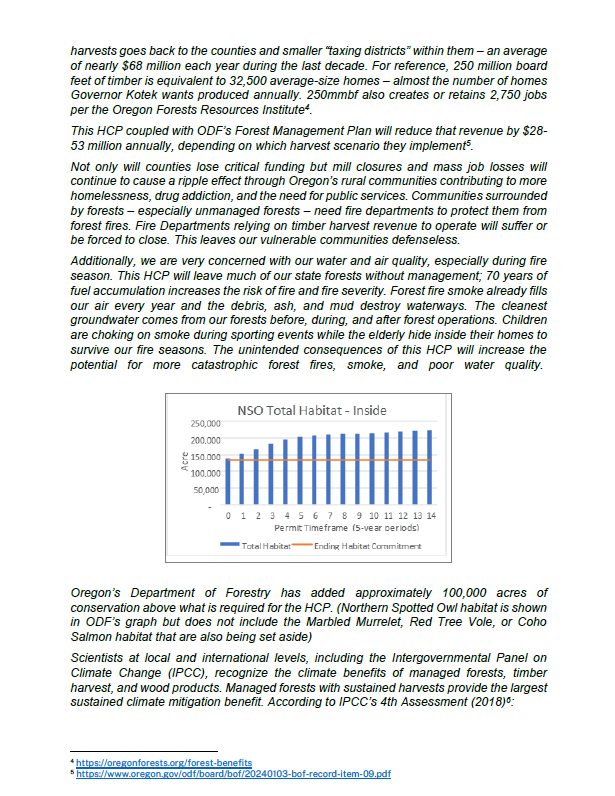
Ahead of the Oregon Board of Forestry's recent decision to approve the Habitat Conservation Plan, I joined the Oregon Republican Caucus in urging Governor Tina Kotek to ask for immediate reconsideration of the proposed HCP. The Habitat Conservation Plan is expected to cut funding to Oregon's counties by $13-15 million annually which supports Oregon schools and local law enforcement.
Elliott State Forest
I recently sent a letter to Vicki Walker, the Director of the Department of State Lands, outlining my concerns related to the Elliott State Forest and its market value. I have included the letter below.
Director Walker:
Part of the Elliott State Forest lies in my house district, so its fate is important to the people of my district. This letter asks you to please answer basic questions about its market value. The forest's market value is important because if the forest is going to be sold from the Common School Forest Lands to become a research forest, then Oregon's schools and school children must be compensated appropriately. Also, the legislature needs to know the forest's market value in order to decide what should be done with the forest.
Question #1: Has the Department of State Lands ordered a recent market value appraisal of the forest? If so, what is the forest's market value today?
Question #2: Determining a forest's market value can be done in many ways, and perhaps the most common method is to cruise the forest to find out how much timber it has, and then multiply the timber volume (usually measured in thousands of board feet) by the current stumpage rate (usually measured in dollars per thousand board feet).
- When was the last timber cruise, and what was the timber volume then?
- How much timber volume has grown since the last cruise?
- When these two timber volumes (cruise plus growth) are added together, what is the forest’s total volume of timber today?
- What is a rough guess at the stumpage rate that a private firm would pay for timber of the quality found on the Elliott State forest today?
- When the timber volume is multiplied by the stumpage rate, what is a rough guess of the total forest's market value for timber?
Question #3: I understand $221 million of proceeds from selling bonds was deposited in the Common School Fund to “decouple” the Elliott State Forest. Was this payment's size largely determined by the 2016 appraisal value of $220.8 million? Please explain how the $221 million value was determined, and does $221 million value have anything to do with the forest's market value today?
Question #4: Log values have risen since 2016 and no commercial harvesting has been done in the forest since 2016. So if the 2016 value of $221 is updated based on today's timber volume and stumpage rates, what is the implied market value of the forest today?
Question #5: The last forest management plan prepared by the Oregon Department of Forestry was written in 2011. That plan estimated the forest’s market value in 2010 as being between $300 and $554 million. If those values are adjusted to account for higher timber volumes and stumpage rates, what would be today’s implied range of market values?
Question #6: I believe your answers to the previous questions will show the Elliott State Forest is worth a lot more than $221 million today. For example, I have received what I consider to be reliable market value estimates between $1 and $1.3 billion. So my most important questions to you are:
- Doesn’t Oregon have a responsibility to pay the Common School Fund an up-to-date market value if it wants to "decouple" the Elliott State Forest?
- Isn’t any payment less than full market value equivalent to stealing from Oregon’s “Common Schools”; that is, from our school children?
Director, this entire process has not proceeded in the best interests of our children. I commend Oregon State University for their common sense in refusing to take responsibility for this fiasco. This land was placed in trust to ensure that our children were supported educationally and our communities supported through sustainable harvest. This forest’s sustainable harvest was estimated at 80 million board feet by one of the original members of the taskforce not 17 million as recommended. What we need in Oregon, and especially on the coast, are family wage jobs so families can support their children and schools can support the education of our children. There are mills in my district that have barged in logs from Canada to sustain themselves and jobs instead of harvesting a sustainable forest just 40 miles away. There is a reason these lands were placed in trust. We need to respect that trust.
I look forward to hearing from you.
- Representative Boomer Wright, District 9
Oregon Employment Department Update
As I mentioned before, the Oregon Employment Department recently updated their system. It has been reported that Oregonians are having several problems with it and are getting busy signals when they try and call for help.
If you are not receiving the assistance you need, please reach out to my office and we will do our best to help you: Rep.BoomerWright@oregonlegislature.gov.
Oregon Department of Fish & Wildlife Update
The current ODFW Director, Curt Melcher, is set to retire on April 1st. The search for his replacement is currently ongoing. On May 10, the Oregon Fish and Wildlife Commission is set to decide on a replacement.
To stay up to date on updates from the ODFW and their search for a new director, you can sign up to receive their press releases in your inbox here.
I also encourage you to email the members of the Oregon Fish and Wildlife Commission with your thoughts on what values you would like to see in Oregon's new ODFW director.
You can contact them at this email: ODFW.Commission@odfw.oregon.gov.

Rhododendron Court at The Capitol
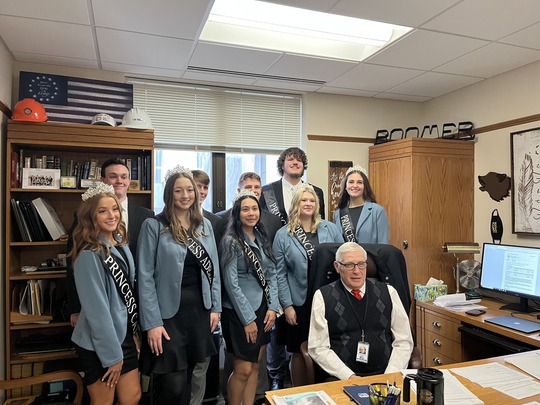
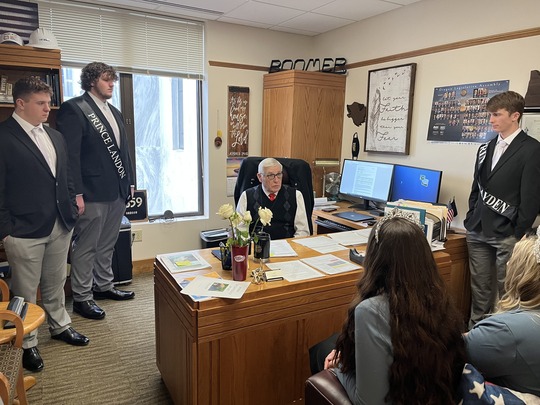
During the final days of the Legislative Session, I had the honor of welcoming the 2024 Rhododendron Court to the Oregon State Capitol! The Rhododendron Festival is the second longest continuing festival in the State of Oregon, second only to the Rose Festival in Portland. This year marks the 117th Rhododendron Festival in Florence. It will be held May 16th -19th. You don't want to miss it!
House Republican Caucus
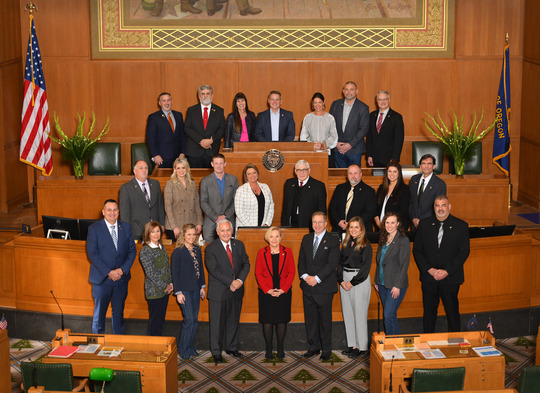
Below is our "official" portrait of the 2024 House Republican Caucus. It is an honor to work alongside so many bright and talented leaders. I am proud to call many of my colleagues in the Legislature friends.
As always, please reach out to my office if we can ever be of assistance to you. It is an honor to serve as your State Representative.
Sincerely,
Representative Boomer Wright

Capitol Phone: 503-986-1409
Capitol Address: 900 Court St NE, H-372, Salem, OR 97301
Email: Rep.BoomerWright@oregonlegislature.gov
Website: http://www.oregonlegislature.gov/wright
|