* “I am only one, but still I am one. I cannot do everything, but still I can do something; And because I cannot do everything I will not refuse to do the something that I can do.”
—Helen Keller
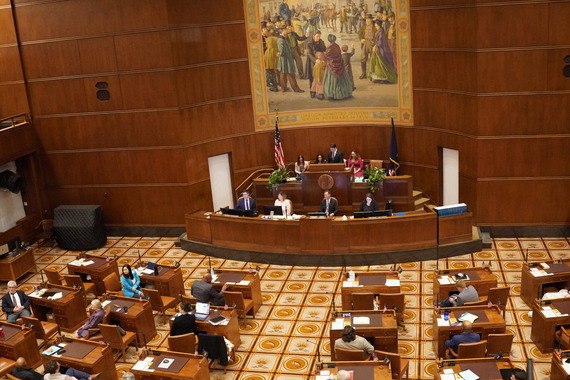 Photo from Ben Botkin/Oregon Capital Chronicle
Oregon’s 2024 legislative session is over. We adjourned sine die last Thursday evening, three days shy of the 35 day constitutional limit for short sessions. It was a sprint. Most legislators I’ve talked to are just now recovering from the whirlwind, finding their feet to either return to their non-legislative second jobs or chart out plans for the long 2025 session.
Here are the issues that took most of my time and attention this session. I’ll include video of Senate floor speeches where I can; they give some of the flavor of our real-time debate and save me from having to write (and you having to read) long dull paragraphs.
Revising Measure 110
Everyone knew from the beginning what the session’s main event would be. The public’s demand to take action on increasingly troubling and visible drug addiction was a cresting wave when we convened in early February. A bipartisan committee of Senators and Representatives had been meeting for months to craft a revision to Measure 110 and avoid a November ballot measure that many, including me, saw as a threat to return to the War on Drugs.
The result was HB 4002, which handily passed both chambers late in the session. My vote for it earned me both thanks and angry criticism afterwards. I wrote about my decision process in this email to people who had written me, and spoke to it on the Senate Floor, here.
 |
Progress on housing
The other issue expected to trigger long hard debates this session proved to be a lot easier. HB 1537, the omnibus bill for more rapid housing development, passed weeks ago with little conflict. That’s mostly the result of the Governor’s outreach to those of us who opposed last session’s housing package because we thought it indiscriminately pulled unincorporated land into urban growth boundaries and shortchanged the need for infrastructure—water sewer, power, sometimes roads—to serve new development. Both issues were addressed in the new proposal to the point that I could easily support the final package. We’ll need to monitor the roll-out to make sure that an adequate portion of the new homes will be affordable for Oregonians who aren’t affluent.
Campaign Finance Reform
This was the issue that moved me to run for the Senate in the first place. I didn’t expect it to end up where it did this session. HB 4024 was an unanticipated freight train roaring through the Capitol, an unprecedented, seemingly overnight partnership between Oregon’s Big Business and Big Labor sectors to head off a citizen initiative headed for the November ballot. When news of these closed-door meetings came out early in the session, I had the same take that longtime political expert Tim Nesbitt did when he wrote about Oregon’s “30 Years War” on campaign finance reform.
We were wrong. In the final days of the session, HB 4024 sped through committees and across the House floor, reaching the Senate floor for passage on the very last day.
Very few of those voting for the bill could tell you what’s in it. You’ll understand why if you read the whole bill, here, or merely the summary written by staff—the document meant to boil complex bills down to their understandable basics—here.
Speaking on the Senate floor, March 7th.
Six years of intense work on CFR persuaded me that two standards need to be met for a proposal to qualify as true reform. My floor speech on HB 4024 describes what they are, and why this bill fell short for me on both counts.
My scan of CFR policies in states across the country found no other state where moneyed interests can give candidates as much as HB 4024 allows. I don’t think there’s another state where there are as many conduits for donations, each making it a little harder to follow the money, as there will be here. My uneasy sense is that this bill will make Oregon the national outlier when it comes to Big Money in politics. Unlike other historic examples of the Oregon Way, this one’s not likely to make us proud.
The COAL Act
After several bills over several sessions designed to reduce the Oregon Treasury's investments in fossil fuels, passage of HB 4083—the Clean Oregon Assets Legislation, or COAL Act—was a real milestone. It directs the Treasury to —quoting from the staff summary—“try to ensure that Oregon Public Employee Retirement Funds (OPERF) are not invested in thermal coal companies or any fund containing a thermal coal company.” Bundled up when construction work cut off heat to the Senate chamber, I carried the bill on the Senate floor, where it prevailed on a party line vote of 16-13. I’m told that it’s the third fossil fuel divestment measure in the nation to become law.
There’s some basic common sense in play here. I don’t see why we’d want to invest money that originated in taxpayers’ pockets in products and activities that, over time, drive climate conditions that steadily make our wildfires more catastrophic. It seems like betting against our own wellbeing.
But a deeper dive into the issue shows its legal complexity. The constitutional separation of powers makes it highly unlikely that the legislature can order the Treasury, an executive branch agency, to do anything at all. That’s why the bill is a strong advisory direction instead of a mandate.
A second complex element centers on the Treasury’s core duty as a “fiduciary,” obligated to act fully in the best interests of its beneficiaries—most notably PERS retirees. Traditionally that’s been measured in “risk-adjusted return,” as measured by the numbers on the year-end statements for the invested funds. But investment professionals around the country are challenging that narrow definition, suggesting that other economic impacts on the beneficiaries—the costs, say, of homes and communities destroyed by wildfire, respiratory damage from long smoke episodes, spiking homeowner insurance premiums, tax increases to pay for wildfire services—also need to be factored into the equation. An intense national conversation is underway on broadening the meaning of fiduciary duty, and Oregon should be part of it.
Photo of canola fields from the Oregon Department of Agriculture
The canola story continues
Those of you who were part of the intense campaign in 2014 to ban GMO crop cultivation in Jackson County—still the only GMO-free county in Oregon—might have followed the long battle over whether canola should be regulated in the Willamette Valley. That valley’s home to what might be the most valuable specialty brassica seed industry in the world, small farmers who command premium prices because of the trusted purity of their seeds. For a decade now, the Willamette Valley Protection District has limited canola cultivation to 500 acres, a cap that would have expired this year if no bill was passed.
As I highlighted in this floor speech, a stakeholder work group nearly reached a workable compromise in recent months. When that unraveled, no proposal could come to the session that wouldn't re-ignite an old battle between different agricultural modes and beliefs. Since failing to act would have left the Willamette Valley with no sideboards on canola at all, we passed HB 4059 to extend the current system to 2028. Chances are good that the stakeholders will reach a long-term solution, probably very close to the recent work group’s almost-compromise, well before then.
 |
How will we fund wildfire programs?
After addiction policy reform and housing challenges, this was the big question going into session. My suggestion for answering it was a bill asking voters to restore part of the timber severance tax that was discontinued in the 1990s. The proposal turned into a study bill, SB 1593-3, to bring recommendations for a sound and equitable system to the 2025 session. Here’s how I laid it out to the Senate Finance and Revenue Committee, which was as far as it got this session. Two other introduced bills took very different approaches; by mid-session, this was the landscape.
To no one’s surprise, my bill prompted an angry pushback from industry leaders. They called it an example of anti-timber bias that takes no notice of all the challenges they currently face. At about the same time, we were getting buried by emails from people about provisions in the other bills to increase taxes on Oregonians generally for wildfire programs—they uniformly told us that’s a very, very, very bad idea at a time when people are feeling so many financial pressures.
So here’s where we are. All the signs point to hotter, drier, windier summers ahead, probably for many years to come. If we want to protect our communities from outcomes like the 2020 Labor Day fires or worse, Oregon needs to invest something like $100 million each year in wildfire programs. The general fund, which has shouldered most of the burden so far, can probably provide a third of that. The rest has to come from somewhere. Oregonians generally—at least the ones who write to us on proposed wildfire taxes—say Yeah, but not from us. Timber industry representatives and lobbyists—at least the ones testifying at our recent hearing—say Yeah, but not from us.
We had a chance to avoid this deadlock. In the 2023 session I introduced SB 502, which would have used $1.8 billion of the historically huge $5.6 billion income tax kicker to create a permanent Wildfire Trust Fund. A 6% investment return on that $1.8 billion would provide about $100 million every year for wildfire programs. The bill never got out of committee, and those kicker checks are going out in the mail right now.
With that opportunity gone, establishing reliably adequate wildfire funding will be a painfully steep hill to climb. We have to climb it.
And in the short term...
…we’re not doing much better when it comes to facing the realities of wildfire. Early in the session we proposed a $28 million package to fill some of the hole created last year when community risk reduction and smoke-related public health programs were slashed by some 90%. With so many important budget asks this season, I assumed we’d have to settle for less, somewhere in the $15-$20M range. The final budget included no dollars at all. Thinking about that prompted this floor speech on the last morning of the 2024 session.
For wildfire survivors
In the end, the notable wildfire bill that crossed the finish line this year was SB 1520. It responded to reports from wildfire survivors that the state was imposing heavy taxes on judgments and settlements they received from utility companies whose lines ignited fires that destroyed their homes. After all related expenses, there often wasn’t enough left over for them to rebuild.
SB 1520 ends state taxation on those settlements for wildfires that trigger an emergency declaration from the Governor. There wasn’t a ‘no’ vote in either legislative chamber on this one.
It's about time
When we get dozens and dozens of emails on a bill, they’re almost all identical, a form letter supplied by the group asking people to weigh in. One bill stood out this session for the mass of individually-written emails that came in. SB 1548 would have ended daylight savings time in Oregon, and the twice-yearly ritual of setting clocks ahead or back one hour, if California and Washington did the same (both states are actively considering the idea). Here’s the story of why it didn’t happen.
There are three camps on this issue, each, it turns out, with passionate champions:
- Daylight savings should last all year round, to give us more light into the evenings.
- Standard time should last all year round, because studies show it’s better for us.
- We don’t care! Just pick one so that we don’t have to keep making the switch!
If you didn’t get your opinion in, don’t worry. It’s a safe bet this issue will be back on the table before long.
Some help for SOU
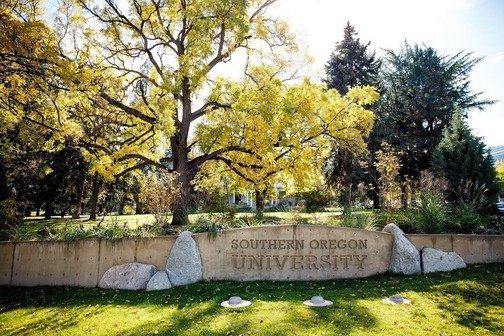
The short session always sees a scramble for dollars to address unmet needs. This time I focused my attention on Southern Oregon University. For a variety of reasons, SOU just hasn’t seen the state support that it needs to help young people advance to the lives and careers they want. When that doesn’t happen, there’s little chance to expand opportunity to groups of people who are generally left behind.
As part of a statewide plan to build out the behavioral health workforce, the Legislature adopted my plan to fund new Masters in Social Work programs at SOU and some of its sister schools. SOU President Rick Bailey was right in saying that legislators “understand that our universities are very interested in helping to be part of the solution” to the state’s addiction and mental health problems.
We also came out of session with a $6 million construction bond for the badly-needed modernization of Central Hall, a workhorse of a building in the middle of campus that has served SOU so well for many decades. (This one gave me a extra shot of satisfaction because of the ten years I spent hosting the Jefferson Exchange in the building’s dark gloomy basement, before JPR built and moved into its fine new facility.)
I'm also glad to report that we were able to bring home a little more than $2,500,000 to boost the Oregon Shakespeare Festival's comeback and a construction grant to support the Southern Oregon Historical Society.
Want more?
This summary takes in much of what I covered and more.
And if you still want more about what we did this year, Representative Pam Marsh, who represents me and many of you in the House of Representatives, is hosting a Town Hall at 10:00am this Saturday, March 16, at the Rogue Valley Unitarian Universalist Fellowship, 87 Fourth St. in Ashland. Maybe I’ll see you there.
Best until then,
 Senator Jeff Golden, Oregon Senate District 3
From Oregon Housing and Community Services:
Oregon Housing and Community Services (OHCS) is going to launch the intake phase of the Homeowner Assistance and Reconstruction Program (HARP) for survivors of the 2020 Labor Day wildfires and straight-line winds on March 25. Phase 1 of HARP will help low- and moderate-income homeowners who still need assistance to repair, rebuild, or replace their homes.
Beginning on March 25, applicants can fill out an Eligibility Questionnaire on the re.oregon.gov website where eligibility requirements are listed. OHCS will notify applicants who are eligible to apply for the first phase of HARP. Those who may not be eligible during this first phase may qualify in later phases if there are still funds available.
|