|
March 12, 2024
Dear Neighbors and Friends,
Sunday night marked the Constitutional terminus of our 2024 legislative session. However, as I’m sure you already heard, we actually finished a few days early—8:15 p.m. on Thursday, March 7. And as you’ve probably also heard, the session managed to end on a fairly upbeat note, with bipartisan agreements on the session’s major issues of housing and addiction treatment and sentencing reform, as well as a somewhat surprising last-minute agreement on campaign finance reform. (If you’ve missed the reporting, you’ll find links to the major sources at the end of tonight’s newsletter.)
There were certainly many disappointments as well, particularly around the many funding requests that went unfunded. And for many (including me) the recriminalization measure brings with it many concerns and unanswered questions.
Still, without a doubt a lot was accomplished in these five (not even) short weeks. I would certainly include the big Education Omnibus bill in that group, along with a number of the priorities for the new Environmental Caucus. At the end of the day, we were able to find funding for badly-needed childcare programs, which will be needed to build and retain our workforce. Many good things, some of which I’ll discuss in tonight’s newsletter, and others I’ll save for next week’s.
I do want to say that none of this would not have been possible without enormous work being put in during the months leading up to this session. It’s only because of many hours of work groups, task forces, research, discussions, and individual meetings that bills of this magnitude can be shepherded to passage in such a short time.
I will say also—particularly given the partisan rancor that marked the 2023 session, with its prolonged walkout by Senate Republicans—that a lot of healing needed to be done during the interim and was done. Whether through forums such as the Eastern Oregon Economic Summit during the summer, where large numbers of westside Democratic legislators traveled to listen and learn, or the Governor’s many meetings in small town after small town around the state, or Senate President Rob Wagner’s many visits to Republican Senate colleagues on their home turf during the summer and fall, or members of both parties working together in work groups and taskforces to problem solve and prepare legislation—the personal touch really can make a difference.
In tonight’s newsletter you’ll find final updates on what happened in the areas on which I myself focused most—education and climate/environment. Next week I’ll focus on the various funding accomplishments and disappointments. For now, here's a list of all the investments that we WERE able to make.
On Friday I was asked by a reporter how I was feeling on the day after sine die, particularly given that this was my last sine die. I told her that the day after sine die is always exceedingly strange, particularly after a short session. The contrast between the intensity of the session and the absence of that intensity is so powerful. It’s even more so when the end comes unexpectedly, as it did this time. (This time we had all assumed that things would end Friday night, not Thursday night, but thanks to bipartisan agreements to suspend the rules and move things along, Thursday night made more sense.)
For me, it was even stranger and more unreal because it was my last. As I think I’ve mentioned before, the renovation work being done on the Capitol means that the Senate chamber will not be available and accessible for meetings during the remainder of the interim. (Senate confirmations of Governor appointments will take place in one of the hearing rooms during May, September, and December legislative days.). Even the parking garage underneath the Capitol, where legislators normally park, will be off limits to us between now and January. Lots of little things, little realizations of passage.
Fortunately, on that final day I was able to carry the Omnibus Education Bill (more on that below) to the Senate floor, where it passed overwhelmingly, as it did on the House floor. And then in the final hours before adjournment I was privileged to carry HB 4080,, a bill focusing on the deployment of offshore wind off the Southern Oregon coast. It would be my final speech of the session and of my legislative career. It’s a bill that combines three of my ongoing passions: the need for renewable energy as one important piece of climate action; the need for ongoing commitment to strong labor standards and good jobs; and the need for apprenticeships and similar career pathways for our young people. It was a privilege to be allowed to carry it. You can read my floor speech here. I’m happy to report that it passed and is now on the Governor’s desk awaiting her signature.
Please do let me know if you have any questions about tonight’s newsletter. More to come next week.
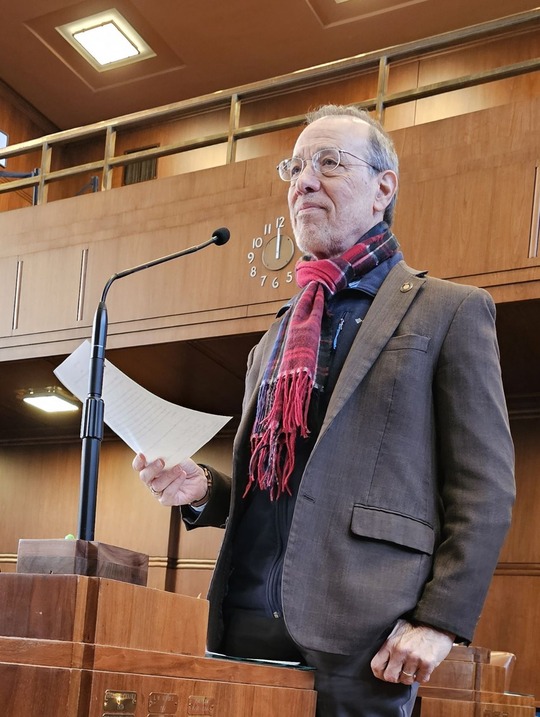 Here I am delivering one of my final floor carries. As I mentioned in my previous newsletter, we were having problems with the heating in the Senate chamber as a result of the construction going on, so you can see that I'm quite bundled up.
Coming Tomorrow: Post-Session Town Hall
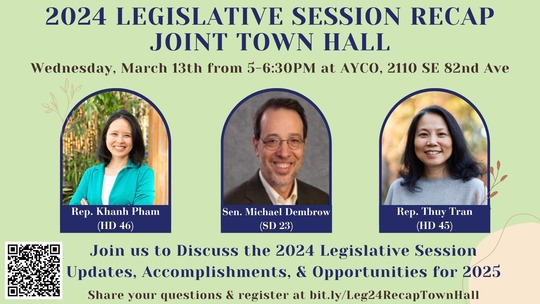 And coming up tomorrow, our in-person SD 23/HD 45/HD 46 debrief. I hope you can join us for our End of Session Joint Town Hall on Wednesday, March 13th from 5pm - 6:30pm. You can register here and submit questions to help direct the discussion. Looking forward to seeing you then!
Education Omnibus Bill Moves to the Governor’s Desk
I’m very proud to report the successful passage of SB 1552 , the so-called Senate Education Omnibus Bill in this, my last session in the Legislature. After many months of preparation work, we were able to assemble the many pieces of this year’s omnibus education bill (ultimately addressing 20 different issues), meet with the affected parties to work out potential problems and get the language right, and get it over the finish line in a very short period of time. Actually, it could never have been successful if not for all that preparation.
For a description of all the issues addressed in, here’s a section-by-section overview of the issues addressed in the bill. Half of them were essentially technical fixes of bills that had passed in 2023 and had unintended consequences or other unintended problems. The rest included a number of attempts from past sessions that got lost in Ways and Means or otherwise weren’t able to make it through on their own, but packaged together as a group were able to find the necessary support. Many are essential to further work that needs to be done by the Legislature in 2025. Here are some highlights:
-
Youth Advisory Group: This assembly of students from around the state, representing a range of geographic, racial, ethnic, and gender identities, will advise the Oregon Department of Education on issues affecting youth, providing a long-needed student voice.
-
Collecting Course Grade Data: Currently, districts do not provide ODE with information about the courses students are taking, their course grades, or their GPAs. (They currently only provide data on student scores on standardized tests.) The Department will create a process for collecting this data for middle and high school students. It will be especially important to accomplish the next item.
-
Direct Admission: The Higher Education Coordinating Commission will develop a process for graduating high school seniors automatically to be admitted to the colleges and universities for which they qualify on the basis of their GPAs. This is an approach that is beginning to be used around the country and has been found to make a real difference in increasing college-going for students who would be first in their families to attend college but didn’t necessarily think of themselves as college material.
-
Modernizing the Quality Education Model. Oregon’s model for funding K-12 education, as well as system for overseeing how those dollars are distributed to and spent by districts is badly in need of an overhaul. The Legislative Policy and Research Office will work with national experts to recommend changes that align us with best national practices. Legislators and the Governor’s Office will then prepare legislation to implement those changes in 2025.
-
Stabilizing Funding for Youth Corrections. The methodology for funding education for youth in county jails (JDEP) and state prisons (YCEP) has changed from year to year, creating a great deal of uncertainty and discontinuity. SB 1552 will provide stability and predictability in funding in order to better get these kids the education and training they need to reintegrate back into the community.
-
Classified Educational Staff Included as “Educators” for Programs Funded by the Educator Advancement Council. Classified employees, such as Instructional Assistants, who play such vital roles in educating our kids, are currently not included as “Educators” in the statutes for the Educator Advancement Council, which funds a number of programs to help recruit and retain educators. They need to be, and now they will be.
-
Removing Barriers for College Students in Remedial Programs: National best practice is suggesting that many new college students who test into remedial courses can succeed in college-level courses with the proper supports. These so-called “Co-Requisites” have been shown to help students get to their majors and lower the dropout rate—IF they are done right. Faculty, administrators, and policy experts will meet and work to make sure this is the case.
-
Funding Applied Baccalaureates. The Legislature has made it possible for community college students to receive bachelor’s degrees in certain applied fields—but has not made it possible to provide state funding support for these students. SB 1552 directs the HECC to use the regular CC support fund to do so.
-
Forestry Workforce Study. We are experiencing a shortage of workers in the forestry industry. SB 1552 provides funding to the HECC to do a study of industry needs and training gaps, and make recommendations for creating better pathways for young people to enter this workforce.
-
Access to Licensing Pre-Determination. This will allow individuals who have a criminal record to seek and receive a pre-determination from a licensing board as to whether or not they can work in this area, given the specific nature of their offense and rehabilitation, BEFORE they embark upon a course of study or apprenticeship. This will save them and us a great deal of expense and frustration.
For a discussion of why the Education Omnibus Bill is so important in setting us up for the next session, I’d recommend this reporting from the Oregon School Boards Association entitled "The 2025 Legislative Session Already Under Construction."
Update on All the Education Bills
Here’s the final update on the bills that passed out of the Senate Education, House Education, and House Higher Education committees. As you'll see, 14 were ultimately successful, and 9 were not. Here’s an overview of this session’s education accomplishments from OPB.
Passed Both Chambers
SB 1502 Requires school district, community college, and university boards to post recordings of their meetings online to ensure public access. Passed Senate 29-1. Passed by the House 55-1. Awaiting Governor’s signature.
SB 1532 Directs the Department of Education to develop a Student Success Plan for Immigrants and Refugees. Passed the Education Subcommittee of Ways and Means unanimously. Passed full Ways and Means unanimously. I carried it on the Senate floor, where it passed 22-8. Passed House 46-11. Awaiting Governor’s signature.
SB 1552 The “Education Omnibus bill.” It makes a number of technical fixes to bills that passed last year and that needed repair or clarification. It also includes some items that passed out of committee last year but then got lost in the Ways and Means process. It includes others that address timely issues that arose after the close of the last session. Finally, it also directs studies and work-groups to prepare for the 2025 session. Here is a section-by-section overview of the issues addressed in the bill. Passed out of the Senate Education Committee on a 5-0 vote. Passed by the Capital Construction Subcommittee and then full Ways and Means unanimously. Passed the Senate 23-5 and the House 48-8. Awaiting Governor’s signature.
SB 1558: Makes clarifying changes to SB 819 (2023), the controversial bill from last year designed to ensure that all students have access to a full school day if they and their parents so desire, irrespective of their disability. SB 1558 makes it clear that students who have otherwise completed their required credits can be released to work or take college credits during the school day. Passed Senate 30-0 on February 21. Passed out of House Education 6-0. Passed by the House 54-0 today. Awaiting Governor’s signature.
SB 1592 Appropriates $6 million to Oregon universities to develop and support much-needed programs and students in Behavioral Health. Folded into HB 5204, the addictions funding bill, which passed the House and Senate. Reduced to $4 million.
HB 4082 Creates the Summer Learning Grant Fund and in its original form would have appropriated $50 million to the fund for this year. Identifies goals, purposes, success metrics, and oversight of summer learning programs going forward. This is one of the Governor’s funding priorities for the session. Passed out of House Education on a 7-0 vote. to the Education Subcommittee of Ways and Means, where it passed unanimously with a $30 million appropriation. Passed full Ways and Means unanimously. Passed the House 53-4. I carried it on the House floor, where it passed the Senate 26-4. Awaiting Governor’s signature.
HB 4084 We know that success rates for current and former foster youth are much lower than for their peers. This measure seeks to begin to change that, directing the Oregon Department of Education to establish and administer a pilot program to provide three public middle or high schools with funds to address academic disparities experienced by foster child students. Passed out of House Education on a 7-0 vote. Referred to the Education Subcommittee, where it passed on a unanimous vote. Passed full Ways and Means unanimously. Passed the House 57-2. Passed the Senate 26-3. Awaiting Governor’s signature.
HB 4119 A follow-up to SB 5 (2021), which allowed Oregon athletes to benefit financially from use of their Name, Image, and Likeness (NIL). HB 4119 prohibits the NCAA and like associations from investigating schools or athletes for potential violations. Protects Oregon institutions of higher education from liability for damages as a result of the institution's attempts to identify and facilitate NIL opportunities for the student athlete. After passing the House, this bill went to Senate Rules at the request of the Rules Committee Chair. Passed out of House Higher Education on an 8-0 vote. Passed the House on a 50-4 vote. Passed out of Senate Rules 5-0. Passed the Senate 18-12. (I was a No vote because of the provisions that shield universities from either investigation by the NCAA or a lawsuit by students who believe they have been given bad NIL advice.) Awaiting Governor’s signature.
HB 4137 Directs the State Board of Education to develop rules that would exempt students who have completed full International Baccalaureate programs from having to meet all other high school graduation requirements. Passed out of House Education on a 7-0 vote. Passed the House on a 54-0 vote. Passed Senate Education on a 5-0 vote. Passed the Senate unanimously. Signed by the Governor.
HB 4147 Allows school districts to mount stop-arm cameras on school buses and for police to use footage from those cameras to cite drivers who fail to stop. Passed out of House Education on a 7-0 vote. Passed the House on a 49-5 vote. Passed 5-0 out of Senate Education. I carried it on the Senate floor, where it passed 25-1. Awaiting Governor’s signature.
HB 4154 Directs $14.9 million to institutions of higher education and $15 million to the Semiconductor Talent Sustaining Fund. Passed out of House Higher Education on a 9-0 vote. Referred to the Capital Construction Subcommittee of Ways and Means, where it passed on March 1. Passed unanimously by full Ways and Means. Passed the House 52-4 and then the Senate 24-4. Awaiting Governor’s signature.
HB 4160 Extends the prohibition on sexual conduct by educators with their students from 90 days after the student has left school to a full year. Passed the House 58-0 and the Senate 29-0. Awaiting Governor’s signature.
HB 4164 Makes consensus changes to HB 3456 (2023), which created a statewide Sexual Misconduct Survey Council to develop a standard statewide sexual misconduct climate survey for Oregon’s colleges and universities. These changes will make it easier to implement, recognizing differences between larger and smaller institutions. Passed out of House Higher Education on a 9-0 vote. Passed the House on a 53-1 vote. Passed out of Senate Education 5-0. Passed the Senate 26-3. Awaiting Governor’s signature.
Bills That Failed to Move
SB 1551 Gives temporary access to the Oregon Promise for students in the High School "COVID Cohorts" of 2020 and 2021, even though they didn't go immediately to community college following graduation. Passed out of Senate Education 5-0. Moved to Ways and Means. Never referred to a Ways and Means subcommittee.
SB 1583:This bill has become one of the most controversial of all the bills so far this short session. It touches on a subject that has become a feature of the culture wars that are pervasive right now. It prohibits discrimination when selecting textbooks, instructional materials, program materials, and library books for use within Oregon public schools. It prohibits districts from banning textbooks, library materials, or other instructional materials because they tell stories or include the histories of groups protected from discrimination by Oregon law (i.e., by their race, gender, ethnicity, or disability, or because they are gay, lesbian, bisexual, or transgender). We have seen such prohibitions and book bans proliferating around the country. SB 1583, whose chief sponsor is Senator Lew Frederick, will ensure that such bans do not occur here in Oregon.
We had a lengthy public hearing on the bill on February 13, with many people signing up to speak for and against. Those speaking in support outnumbered those speaking against. Most of the oppositional testimony emphasized the rights of local districts to make decisions that reflect their local values and prohibit children from having access to materials and perspectives that don’t reflect those local values. Those speaking in support emphasized the importance of giving children access to historical truths and a variety of perspectives. More than a thousand pieces of written testimony came in, again with a strong majority being in support of the bill. You can find the testimony here.
SB 1583 passed out of committee on February 15 on a partisan 3-2 vote. It then went to Senate Rules to allow the Republicans to file a “minority report,” an alternative that would have turned the new policy into a task force. Minority Report was rejected on a party-line vote. SB 1583 passed the Senate on a party-line 17-12 vote. Moved to House Rules. Voted out on a 4-3 party-line vote on March 6. Republicans indicated that they would add a minority report (turning it into a task force), which meant that it could not come to the floor before Saturday. Adjournment meant that it could not move. The sponsors are planning to bring it back in 2025.
HB 4068 Dramatically expands and increases the High Cost Disability Account (which funds supports for students with particularly high-cost needs) so that more resources go to districts that need them. The cost of the measure is estimated to be $150 million per year. Passed out of House Education on a 7-0 vote. Moved to Ways and Means. Never referred to a Ways and Means subcommittee.
HB 4077 This had started off as a companion bill to HB 4068 that was no longer needed. The -3 amendment turned it into a bill that addressed another need: the need to develop a better reporting system for school employees to report incidents of injury in a way that would allow for state-wide tracking. Passed out of House Education on a 7-0 vote. Moved to Ways and Means. Never referred to a Ways and Means subcommittee.
HB 4078 Creates a task force to study and make recommendations for creating a statewide data system that all districts could use. It would facilitate the transferring of student records and individualized educational programs when students change districts. Passed out of House Education on a 7-0 vote. Moved to Ways and Means. Never referred to a Ways and Means subcommittee.
HB 4079 Lifts the cap percentage cap on the amount of moneys that are distributed from the State School Fund to school districts for students eligible for special education as children with disabilities. The State provides extra dollars to districts to support students with disabilities, but for budget reasons those extra dollars are capped at 11% of the funds going to the district. HB 4079 would lift the cap. Passed out of House Education on a 7-0 vote. Was referred to the House Revenue Committee, where it has received a public hearing and an informational hearing. Never scheduled for a vote.
HB 4125 Directs the Legislative Policy and Research Office to contract for a study on the effects of the changes in university governance (individual university boards and a Higher Education Coordinating Commission) since they began ten years ago. Will compare this model to models used in other states. Passed out of House Higher Education on an 8-0 vote. Never referred to a Ways and Means subcommittee. I’m planning to work on doing much of this data-gathering in-house over the next few months.
HB 4162 Appropriates $5 million for grants to colleges and universities to help support students with basic needs (e.g., cost of textbooks, food, housing, childcare). Passed out of House Higher Education on an 8-0 vote. Never referred to a Ways and Means subcommittee.
HB 4163 Last session the Legislature made a one-time appropriation of $5 million to support “wraparound” student success and high school-to-college transition programs such as College Possible, Trio, AVID, and ASPIRE, organizations with strong records of success. HB 4163 will make this support ongoing, with $86k this year and another $5 million in 2025-27. Passed out of House Higher Education on an 8-0 vote. Never referred to a Ways and Means subcommittee.
And an Update on the Environmental Caucus Priorities
Here’s the rundown on the Enviro Caucus priorities (and here's an end-of-session review of climate/environment bills from OPB.
SB 1559 Updating Oregon’s Emissions Reduction Goals. Following public hearing in Senate Energy and Environment, not scheduled for a vote.
SB 1596 Right to Repair: Will allow owners of most consumer electronics products to do their own repairs or have the repairs done by local small businesses. Passed Senate 25-5. Passed the House 42-13. Awaiting Governor’s signature. Here’s reporting from the Oregonian.
SB 1572 Studies extending the Westside Express Service (WES) commuter line to Salem. Never referred to a Ways and Means subcommittee.
HB 4015 Clarifies and streamlines the process for siting battery energy storage systems. Passed House 44-13. Passed the Senate on a partisan 16-13 vote this morning. Awaiting Governor’s signature.
HB 4132 Investing in Oregon’s Marine Reserves. Passed out of the Natural Resources Subcommittee of Ways and Means and then full Ways and Means. Passed the House 55-0. Passed the Senate 26-3. Awaiting Governor’s signature.
HB 4080 Creates Roadmap for Offshore Wind, Sets Robust Labor Standards. Passed out of the Natural Resources Subcommittee of Ways and Means and then full Ways and Means. Passed the House on a bipartisan 37-25 and the Senate on a partisan 17-13. Awaiting the Governor’s signature.
HB 4083 “The Coal Act”: Begins to divest Oregon public funds from companies with holdings in coal. Passed the House 33-24. Passed the Senate on a partisan 16-13 vote this morning. Awaiting Governor’s signature.
SB 1561 Monsanto Settlement Funds: In 2022, a settlement was reached between the State of Oregon and Monsanto for $698 million, the largest environmental settlement in the state's history. SB 1561 puts that settlement into a trust fund and establishes the Environmental Restoration Fund for the next 50 years of environmental remediation work. Passed the Senate 26-4 and the House 54-2. Awaiting Governor’s signature.
Other Funding Requests the Caucus is Supporting
Along with the bills referred to Ways and Means mentioned above, the Environmental Caucus was also supporting funding for the following bills that were still awaiting final funding decisions in Ways and Means at sine die.
PFAS Study Bill (HB 4049) Was not funded.
Landowners Living with Beaver Grants (HB 4014) Was not funded.
The Wildlife Omnibus Package (HB 4148) Was funded at a reduced amount.
Elk Damage Prevention and Compensation Fund (HB 4061) Was not funded.
The Oregon Agricultural Heritage Program (HB 4060) Was funded at a reduced amount.
DEQ Toxic Plume Study Bill (HB 4044) Was not funded.
The Caucus also supported additional appropriations for
- DEQ's Charge Ahead EV rebate program; Was not funded.
- Funding for ODFW positions to work with the Klamath Tribes on fish monitoring on the Klamath Riverin the wake of dam removal; Was funded at a higher-than-requested rate.
- Funding for tribes and environmental justice communities to address water equity and infrastructure issues. Was funded at a reduced amount.
- And funding for wildfire programs.Only the costs of firefighting for the last wildfire season were funded, along with helping communities cope with the costs of past wildfires. No new funding for prevention programs.
For more information about the Caucus, here’s the caucus website.
Additional Links Regarding the 2024 Session
And Some COVID Updates

Best wishes,
 Senator Michael Dembrow
District 23
email: Sen.MichaelDembrow@oregonlegislature.gov
web: www.senatordembrow.com
mail: 900 Court St NE, S-407, Salem, OR, 97301
| 

