|
Dear Friends,
It's official, the 82nd Oregon Legislature adjourned late on the evening on March 7th. If you've stayed up to date with my previous newsletter, you know the last weeks of session are extremely challenging to say the least. Serving on four policy committees, meeting with stakeholders and constituents, voting on the House Floor, and thoroughly vetting legislation makes for some long and busy days. Regardless of the challenges, I am honored to be in this position and to serve House District 23.
As a friendly reminder, the legislature is prohibited from sending official office newsletters during certain portions of the election cycle. So, this will be the last official newsletter for a few months. The next one will be the end of May during Legislative Days (May 29-31) and then again in September during Legislative Days (September 23-25).
However, our office continues working and is here to help with questions or concerns that you may have. Please reach out to our office if we can be of any assistance.
I wish you all a wonderful rest of the spring and into what I hope will be a fantastic summer. Your support and engagement are always appreciated.
 Anna Scharf
State Representative - HD 23

The Good:
-
HB 4002: Recriminalizes the use of hard drugs, partly repealing portions of M110. Read information from previous newsletter here. While this legislation was a good move in the right direction, there is still much work to be done to slow Oregon’s drug crisis brought on by the passage of M110. Here are a few of the things that will need to be addressed in 2025:
- The ability of counties to opt in/opt out of pre-booking diversion means there will still be some counties like Multnomah that will probably see no change with this bill. We need to find ways to hold rogue, activist DAs accountable.
- We need to find more ways to increase penalties for those who deal and manufacture drugs to make it clear that Oregon will not tolerate it.
- We need easier access for third parties to compel treatment, especially for parents.
- Oregon is still spending too much funding on corrupt activists who enable drug use. That money should always go to evidence-based treatment.
- We need to have more strict regulations on drug encapsulating, tableting, or counterfeiting equipment.
- We need to make sure that police discretion is protected, and we don’t reverse course again in four years.
- Counties need stable funding guarantees, so programs don’t become burdensome unfunded mandates.
-
HB 4024: Campaign finance reform, which will fundamentally alter Oregon’s campaign finance system beginning January 2027. Campaign spending in Oregon has long been characterized by the absence of limits accompanied by thorough transparency. This is a bi-partisan bill that I supported. For many years, Oregon was one of the few states in the nation without any campaign finance reform limits, but after Ballot Measure 107 passed in 2020, which allowed the state to adopt limits, it was only a matter of time before we got some kind of regulation. Competing ballot measures that threatened campaign finance reform of some sort were being circulated and set to go on the November ballot. This encouraged legislators to negotiate on a bill. As a result, the ballot measure campaigns have dropped their efforts. Under House Bill 4024, starting in 2027:
- Individuals and businesses will be capped at giving only $3,300 per election to a candidate for State House, State Senate, circuit court judges, district attorneys, and local candidates like city council. Individuals and businesses will be capped at $10,000 to give to state parties and caucus committees.
- What is also new is small-donor committees (SDC) and membership organizations. Individuals and businesses will be able to contribute up to $250 per year to an SDC and an unlimited amount to membership organizations. An SDC is defined as a committee that doesn’t take any contributions over $250. In turn, membership organizations can give up to $66,000 to State House, State Senate, circuit court judges, and district attorneys and $33,000 to local candidates per election year. SDC’s may give $33,000 to statewide candidates for every 2,500 donors they have. If they meet the 10,000 donor threshold, they can double their giving from $132,000 to $264,000.
- There are also allowances for membership organizations to donate in-kind personal services, meaning they can pay someone to work on a candidate's campaign or donate office space to be used as campaign headquarters.
-
SB 1562: Increases the limit for transferring funds from the General Fund to the Rainy Day Fund from 7.5 percent to 12.5 percent of revenue received in the prior biennium. This will allow the state to increase the reserve limit in Rainy Day Fund. The current deposit is at 7.2% and the cap is at 7.5%. By raising it to 12.5% it will allow for future growth of the fund and stability in the state should it be needed. This does NOT affect the kicker. While revenue forecasts have remained optimistic, it is still important for the state to plan for a time when revenues are not as rosy.
The Bad (some passed and some will be back):
-
HB 4129 (Passed): Agency choice - this is a loophole bill to grow membership for SEIU 503 and to work around the US Supreme Court Ruling (Harris v. Quinn). Similar legislation was passed in Washington in 2018 and the projected cost to the state has tripled since it passed. There have been no added benefits to workers of those receiving services from the state. Read more here.
-
SB 1559 (Failed): Would have tightened Oregon’s greenhouse gas emissions goals unrealistically. It is legislation like this one which is adding to the increased utility costs and I expect to see it come back in 2025.
-
HB 4080 (Passed): Applies onerous labor requirements on offshore wind projects. While offshore wind is years away, this bill sealed the deal in how those projects might move forward instead of telling the Federal Government that Oregon Coastal waters are not for sale. Read more information from a previous newsletter here.
-
HJR 201 (Failed): Would have increased property taxes to help with emergency wildfires, but died in committee. Be prepared to see this legislation again next year alongside many other ideas on how to tax property to pay for various state programs.
-
SB 1583 (Failed): The stated goal of this bill by supporters was to prohibit discrimination in schools when it comes to curriculum, libraries, and other instructional materials. However, the main intent of SB 1583 was to ensure that teaching all forms of sexuality, gender identity, and critical race theory was enforced. SB 1583 would ultimately take power away from local communities who are standing against the radicalized ideologies being brought into schools. This bill passed in the House Committee on Rules, almost made it to the House Floor for a final vote, but due to a Minority Report being filed the bill did not meet the deadlines in time for Sine Die.
The Misses:
-
SB 1537 (Passed): Gov. Kotek’s housing bill. This bill had some good components to it, but fell short when it gave the authority to go around Oregon’s 50-year-old land use laws with no protections for farms and forestry operations. The bill also created a new department in the Department of Land Conservation and Development office which will give out $5M in technical assistance grants to help communities navigate housing development. However, to do so, there was a cost of $5.6M to stand up the new department and create more government. Other funds in the bill were also well intended such as a project revolving loan fund for cities, and assistance with development costs. However, it fell short again with millions dedicated to new government positions to manage projects and coordinate government agencies. Bottom line, this bill has too much government in it, and it gives a free pass to ignore land use planning. Oregon’s land use laws were put into place to protect farm and forest lands. By placing housing right up against those lands without any protections for existing farming and forestry practices, it puts them at risk for future regulations because urban moved into rural.
-
HB 4133 (Failed), SB 1511 (Failed), SB 1520 (Passed): Bills to address wildfire funding. The cost of wildfire funding in Oregon has increased greatly over the years. While the why can be argued in many ways, the bottom line is costs are going up. There were three proposals to boost funding this session. HB 4133 was a bipartisan bill but died in Ways & Means, SB 1511 also died in committee. SB 1520 that passed will ensure wildfire survivors do not need to pay state income tax on compensation and settlements from losses. The issue of wildfire funding will certainly be back in 2025.
-
HB 4059 (Passed): Canola has been a controversial coexistence conversation in Salem since 2013 and continues to have no real solution. A workgroup held last summer came up with several agreements but left the issue of GMO crops unsettled. The result was another extension of the 500-acre cap in the 3.69M acres of the Willamette Valley with a new sunset date of 2028. I remain committed to working with the Governor and the Department of Ag on finding a coexistence solution to introduce in the 2025 session. Farmers are struggling to find rotation crops and crops in general to maintain their farms. With the downturn in the grass seed industry, farmers are asking for something to plant. Many of them want to try canola, but 500 acres won’t make a dent in that need.

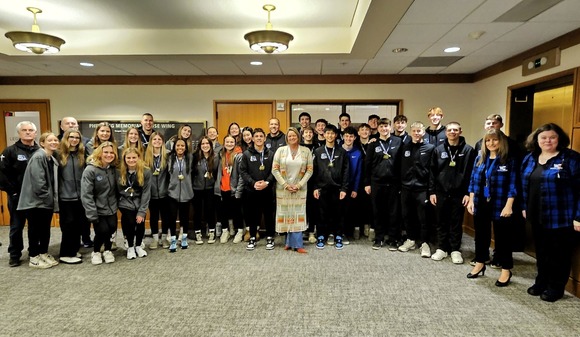 Western Christian Boys and Girls 2A State Basketball Championship teams were honored by Rep. Scharf on the Floor of the House.
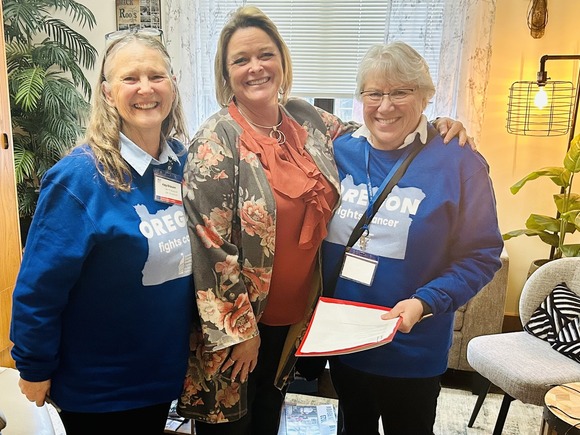 Meeting with constituents on the American Cancer Society Lobby Day.
 It takes a village! I missed meeting the FFA State Officers on the farm, but I was able to give them a courtesy on the House Floor. Congratulations to this group!
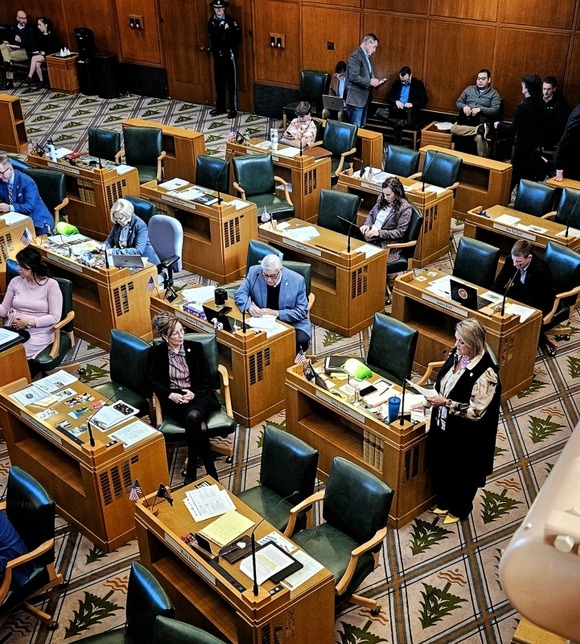 Rep. Scharf giving a courtesy congratulation to the Dallas High School Boys & Girls Wresting teams! The boys took home the1st place finish at the 5A Championship, and the girls took home the 2nd place trophy.

State Board of Forestry Passes Habitat Conservation Plan
Last week, the Oregon Board of Forestry approved a 70-year plan that will reduce timber operations on about 630,000 acres of state-owned timberland in the state of Oregon. The plan passed narrowly, along a 4-3 vote.
The effort is aimed at protecting endangered species. (We know how well the government has been at doing that: Shooting barred owls to save spotted owls in the Northwest)
The plan will crush rural communities that thrive on their timber industry to provide jobs and tax revenue for local services. While Polk and Yamhill Counties will not experience the losses projected for other counties, it is still a hit to these communities that will result in the need for the State to step in which may reduce available funds to other counties
It’s not just county budgets, which include services like elections, sheriff's offices, and road maintenance. School districts also rely on timber revenue from state lands.
The day before the vote, the entire House and Senate Republican Caucus sent a letter to the Board of Forestry asking them to reject the plan and revise it with a less damaging one. Read full letter here.
How State Policy is Driving Utility Bill Increases
We all know inflation has caused everything to be more expensive. But it’s not just government spending that causes inflation to increase – it’s regulation too.
You might have seen increases on your utility bill at the beginning of this year. PGE kicked off the year with a 17% increase in rates for customers. It’s easy to blame PGE for the increases, but we must take a closer look at why they are increasing their rates.
Take a look at the recent filing from PGE about why they will be requesting another rate increase in 2025. They talk about the investments they are making in “clean energy.” Whatever you think about this kind of energy, the bottom line is that it is just more expensive. Yet, government, at both the federal and state continues to push utilities in this direction.
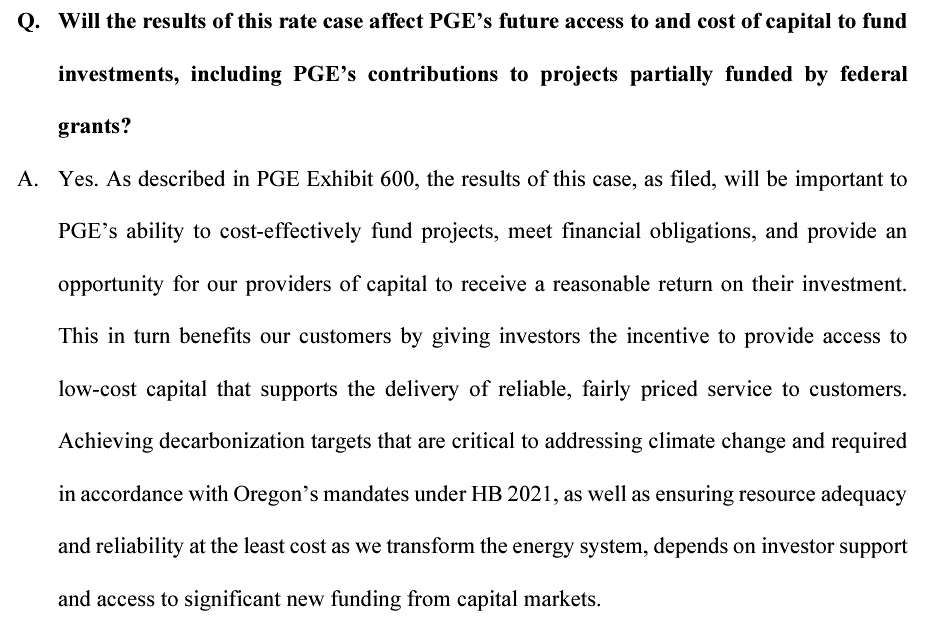
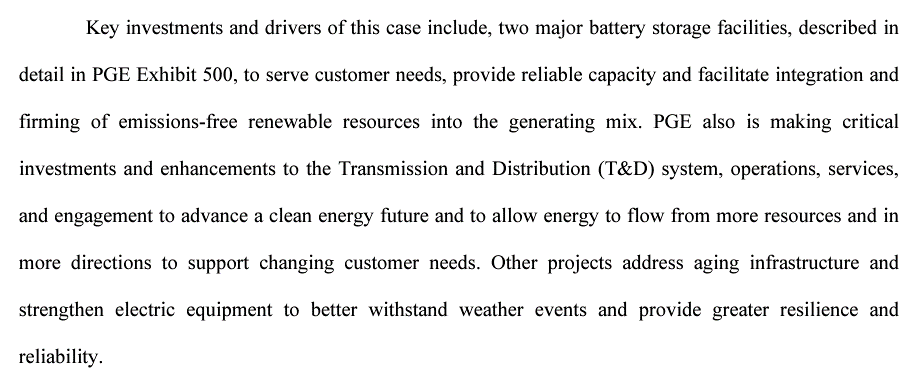 In their testimony in support of the rate increase, PGE’s CEO and Vice President of Strategy Regulation and Energy Supply contend that this rate increase is necessary to comply with the mandates of Oregon House Bill 2021, which requires PGE and Pacific Power to submit plans to reduce emissions by 80% from a baseline amount by 2030, 90% by 2035, and completely eliminate emissions by 2040.
From Oregon Employment Department:
We have updated the partner toolkit with talking points, a “What’s Changing for Claimants” flier, sample newsletter article, and sample social media posts to help get the word out and support claimants in using the new system.
Action Required for Current Claimants
We are asking partners to help spread the word about what current claimants need to do to use the new system:
-
Create a Frances Online account at frances.oregon.gov. If they have an active claim or applied but their claim is still being reviewed, information about their claim will appear in their new Frances Online account. If they have an account in Frances Online because they claimed benefits from Paid Leave Oregon, they do not need to set up a new account.
-
File their weekly claim at frances.oregon.gov/claimant. Claimants can now file for the week of February 25-March 2. If they did not file a weekly claim for the week of February 18-24 and they are seeking benefits for that week, they can still claim that week using Frances Online. They can file all future weekly claims using Frances Online.
Customer Service Tips
OED expects the Unemployment Insurance Program will receive high call volumes for at least the first couple of weeks after going live in the new system. We are encouraging customers to use self-serve features available through Frances Online such as checking the status of a claim, uploading documents online, or making a payment online. Go to unemployment.oregon.gov/frances for more customer service tips.
We value your partnership; thank you for helping us serve the people of Oregon. We are excited about the enhancements with this new system. We are pleased we can follow through on our commitment to modernizing to better serve Oregonians. Visit unemployment.oregon.gov/frances to learn more.
Capitol Phone: 503-986-1423
Capitol Address: 900 Court St NE, H-387, Salem, OR 97301
Email: Rep.AnnaScharf@oregonlegislature.gov
Website: https://www.oregonlegislature.gov/scharf
|