|
March 3, 2024
Dear Neighbors and Friends,
Happy Last Week of Short Session! I hope that you and your loved ones are doing well, staying healthy, and staying warm and dry.
Technically, we have until a week from this evening to wrap up the 2024 legislative session. (The Oregon Constitution limits us to 35 calendar days in all.) But it appears that we are on track to finish up sometime Friday evening.
As you’ll see further down in tonight’s newsletter, most of the wrapping-up work involves budget issues and final appropriations. There are still some policy bills making their way through the House and Senate Rules and Revenue Committees, but most of them seem to have their paths clearly laid out. One exception is a last-minute attempt to do Campaign Finance Reform through an agreement between business and labor, but it’s fate is not yet clear. We’ll see.
Policy committees have all shut down now, as have all the Ways and Means subcommittees other than Capital Construction. (More on that also below.) This is inevitable, particularly as we move into double floor sessions this week to get through all the bills. There's no time even for final informational sessions.
This whole session has been somewhat painful for me personally because it is my last. A day doesn’t go by (OK, an hour doesn’t go by) without multiple people reminding me of that! During Senate Education on Tuesday, as I dropped the gavel to end the work session (i.e., debate and vote) on HB 4164A, I quietly realized that this would be my last work session ever as a Committee Chair. It was a strange, bittersweet moment. . . .
In tonight’s newsletter you’ll find updates and status reports on this year’s Education bills and Environmental/Natural Resources bills. I’ll also try to pull back the curtain on the difficult final decisions regarding budget appropriations and the processes in play. You’ll also get a report on the final Measure 110 bills that passed the Senate on Friday.
And a reminder of our post-session town hall, taking place a week from Wednesday. This one will be in-person only in Southeast Portland.
Yesterday morning, during my online constituent coffee, someone reminded me that this would be the last time I’d be holding a constituent coffee during a legislative session. (See what I mean?!!!) I was then asked whether we were again looking at a walkout threat during my final session. I pointed out to those in attendance that it appeared that my last session was shaping up to be one with a fairly bipartisan tenor to it. The big, timely issues of the session—Housing and Addictions Response—have been priorities for both parties, and the final bills on those passed on bipartisan votes (both for and against). There was never any serious consideration of a walkout in either chamber, which was a relief, particularly in this election year, as the national political climate seems more polarized than ever. So far, we’ve seen very few bills pass entirely on party lines.
We’ll see if that continues during this final week.
More to come in a few days.
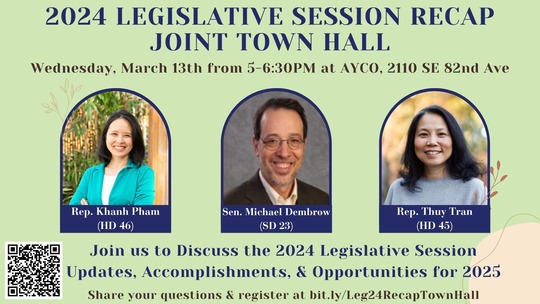 Coming Soon: Post-Session Town Hall
With session coming to an end this week, it's time for a debrief with constituents. Coming up next week, our in-person only SD 23/HD 45/HD 46 debrief. I hope you can join us for our End of Session Joint Town Hall on Wednesday, March 13th from 5pm - 6:30pm. You can register here and submit questions to help direct the discussion. Looking forward to seeing you then!
HB 4002 and HB 5204 Pass Both Chambers
After having passed the House on Thursday, the Addictions Response bill, HB 4002, and its related investments in treatment and prevention, HB 5204, passed the Senate late Friday afternoon. The passage of these two bills was the culmination of difficult and controversial work that has been the focus of this session since it became clear that a well-funded effort was underway to overturn Ballot Measure 110, the effort to decriminalize personal possession of small amounts of drugs, which the voters passed in 2021.
Though i respected the effort to ward off the harmful effects of the ballot measure, in the end I could not support HB 4002, particularly in its final form, worked out with law enforcement and those behind the reverse ballot measure. Though they did get the backers to stand down on filing their initiative, the final amendments--which made it optional for counties to adopt a treatment-first policy--actually made it more difficult for me to support it.
Here's a chart showing the overall design of the HB 4002 program. It’s a complicated system, designed in the hope that once someone with substance use disorder engages with law enforcement and is offered treatment (assuming that treatment is available), they will begin the road to recovery. That’s a good goal, and I hope that it works out. If it does not, then legislators will need to be prepared to make changes, which for political reasons will not be easy. That’s why I was pushing (unsuccessfully) for a sunset on the bill, without which I could not support it.
For more details, here's my prepared floor speech from Friday. It actually includes some remarks that I had to cut out at the last minute because of time constraints.
Though I couldn’t support HB 4002, I did vote enthusiastically for HB 5204, which included a hefty $211 million for badly-needed treatment, prevention, and related addictions services. (Here are details about those investments.) You’ll see that one badly-needed resource that it funds is a long-overdue intake/sobering center in Portland, a place where law enforcement and behavioral health workers can take those in need and at risk. Here’s a description of the anticipated resource from the Oregonian.
HB 4002 ultimately passed on a 21-8 vote, with five Democrats (Dembrow, Frederick, Jama, Manning, and Prozanski) and three Republicans (Boquist, Linthicum, and Robinson) voting against. HB 5204 voted on a 27-3 vote, with all the Democrats voting aye and the same three Republicans voting no.
For some press coverage, here’s reporting from the Capital Chronicle and from OPB.
All Eyes Now On Ways and Means and Its Capital Construction Subcommittee
As we enter the final days of the session, the big question marks are around potential funding for new programs. Funding new programs is particularly difficult during the mid-biennial short session. Unlike many states, Oregon does not budget on an annual basis. Rather, we set our budgets during the long odd-numbered-year sessions, beginning with recommendations from the Governor. Agency budgets are examined closely for potential savings to be added to potential revenue increases to fund new programs for the coming biennium. During the short session all that we have to work with are unallocated dollars that were held back in the previous long session for employee contract settlements, emergencies, or other unanticipated needs and added dollars from the intervening revenue forecasts. Thus, the short session is really not the time for big appropriations.
Nevertheless, there are many critical, worthwhile needs out there, and legislators are barraged with funding requests from local governments and organizations. Most of the added dollars, not surprisingly, are going to the big bipartisan areas of Housing and Addictions Behavioral Health services. That leaves around $150 million in available added dollars for the next year, with requests amounting to more than $2 billion. Obviously, there will be many disappointments.
Individual legislators and chairs have made our best arguments for the programs we want to see funded. The final appropriation decisions are now in the hands of the Senate President and the Speaker of the House and their staffs, who are now finishing up the final packages. It’s a tough, tough job. We’re told that it’s now “pencils down” time. Tomorrow we should start to learn what the final funding recipients are, and at what level. (Nearly all that will be funded will be funded at levels lower than requested.) All will need to go through Ways and Means in the next few days.
So far, 24 bills have made it through Ways and Means and are being heard on the House and Senate floors. Another nine are scheduled for votes during tomorrow afternoon’s Ways and Means meeting. More are in the works.
As I mentioned in the last newsletter, all the issue-area Ways and Means subcommittees have now shut down for the session. This means that any remaining appropriations will be worked in the catchall Capital Construction Subcommittee. Here's a list of all the measures that have been assigned to it so far. That list will grow in the next few days, so keep an eye on it.
Many of the final appropriations will be made in HB 5701, the omnibus end-of-session appropriations bill. If you go to it now, you’ll find all the appropriations (mainly adjustments to agency budgets) that were made by Ways and Means back during January Legislative Days. These will be joined by the final individual appropriations by Wednesday or Thursday of this week.
Infrastructure bonding appropriations will be contained in HB 5201 (for lottery bonds) and HB 5202 (for regular bonds). Here you’ll also find the bonding appropriations that were made back in January. They too will be joined by others.
All of these appropriation bills must also go through Capital Construction.
In the next newsletter I’ll be able to give you more details on what exactly has been given the green light.
What’s Happening with the Education Bills?
Here’s an update on the bills that passed out of the Senate Education, House Education, and House Higher Education committees. The latest is boldfaced below.
Passed Both Chambers
HB 4137 Directs the State Board of Education to develop rules that would exempt students who have completed full International Baccalaureate programs from having to meet all other high school graduation requirements. Passed out of House Education on a 7-0 vote. Passed the House on a 54-0 vote. Passed Senate Education on a 5-0 vote. Passed the Senate unanimously. Awaiting Governor’s signature
Passed the Senate and Moved to the House
SB 1502 Requires school district, community college, and university boards to post recordings of their meetings online to ensure public access. Passed 29-1 on February 21. Passed out of House Education 6-0. Will be voted on the House floor early this week.
SB 1558: Makes clarifying changes to SB 819 (2023), the controversial bill from last year designed to ensure that all students have access to a full school day if they and their parents so desire, irrespective of their disability. SB 1558 makes it clear that students who have otherwise completed their required credits can be released to work or take college credits during the school day. It received a unanimous committee vote on Thursday and should receive its Senate floor vote soon. Passed 30-0 on February 21. Passed out of House Education 6-0. Will be voted on the House floor early this week.
SB 1583:This bill has become one of the most controversial of all the bills so far this short session. It touches on a subject that has become a feature of the culture wars that are pervasive right now. It prohibits discrimination when selecting textbooks, instructional materials, program materials, and library books for use within Oregon public schools. It prohibits districts from banning textbooks, library materials, or other instructional materials because they tell stories or include the histories of groups protected from discrimination by Oregon law (i.e., by their race, gender, ethnicity, or disability, or because they are gay, lesbian, bisexual, or transgender). We have seen such prohibitions and book bans proliferating around the country. SB 1583, whose chief sponsor is Senator Lew Frederick, will ensure that such bans do not occur here in Oregon.
We had a lengthy public hearing on the bill on February 13, with many people signing up to speak for and against. Those speaking in support outnumbered those speaking against. Most of the oppositional testimony emphasized the rights of local districts to make decisions that reflect their local values and prohibit children from having access to materials and perspectives that don’t reflect those local values. Those speaking in support emphasized the importance of giving children access to historical truths and a variety of perspectives. More than a thousand pieces of written testimony came in, again with a strong majority being in support of the bill. You can find the testimony here.
SB 1583 passed out of committee on February 15 on a partisan 3-2 vote. It then went to Senate Rules to allow the Republicans to file a “minority report,” an alternative that would have turned the new policy into a task force. Minority Report was rejected on a party-line vite. SB 1583 passed the Senate on a party-line 17-12 vote. Now in House Rules.
Awaiting Senate Floor Vote
SB 1532 Directs the Department of Education to develop a Student Success Plan for Immigrants and Refugees. Passed the Education Subcommittee of Ways and Means unanimously. Passed full Ways and Means unanimously. Will be voted by the full Senate on Monday. I’ll be carrying it, along with Senator Jama.
HB 4119 A follow-up to SB 5 (2021), which allowed Oregon athletes to benefit financially from use of their Name, Image, and Likeness (NIL). HB 4119 prohibits the NCAA and like associations from investigating schools or athletes for potential violations. Protects Oregon institutions of higher education from liability for damages as a result of the institution's attempts to identify and facilitate NIL opportunities for the student athlete. After passing the House, this bill went to Senate Rules at the request of the Rules Committee Chair. Passed out of House Higher Education on an 8-0 vote. Passed the House on a 50-4 vote. Passed out of Senate Rules 5-0. Will come to Senate Floor on Monday.
HB 4147 Allows school districts to mount stop-arm cameras on school buses and for police to use footage from those cameras to cite drivers who fail to stop. Passed out of House Education on a 7-0 vote. Passed the House on a 49-5 vote. Passed 5-0 out of Senate Education. Awaiting Senate Floor vote on Monday. I’ll be carrying it.
HB 4164 Makes consensus changes to HB 3456 (2023), which created a statewide Sexual Misconduct Survey Council to develop a standard statewide sexual misconduct climate survey for Oregon’s colleges and universities. These changes will make it easier to implement, recognizing differences between larger and smaller institutions. Passed out of House Higher Education on a 9-0 vote. Passed the House on a 53-1 vote. Passed out of Senate Education 5-0. Awaiting Senate floor vote on Monday.
In Ways and Means
SB 1592 Appropriates $6 million to Oregon universities to develop and support much-needed programs and students in Behavioral Health. Folded into HB 5204, the addictions funding bill, which passed on Friday. Reduced to $4 million.
SB 1551 Gives temporary access to the Oregon Promise for students in the High School "COVID Cohorts" of 2020 and 2021, even though they didn't go immediately to community college following graduation. Still hoping for a referral to the Capital Construction Subcommittee. Seems unlikely at this point.
SB 1522A. It makes a number of technical fixes to bills that passed last year and that needed repair or clarification. It also includes some items that passed out of committee last year but then got lost in the Ways and Means process. It includes others that address timely issues that arose after the close of the last session. Finally, it also directs studies and work-groups to prepare for the 2025 session. Here is a section-by-section overview of the issues addressed in the bill. Passed out of the Senate Education Committee on a 5-0 vote. Referred to the Capital Construction Subcommittee and then on to full Ways and Means.
HB 4068 Dramatically expands and increases the High Cost Disability Account (which funds supports for students with particularly high-cost needs) so that more resources go to districts that need them. The cost of the measure is estimated to be $150 million per year. Passed out of House Education on a 7-0 vote. Still hoping for a referral to the Capital Construction Subcommittee but seems unlikely at this point.
HB 4077 This had started off as a companion bill to HB 4068 that was no longer amended. The -3 amendment turned it into a bill that addressed another need: the need to develop a better reporting system for school employees to report incidents of injury in a way that would allow for state-wide tracking. Passed out of House Education on a 7-0 vote. Still hoping for a referral to the Capital Construction Subcommittee.
HB 4078 Creates a task force to study and make recommendations for creating a statewide data system that all districts could use. It would facilitate the transferring of student records and individualized educational programs when students change districts. Passed out of House Education on a 7-0 vote. Still hoping for a referral to the Capital Construction Subcommittee.
HB 4082 Creates the Summer Learning Grant Fund and appropriates $50 million to the fund for this year. Identifies goals, purposes, success metrics, and oversight of summer learning programs going forward. This is one of the Governor’s funding priorities for the session. Passed out of House Education on a 7-0 vote. to the Education Subcommittee of Ways and Means, where it passed unanimously with a $30 million appropriation. Passed full Ways and Means unanimously. Headed to the House floor, then the Senate.
HB 4084 We know that success rates for current and former foster youth are much lower than for their peers. This measure seeks to begin to change that, directing the Oregon Department of Education to establish and administer a pilot program to provide three public middle or high schools with funds to address academic disparities experienced by foster child students. Passed out of House Education on a 7-0 vote. Referred to the Education Subcommittee, where it passed on a unanimous vote. Passed full Ways and Means unanimously. Headed to the House floor, then the Senate.
HB 4125 Directs the Legislative Policy and Research Office to contract for a study on the effects of the changes in university governance (individual university boards and a Higher Education Coordinating Commission) since they began ten years ago. Will compare this model to models used in other states. Passed out of House Higher Education on an 8-0 vote. Still hoping for a referral to the Capital Construction Subcommittee.
HB 4154 Directs $14.9 million to institutions of higher education and $15 million to the Semiconductor Talent Sustaining Fund. Passed out of House Higher Education on a 9-0 vote. Referred to the Capital Construction Subcommittee of Ways and Means, where it passed on March 1. Scheduled for a vote in full Ways and Means on Monday.
HB 4162 Appropriates $5 million for grants to colleges and universities to help support students with basic needs (e.g., cost of textbooks, food, housing, childcare). Passed out of House Higher Education on an 8-0 vote. Still hoping for a referral to the Capital Construction Subcommittee or appropriation in the end-of-session budget bill.
HB 4163 Last session the Legislature made a one-time appropriation of $5 million to support “wraparound” student success and high school-to-college transition programs such as College Possible, Trio, AVID, and ASPIRE, organizations with strong records of success. HB 4163 will make this support ongoing, with $86k this year and another $5 million in 2025-27. Passed out of House Higher Education on an 8-0 vote. Still hoping for a referral to the Capital Construction Subcommittee.
In House Revenue:
HB 4079 Lifts the cap percentage cap on the amount of moneys that are distributed from the State School Fund to school districts for students eligible for special education as children with disabilities. The State provides extra dollars to districts to support students with disabilities, but for budget reasons those extra dollars are capped at 11% of the funds going to the district. HB 4079 would lift the cap. Passed out of House Education on a 7-0 vote. Was referred to the House Revenue Committee, where it has received a public hearing and an informational hearing. Appears to be dead for this session.
And How About the Environmental Caucus Priorities?
I reported last month that the Legislature’s bicameral, bipartisan environmental caucus identified eight bills as priorities for the 2024 session. I’m happy to report that six of the eight are on track to pass. The seventh is still in the running. Here they are:
SB 1559 Updating Oregon’s Emissions Reduction Goals. Following public hearing in Senate Energy and Environment, not scheduled for a vote. Will not move this session.
SB 1596 Right to Repair: Will allow owners of most consumer electronics products to do their own repairs or have the repairs done by local small businesses. Passed Senate 25-5. Scheduled for House Floor Vote on Monday.
HB 4132 Investing in Oregon’s Marine Reserves. Passed out of the Natural Resources Subcommittee of Ways and Means and then full Ways and Means. Headed to the House floor in the next day or two, then the Senate floor.
HB 4080 Creates Roadmap for Offshore Wind, Sets Robust Labor Standards. Passed out of the Natural Resources Subcommittee of Ways and Means and then full Ways and Means. Headed to the House floor in the next day or two, then the Senate floor.
SB 1572 Studies extending the Westside Express Service (WES) commuter line to Salem. Still hoping for a referral to the Capital Construction Subcommittee or appropriation in the end-of-session budget bill.
HB 4015 Clarifies and streamlines the process for siting battery energy storage systems. Passed House 44-13. Scheduled for a Senate floor vote on Monday.
HB 4083 “The Coal Act”: Begins to divest Oregon public funds from companies with holdings in coal. Passed the House 33-24. Scheduled for a Senate floor vote on Monday.
SB 1561 Monsanto Settlement Funds: In 2022, a settlement was reached between the State of Oregon and Monsanto for $698 million, the largest environmental settlement in the state's history. SB 1561 puts that settlement into a trust fund and establishes the Environmental Restoration Fund for the next 50 years of environmental remediation work.
Other Funding Requests the Caucus is Supporting
Along with the bills referred to Ways and Means mentioned above, the Environmental Caucus is also supporting funding for the following bills that are still awaiting final funding decisions:
PFAS Study Bill (HB 4049)
Landowners Living with Beaver Grants (HB 4014)
The Wildlife Omnibus Package (HB 4148)
Elk Damage Prevention and Compensation Fund (HB 4061)
The Oregon Agricultural Heritage Program (HB 4060)
DEQ Toxic Plume Study Bill (HB 4044)
The Caucus also supports additional appropriations for DEQ's Charge Ahead EV rebate program; funding for ODFW positions to work with the Klamath Tribes on fish monitoring on the Klamath River in the wake of dam removal; funding for tribes and environmental justice communities to address water equity and infrastructure issues; and funding for wildfire programs.
For more information about the Caucus, here’s the caucus website.
COVID Update: Additional Links
- Here’s the latest recommendation from the CDC advisors that older Americans get another booster this spring.
- The CDC has now formally announced that Americans who test positive for the coronavirus no longer need to routinely stay home from work and school for five days when they no longer show symptoms. However, they still recommend that such individuals should continue to take steps (e.g., masking, keeping their distance from others) for the next few days to make sure that they are not infecting others.
Best wishes,
 Senator Michael Dembrow
District 23
email: Sen.MichaelDembrow@oregonlegislature.gov
web: www.senatordembrow.com
mail: 900 Court St NE, S-407, Salem, OR, 97301
| 

