
Dear Friends,
I want to take time during this busy holiday season to wish everyone a Merry Christmas and best wishes for a wonderful New Year.
A new year approaches, with that will bring the 2024 Legislative Short Session. In January, the legislature will meet for Legislative Days to prepare for session, which will begin on February 5th. I will remain serving on four policy committees, which means the 35-day session will be extremely busy...most likely a little chaotic. Those committees are Ag & Natural Resources, Business & Labor, Early Childhood & Human Services, and Rules.
However, prior to all of these planned events, I have joined Senator Boquist in filing for a special one-day Legislative Session to be held to address the weight mile tax and the current violation of the Oregon Constitution pertaining to the tax. Details on this and why it is necessary are in the first section of this newsletter.
As always, please reach out to my office with any questions or concerns. It is always my goal to keep you updated and have an open-door policy. I hope you find the update below helpful and informative.
Merry Christmas,
|
 Anna Scharf
State Representative - HD 23


I joined with Senator Brian Boquist (Senate District 12, R-Dallas) in formally requesting a one-day Special Legislative Session to rebalance the weight mile tax. OBP did a great article, going into further details.
Article IX 3a of the Oregon Constitution requires the State Highway Fund to be fair and equitable to light and heavy users alike ensuring that cars and trucks pay their fair share of the usage of the road. Cars pay the gas tax, while diesel trucks pay their portion through the weight mile tax.
The biennial Highway Cost Allocation Study (HCAS) is used to understand the cost responsibility of each class of vehicle. The 2021-2023 report showed that heavy vehicles were overpaying by 16%, while the 2023-25 report showed heavy vehicles were overpaying by 31%. During the 2023 session, the Majority party knew of this imbalance and refused to address it and have no plans to address it in the upcoming 35-day session in 2024. This constitutional violation must be addressed in a Special Session.
Based on the 2023-2025 HCAS, the Department of Transportation has estimated that trucks will overpay by approximately $193 million per year. That is over $500,000 in taxes being collected every day in violation of the State Constitution. While the weight mile tax is paid by trucks, the cost is passed onto Oregonians as increased prices on goods and services they use every day. The real people overpaying are the working class, seniors on fixed incomes, and families.
You can read my full press release here.
|
Earlier this month, the Joint Committee on Addiction and Community Safety Response met to discuss the drug crisis in Oregon created in part by the policy changes in Measure 110. I've been extremely vocal about my desire to completely repeal Measure 110 which you can read about in my past newsletters or click here to see the testimony I submitted to the committee. We need action NOW. Poll after poll results illustrate the public has turned against Measure 110. Oregonians want a full repeal and significant reform. I am seeking a full repeal of Measure 110 and the implementation of policies that do the following:
- mandatory treatment for those struggling with addiction
- criminal accountability for drug dealers
- doing away with progressive activist boards that are directing tax dollars to untested “harm reduction” and other failed “treatment” that only enables continued drug use and abuse
- setting long-term sobriety as the state’s goal for drug policy
- accepting law enforcement’s role in regulating criminal behavior like public drug use as a way to get people into treatment
- maintaining funding for treatment that supports emergency detox, long-term sobriety, and wrap around services
Please find the below collection of information you might find help.

Beginning January 1, 2024, the new 988 Coordinated Crisis Services Tax will be in effect for all billings or purchases of prepaid wireless service. House Bill 2757 included the 988 Coordinated Crisis Services Tax with the existing Oregon Emergency Communications (911) Tax with the purpose of providing additional funding and expanding service of the 988 Suicide & Crisis Lifeline.
The 988-tax rate is 40 cents per subscriber line of telecommunications or Voice over Internet Protocol (VoIP) service, and 40 cents for each prepaid wireless service or product retail transaction.
When this was passed in the House, a 3/5 majority was needed, or 36 votes. I was not one of the two Republicans that voted yes on the bill to implement the new tax. While I support the 988-crisis line, I felt that the $0.40 was way too high and unjustified given the large Oregon Health Authority budget, and the actual funding estimated needed to run the service. In addition, the Oregon tax is much higher than any other state that has implemented the tax. Click here to read my vote explanation.
|
Longer waiting times for unemployment insurance benefits?
Some of you may have recently filed for unemployment insurance benefits. Unfortunately, call-wait times for the Unemployment Insurance program have been increasing over the last several weeks. Due to a lack of federal funding, the Oregon Employment Department (ODE) doesn’t have enough people to keep up with the volume of calls it’s receiving. So, we encourage people to try other options before they call to save time and get the answers they need. This will free up the phone lines for people who have more complex problems or interpretation needs and allow staff to spend more time working on claims.
Tips from ODE:
- Online Claim System – This is the fastest, easiest way to check the status of your claim. You don’t need to wait on hold when you can get quick answers with the Online Claim System, the department’s safe and secure website. You can use it to apply for benefits, file a weekly claim for benefits, restart your claim, and more.
- Read your letters from the Employment Department – The department will send you letters with questions about your eligibility, instructions on how to maintain your eligibility, and what to do about any issues regarding your claim.
- Use the contact Us form – There is an easy online method to quickly send the department a question or information. Use the Contact Us form to send a message quickly and securely without waiting on hold.
Tips from Rep. Scharf:
If you need help from our office we are happy to do so. However, to expedite the process, please email us with the following information and we will try to help with your claim any way we can:
- Date of claim submission
- Full name
- Date of birth
- Last four of SSN
- Mailing address
- Phone number

Paid Family Leave Fraud?
The Oregon Department of Employment has dispersed $95 million in benefits in three months. This program appears to be processing funds faster than unemployment benefits, but there have been many concerns of fraud. If you did NOT apply for benefits and receive a notice, please take the proper steps to report the fraud. This will help the department and protect those that do qualify for the new assistance.
|

Agriculture Overtime Tax Credit
a message from the Oregon Dept. of Revenue:
The Oregon Department of Revenue reminds taxpayers who plan to apply for the new Agriculture Employer Overtime Tax Credit that they need to set up a Revenue Online account soon.
Taxpayers who want to apply for the tax credit need to have a Revenue Online account prior to filling out an application. Applications must be filed electronically and will be available by January 1, 2024. No paper applications will be accepted. The application window closes January 31, 2024.
The Oregon Legislature approved House Bill 4002 in 2022. The measure requires agricultural employers to pay certain workers for overtime hours worked and creates a refundable personal or corporate income tax credit for employers for a percentage of wages paid as overtime pay, starting with the 2023 tax year. I opposed both the original bill in 2022 and the tax credit program bill that passed in 2023 (House Bill 2058). I opposed the tax credit because it is not a tax credit, but a loan, and is limited to specific farming operations. If you are interested in this program, I encourage you to contact your accountant first before accessing the program to make sure it is in the best interest of your farming operation.
|

Oregon Kids Credit - New in 2024
In 2023, the legislature created the Oregon Kids Credit, which is a refundable credit for low-income people with young dependent children. Families with $30,000 or less in annual income can claim up to $1,000 per child, for up to five children aged five and below. Since the credit is refundable, the portion of credit that is more than what a person owes will be refunded to them.
How to Get Credit
Eligible families need to file an Oregon state income tax return—something many of them may have never done because their low incomes mean they haven’t had a filing requirement. Families may need help with filing a return – learn more here about Oregon Kids Credit and other programs. Learn more here about free tax preparation assistance and resources.
|

Salem Payroll Tax Defeated
On Nov. 7, Salem voters defeated an employee payroll tax narrowly adopted by the City Council in July. The defeat was overwhelming, as more than 80% of voters opposed the tax.
The tax would have collected nearly 1% of wages for work performed in the city, costing the average Salem worker about $500 per year.
|

Updated December Forecast
(provided by the Oregon Business Industry -OBI)
Revenue
The corrected December forecast (compared to the forecast issued in September) shows slight adjustments to anticipated 2023-25 and 2025-27 revenue. The forecast for the current biennium (2023-25) is up a bit ($218 million) due to strong personal and corporate tax revenue as well as interest earnings. The 2025-27 forecast, despite a slight downward adjustment, is still expected increase the general fund 34% over 2023-25.
Kicker
It is important to note that changes to the 2023-25 revenue forecast will not affect the personal income tax kickers that will be credited to taxpayers in 2024. The kicker triggers when revenue growth exceeds the forecast by at least 2%, and the 2024 kicker is based on revenue collected during the 2021-23 biennium.
While the personal income tax kicker is returned to taxpayers, the state retains the corporate kicker to fund education. The kicker represents money the state collects beyond the total used to set the budget.
Reserves
The state’s reserve funds remain high. The combined Education Stability Fund and Rainy Day Fund balance is $2.1 billion, which represents about 8.2% of the current general fund budget.
Bottom line
Given the projected economic stability and the generally stable revenue outlook, the December forecast should be considered good news. While OBI encourages spending restraint, legislators will have a little more to work with for any urgent or emergency need that may come up. These factors, coupled with the strong reserve fund balances, argue against a search for new revenue sources or tax increases.
|

 |
Connecting with the OSU Dean of Agriculture, Staci Simonich, and fellow farmer, Denver Pugh at the OSU game.
 Gathering with other current and past elected officials at the Denim and Diamonds event to support Aglink.
 Participating in the Joint Water Caucus Mid-Coast Water Infrastructure Tour.
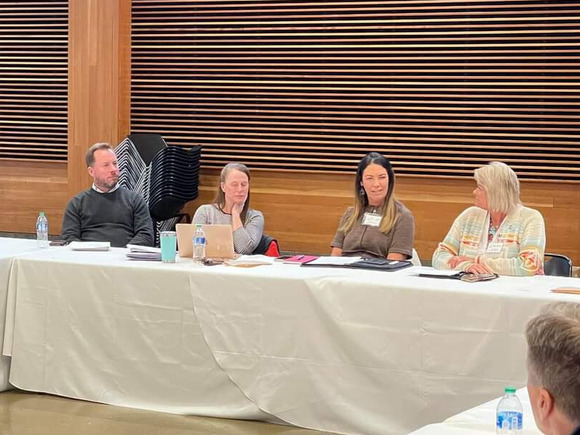 Speaking at the Oregon Wine Council meeting.
 Meeting with the Eastern Oregon University President while visiting my daughter.
Capitol Phone: 503-986-1423
Capitol Address: 900 Court St NE, H-387, Salem, OR 97301
Email: Rep.AnnaScharf@oregonlegislature.gov
Website: https://www.oregonlegislature.gov/scharf
|