|
November 27, 2023
Dear Neighbors and Friends,
I hope that you and your loved ones were able to enjoy a happy, fulfilling Thanksgiving holiday.
Tonight’s newsletter is full of information about the Portland Teachers Strike, the new revenue forecast, and the newly-released report on Natural and Working Lands to the Oregon Global Warming Commission. You’ll also find info about this Saturday’s constituent coffee, the newly-distributed schedule for the next round of Legislative Days in January, and some special news from Franklin High School.
Plus—some more detail about my recent experience leading Oregon’s friendship delegation to China, including photos and some news coverage.
Until next time, take care, and please do reach out and let us know if you have any questions about anything in this newsletter.
Next Constituent Coffee This Saturday
Our next constituent coffee will be the first Saturday of December. That’s this coming Saturday, December 2nd.
We’ll be back (with coffee and cookies) at the Hollywood Senior Center, 1820 NE 40th Avenue (from 9 am to 10:30 am).
We’ll also have a zoom option for the meeting to accommodate those who cannot be there in person. (Register for Zoom access here)
This will be an opportunity for me to catch you up on the latest news from the Legislature. We’ll also discuss lessons learned from the just-concluded Portland teachers strike. I’ll give you a sense of the ongoing issues that are out there as we prepare for the short session in February/March 2024—especially the hot items related to education, environmental action, and Measure 110. I’ll also of course want to hear your priorities, and answer any questions that you might have.
Hope to see you there!
Just Received: Committee Calendar for January Legislative Days
The final round of pre-session committee meetings will be held Wednesday, January 10, through Friday, January 12, 2024. The schedule for these meetings was just sent out this afternoon. Here it is.
You can expect most of the hearings to be devoted to the bills that will be introduced in the session that begins on February 5. All Committee Bills need to be approved for submission (each committee gets three), so it will give us all a first chance to see the initial drafts of those bills. Information sessions related to many of the personal bills that members have requested for drafting (each member gets two) will dominate the hearings.
In addition, many task forces and work groups will meet on Tuesday, January 9.
I’ll have more details for you as the date approaches.
PPS Teachers Strike Comes to an End
As you’ve probably heard by now, the contract dispute between Portland Public Schools and the Portland Association of Teachers that led to a strike lasting more than three weeks (including 11 actual class days) came to an end yesterday afternoon, as the two sides signed a tentative agreement. The PPS Board is scheduled to formally approve the agreement on Tuesday evening and the PAT membership will hold a ratification vote sometime soon. Both sides were confident enough of the outcome of those votes to agree to resume school today.
The good news for kids is that every one of those eleven missed days will be made up in full between now and the end of the school year. Winter break will start a week later than scheduled, a few days will be added in June, and the rest replacing scheduled non-teaching days in between. We’ve all been concerned about the impact of missed school days on kids still recovering from the legacy of the pandemic. The added school days in December will require some parents (and teachers) to modify their plans, but I think it’s fair to say that it’s worth it.
This has unfortunately been a painful, protracted experience (more on that below) for most everyone concerned, but now that it’s over both sides are trying to focus on the positive.
Here’s the news release that came from Portland Public Schools. Here’s the news release from the Portland Association of Teachers.
And here’s PAT’s breakdown of the key issues of accomplishment.
For more perspective, here’s reporting from OPB and from the Oregonian. News of the settlement even made it into the New York Times.
And here’s a report from the Oregonian on the first day back at school. first day back at school.
Looking back over the last few months—the days of the strike and the days leading up to it--we can ask ourselves if the strike was inevitable and if so, did it need to last so long? I’d say yes and no. As you perhaps know, I’ve had a lot of direct experience with collective bargaining, as a result of my many years as President of the PCC faculty union, which has led me to the following observations (which I’ve shared both in public and in private with representatives of the two sides):
- This first-ever PPS strike appears to have been due in large part to an accumulated lack of trust and respect between the parties that existed long before this impasse began and made real communication, creative problem-solving, and compromise difficult if not impossible for both sides;
- Settlement could only become possible once the parties could come to an honest agreement over the available resources and the true cost of the proposals. (The Governor’s intervention helped there.) Only then could true negotiations begin, slow as they might be; and
- Once the contract was finally settled (as it would be eventually), there would need to be a great deal of soul-searching and, for the sake of Portland’s students, a commitment to healing by everyone involved.
At the end of the day, both sides were driven by the commitment to get kids back in school and found ways to compromise. Healing will not be easy, however, particularly after the high level of polarization, inflamed rhetoric, and resentment, along with outright violence directed at PPS board members and demonization of both the Board and the Union in social media,
I was therefore very happy to see the following quote in the Oregonian from Board Chair Gary Hollands, which gives me hope going forward: “It is going to take a lot of healing,” Hollands said. “It is going to take a lot of building of trust to get back. But I can’t be mad at the people across from me who care about our kids just as much as I do. We had a difference of opinion. Now we have to be intentional about moving forward.”
I’ll come back to the lessons learned from the strike going forward in a future newsletter, within the context of broader concerns around education funding and appropriation here in Oregon. I want to bring you up to date on potential recommendations regarding Oregon’s Quality Education Model from the Joint Committee on Public Education Appropriation (JPEA), https://olis.oregonlegislature.gov/liz/2023I1/Committees/JPEA/Overview as well as the work being done by the Task Force on Statewide Educator Salary Schedules. https://olis.oregonlegislature.gov/liz/2023I1/Committees/JTFSES/Overview The experience of the PPS strike has brought more urgency than ever to the question of how our schools are funded.
The Latest Revenue Forecast Continues to Look Good for Oregon
On November 15 the House and Senate Revenue Committees received the latest revenue forecast from the state’s Office of Economic Analysis. This was the second forecast of the new biennium.
The overall message was again positive. It was relatively quite similar to the last forecast, with revenues coming in $76 million lower than was predicted in September. This is still $217 million higher than was projected back in May, when this current two-year budget was built. However, this level of increase is lower than some of the big unanticipated increases that we’ve experienced in recent years; this suggests that the new methodology that the Office is using to project future revenues is on the right track and may help us avoid outsized individual kicker payments in the future. That’s not to say that we won’t see another kicker in our future
As you’ll see below, however, corporate profits continue to be unexpectedly high, which is good news for K-12 education, as the corporate kicker is constitutionally mandated to send dollars to Oregon schools.
When you read the news reporting on the forecast, you’ll see that at the time of the forecast on November 15, the assumed increase in revenues was actually higher--$335 vs. $217—but later analysis led the OEA to revise its prediction last week. They had thought that we were receiving more payments from insurance revenues than had been anticipated; closer analysis showed that less, not more, had come in.
Looking at the national economy as a whole, the picture is also positive: it suggests that the Federal Reserve’s efforts to gradually slow down inflation without hurting the overall economy is working. This forecast, while showing increased revenues, shows more stable growth than earlier forecasts, which bodes well over the long term.
The message in this year’s forecast is that so far it appears that the Fed has been able to thread the needle. This is the consensus of the state’s national panel of economic advisors. Inflation has come down steadily and dramatically from 9% a year ago to 3% now. That has occurred without the feared increase in unemployment (which remains at record lows, though appears to have stabilized). However, the Fed remains determined to bring the inflation rate down even lower, to 2%.
While the news is good overall for Oregon and for our ability to fund critical public services, that’s not to say that many Oregonians don’t continue to find themselves in difficult circumstances. We continue to face many challenges. The more we can stabilize our revenues and think about long-term solutions to meeting these challenges, the better off we’ll be as a state.
Much of the presentation focused on the possibility that Oregon’s population will no longer grow at the pace that we’re used to. That will definitely have an effect on tax revenues. Though still hypothetical, it’s an interesting discussion, and I’d recommend that you check out those slides. (It’s the last part of the presentation.)
Here are some highlights from the forecast presentation:
- OEA economists and their panel of advisors believe that the Federal Reserve’s efforts towards a “soft landing” are working out. Most forecasters, including the Fed itself, expects some small (“surgical”) interest rate cuts in the second half of 2024. If inflation slows further, the cuts may begin sooner. “Lower rates will spur more activity, ensuring the economic expansion continues.”
- Oregon’s employment situation continues to improve, as poverty rates decline. These improvements are true across the board, though gaps remain between Whites and People of Color.
- Although we’re not seeing the big population gains that we have in the past, we’re continuing to see large economic gains due to more output and income per worker.
- Productivity gains should persist going forward, with large capital investments planned among both public and private sources, and vibrant start-up activity.
- Infrastructure investments funded by the Legislature are creating more jobs and fueling more economic activity. These will be augmented by the federal spending that is coming our way.
- Despite fears that many Oregonians are leaving the state, in fact the number of those moving to other states (and giving up their Oregon licenses) is right in line with what it has been over the last decade.
- For the first time, more Washingtonians are moving to Oregon than the reverse.
- We’re not seeing out-migration dominated by any particular demographic group (age, income, race, or income). We are seeing net in-migration dominated by 18-24 year olds.
- If these trends persist, and Oregon continues to experience overall net-zero population growth, there will definitely be effects on the economy. With an older population and fewer working-age adults to support and care for them, we may still see the economy grow, but it will be at a slower pace than we’re used to.
- Any day now we should soon be receiving further information about Oregon’s population trends from Portland State University and the U.S. Census. It will help us to understand what exactly is going on with in-migration vs. out-migration.
- Oregon’s budget reserves from the Rainy Day Fund, the Education Stability Fund, and the Ending Fund Balance remain at very healthy levels. Our budget reserves are currently at $3.2 billion (12.6% of General Fund Expenditures), and they’re projected to be at $3.96 billion (15.5%) by the end of this biennium. This is a far cry from when I joined the Legislature in 2009 (coinciding with the start of the Great Recession), when we had virtually no reserves and had to cut $4 billion from the budget.
If you’d like to watch the forecast presentation, here’s the webpage for the meeting.
Here is the forecast slide presentation.
Here are the revenue forecast tables from the Legislative Revenue Office.
For ALL the details, go to the Office of Economic Analysis forecast web page. You’ll find these links for the Nov. 15th forecast:
Forecast Document by Section
For a good overview of the forecast, I’d recommend Peter Wong’s reporting in the Oregon Capital Insider. and Dirk Vanderhart's for OPB. And here’s coverage of the subsequent reduction in the revenue projection from the Oregon Capital Chronicle's Julia Shumway.
Late Breaking! Latest PSU Population Report Shows Continued Gains in the Portland Area
I mentioned above the Office of Economic Analysis (OEA) prediction that we would soon be getting the latest Oregon population numbers from the PSU Population Research Center, the state’s official source of population data. The prediction was correct: the numbers became available today.
Here’s a summary of its findings (with a link to the report itself) in today's OEA blog by Josh Lehner.
The findings for 2023 cut against the narrative that Oregon is seeing a depopulation of its urban areas. In fact, for 2023, PSU estimates that 26 counties saw growth, while 10 counties experienced declines. Many of the slower increase or outright estimated declines are in rural counties. The stronger population gains are in urban counties.
In what appears to be a return to pre-pandemic patterns, the Portland region is seeing stronger gains than the mid-Willamette Valley, while Southern Oregon and Klamath County is seeing a slowdown (after showing gains during the pandemic and immediate post-pandemic). The declines in rural Oregon (including the North Coast and much of Eastern Oregon) are likely due not so much to out-migration as the result of an older, aging population in those areas. However, there are a few exceptions, with continued growth in Umatilla, Morrow, and Malheur Counties.
Corporate Kicker Appears Likely to Kick Again Next Biennium—Which Is Good News for Schools
Unlike the Personal Kicker, which the Oregon Constitution requires us to return to taxpayers as a percentage of what they owe, the Corporate Kicker goes to help fund K-12 education. As a result of much higher than expected corporate profits in Oregon, the 2023-25 budget will partly be funded with a record $1.8 billion in Corporate Kicker dollars.
The Corporate Kicker, like the Personal Kicker, occurs when corporate income tax revenues come in higher than 2% above what the economists projected two years earlier. The economists had a particularly hard time doing their predictions in 2021 because of all the uncertainty around the pandemic. The result is a one-time windfall in tax credits for individuals and money for the State School Fund from record corporate profits. I want to stress that tax revenues of this magnitude are not something we can count on again and again. I believe that they should not be used to pay for ongoing operating expenses—which current statute not only allows but requires--and should be used primarily if not exclusively for one-time projects.
Last year I had a bill to that effect, SB 521, which would have allowed the Legislature to use Corporate Kicker dollars for one-time expenditures rather than ongoing operations. It made it out of the Senate Education Committee but unfortunately died in Ways and Means. The budget-writers decided they needed to use the entire $1.8 billion to help fund the State School Fund. I understand the reasons behind that decision (e.g., funding demands from Higher Ed, mental/behavioral health, housing), but it puts us in a difficult position next budget cycle, as there’s no way that we can count on a Corporate Kicker of that magnitude next time. I’ve been concerned that without a $1.8 billion kicker to rely on, the Education Budget will be starting the next biennium in a hole (not to mention the additional dollars that we know will be needed).
Still, we did receive some good news on November 15. Much to the surprise of the state economists, corporate profits remain high, and corporate income tax revenues have continued to come in higher than expected. Right now they are projecting a corporate kicker of $418 million at the end of this biennium. If that holds up, it will definitely help start to fill the hole. Let's hope it does.
Please remember that in addition to the corporate kicker, Oregon businesses also support education via the new Corporate Activities Tax (CAT), which helps fund K-12 and Early Learning. The CAT is projected to bring in more than $2 billion over the next two years.
Global Warming Commission Hears About Natural Climate Solutions
As many of you know, I’ve been working for some time on policy to ensure that Oregon’s climate action agenda includes a focus on the potential benefits of Oregon’s natural and working lands (forests, farms, rangelands, coastal and freshwater marshes) for sequestering carbon if properly managed. I see these as beneficial not only as a way to trap emissions naturally but also potentially reduce emissions in the first place, thereby helping us to meet our climate goals and responsibilities. Moreover, if done right, they can also benefit the economies of rural communities all over the state.
These efforts led to the Natural Climate Solutions sections of HB 3409 (2023), which also made the Oregon Global Warming Commission (which will be renamed the Oregon Climate Action Commission as of 1/1/24) the hub of this activity.
Even before the passage of HB 3409, the Commission (thanks to outside grants) contracted with OSU’s Institute for Natural Resources (INR) to begin working on the proposal that the bill would ultimately fund. INR helped to coordinate a Natural and Working Lands Advisory Committee, develop a methodology to inventory net carbon capture in Oregon’s natural and working lands, develop climate-smart management practices, and help establish activity-based baselines for them, define the scope of work for a workforce and training needs analysis, identify community impact metrics, and produce a final report.
That report has been completed and was presented to the Commission at its November 17 meeting. at its November 17th meeting. You'll find the report. here.
It's an important first step. At this point, the report doesn’t include consideration of the role that carbon markets could play in increasing natural sequestration in Oregon. That wasn’t part of their initial assignment, but at the meeting they expressed interest in looking at the role that carbon markets (which use carbon offsets to provide financial incentives to landowners who choose to incorporate climate-smart techniques) could play in helping Oregon meet its sequestration goals.
The Commission also heard a report from Debbie Colbert of the Governor’s Office on how the $10 million in the Natural and Working Lands Fund will be appropriated. Here’s what we learned (I say “we” because I’m one of the two senators on the Commission.):
- She will be bringing a package of appropriations to the December 11 Commission meeting for an initial presentation. It will then receive formal consideration in the Commission’s January meeting.
- It will incorporate many elements of the Institute for Natural Resources report and recommendations.
- It will include a variety of technical assistance grants to landowners, incentives, and on-the-ground projects.
- It will include the full variety of natural lands: forests, wetlands, rangelands, coastal marshes.
- It will be the result of engagement with a variety of tribal and environmental justice communities.
- The appropriations, once approved by the Commission, should be able to move forward in April.
- The appropriations will also be prioritized with an eye to being able to leverage federal dollars.
- The $10 million will be impactful in and of itself, but the potential federal dollars will of course be even more significant.
Please let me know if you have any questions about the Commission’s work.
Congratulations Franklin HS Cross-Country!!!
Please join me in congratulating the winners of this year's OSAA/OnPoint Community Credit Union State Cross-Country Championship: the Quakers of Franklin High School, which I'm proud to say is located in Senate District 23.
The Franklin Cross Country team earned first place among 6A Boys HS teams at the recent state championships held at Lane CC on November 4th.
Here's a statement about this accomplishment from OSAA: "Each team that wins a high school state championship in Oregon has displayed the dedication, commitment, and teamwork required to reach the highest level of success. All teams begin the season with the goal of capturing the state championship, and Franklin High School Cross Country has achieved this historic milestone."
Thank you, athletes and coaches, for all the hard work and determination that went into this accomplishment. And Congrats to all the proud Quakers out there, present and past!
Some Additional Links to Stories of Interest
- Those who have attended my constituent coffees over the last few years will have heard about efforts to move Oregonians away from noisy, polluting, gas-powered garden equipment. Constituent Michael Hall of Quiet Clean PDX has been a passionate, tenacious advocate for this effort, which has included proposed legislation for a statewide phase-out of this equipment, as has been passed in California. I’ve recommended to Clean Quiet PDX that they focus initially on a regional approach that would involve a combination of local regulation and incentives to facilitate conversions. Here's a recent article in the Oregonian that reports on this effort. In it we also learn that “operating a leaf blower for an hour emits the same amount of smog-forming pollutants as driving a Toyota Camry about 1,100 miles, or the distance from Portland to San Diego, based on calculations by the California Air Resources Board.”
- Free COVID tests again became available to U.S. households on November 20. Here's information on how to get yours through the Post Office.
More On My Trip to China
In my last newsletter I included a few photos from my recent trip to China, from which I had just returned, and promised more to come. So let me share a little more with you here.
For a little back-story, I’ve been a member of the Oregon China Council for a few years now. The China Council encourages partnerships, trade, and cultural/educational exchanges between Oregon and the People’s Republic of China, particularly with our sister provinces there: Tianjin and Fujien Province. Among its members the Council includes four senators: two urban Democrats (Senator Lew Frederick and me) and two rural Republicans (Senators Bill Hansell and David Brock Smith).
I’ve never had the opportunity to visit China before. I had hoped to do so in 2020, but then the pandemic struck, and travel there became impossible until this year. When a delegation from Oregon became possible at last, I was asked to lead it, and I agreed. It seemed particularly important right now—given the current tensions between our two countries—to help promote the person-to-person relationships and understandings that can be so important at defusing such tensions.
As part of the delegation, along with several members of the Oregon China Council, we had Craig Ackerman, the Superintendent of Crater Lake National Park. (Crater Lake has a Sister Park relationship with Fujien Province’s Wu Yi Shan National Park, a relationship that was up for renewal this year.) We had the Director (Elizabeth Nye) and Deputy Director (Venus Sun) of Portland’s Lan Su Classical Chinese Garden. (The Lan Su Garden is the result of a partnership with the City of Suzhou, home of Classical Chinese Gardens, and Portland’s Sister City for the past 35 years. One of the purposes of the trip was to renew that partnership as well.) We also had several people engaged in trade and investment.
During our stay in our Sister City-State of Tianjin, located due east of Beijing, just an hour by bullet train (and whose port has a Sister Port relationship with the Port of Portland, we celebrated the ninth anniversary of our relationship by visiting and adding fresh soil to a tree planted nine years ago by then-Speaker of the House (and now Governor) Tina Kotek. I remarked that it’s not enough to plant a tree—the tree had to be nurtured and renewed on a regular basis, a metaphor for the purpose of this trip. Here's coverage from local TV (in Chinese but with some English).
While in Tianjin, we also spent time at Nankai University (one of China’s leading universities and the alma mater of the PRC’s first Premier, Zhou En Lai) and visited Nankai High School (from which Zhou also graduated). Speaking of schools, here’s coverage of a delightful visit to a high school in Fuzhou.
Here's a news story from Suzhou about the renewal of the Garden Partnership. (And for those of you who need help with your Mandarin, here's a translation.)
One of the highlights of the trip for me was to open the Third China-Oregon Forum on Sustainability and Climate Change in Fuzhou (in Fujien). It featured government leaders, businesspeople, and academics from Tianjin, Fujien, and (mainly by Zoom) Oregon. One of the highlights was a joint presentation by OSU Dean Tom DeLuca and a professor from Fujien University of Forestry and Agriculture, who are working on a research project together on the effects of climate change on soil health. (The Chinese professor actually left China right after the forum and is now in Corvallis for a year-long research fellowship to work on this project.)
(Speaking of climate action, one of the benefits of this trip was to allow me to see up close some of the efforts underway in China to reduce emissions and improve air quality. They're got a long way to go still to move off of coal, but already they are moving much faster than we are in shifting to electric vehicles and creating new sources of renewable energy. You can tell which cars are electric because they have green license plates (vs. the standard blue): the numbers are impressive. Another highlight of our trip was our visit to Tianjin's "Eco-City," built in partnership with Singapore--a planned Net-Zero city built on what was formerly a polluted salt flat. Very impressive. Check it out here and here.
Here's the agenda for the forum, my opening remarks, and reporting by ChinaDaily.com
And here's some local reporting on the renewal of the Crater Lake/Wu Yi Shan partnership, which was actually signed as part of the forum.
As you can imagine, I could go on and on. But for now at least let me leave you with some more photos.
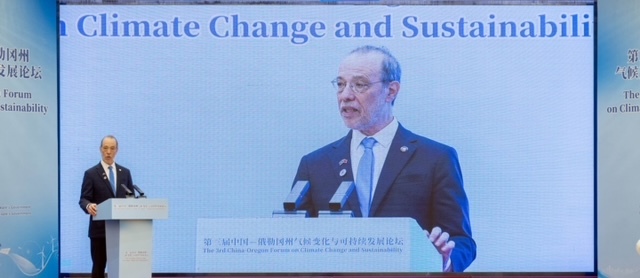
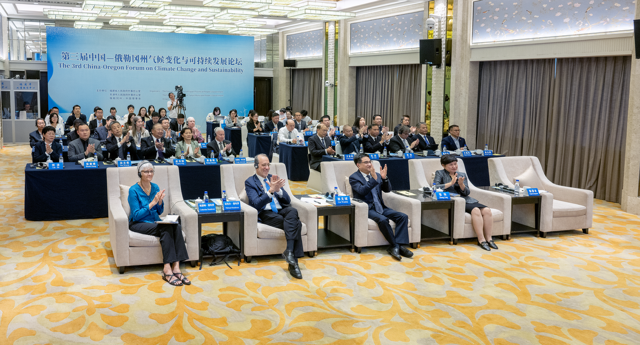 At the Climate Change and Sustainability Forum.
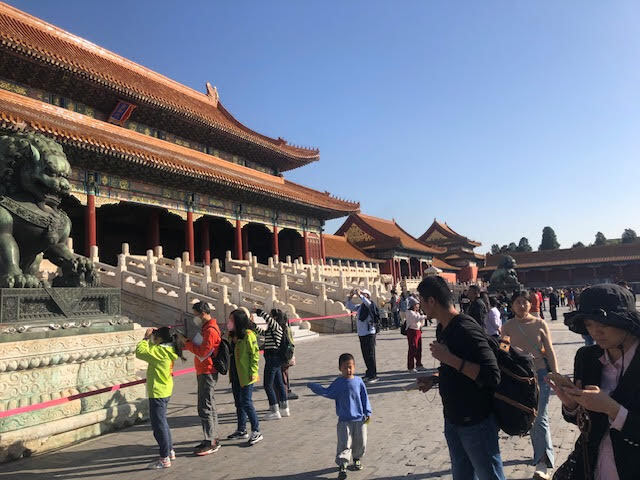 A visit to the Forbidden City in Beijing.
 It's all the rage now for young women to dress up in costumes from the classical era, either when visiting historic sites or at special parties. This is in the Forbidden City in Beijing.
 Here's a young woman at the Forbidden City in Beijing, combining old and new.
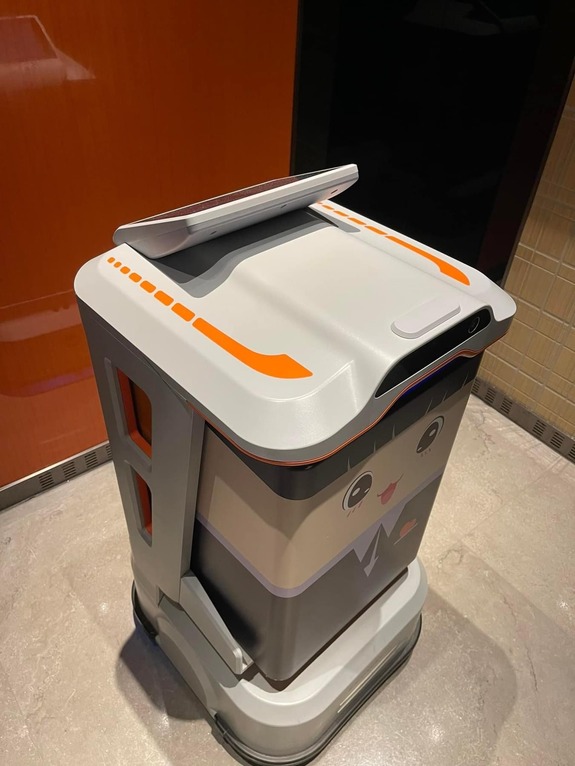 Sharing elevator with robot room service.
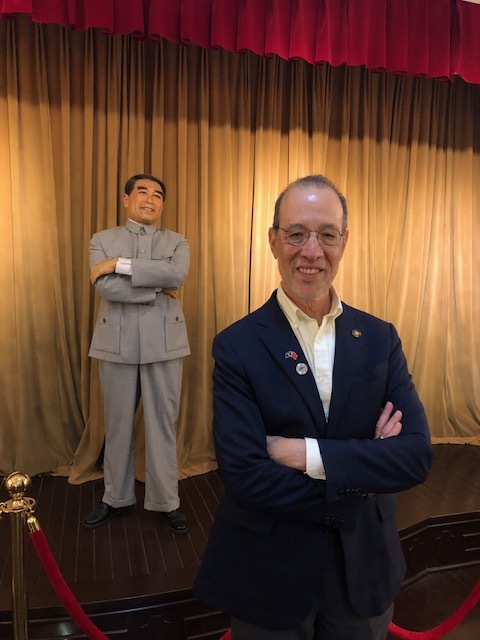 At Nankai High School in Tianjin, whose most famous graduate was Zhou Enlai, first Premier of the People's Republic of China. .
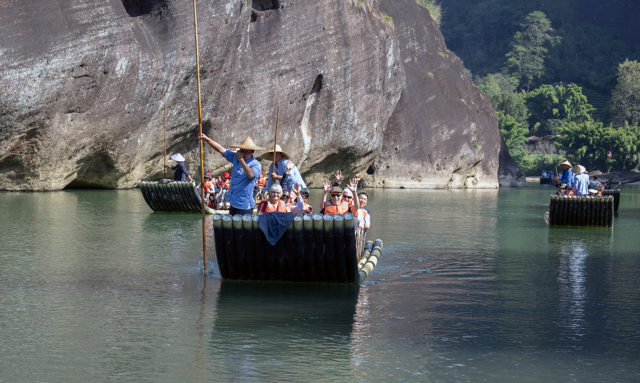 In WuYi Shan National Park, Sister Park to our Crater Lake.
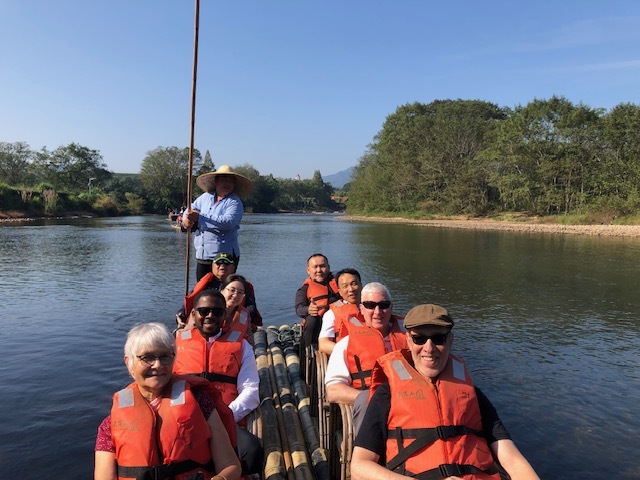 At WuYi Shan National Park.
 "Ancient Water City" near Suzhou, also known as China's Venice.
 Senator Michael Dembrow
District 23
email: Sen.MichaelDembrow@oregonlegislature.gov
web: www.senatordembrow.com
phone: 503-281-0608
mail: 900 Court St NE, S-407, Salem, OR, 97301
| 

