|
August 30, 2023
Dear Neighbors and Friends,
I hope that you and your loved ones are doing well, staying healthy, and have been looking out for your neighbors and friends during this past week.
If you’re like me, you’ve been enjoying the turn in the weather over the last few days. It’s been a nice relief, has cleared out the air for many of us, and (as you’ll see in tonight’s newsletter) has had a very positive effect on efforts to contain the current spate of wildfires.
Tonight’s newsletter provides you with information about this weekend’s constituent coffee, gives you notice of this year’s SD 23 Bike Town Hall (sorry, it won’t be coming for another month . . .), gives you info about and the schedule for the upcoming Leg Days (committee hearings at the end of September, details about the most recent revenue forecast (revealed this morning), the latest wildfire news, my visits to Kellogg and Roseway Heights Middle Schools for opening day (!), and some links to interesting and useful articles.
I have more that I wanted to report on, but I think this is it for now. In the next newsletter I promise to tell you about some of the national work that I’m doing to further access to and success in post-secondary education and workforce development. I’ll also be providing information for the hundreds of thousands of Oregonians who are about to confront the “Return to Repayment,” the reinstatement of student loan payments after a three-year hiatus. Fortunately, as I’ll discuss, the Biden administration has recently rolled out the new SAVE program, which will make repayment MUCH easier by many Oregonians. In addition, I’m proud to say that we in Oregon have created a Student Loan Ombuds Office, which is shaping up to be a real treasure-trove of information, support, and advocacy. For now, please check out the links, and share them with those who might need them.
Until next week, please enjoy this temperate weather and do have an enjoyable Labor Day weekend. Please do take some time to appreciate the important and difficult work that so many of our neighbors do, as we recognize the importance of this work and the sense of solidarity among workers—those who are able to be part of a labor union and those who are not yet able to but find analogous ways to form a sense of community and mutual support at work.
And let me know if you have any questions or thoughts about anything in this week’s newsletter.
Next (Zoom) Constituent Coffee This Coming Saturday!
This coming Saturday, September 2, is the first Saturday in September, and that means time for another constituent coffee.
It will be all-Zoom this time, so even if you’re out of town for the Labor Day Weekend, you can still participate!
It will again run 9 a.m. to 10:30 (or so . . .).
You can register for the Zoom here.
This will be an opportunity for me to catch you up on the latest news from the Legislature, including details and implications of this morning’s Revenue Forecast. I’ll also give you a sense of the ongoing issues that are out there as we prepare for the short session in February/March 2024, hear your priorities, and answer any questions that you might have.
Hope to see you there!
Looking Ahead: BIKE TOWN HALL in October
It’s been a challenge this year finding a date that works for all three SD 23 legislators (Reps Khanh Pham, Thuy Tran, and me). As a result, the bike town hall is going to be a little later than usual, but it’s already lining up to be another great one:
Sunday, October 8, 2023, Noon to 4 pm (including special musical entertainment during the first hour)
This year’s bike town hall will cover neighborhoods in the southern part of HD 46. We’ll be making a number stops to get a better sense of both the challenges and the successes occurring in those communities. More details coming in future newsletters.
Coming Soon: September Legislative Days
During the interim period between legislative sessions, legislative committees meet at the Capitol in public session every few months. This is a time for committees to catch up on the implementation of policy and programs created in previous session(s)
The interim committees themselves meet over three days, while a fourth day is devoted to various interim task forces. These are known informally as “Leg Days.”
The next round of Leg Days will be held September 26-29. Tuesday, September 26, is Task Force Day. I know that the Joint Task Force On Statewide Educator Salary Schedules, which was created by SB 283, and which I’ll be co-chairing, has its first meeting that day. Here is the schedule for the committee meetings that will be held Wednesday through Friday.
Another feature of Leg Days is that the Senate meets in full session in order to confirm the Governor’s appointments to various boards and commissions, and to serve as agency heads. This time that will occur on Friday morning at 11:00 a.m. One thing to note, though, is that will NOT be meeting on the Senate Chamber floor. As a result of the Capitol seismic/remodel project, the chamber will not be available. I believe that we’ll be meeting in Hearing Room A instead.
Also, here are the committee assignments for the Interim. (They are essentially, but not exactly, the same as they were during the long session.) First for the Senate, and then for the House.
The Latest Revenue Forecast Continues to Look Good for Oregon
This morning the House and Senate Revenue Committees received the latest revenue forecast from the state’s Office of Economic Analysis. This is the first forecast of the new biennium and has the special role of letting us know the final size of the kicker payments that we can expect. (As you’ll see, the kicker will be enormous, nearly three times the previous record.)
The overall message today was quite positive. It suggests that the new methodology that the Office is using to project future revenues is on the right track and may help us avoid outsized kicker payments in the future.
It also suggests that the Federal Reserve’s efforts to gradually slow down inflation without hurting the overall economy is working. This forecast, while showing increased revenues, shows more stable growth than earlier forecasts, which bodes well over the long term.
I looked back at my write-up of last August’s revenue forecast. At that time the economists actually gave us TWO forecasts: one projecting that the Federal Reserve had gotten things right and achieved a “soft landing” from the hot economic inflationary period; and the other envisioning that they had applied the brakes too hard, stalled the economy, increased unemployment, and put us into a mild recession.
The message in this year’s forecast is that so far it appears that the Fed has been able to thread the needle. This is the consensus of the state’s national panel of economic advisors. Inflation has come down steadily and dramatically from 9% a year ago to 3% now. That has occurred without the feared increase in unemployment (which remains at record lows, though appears to have stabilized). However, the Fed remains determined to bring the inflation rate down even lower, to 2% (not sure I agree with that, for what it’s worth).
While the news is good overall for Oregon and for our ability to fund critical public services, that’s not to say that many Oregonians don’t continue to find themselves in difficult circumstances. We continue to face many challenges. The more we can stabilize our revenues and think about long-term solutions to meeting these challenges, the better off we’ll be as a state.
Here are some highlights from the forecast:
- Inflation has slowed to somewhere between 3% and 4%, which is a far cry from a year ago, but the Fed continues to want us down at 2%. That will mean further increases in interest rates, which could slow homebuilding and home purchasing.
- The economy may be reaccelerating, thanks to federal investments and improved business performance. Wages appear to be outpacing inflation. That’s good for overall standard of living, but there’s some fear that it could cause inflation to rise again.
- After several quarters of unexpectedly rapid growth in tax collections, Oregon’s state revenue outlook appears to have stabilized. Collections in recent months have tracked closely with the May forecast.
- The federal investments in semiconductors and Oregon’s willingness to support those efforts through legislative appropriations appears to be paying off. Oregon is poised to benefit more than most states and can expect an increase in the number of highly-paid, educated workers in this sector.
- Although we still can see the effects of a low birth rate here in Oregon (currently the fifth lowest in the nation, due in part to our relatively aged population), we are no longer seeing predictions of continued out-migration. We’re not seeing an increase in the number of those giving up their Oregon licenses. The general Portland area appears to have stabilized in population.
- Based on demographics alone, we can expect 10% fewer new schoolchildren in the coming years.
- Skyrocketing revenues from capital gains have slowed down considerably, again helping our growth to be more stable and predictable.
- We continue to see big increases in revenues from corporate taxes.
- The Corporate Activities Tax (CAT), which funds our Student Success Act, continues to grow slowly. (That is likely a combination of increased business activity and ongoing inflation, albeit smaller than before.)
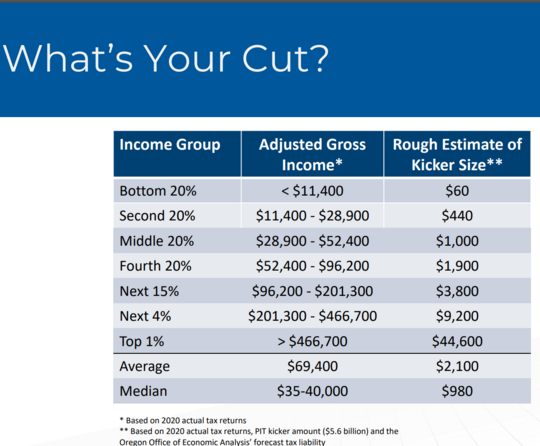
- The individual kicker is now projected to be $5.6 billion, nearly triple the previous record. While the ultimate kicker distribution won’t be finalized until October, it will likely be very close to what was announced in today’s forecast. (See the chart below.) The median kicker tax credit (which will show up on our 2023 income taxes)—the point where half of Oregonians receive less and half more—is currently projected to be just under $1,000 ($980 to be precise). Since the kicker is based on personal income levels, the difference between the bottom and the top income levels is enormous. [If we were to refund all Oregon households the median amount of $1,000, which would be a big increase for lower-income Oregonians, we would have billions left that could be used for housing, homelessness, services for the disabled, firefighting, and other huge priorities for so many people.]
- The corporate kicker, which goes into the K-12 State School Fund, will reach $1.8 billion.
- Oregon continues to build up record reserves in our Rainy Day Fund, our Education Stability Fund, and our ending fund balances.
If you’d like to watch today’s presentation, here’s the webpage for the meeting. (As I send this, the video is not yet available, but it hopefully will be soon.)
Here are the PowerPoints from the Forecast presentation.
Here are the forecast tables forecast tables from the Legislative Revenue Office.
For ALL the details, go to the Office of Economic Analysis forecast web page. forecast web page.
Here’s a write-up on the forecast from the Statesman-Journal and from the Oregonian, which focuses on the kicker.
One final note: If you look at the various press releases coming out of the Democratic and Republican caucuses, you’ll see the expected partisan differences, but you’ll also see a shared recognition of the importance of using the additional resources in a way that will most benefit Oregonians. The decisions we make in the next (2024) legislative session will chart our course for years to come—assuming, of course, that the threat of another walkout doesn’t get in the way.
Legislators Hear the Latest on Wildfires: Window of Opportunity?
This morning legislators received another briefing on the current status of wildfires and firefighting here in Oregon. We heard mainly from the two firefighting leaders for the state—Mike Shaw from the Oregon Department of Forestry and Mariana Ruiz-Temple, the Oregon State Fire Marshal. Their report reflected the serious increase in fires that we’ve experienced in the last week. Thursday evening we had a “relatively unique” dry lightning event all along the western side of the state. The result was 80 different fires on land protected by the Oregon Department of Forestry alone (which includes state forests and private forestland, but not federal forestland, which included many more).
Up to this point, most of the fires we’ve experienced this summer have been caused by humans. Human-caused fires are avoidable, and ODF asks us to continue to do all we can to prevent them. (Check out Keep Oregon Green for advice on that.) These were different.
Fortunately, as I’m sure you’ve noticed, we’ve been experiencing cooler and moister weather these last few days. That has definitely helped the firefighters. We should continue to see additional moisture in the near future in parts of the state, including some heavy rain in some of the affected areas. This creates what Mike and Mariana referred to as a “window of opportunity” to contain the fires created by the lightning.
But they also made clear that this current weather is “fire season-slowing,” NOT “fire season-ending.” The meteorologists are forecasting that a high-pressure ridge will be forming over the Pacific Northwest in mid-September. And with it will come the dangerous east winds that can wreak havoc on the western side of the Cascades. We were told that it is really important that we use this window to prepare for that. With the east winds, uncontained fires, wherever they are, will just take off. The priority now is to get the current fires into containment before the winds come.
So far this season, the number of individual fires that we’re seeing is around the 10-year average; however, I’m glad to say, it’s been less than average in terms of acres burned. Firefighters have been more successful than usual at getting fires contained early, particularly those in the “WUI” (“Wildland-Urban Interface”). This is due to a combination of receiving the benefits of investments the Legislature made via SB 762 in 2021 (more equipment, drones, and other resources), better coordination between the state agencies, federal agencies, counties, local fire districts, and landowners—and to some extent luck. Let’s hope it continues.
Though we all may be very happy with the current turn in the weather, Mike and Mariana did caution us not to be complacent with respect to the current moisture. It may lead some people to be careless in terms of campfires, cigarettes, driving on grass, etc. Conditions can and will dry out again very quickly, and it’s important that we all remain cautious.
Are you interested in staying current on fire conditions around the state? Each of the individual wildfires and wildfire complexes have their own Facebook pages, providing all sorts of notices and updates. For a broader overview of all the conflagrations, I’d recommend that you use ODF's wildfire website, which provides a wealth of resources. I would also recommend the state’s Wildfire Response and Recovery website, which includes maps, alerts, weather info, alerts, and a variety of updates.
The Oregonian has also created a helpful mapping tool helpful mapping tool for Oregon wildfires.
Another good resource that will give you info both within and outside of Oregon is InciWeb, an interagency all-risk incident information management system from the federal government.
If you’re in a current wildfire area, here’s a very thorough evacuation checklist of things to do, to prepare, and to consider from the Office of Emergency management.

And a Closer Look at the Camp Creek Fire in the Bull Run Watershed
If you live in the Portland area, I’m sure you’re paying close attention to the fires currently burning in the Bull Run watershed in rural Clackamas County. This watershed is the source of drinking water for more than a million people in this area, and for that reason alone it warrants particular attention. However, this is a special—and uniquely challenging—fire for a number of reasons.
This fire, currently burning at around 2,000 acres, was one of the 80 sparked by last Thursday’s lightning storm. It has not yet been contained at all.
What’s unique about this area (aside from its importance in providing clean water) is that it is mainly Old Growth Douglas Fir, untouched by fire since 1492. The area is technically referred to as “Pristine.” The trees are six feet or more in diameter, and the ground is covered with duff (decaying vegetable matter).
Because it has such a thick canopy, water that is dropped by air doesn’t necessarily penetrate to the duff on the ground. The rain that we’re experiencing doesn’t necessarily penetrate either. The rain is definitely helping to contain the fire, but it’s not necessarily putting out the fires that will continue to smolder in the duff. Again, they become potential fodder for the east winds that will potentially arrive. We may not be able to consider ourselves truly out of danger until the winter.
Because it is a “Pristine Resource” area, all equipment that comes into contact with the area must be scrubbed (including air resources after each pass) in order to eliminate the danger of contamination by invasive vegetation or pests. This obviously creates additional stress.
A third challenge is the proximity of the Headworks water treatment facility in the area. That’s where chlorine is normally stored. Much of the chlorine has been evacuated, and HazMat teams are on the scene ready to remove the rest if need be. HazMat Teams due to Chlorine.
The Fire Marshal’s Office (which, by the way, has primary responsibility when close to structures and habitation) has been doing modeling and preparing contingency plans for potential evacuations if the fire were to hit certain points.
The Portland Water Bureau has created a very useful web site on the Camp Creek Fire, with a number of questions and answers. So far, our pristine water source has not been compromised, but if necessary we may need to rely more heavily on groundwater from Columbia River wells. (We've already been relying on the wells to a certain extent because of the dry spring that we experienced.)
Here’s the current InciWeb Page for the Camp Creek Fire. As you’ll see, 306 firefighters are currently fighting the blaze.
And from the media, here’s reporting from the Oregonian and from the Capital Chronicle.
First Day of School!!!
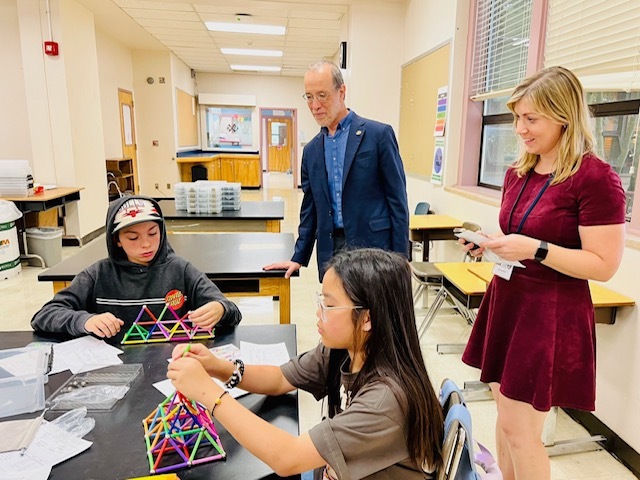
The first day of school is always such an exciting time for kids, parents, educators—and legislators! I love to visit local schools on that day and feel the energy, the angst, and the excitement.
This year I got to stand with Kellogg Middle School’s new principal as he introduced himself and shook the hand of every new sixth-grader walking through the door. Kellogg is a beautiful, newly renovated middle school (funded by PPS bond dollars, it opened just a couple of years ago) in Southeast Portland, just off SE Powell Blvd. What was extra special about this first day was that the new principal, Thai Nguyen, was himself a Kellogg student some years ago. He’s been working in Arizona as a teacher and a principal for the last 15 years, but now has come home to Portland and home to Kellogg. Here's a television story from KPTV about yesterday’s first day for Principal Nguyen.
I then visited with the new sixth graders (and teachers) at Roseway Heights Middle School and had a great time wandering the halls. Now, what was extra special about Roseway Heights was that they’ve just celebrated their 100-year anniversary (used to be Gregory Heights), and they opened a time capsule that was inserted into the foundation 100 years ago. Here's a video about that. Very cool.
A Few Additional Links to Stories of Interest
-
Summer Learning: One of the big disappointments from the 2023 session was our failure to come up with significant ongoing funding for summer-learning and after-school programs. Thanks to money provided to us for COVID relief in 2021, we had seen what two years of investment in summer learning could do—but that was one-time money. We needed (and continue to need) to keep working on coming up with investments that can be sustained. Talks are continuing. In the meantime, we just received some excellent news from our federal partners: $53 million will be coming to two dozen Oregon districts over the next few years. This will help. You can read about it here.
-
The Latest on COVID in Oregon from OHA. OHA reports on the prevalence of the new COVID variant here in Oregon. Fortunately, we're not seeing undue effects so far.
-
Re: COVID, Masking and Restrictions did make a difference. A recent study from the British Royal Society reveals that—though they remain the subject of attack from some quarters—COVID restrictions, masking, and other pre-vaccine interventions definitely made a difference during the initial phases of the pandemic. Where they made the most difference was when they were used in combination. Here's more.
-
More COVID Misinformation. Meanwhile, legislators are starting to receive another round of COVID misinformation. This time we’re hearing that the state and federal governments are about to require masking in public places, including air travel. Here's some background
-
Kmart Briefing. In the last newsletter I reported on the work to address the Kmart fire in Parkrose and the good work being done by Argos Scientific and the Parkrose School District to provide analysis and communication to the community. I also mentioned that there was going to be a District-sponsored briefing on August 15th. Here’s a link to a Youtube of the briefing. The audio on the Youtube starts a little rough but gets better about five minutes in.
-
Energy Rebates. Here’s a very useful article from the Oregonian providing an update on federal and state rebates that will be available to Oregonians to help them switch to cleaner forms of energy. On the downside, the $100 million in federal dollars for heat pumps coming our way will be slow in coming. On the upside, thanks to the omnibus climate and energy bills passed in the last session, there will also be state dollars, along with a new Department of Energy program that will help consumers navigate all that’s out there for their benefit.
Best,
 Senator Michael Dembrow
District 23
email: Sen.MichaelDembrow@oregonlegislature.gov
web: www.senatordembrow.com
mail: 900 Court St NE, S-407, Salem, OR, 97301
| 

