|
June 18, 2023
Dear Neighbors and Friends,
I hope that you and your loved ones are doing well, staying healthy, and looking out for your neighbors and friends during this past week.
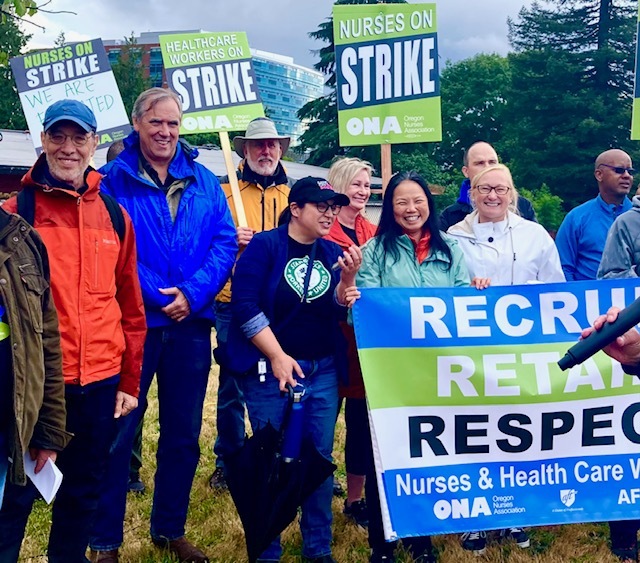
I hope that you had an enjoyable Father’s Day yesterday and found a positive way to celebrate Juneteenth today. For me, Father’s Day this year was particularly memorable, as I was given the gift of seeing my wonderful granddaughter graduate from high school. And today I was able to join the huge crowd of people supporting the nurses and clinicians who are out on strike at Providence Healthcare Systems, fighting for needed improvements to their working conditions—better staffing ratios, better pay, paid time off when they need it, overall just more respect from Providence management. It was great to be there with those striking workers, Senator Merkley, a number of my Senate and House colleagues, other elected officials, and other supporters. A great way to end the day.
In tonight’s newsletter you’ll find information about what’s ahead of us in these final days of the Legislative session. Now that most Senate Republicans have returned, we have the potential to get all the work of this session completed before our “Sine Die” deadline (June 25th) passes. We’ll be back at it in long days and nights starting tomorrow. I also have an interesting little story to tell about one of the bills that passed last week.
You’ll also find information about the data breach that struck the Department of Motor Vehicles last week.
Moving over to COVID, we continue to experience relatively low COVID metrics and risk to our communities. Most of the metrics actually improved further this last week here in Oregon and around the country. In tonight’s links to COVID news articles, you’ll also find out more about the new COVID boosters being planned for this coming fall, which will be designed to be even more focused and effective than those we’ve had so far.
The good news is always tempered by the reality that COVID remains with us, even if it is not as virulent as it once was (and treatments have become more effective). As I mentioned above, we got to celebrate my granddaughter’s graduation this weekend. But not all of us could: my daughter-in-law’s sister flew out from Washington D.C., and almost immediately learned that she had COVID. She experienced a miserable few days (Thank heavens for Paxlovid!) shut up in a hotel room. Sigh.
Until next week, please do your best to stay happy, healthy and safe. And let me know if you have any questions or thoughts about anything in this week’s newsletter.
Joint Ways and Means About to Complete Its Work
As I mentioned last week, most of the legislative action (aside from the final floor votes) is now in the hands of Ways and Means. This is where the remaining policy bills that have budget impacts are about to receive their final committee votes. It’s also where all the final bonding and budget investment decisions are located.
The bonding and final investment bills are all going to be voted out of the Capital Construction Committee at 9 am tomorrow. Here's the agenda. If you want to see the details of what’s on the lists to be funded, go to the individual bills and click on “Amendments.” There you’ll find the version to be voted on tomorrow. You’ll find additional information under “Analysis.”
These amendments and analyses were posted this afternoon. Advocates and agency people have been poring over them ever since. Many have already written to express their relief, others their disappointment. It’s always difficult in these final days of the session, as time runs out on what will and will not be funded.
Tomorrow morning’s final Capital Construction subcommittee meeting will be followed by full Ways and Means at 2 p.m. That’s where those bills and few last policy bills will be voted on and sent to the Senate and House floors. I’ll be carrying three of the policy bills: HB 3198 A (Early Literacy), HB 3229 (DEQ’s Title V Air Quality Program), and SB 283 (Educator Workforce).
Here's the agenda for that meeting.
Around 200 Bills Left on the Senate Docket
The Senate begins its floor session tomorrow morning at 10. (The Capital Construction Subcommittee of Joint Ways and Means has its last meeting at 9.) On the docket now are 185 bills, a combination of those set for 3rd Reading (the great majority) and 2nd Reading (only a couple). These will be joined by around a dozen final bills coming from Ways and Means, Revenue, and Rules.
That’s a lot of bills, and it means we’ll be working long days and nights in order to finish up by the end of Sunday (as we are constitutionally required to do). But at this point it appears doable, now that the Republicans have agreed to suspend the rules that tend to slow things down (including bill reading). I also expect that we won’t see many long speeches. If a bill has made it to the floor, it very likely has the votes committed to pass it. (However, there are always exceptions, which always makes the process interesting and unpredictable.)
Some are saying that we could be finished by very late on Friday. I guess that’s possible, but Saturday or Sunday seems more realistic to me. There are always potential process hiccups (what we call “paperwork”) to be expected.
The House of course has far fewer bills to be worked, since they’ve been able to hold floor sessions and move bills. Right now they are looking at 42 bills on their schedule. Within the next couple of days, though, they can expect the remaining 45 Senate bills that are still to be voted on in the Senate (most of them bills coming out of Ways and Means), plus the final bills coming out of Ways and Means, Revenue, and Rules.
They too will be seeing long days, if not long nights to make the deadline.
Will We Be One of the First Ten?
There was an interesting subtext to one of the bills that passed the Senate Thursday after in a concurrence vote. SB 279 would allow Oregon to join the new Interstate Compact on Teacher Mobility. Teachers in compact states will be able to have their licenses immediately recognized by states to which they move, as long as the new state is also a compact member. Becoming part of the compact was another recommendation that came out of the Educator Workforce Shortage work group as a way to remove unnecessary barriers to securing the workforce we need.
To be part of the compact, a state must pass enabling legislation authorizing its joining. That why we had SB 279 drafted. Another wrinkle is that the first ten states to pass the necessary legislation and get it signed by their governors would form the initial steering committee for the new compact, establishing the necessary groundrules. We were therefore hoping for speedy passage through the Legislature.
The bill passed early and overwhelmingly in the Senate. When it was in the House, the Department of Justice asked for some technical language changes to better align it with existing Oregon law. It then went on to pass the House (again overwhelmingly) in May. But because it needed an amendment, it needed to come back to the Senate for concurrence. That of course couldn’t happen until the Republicans returned.
Meanwhile, other states were passing their authorizing legislation. We learned on Thursday that nine states had already done so, and others were getting close. So, as you can imagine, it was imperative that we get the bill to the Governor’s desk for her signature ASAP.
Well, that’s easier said than done. Once the bill passed its final vote, it needed to go back to Legislative Counsel to be reprinted in its final “Enrolled” version, then signed by the Senate President, then by the Speaker of the House, then the Governor. I was told that that process would likely take a week.
Except that we didn’t have a week to spare! So a number of people in both chambers and a number of offices, knowing what was at stake, put their heads together and did the remarkable. Within 24 hours all the necessary steps were taken and the bill had the Governor’s signature on it. Because of the time zone difference, it was already after 5 pm on Friday at the offices of the Council of State Governments, who are coordinating the Compact.
So we still don’t know it we are in fact #10, or if another state slipped ahead of us in line on Friday. We should find out tomorrow, and I promise to let you know!
Big Data Breach at the DMV
You may or may not have heard of a big international hack of confidential data last weekend, exploiting a software system used by our Department of Motor Vehicles. It appears to be quite serious. Here’s how ODOT described it to us in an email late last week::
Good afternoon Senators and Representatives –
I wanted to share with you some unfortunate news you may have already seen covered in the media.
As part of a global technology hack that affected many organizations across the world who use the MOVEit transfer software tool, ODOT-DMV was victim of a malicious attack that enabled unauthorized access to files transferred between DMV and other partner agencies. This hack affected more than 2,000 organizations worldwide and included nearly 3,000 ODOT files. During this broad-based attack some DMV data was copied and taken while DMV was sending it through that software.
Individuals who have an active credential (license, permit, ID card) should assume information related to that credential is part of the breach.
We’ve taken steps to secure our servers and prepare to notify folks who have been affected. Since this hack included information on so many people, we’re providing that public notice via the media.
And then on Friday we received the following update from ODOT:
We have set up a website for this breach. This is the best place to get most up to date information and will have all relevant resources linked or otherwise available here.
We have established a call center/customer hotline: (503) 945-5000. As of now the automated message on this hotline will provide an option for someone to get a text with a link to the webpage above. It was also provide, during regular business hours, an option to talk to someone directly. Our staff are ready and standing by to help Oregonians better understand what happened and how they can best protect themselves/their identities.
Folks can also call the DOJ Consumer Protection hotline if there’s suspicion of a scam or fraud: (877) 877-9392
We are still providing the same information and recommendations to impacted Oregonians, notably strongly urging people to check their credit, consider freezing their credit if possible, and paying close attention to their accounts.
I’m sorry for not getting this out to you sooner. As always, please let me know if you or your constituents have any questions. thanks and happy weekend.
Lindsay
And here's the letter that ODOT sent out to potentially affected license holders.
I’m sure we’ll learn more in the coming days. I’ll be sure to pass it along.
ON THE COVID FRONT
Weekly Data Report:
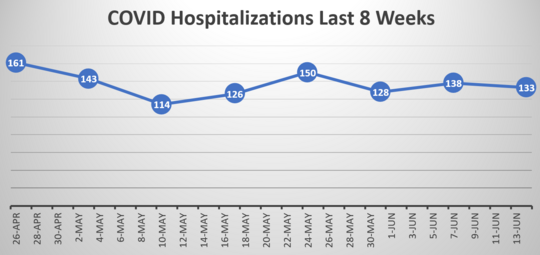
OHA is no longer providing updates on COVID test results each week (because most tests are being done at home and not reported), but it is reporting on the other metrics. Here is the most recent set of results, for this past week from 6/8/23 through 6//23.
As you’ll see, the metrics have generally stabilized at their recent relatively low levels.
On Wednesday there were 133 COVID hospitalizations, back down from the previous week’s 138 COVID-19-related hospitalizations statewide. Hospitalizations are now our best indicator of disease spread. Again, however, many of these hospitalizations are not in and of themselves due to COVID—many are those who tested positive after having been admitted for other reasons.
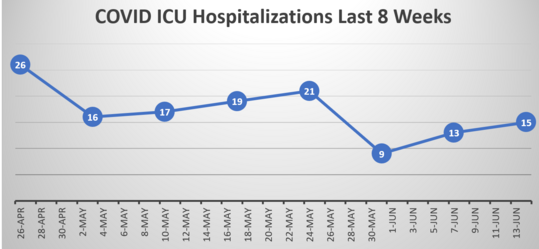
On Wednesday there were 13 COVID patients in intensive care, a small increase from last week’s 11. These are the most serious cases.
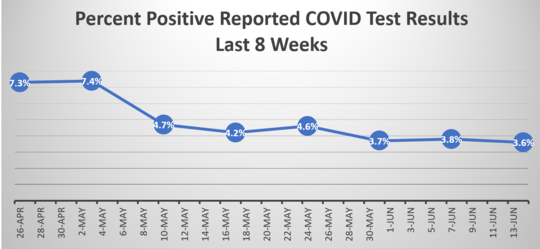
Testing percent positive was reported at 3.6%, slightly down from the previous week’s 3.8%. Test positivity is a function of those who are tested in medical facilities and other testing sites.
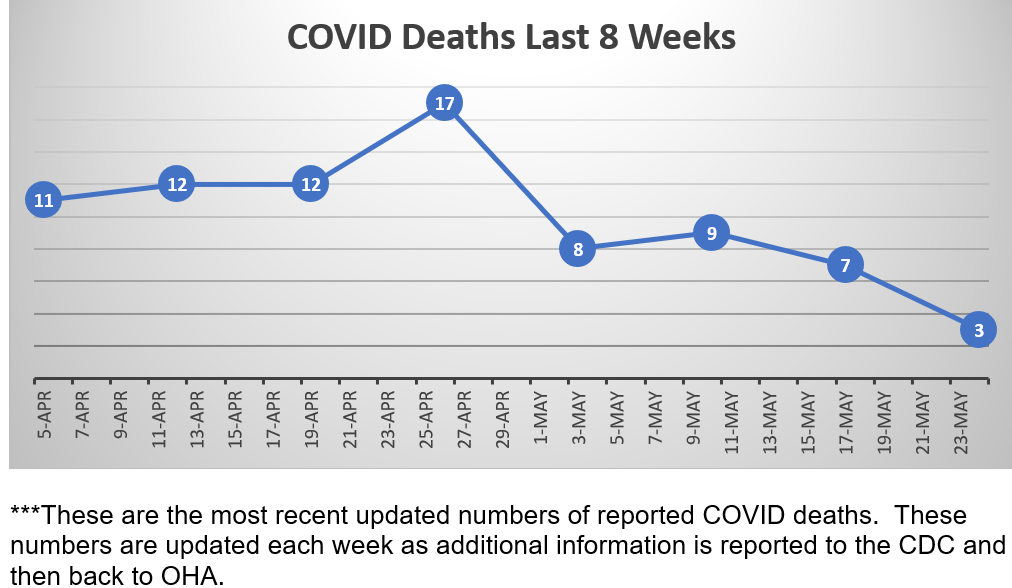
The most recent updated reporting of COVID deaths continues to show three deaths for the week of May 21th.
Weekly County Report: All Oregon Counties Remain at Low Risk for Hospitalization
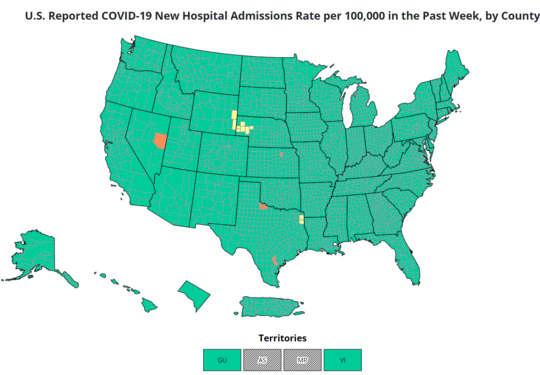
The CDC is continuing to assign risk levels based the number of people in hospital for COVID.
According to the CDC Daily Counter (updated each Thursday), all 36 Oregon counties are again at Low Risk for hospitalization.
Here’s a national map of all counties. As you’ll see, Oregon’s experience is currently being replicated in nearly all the states. (99.44% of U.S. counties are showing low levels of COVID hospitalization.
This Week’s Wastewater Monitoring Report: Equal Increases and Decreases
With testing reports giving us just a fraction of infections out there, wastewater monitoring has become a more reliable indicator of the amount of virus in cities around the state. That report is updated each week.
This week’s report, updated on Wednesday, reveals that 14% of the cities tested showed increases or sustained increases last week (down from 18% the previous week). Fourteen percent showed declines or sustained declines (up from 6%).
Overall, the great majority of cities continue to show little change one way or the other: the remaining 73% (down from 77%) report being at a plateau.
Astoria was the only city showing sustained increases last week.
Additional COVID Updates and Links
Here again are some COVID resources that you will find useful:
If the above links are not providing you with answers to your questions or directing you to the help that you need, please consider me and my office to be a resource. We’ll do our best to assist you or steer you in the right direction.
Sincerely,
 Senator Michael Dembrow
District 23
email: Sen.MichaelDembrow@oregonlegislature.gov
web: www.senatordembrow.com
phone: 503-281-0608
mail: 900 Court St NE, S-407, Salem, OR, 97301
| 

