|
June 11, 2023
Dear Neighbors and Friends,
I hope that you and your loved ones are doing well, staying healthy, and looking out for your neighbors and friends during this past week.
In tonight’s newsletter you can read more about the Republican walkout (now five weeks long, which I believe is the longest ever in the history of this nation), the effects and the risks if a solution is not found. But you’ll also find a note of hope, as prolonged and determined negotiations appear to be leading to a resolution. If so, that resolution could come as early as tomorrow, with action on the floor beginning again within the next few days. Let’s hope that this is indeed the outcome. If we do indeed settle on a path forward, I'll follow up with the details.
Moving over to COVID, we continue to experience relatively low COVID metrics and risk to our communities. If our experience over the last few years continues, we should be seeing these low numbers continue now that summer is coming, school is letting out, and people are spending more time outdoors.
Speaking of outdoors, I do want to say what a pleasure it has been to experience the return of Rose Festival, with its parades, Dragon Boat races (Go Love Boat!), all the other events, and the hordes of Portlanders and visitors experiencing the festivities in Downtown Portland. It’s a little easier to feel hopeful about the world.
Until next week, please do your best to stay happy, healthy and safe. And let me know if you have any questions or thoughts about anything in this week’s newsletter.
An End to the Impasse?
As I write this, it’s the end of several days of intense negotiations involving leaders of all four legislative caucuses (Senate Democrats, Senate Republicans, House Democrats, and House Republicans) in a quest to find an agreement that would bring an end to the Republican walkout and a successful end to the 2023 Legislative session. It’s been quite the weekend.
It's too soon for me to say much of anything about these negotiations, but I can say that they are promising at this point. If they work out, we could be back voting on the Senate floor by midweek. The agreement would allow us a clear path to clearing the backlog of bills that are currently on the Senate bill list in time for Sine Die (end of session on June 25).
I don’t want to ay anything to jinx the current state of play, but I will say that at this point I’m optimistic. But as I’ve said before, life in the Legislature can be a roller coaster . . .
If and when we have an agreement fully worked out, I’ll put out a special newsletter to tell you more.
The Stakes Are Very High
If you’ve been following the media, you’ll know that Senate and House Democrats, along with a number of advocacy groups, have been highlighting the many, many important bills and budget investments benefiting all of Oregon that become further at risk every day the Republican Senate walkout continues. We are poised to take crucial action on housing, behavioral health, education, climate action, wildfire, and job creation. But all of this could be lost if the clock runs out on this session.
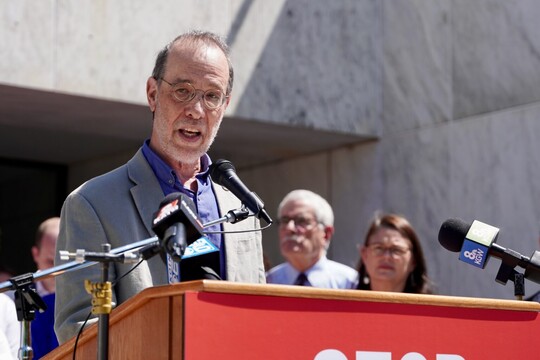
We held a big rally cum press conference on Tuesday on the Capital steps with a number of legislators and partners speaking and supporting. I was among those who spoke (focusing particularly on the crucial education bills and historic investments in education that are at risk) and answered questions from reporters.
In response to a reporter's question, I made it clear that despite the adversity, I have not given up on this session. The stakes are simply too high. Democrats made it clear at the rally that we are open to negotiations as long as they are serious and honest. It now appears that serious, honest negotiations are at last occurring and appear to be bearing fruit. Fingers crossed.
Here's a press release on the event, and here’s some of the coverage from the Capital Chronicle, the Associated Press, and KOIN.
300 Bills Now Stalled in the Senate
On the Senate side, bills coming out of committee continue to stall, including the budget bills coming out of Joint Ways and Means.
Seven House bills are now on the Third Reading list, along with two “special orders of business.” These are bills that came over to the Senate after successfully passing the House, successfully went through a Senate committee, then went to the floor for a Second Reading vote. After a bill is Second Read, it is scheduled for a final (Third Reading) vote the following day. These seven bills all had their Second Reading and were then trapped awaiting their Third Reading.
There are now 204 bills on the Second Reading list. These are all bills that have been voted out of committee (either a Senate policy committee or one of the joint committees). There are 87 bills on the First Reading list. Some are brand new, but most are budget bills that went from Ways and Means to the House, where they passed last week.
There are also now 32 Senate bills that passed the House but generated an amendment of some sort while in their House committee. They need to come back to the Senate for “reconsideration.” Such votes are nearly always formalities and they are required to come up first on the day’s agenda. I’m currently scheduled to carry 8 of them in my role as Senate Education Chair—these are all good bills that came out of Senate Education and were amended in the House.
In all, we therefore have 300 bills in all awaiting action.
While the Senate continues to accumulate bills, mainly House bills now, the House continued to be able to pass Senate bills and budget bills coming out of Ways and Means. Last week they passed 22 such bills.
Looking at the week ahead, 25 bills are currently on the docket for House floor votes this week
Here’s the current list of bills currently awaiting action. You’ll find them under “Third Readings,” “Second Readings,” and “First Readings.”
Is This Session as “HyperPartisan” as Some Are Claiming?
As I’ve mentioned before, there’s a kind of disconnect this session between the assertions coming out of partisan press releases (not surprisingly, I would say on the Republican side in the Senate) and the general performance in committee and in votes on the floor. I’ve mentioned that more than 90% of the House bills and 95% of the Senate bills passed their chambers with support from legislators of both parties prior to the walkout.
To further test this assertion, I asked Noa Stoll, my excellent intern from OSU this session, to do an analysis of the House bills currently stalled in the Senate because of the walkout. Here is the result of her research.
I asked her to use a very high standard—bills that passed the House floor with two-thirds majorities. This means more than just a couple of Republican votes.
You’ll see that her findings are quite revealing: rhetoric aside, this session has actually been unusually bipartisan in terms of the votes on bills passing off the floor. Many if not most of those bills were significantly amended in committee to get to that bipartisanship: that’s how the system should work.
Thanks for your work, Noa!
Ways and Means Finishing Its Work
Last week saw the final meetings of the various subcommittees of Ways and Means. All the agency budgets have been finalized, forwarded from the relevant subcommittees to the full Joint Ways and Means Committee, and voted out to the House and Senate floors. As a co-chair of one of the subcommittees (Natural Resources), I can attest to just how difficult and important this budget-writing is, and how hard the Legislative Fiscal Office staff work to get it right.
The final bills coming out of the subcommittees were all policy bills—bills approved by House and Senate policy committees for new policy that had some cost attached to them. Even though the subcommittees have finished their work, there are some policy bills out there that still need to go before a subcommittee. Those will go to the "Capital Construction" subcommittee—the catchall committee that mainly deals with infrastructure/bonding investments and the final “End-Of-Session” funding bills (sometimes referred to as the “Christmas Tree Bill”), the one-time investments that come up at the end. Cap Construction membership includes most of the Democratic and Republican legislative leadership. Interestingly, the Senate Chair is a Republican this session.
Cap Construction will likely have its final meeting tomorrow (OK, maybe another on Tuesday). Full Joint Ways and Means meets tomorrow morning and will likely meet for the last time on Tuesday or Wednesday.
Fire Season Returns
You’ve probably been following the struggles with smoke faced by those living on the East Coast this past week as a result of the fires raging in Canada. They are unfortunately getting a taste of what we’ve been experiencing in recent years here in the West as a result of heat and drought and other effects of climate change.
Conditions are improving in the East, but it has been quite the wakeup call for them—particularly as it comes so early in what is traditionally considered fire season. But it’s a reminder for us in the West that fire season is upon us, and predictions suggest that this may be another tough one for us.
Legislators just received our first communication about fire season from the Oregon Department of Forestry (ODF). Here it is. I’ll continue to pass them on to you as I receive them.
Greetings,
As fire season progresses in Oregon, I wanted to take just a couple of minutes to provide a brief update. Due to evolving weather conditions over the past month, many parts of the state are seeing abnormally dry fuel conditions. Additionally, persistent drought is showing across significant portions of Oregon, with the east slope of the Cascades and central Oregon in severe drought conditions.
In response to these fuel conditions, initial attack activity, and forecasted weather, many ODF districts and active associations have declared fire season, beginning the regulation of outdoor activities and with the intention of preventing human-caused fire starts. As of today, 5 of 11 ODF districts and all 3 active associations are now in fire season. Each of the three ODF-protected areas (Northwest Oregon, Eastern Oregon, and Southern Oregon) have experienced fires resistant to suppression efforts to-date. These fires are also at a size uncommon for this time of year. In combination, these factors highlight the need for continued prevention efforts. The agency is making final preparations for fire season statewide; this includes the final hiring and training of seasonal firefighters, signing of contracted severity-funded aircraft, and continued coordination with our agency partners across all jurisdictions.
Attached to this email is a news release, which explains the current fuel conditions on the landscape and reminds Oregonians to be mindful as they recreate outdoors across the state. ODF continues to collaborate with Keep Oregon Green, among other partners, to engage the public in wildfire safe practices.
Thank you for the work you do. I will continue to keep you updated on important information and changes throughout this fire season.
Mike Shaw
Chief of Fire Protection
Oregon Department of Forestry
Double Up Your Bucks!!!
Spring is here, and our local farmers markets are in full force throughout the state. As I always try to do at this time each year, I want to remind you of the big benefits that farmers markets provide for health eating and enhancing our local economies. I hope that you had a chance to shop at one of your local farmers markets this weekend, and if not, there's always next weekend!
If you or someone you know is able to take advantage of SNAP (food stamps) benefits, I want to remind you of a way to enhance your purchasing power: the Double Up Food Bucks program. I just received a reminder from Rachael Ward, Executive Director of the Farmers Market Fund with more info. Here it is:
Spring is arriving and farmers markets are opening! Shopping at a farmers market is a great way to find the freshest food for your family, while supporting our local farmers and small businesses. One program that helps make farmers markets affordable and accessible for all is Double Up Food Bucks. This program matches SNAP benefits, dollar for dollar, for the purchase of fresh fruits and vegetables. Double Up is also available at participating small grocers, farm stands, and Community Supported Agriculture (CSA) programs. Check the map here for locations that participate in our district. Happy eating!
ON THE COVID FRONT
Weekly Data Report:
OHA is no longer providing updates on COVID test results each week (because most tests are being done at home and not reported), but it is reporting on the other metrics. Here is the most recent set of results, for this past week from 6/1/23 through 6/7/23.
Following the big declines that were reported last week, this week’s report shows some small increases in most of the COVID metrics in Oregon.
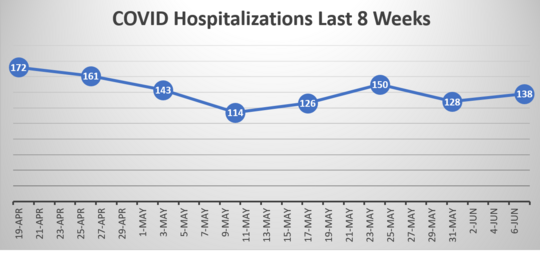
On Wednesday there were 138 COVID hospitalizations, back down from the previous week’s 128 COVID-19-related hospitalizations statewide. Hospitalizations are now our best indicator of disease spread. Again, however, many of these hospitalizations are not in and of themselves due to COVID—many are those who tested positive after having been admitted for other reasons.
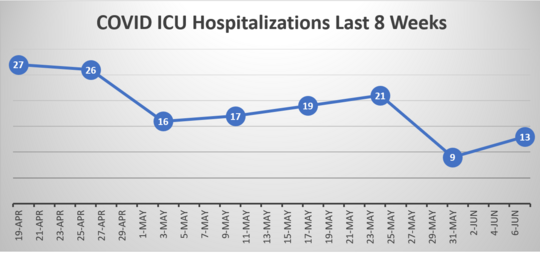
On Wednesday there were 11 COVID patients in intensive care, an increase from last week’s 9, and the lowest since the beginning of the pandemic. These are the most serious cases.
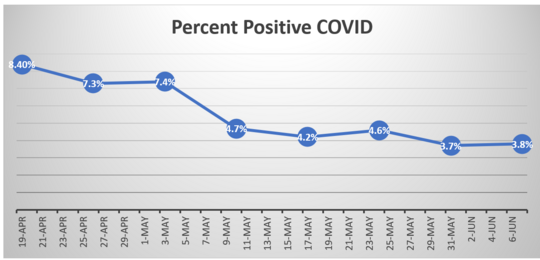
Testing percent positive was reported at 3.8%, an increase from the previous week’s 2.9% (though still very low).. Test positivity is a function of those who are tested in medical facilities and other testing sites.
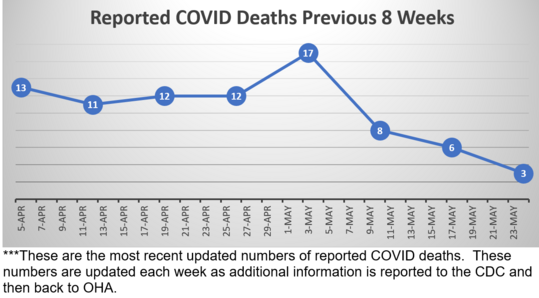
The latest numbers of reported COVID deaths shows three deaths for the week of May 21th, down from six the previous week.
Weekly County Report: All Oregon Counties Remain at Low Risk for Hospitalization
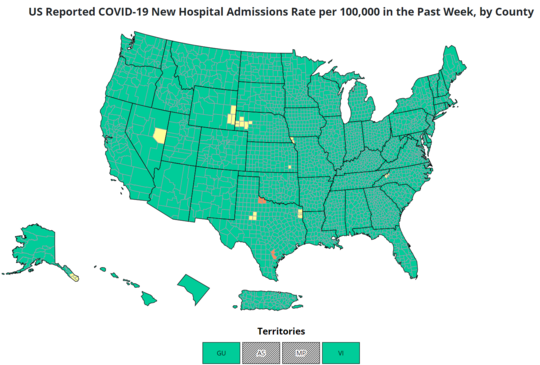
The CDC is continuing to assign risk levels based the number of people in hospital for COVID.
According to the CDC Daily Counter (updated each Thursday), all 36 Oregon counties are again at Low Risk for hospitalization.
Here’s a national map of all counties. As you’ll see, Oregon’s experience is currently being replicated in nearly all the states. (99.04% of Oregon counties are showing low levels of COVID hospitalization.
This Week’s Wastewater Monitoring Report: Increases Last Week
With testing reports giving us just a fraction of infections out there, wastewater monitoring has become a more reliable indicator of the amount of virus in cities around the state. That report is updated each week.
This week’s report, updated on Wednesday, reveals that 18% of the cities tested showed increases or sustained increases last week (up from 9% the previous week). Six percent showed declines or sustained declines (down from 9%).
Overall, the great majority of cities continue to show little change one way or the other: the remaining 77% (down from 83%) report being at a plateau.
Forest Grove, Newport, and Portland showed sustained increases last week.
Additional COVID Updates and Links
- From the Kaiser Family Foundation, how the mixed messages of vaccine skeptics sow seeds of doubt.
- Here’s an interesting factoid: we know that humans traveled less during the pandemic. But animals traveled more.
- Here are the very technical results of a study showing the interrelationship between fatigue and Long COVID.
- From the Editorial Board of the Washington Post: the mysteries of Long COVID need to be unraveled, but we're getting closer.
- As we continue to struggle with the effects of pandemic learning loss, it’s becoming clear that schools that reopened early did not do much better.
- Leona Wen believes that it makes sense to continue masking in certain medical settings. Here’s more. Here's more.
Here again are some COVID resources that you will find useful:
If the above links are not providing you with answers to your questions or directing you to the help that you need, please consider me and my office to be a resource. We’ll do our best to assist you or steer you in the right direction.
Sincerely,
 Senator Michael Dembrow
District 23
email: Sen.MichaelDembrow@oregonlegislature.gov
web: www.senatordembrow.com
phone: 503-281-0608
mail: 900 Court St NE, S-407, Salem, OR, 97301
| 

