|
Friends and nieghbors,
I hope this summer has been a good one for you and your family. Take a look under the "Back to School" section of this email for a urgent action alert that will expire today at midnight.
We are in a period between legislative sessions called Interim. Committees will meet on September 27-29 during a work period called Legislative Days. You can monitor OLIS (Oregon Legislative Information Service) during to watch Committee members get updated on the biggest issues facing our state.
I was recently appointed to the Task Force on Substitute Teachers which will look at the various issues facing our substitute teachers. Particularly the issue that arises when school districts use staffing agencies to fill teaching gaps. These meetings happen outside of the regular session, but will submit reccomendations to the Legislature.
In the meantime, my staff and I spend less of our time on policy and more on constituent casework. This means that we are helping constituents navigate state agencies, departments, and bureaucracies.
This looks different depending on the issue, but we can assist you navigate state websites, pay registration fees, receiving licenses or certifications, or connecting you to a state agency to ask a question.
Sometimes, we receive requests for help for issues outside my office's jurisdiction. This would be any federal issues – such as the VA, immigration, or passport assistance. In these circumstances, we ensure those requests get put in the hands of your Congressional office, which can best assist.
Make sure to swing by House District 22's biggest attraction this weekend: The Oregon State Fair. Check out the animals, concerns, and rides here.
As always, please don't hesitate to contact me with comments, questions, or concerns at 503-986-1422 or Rep.TracyCramer@oregonlegislature.gov.
Best,
 Tracy
Ensuring Oregon's schools are educating our students properly requires parental involvement. To that end, the Oregon Department of Education is adopting new Health Education standards that you may find alarming.
I would encourage parents read through these standards to familiarize yourselves with what state policymakers recommend teaching your children.
The opportunity to submit public comment closes September 1 at 11:59 PM, so act quickly if you can to submit public comment. Do that here.
As I looked through the standards, I was alarmed that they proposed teaching kindergarteners that "there are many ways to express gender," and first graders to analyze "the differences and similarities in how people with different gender identities are expected to act."
Here is a summary of the things I identified as the most controversial pieces of the standards.
These standards act as a framework for local school boards to implement. If you miss public comment period at the state level, you may have another chance when these standards get adopted at the local level. Write to your school board and give them a heads up on your thoughts. Find their emails here:
Woodburn School Board
Gervais School Board
Contact Form: Salem-Keizer School Board
For questions about the standards, you can email the Department of Education here: ODE.HealthEd@ode.oregon.gov. To keep up with what the Oregon Department of Education is up to and never miss an opportunity to give them feedback, subscribe to their emails here.
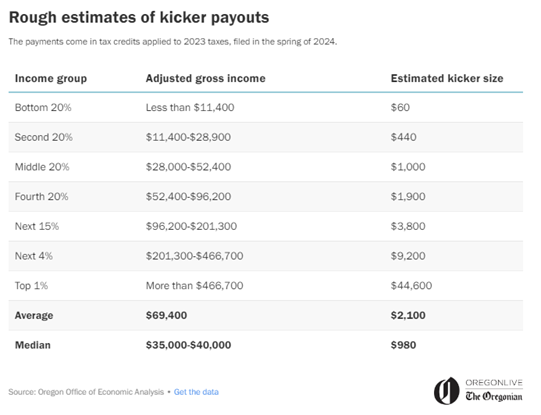
 This week, the Oregon Office of Economic Analysis released updated projections that estimate that Oregonians will have overpaid their taxes by nearly $5.6 BILLION. That means on 2024 tax filings, Oregonians will get the largest Kicker tax credit in Oregon history.
Every time there the Kicker is in the headlines, some use the opportunity to undermine the Kicker by saying it benefits the rich, or the money would be better spent by the government.
First, your Kicker is proportional to how much you pay in taxes. The more you pay, the more you get back. Second, I always believe Oregon families are better capable at spending their own money than the government.
Those who seek to undermind the Kicker also use misleading talking points that might convince you that Oregon doesn't have money saved up for if the economy takes a downturn.
But in reality, we do have a Rainy Day Fund, and its almost as big as Oregon law allows. In otherwords, the Legislature could not put more money into the Rainy Day Fund without breaking the law.
Unfortunately, behind the talking points, I believe that these people truly want to use the Kicker as a slush fund for political pet projects. Again, I think Oregonians are better at making decisions with their money then the government is.
With a Democratic Majority in Salem that always seems to be running out of your money to spend, the Kicker is also the last line of defense against run-away government spending.
While this Kicker may be the biggest on record, record inflation makes it so it is not the biggest in terms of purchasing power. Because of inflation, Oregonian's wages inflated as well, pushing them into higher tax brackets while not feeling the benefit of those wage gains because of increased prices on everyday goods. The money you are getting back because of the Kicker will also be in inflated currency. This is another example of how inflation acts as another tax on Oregonians.
While the Kicker will be finalized on October 1, you can take a look at the estimated tax credit you could be eligible to receive:
Just a few weeks ago, Governor Kotek vetoed $1 million in funding I helped secure for Willamette Career Academy (a local career and technical school serving students in Marion County).
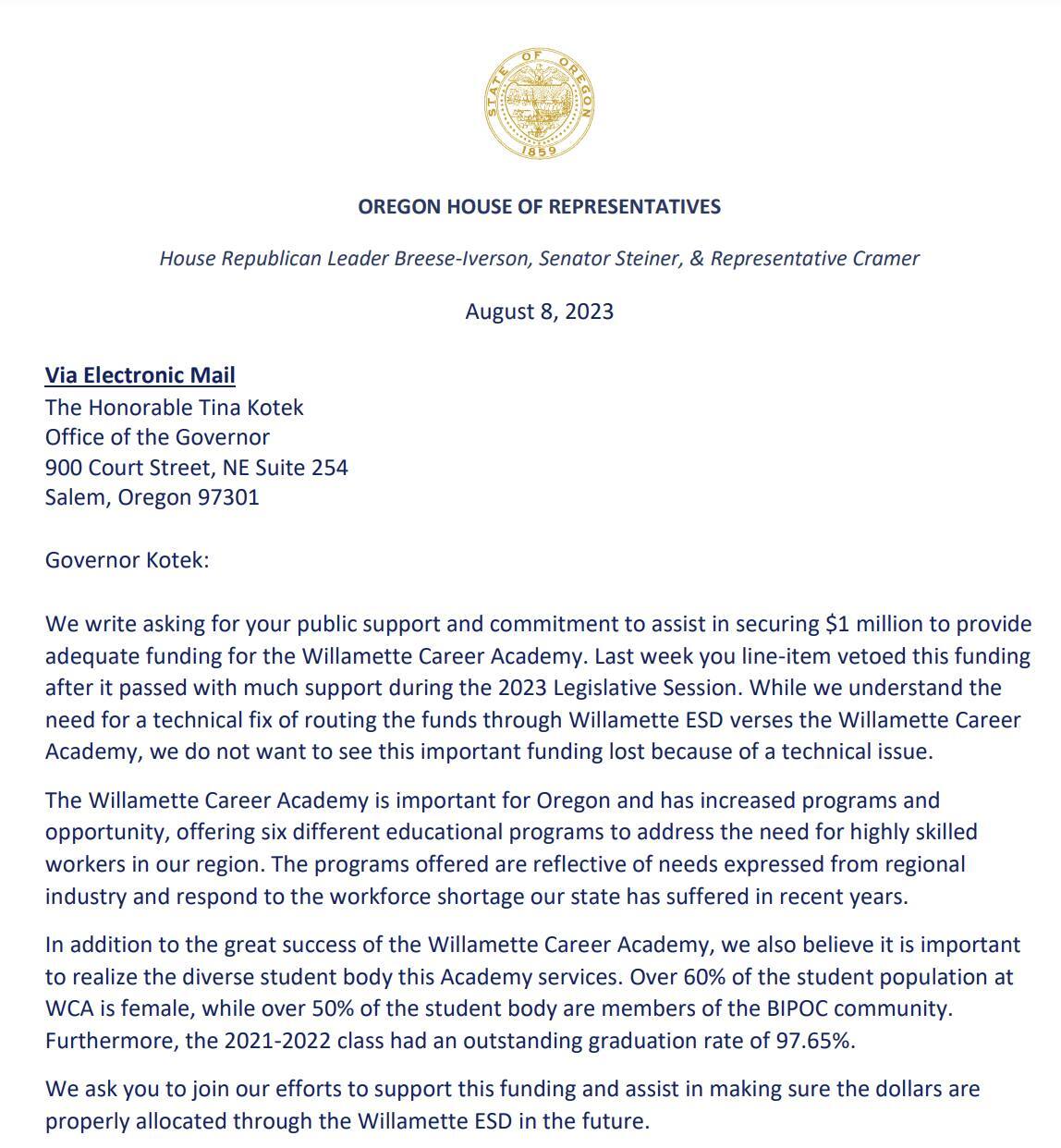
It's frustrating that bureaucratic concerns got in the way of student success. Especially when the students that Willamette Career Academy serves are 60% girls, and over 50% of the student body are members of the Hispanic community. The programs they offer are a proven success, with nearly a 98% graduation rate in the 2021-2022 class.
After her veto, I wrote a letter to the Governor – along with House Republican Leader Breese-Iverson and Democratic budget co-chair, Senator Steiner – asking the Governor to commit to passing this funding at the soonest opportunity.
Education opportunity is not a partisan issue, and I will continue to fight for students.
As kids return to school, I have spoken with many parents who are losing faith in our public school system. In a recent study of 40 states, Oregon came out with the nation's fourth-worst student absenteeism rate. Over 36% of Oregon students miss 10% or more of their school year.
In the last few weeks, reports have shown that Oregon's test scores are not rebounding post-pandemic. Data shows that only 40% of the state's third graders were proficient in reading, writing, and math this spring. That's down from 47% proficiency in English and 46% in math in from before the pandemic. Among eighth graders, only 44% achieved proficiency in reading and 26% in math. Since 2019, that's down from 53% and 38% respectively.
I ask myself why this is… Students in other states are rebounding much better than Oregon students, including states like Mississippi, which historically has had poor achievement rates. However, in the past decade, Mississippi has put a lot of time and energy into laying the foundation of learning for students, specifically in reading. Now, post-pandemic, those efforts are paying off.
I was proud to support Governor Kotek's early childhood literacy package, which I believed was a step in the right direction to begin to solidify our reading curriculum for young students. I believe the investment it makes in teachers to train them in the fundamentals of phonics and "the science of reading" is an good start.
We can and must do better to prepare our students for future success. It's a shame we let our students get to this point, and it won't change overnight just because we passed one bill. Mississippi has been undergoing this process for a decade, but the results speak for themselves.
We must also unleash the power of choice in education. I believe that includes giving parents more power to choose an educational environment that best fits their child's needs. My primary concern is setting our kids up to be the best they can be, and we must do more as a Legislature to empower parents and students.
The effort to refer the Salem payroll tax to the voters has gathered enough signatures to qualify for the ballot. The tax would not only have impacted Salem residents, it would affect anyone who works in Salem. That's a hard pill to swallow for struggling families right now.
Someone living in Woodburn or Gervais, but working in Salem would be required to pay the tax but not be eligible to vote on it. This brings up serious voting rights issues concerning many neighboring areas that house people who work in Salem.
Just this week, the Salem City Council rejected a motion to repeal the tax before it got to the ballot. So it's looks likely that Salem residents will get a chance to vote to keep or reject the tax this November when it appears on the ballot.
Measure 110 and Oregon's drug issues seemed to dominate this summer's headlines. Overdosed, primarily driven by the rise of fentanyl, is a nationwide concern. But in Oregon, it's made worse by Measure 110, which decriminalized hard drugs.
National news – from Atlantic Magazine, the New York Times, Economist, and more – have begun to notice how Measure 110 is handicapping our fight against the drug crisis.
Law enforcement understands that M110 has been a failure. 64% of Oregonians support repealing drug decriminalization. It seems like everyone understands the catastrophic failure of M110 except the political elites in charge of our policy.
That's why I am concerned why Governor Tina Kotek stacked the Portland Central City Task Force with political elites, including a vocal Defund the Police activist and no one from the law enforcement community. The Task Force is supposedly going to offer recommendations on how to solve Portland's homelessness and drug problems while taking no input from the public.
There is little doubt in Oregonians' minds that Measure 110 significantly contributes to Portland's issues. But given the pushback from liberal politicians in Salem to a recently announced effort to roll back M110's decriminalization, it's hard to see the Task Force offering any meaningful solutions.
This all comes after it came to light that the person in charge of overseeing Measure 110's implementation has no prior government or drug treatment experience, was on medical leave for 11 months before quitting, and was sanctioned by the Board of Naturopathic Medicine for not following opioid prescription guidance.
Oregonians passed Ballot Measure 110 with the idea that it would reduce drug abuse. It has only made it worse to the point where we rank dead last in the nation for drug treatment. They are right to have buyer's remorse because those in charge of implementing such a sweeping change have totally screwed it up. It's a predictable result when those in charge want to hand out foil, pipes, and needles as their primary "treatment" method. Our goal should be to get people off of drugs, not enable their use.
House Republicans offered several alternatives aimed at this goal, including HB 2310, which Democrats stonewalled even debating. We introduced a tiered approach that would include escalating penalties for possessing hard drugs. None of these were ever brought up for discussion in the 2023 session.
The fundamental flaw of M110 is that it is all carrot and no stick. We need a different approach for those struggling with addiction and unable to make the best decisions for themselves. Until we get help for those who want it and accountability for those who don't, don't expect our drug and homelessness problems to improve.
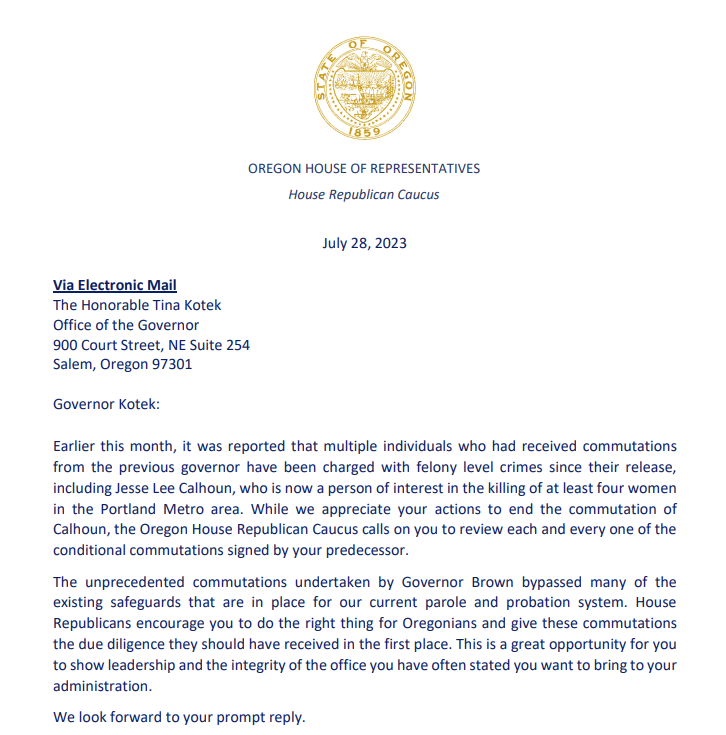
After the news broke that one of the prisoners that Kate Brown let out of prison early was a suspect ina string of murders in Portland, the House Republican Caucus sent a letter to Governor Kotek asking her to review all of the commutations of her predecessor.
It's a shame that it took several people getting murdered for Kotek to do this, but in the end, she has reversed 5 commutations at this point.
It's a fair question after the state botched the $300 million CoverOregon rollout. But just in the last few months, Oregonian's data has been exposed by hacks at the DMV and OHA.
Luckily, free credit monitoring is available for those whose data was breached by the Oregon Health Plan hack. For those with data at the DMV? Not so much luck.
I previously wrote about a bipartisan letter I signed that requested the DMV provide this service to Oregonians. They have yet to do so. If a private business mishandles your data, it is standard practice to offer credit monitoring. It should be the same for your government.
Also, 164,000 Oregonians received false notice of state financial aid for college. So, for the time being, the internet maintains its dominance over Oregon's administrative state.
The City of Salem has been selected by the University of Oregon’s Sustainable City Year Program (SCYP) to partner for the 2023-2024 academic year. This year-long partnership helps communities solve the problems of today and lay the groundwork for a sustainable, livable future—all while helping students prepare for the workforce through applied learning.
Partnership kickoff activities will take place in October.
This SCYP and City of Salem partnership is possible, in part, with support from U.S. Senators Ron Wyden and Jeff Merkley, as well as former Congressman Peter DeFazio, who secured federal funding for SCYP through Congressionally Directed Spending and the US Department of Education.
University of Oregon students and professors will focus on up to 20 courses directed at high priority projects for City Council and our community. SCYP courses will include journalism, architecture, geography, planning, and public administration with more disciplines added throughout the year as project and course matches are made.
The partnership is already underway, beginning with a summer quarter course on potential safe uses of artificial intelligence for greater efficiency in local government. While more options for Winter and Spring quarters are still being explored, SCYP will be in Salem to help with:
-
Climate Action Plan Implementation with a Community-Engaged Architecture course to discover opportunities for resiliency hubs across Salem.
-
Equity in Operations Fee. As we implement new software, this Public Budgeting course can help us advance new ways of thinking about differentiation among customer classes, based on equity considerations.
-
Volunteerism and Community. A Journalism course and a nonprofit consultancy course will work to define what the next wave of volunteers look like and how the City may alter volunteer opportunities to retain Library, Parks, Center 50+, Neighborhood Associations, Board and Commissions, and other volunteers.
-
Digital Divide and Civic Engagement. An Engaged Journalism course will consider where people in Salem get their information, and what tools and methods Salem can apply to better connect with our younger population and members of our cultural communities.
-
Furthering 2022 Safety and Livability Bond Projects. Architecture courses will further our thinking about mixed use building designs for branch library and housing. Another Architecture course may re-think Civic Center to integrate passive cooling into the seismic retrofit project.
-
Walkability and Mobility Policy and Design. A GIS course can help conduct a walkability assessment (and gaps) of pedestrian corridors and a mobility-centered planning course can help advance some topics in the Salem in Motion work to update Salem’s Transportation Systems Plan.
The City of Salem last worked with SCYP in the 2010-2011 academic year. In all, 27 courses with more than 500 students contributed to Salem that year.
Established in 2009, SCYP is now in its 14th year of partnerships with Oregon communities. SCYP partnerships connect University of Oregon students with local communities to implement real change. Students who enroll in SCYP classes engage in coursework that draws directly from community-identified issues. Through applied learning, SCYP is able harness the innovation of students and faculty to offer communities unique perspectives and ideas. Communities emerge from SCYP partnerships with increased outreach, expanded breadth of conversation, and cutting-edge solutions, while students emerge with “real world” experience, prepared to enter the public service-oriented workforce.
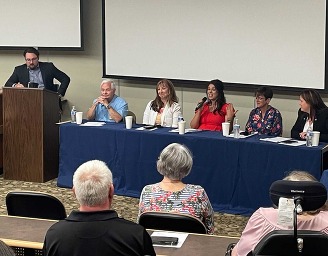
This summer, I have been able to do what makes this job of being your state representative so fulfilling: meeting the people I represent!
 |
|
Thank you to everyone who came out to talk about the issues facing the Salem area! Thank you to Councilor Julie Hoy, Commissioner Danielle Bethell, Representative Kevin Mannix, and Senator Kim Thatcher for being on the panel.
We talked about everything from the Salem payroll tax, voting, school choice, public safety, homelessness, and Measure 110.
|
Stay tuned for more town halls to be scheduled!
|
I recently toured the new Amazon fulfillment center in Woodburn with the Marion County Commissioners, Woodburn Mayor and City Officials, and others.
This new facility will bring thousands of jobs and access to educational and healthcare opportunities for its workers.
I’m excited to take another tour when it’s operational!
|
|
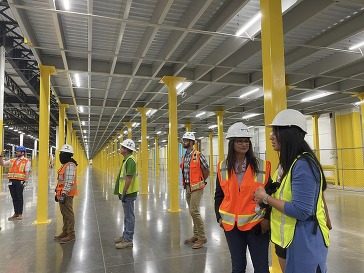 |
Some fun facts that the team shared with us on our tour:
- 48,000 tons of steel (total for the project) is equal to just over 6 Eiffel Towers.
- This project will be the largest building in the state of Oregon by square footage when complete.
- 1,250,000 manhours onsite. This is equal to 5 round trips to Neptune.
- 118,000 cubic yards of concrete placement - equivalent to 362 miles of sidewalk from PDX to Vancouver B.C.
- 30,000 tons of cement used for ground stabilization.
 |
|
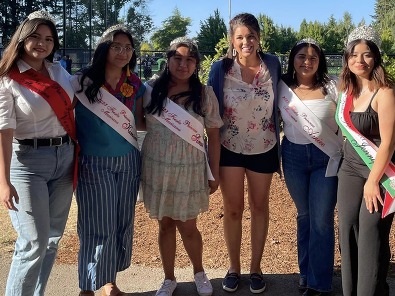
Congratulations to the organizers of this year's Woodburn Fiesta Mexicana and breaking the attendance record. I brought my family on Friday, and it was so wonderful to show my children just how diverse this community is how beautiful Mexican culture is. While I was there, I enjoyed meeting the Court Queen, Jennifer Gomez Peña, and First Princess, Vivian Fregoso Mata. |
|
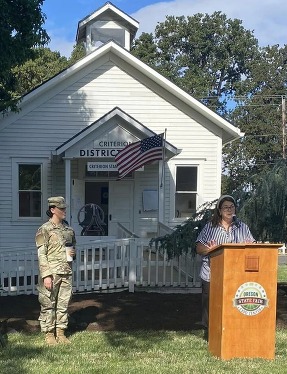
Earlier this month I attended the Country School Association of America’s ceremony to induct Oregon’s Criterion Schoolhouse into their national landmark registry.
Children first attended class in this one room school house in 1912 when it was located in Wasco County. The schoolhouse now sits in my district at the State Fairgrounds.
You can read more about the schoolhouse and how to visit here.
|
|
 |
Capitol Phone: 503-986-1422
Capitol Address: 900 Court St. NE, H-376, Salem, Oregon 97301
Email: Rep.TracyCramer@oregonlegislature.gov
Website: https://www.oregonlegislature.gov/cramer
|