|
June 4, 2023
Dear Neighbors and Friends,
I hope that you and your loved ones are doing well, staying healthy, and looking out for your neighbors and friends during this past week.
I included in the intro to last week’s newsletter the hope that I’d have better news to report this week. Sadly, I do not. We remain in a “Best of Days, Worst of Days” situation. Our committees continue to do good work passing excellent, far-reaching, bipartisan legislation out to the floor. There they continue to languish.
As I wrote last week’s newsletter, I knew that there were behind-the-scenes discussions with Republican senators being led by the Governor. Those were the grounds for my secret hopes at the time. By the middle of the week, it became clear that those discussions had fallen apart even before they could truly have been called negotiations. It was very discouraging.
I haven’t given up all hope, though. But as I’ll explain in tonight’s newsletter, we are facing a make-it-or-break-week for this session.
Following the announcement from the Governor that her discussions with the Republicans weren’t going anywhere, Senate Democrats agreed that it was time to take the next step, to levy a $325-per-day fine on the senators with unexcused absences--the same amount as they were receiving in pay each day. The authority to do so is embedded in Article IV, Section 12, of the Oregon Constitution, where it states that if a quorum is not met, a majority of those who do attend may meet; adjourn from day to day, and compel the attendance of absent members. One of the ways of attempting to compel attendance is by withholding the pay of the members who are not present to vote on bills on the floor.
Some have been wondering why we didn’t take this step earlier. The reason is simple—we had hoped that it wouldn’t have to come to this. Better to find a solution to this walkout through negotiation and a recognition of how devastating a session shutdown would be for Oregon. But we could no longer justify using public resources to pay those who were either not showing up at all or who were picking and choosing the parts of their jobs they were willing to do (and choosing not to do the most important part).
These fines will go into effect tomorrow. I hope that the walkout will be resolved soon and they won’t need to imposed for long.
Moving over to COVID, there the news is quite a bit better. As you’ll see in this week’s newsletter, the COVID metrics have all declined, in some cases fairly dramatically. We’ll see in the coming weeks if this is a temporary course correction or an ongoing trend. Let’s hope for the latter!
Until next week, please do your best to stay happy, healthy and safe. And let me know if you have any questions or thoughts about anything in this week’s newsletter.
The Impasse Continues
As of last Thursday, twenty Senate floor sessions have been canceled due to the Republican walkout. Two Republican senators—Dick Anderson from Lincoln City and David Brock Smith from Gold Beach—continue to attend floor sessions each day. To achieve the necessary 2/3 majority of all senators, all 17 Democrats and at least one additional Republican is needed. So far that has not occurred
A week ago I was hopeful that the Governor was going to be able to broker a deal of some sort, but that was not to be. I wasn’t there, of course, and can’t speak to the specifics of the discussions, but my understanding is that it was very frustrating for Governor Kotek. It also sounds as if it was similar to the earlier discussions involving the Speaker of the House, Senate President, House and Senate Majority Leaders and the two Republican Leaders.
As media reports have indicated, it has been very difficult getting the Republican leadership to articulate exactly which bills of theirs they need to see passed in order for them to return. Their focus has been on complaining about Democratic leadership and killing Democratic priorities, including Constitutional referrals to the voters around same-sex marriage and reproductive rights. As we saw in the recently-concluded federal debt-ceiling negotiations, once each side is willing to put forth a group of opening proposals and then start negotiating to find the middle, progress can occur. So far, from what I understand, the willingness to do that has been one-sided.
I’m hoping that this will change this week. We are running out of time. Over the next week, all the bills that need to come out of committee will have done so. If we can start passing bills on the Senate floor by the middle of next week, we can get through them all.
In the meantime, here are a couple of articles that you might find interesting. The first provides a picture of the Republican walkout from the viewpoint of a national publication--in this case Rolling Stone. It describes the walkout--and particularly the controversy over HB 2002--as part of deeper national trends. Here it is.
The second describes a joint effort by House and Senate Republicans to create a self-appointed "Accountability and Oversight Committee" designed to expose malfeasance on the part of Democrats and justify the walkout by Senate Republicans. As you'll see in this article from the Capital Chronicle (with similar coverage in a number of other publications), it backfired.
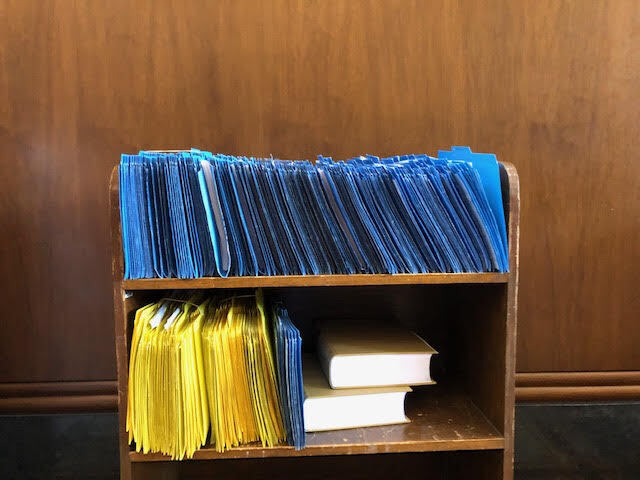 Bills awaiting action on the Senate floor.
More Than 200 Bills Stalled in the Senate
On the Senate side, bills coming out of committee continue to stall, including the budget bills coming out of Joint Ways and Means. The Senate to-do list now includes 173 bills that have already passed the House (19 more than last week’s count of 154 stalled bills).
In addition, there are 31 Senate bills that passed the House but generated an amendment of some sort while in their House committee. They need to come back to the Senate for “reconsideration.” Such votes are nearly always formalities and they are required to come up first on the day’s agenda. I’m currently scheduled to carry 8 of them in my role as Senate Education Chair—these are all good bills that came out of Senate Education and were amended in the House.
Without the quorum that will allow them to be taken up, however, none of them will survive.
While the Senate continues to accumulate bills, mainly House bills now, the House continues to be able to pass Senate bills and send them to Governor Kotek for her signature. Last week they passed 22 more bills.
Looking at the week ahead, only 17 bills remain on the docket for House floor votes this week so far.
Here’s the current list of the bills that are currently awaiting action. You’ll find them under “Third Readings” and “Second Readings.”
Funding Packages Coming This Week
I mentioned last week that one of the positive accomplishments of the session (though in jeopardy if the walkout persists) is the creation of funding packages that address Drought, Climate Action, and the Educator Workforce Shortages. Another one was announced last week, focusing on Rural Economic Infrastructure investments. You can read about it here.
The various packages should see their details posted within the next few days. The Climate Action package (HB 3409) and the Drought/Water Package (HB 3124) should be voted on in the Natural Resources subcommittee on Wednesday or Thursday.
The Educator Workforce Package, SB 283, should be voted on in the Education Subcommittee on Tuesday.
You can find more details about these packages in last week's newsletter.
These packages and others that will bring positive economic vitality and attract many times more investment via federal funds, remain in question, however, as the walkout and potential shutdown continue.
A Moment of Levity
Even as the daily Senate floor sessions have become a ritual of inaction, committees--especially the Joint Committees and Subcommittees that work on budgets and new programs--continue to do their work. Because our committees only require the normal threshold for a quorum--a majority of members--they have been able to continue their work whether or not all the Republican senators attend.
That work should be finished up early next week. House appropriation bills go directly to the House floor for a vote. Senate bills go to the Senate floor. In both cases they will need 20 senators to be in attendance (all 17 Democrats and at least 3 Republicans) to finish the work.
In the meantime, you should know that there continue to be moments of levity in committee, despite the somber backdrop of a session at risk, as this photo from last week's Natural Resources Subcommittee of Joint Ways and Means reveals. (I won't tell you what provoked the laughter!)
As difficult and stressful as this work can be right now, I don't want us to lose sight of that human dimension.
 l-r: Sen Dick Anderson (R-Lincoln City), Sen Lew Frederick (D-N/NE Portland), me, LFO Analyst Matt Stayner, Co-Chair Rep Khanh Pham (D-SE Portland), Rep Paul Holvey (D-Eugene), Rep Mark Owens (R-Crane), Rep Emerson Levy (D-Redmond), Excused Rep Bobby Levy (R-Echo).
ON THE COVID FRONT
Weekly Data Report:
OHA is no longer providing updates on COVID test results each week (because most tests are being done at home and not reported), but it is reporting on the other metrics. Here is the most recent set of results, for this past week from 5/25/23 through 5/31/23.
Following the increases that were reported last week, this week’s report shows a return to declines in the COVID metrics in Oregon. We see declines in all the reported COVID metrics.
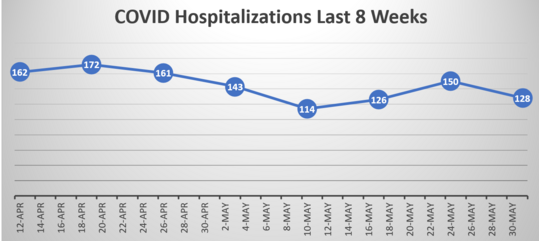
On Wednesday there were 128 COVID hospitalizations, back down from the previous week’s 150 COVID-19-related hospitalizations statewide. Hospitalizations are now our best indicator of disease spread. Again, however, many of these hospitalizations are not in and of themselves due to COVID—many are those who tested positive after having been admitted for other reasons.
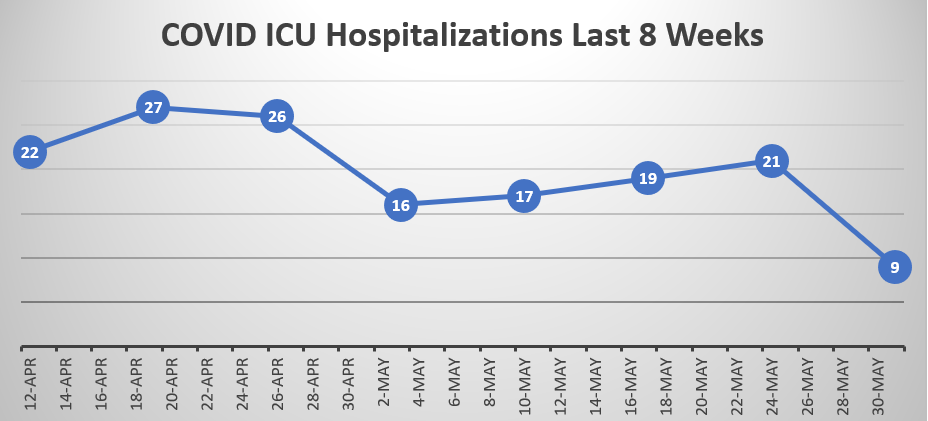
On Wednesday there were just 5 COVID patients in intensive care, a big decrease from last week’s 21, and the lowest since the beginning of the pandemic. These are the most serious cases.
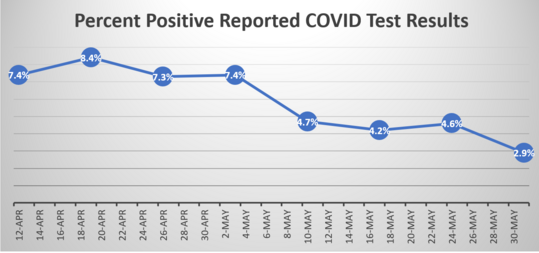
Testing percent positive was reported at 2.9%, a big decrease from the previous week’s 4.6%. Test positivity is a function of those who are tested in medical facilities and other testing sites.
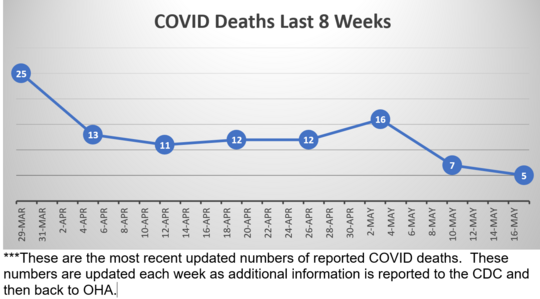
The latest numbers of reported COVID deaths shows five deaths for the week of May 14th, down from seven the previous week.
Weekly County Report: All Oregon Counties Remain at Low Risk for Hospitalization
The CDC is continuing to assign risk levels based the number of people in hospital for COVID.
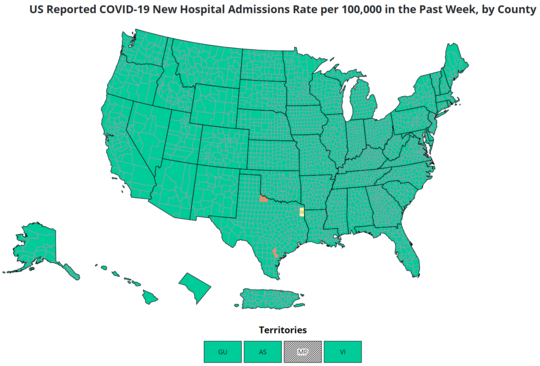
According to the CDC Daily Counter (updated each Thursday), all 36 Oregon counties are again at Low Risk for hospitalization.
Here’s a national map of all counties. As you’ll see, Oregon’s experience is currently being replicated in nearly all the states. (99.8% of Oregon counties are showing low levels of COVID hospitalization.
This Week’s Wastewater Monitoring Report: Stable Levels Last Week
With testing reports giving us just a fraction of infections out there, wastewater monitoring has become a more reliable indicator of the amount of virus in cities around the state. That report is updated each week.
This week’s report, updated on Wednesday, reveals that 9% of the cities tested showed increases or sustained increases last week (the same as the previous week). Nine percent showed declines or sustained declines (down from 25%).
Overall, the great majority of cities showed little change one way or the other: the remaining 83% (an increase from 66%) report being at a plateau.
Corvallis and Grants Pass reported sustained increases last week.
COVID Q & A from OHA (from OHA weekly newsletter)
Dr. Rebecca Pierce, OHA senior health advisor and Healthcare-Associated Infections program manager, and Dr. Paul Cieslak, OHA senior health advisor and medical director, Communicable Diseases and Immunizations program, answered today’s questions.
Q: Are we still required to screen visitors who come into our long-term care setting? I cannot find anything directly answering this question in all of my provider alerts. Thank you! – Melinda, Estacada
A: “Long-term care facilities (LTCF) are not currently required to have a staff member posted at entryways to screen visitors, nor are facilities required to do temperature checks when visitors enter (though they may choose to do either). LTCFs must ensure that visitors entering the facility are aware (through signage and communication with prospective visitors) of infection control practices in place in the facility (e.g., masking if there’s an outbreak in building) and that visitors should delay non-urgent visits if they’re ill, recently tested positive for COVID-19 or had known close contact with someone with COVID-19.
“More details on long-term care facility infection control guidelines for COVID-19 and other respiratory pathogens can be found here. OHA also offers these optional template tools for facility staff to help with visitor communications. Nursing facilities should continue to monitor Centers for Medicare & Medicaid Services (CMS) guidance for updates.”
Q: My wife and I had our bivalent Pfizer shots Dec. 15, 2022 (we had four prior Moderna shots). She is 67, and I’m 73; we are both in good health and have no known preconditions. When should we get a second shot of the bivalent or most current COVID-19 vaccine? – Anonymous, Beaverton
A: “In April, the U.S. Food and Drug Administration (FDA) authorized a second bivalent booster dose for people ages 65+, as well as people ages 6+ with compromised immune systems who may be at higher risk of severe illness. As long as it’s been at least four months since your first bivalent dose, and it appears that it has, you and your wife are good to go and should get the second dose any time. In a couple of weeks, FDA’s advisory committee will meet to discuss the formula for the next generation of updated COVID-19 vaccines for fall to winter, 2023-2024. Getting another bivalent dose now will help protect you and your wife until the next updated COVID-19 vaccine becomes available.”
Additional COVID Updates and Links
Here again are some COVID resources that you will find useful:
If the above links are not providing you with answers to your questions or directing you to the help that you need, please consider me and my office to be a resource. We’ll do our best to assist you or steer you in the right direction.
Sincerely,
 Senator Michael Dembrow
District 23
email: Sen.MichaelDembrow@oregonlegislature.gov
web: www.senatordembrow.com
phone: 503-281-0608
mail: 900 Court St NE, S-407, Salem, OR, 97301
| 

