|
May 21, 2023
Dear Neighbors and Friends,
I hope that you and your loved ones are doing well, staying healthy, and looking out for your neighbors and friends during this past week.
In tonight’s newsletter I’ll give you the latest on the Senate Republican walkout that reached its 13th day last Thursday, along with a sense of which bills are passing and which are not. The House is functioning pretty normally, sending us a combination of bills that are controversial and those that are not. Policy committees in both chambers continue to meet, though not for much longer. We reached one of our final significant deadlines on Thursday, the deadline for policy bills to be voted out of committee. Committees will now start shifting over to informational hearings and then shutting down for the session.
More and more attention moves now to the Ways and Means process, particularly following Wednesday’s final revenue forecast of the session. As you’ll see in tonight’s newsletter, it was a historic, unexpectedly positive forecast, one that should make it easier for us to make many of the crucial investments in housing, education, poverty-reduction, rural economic development, and environmental action that are needed right now—assuming that the walkout ends and senators are able to vote on these crucial measures.
As you’ll see in this week’s newsletter, we remain pretty much in a holding pattern on COVID this week: slight increases in hospitalizations (though still quite low), reductions in COVID deaths and in test positivity. We see some increase in virus in some of our cities, as observed in wastewater analysis. This seems to be in line with what we were told to expect in April’s OHSU forecast. We’re still waiting for the May forecast from Dr. Graven.
Until next week, please do your best to stay happy, healthy and safe. And let me know if you have any questions or thoughts about anything in this week’s newsletter.
The Republican Walkout 2023 Edition: 13 Days and Counting
As I was writing last week’s newsletter, I still had hope that at least three of my Senate Republican colleagues would perform their constitutional duty and return to the Senate floor to vote on the many bills that awaiting passage there. As you know, Ballot Measure 113 (which was approved by 68% of Oregonians, passing in every single Senate district) put that expectation into the Oregon Constitution, with the enforcement penalty barring anyone who goes ten days without showing up on the floor to vote from running for reelection.
Two Republican senators (Dick Anderson and David Brock Smith) have been on the floor nearly every day, while one (Fred Girod) has been out on an extended excused absence due to a serious medical condition. However, that has not been the case for the rest. By Thursday 10 of the 13 Senate Republicans (which includes two “Independents” who vote with the Republicans) had reached the threshold of triggering the constitutional penalty. As a result, the Senate has been unable to perform the primary task for which legislators are elected: debating and voting on bills.
Of the ten, several were not going to be returning anyway. Others were just elected in November and still have 3½ years left in their four-year terms. Some are hoping that the new Constitutional amendment will be thrown out by federal courts as a violation of the U.S. Constitution (which seems very unlikely).
In any case, at the moment we find ourselves in an odd replay of the 2020 session, which was ultimately killed by walkouts, with Republicans insisting that they would only vote on measures that they wanted to vote on. Different Senate President, different Speaker, different majority leaders and minority leaders—same result.
It’s odd because this time it’s only the Senate Republicans who are staying away. This time House Republicans have remained on the job. A few weeks ago, they debated and voted on HB 2002 (Reproductive Rights and Gender-Affirmation Care) and 2005 (Gun Violence Reduction), the two most controversial this year. House members continue to debate and vote on many bills. Most of these votes have been bipartisan, but many others have been strongly partisan (actually, the votes are typically more partisan in the House than in the Senate). But even when the votes have been partisan, House members have shown up to take them.
So it’s not clear why the Senate Republicans are using a different playbook or at this point what the ultimate resolution will be.
There have been a series of closed-door meetings involving the Senate President, Speaker of the House, Senate Majority Leader, and the Minority Leaders of the House and Senate. As I understand it, they’re still waiting to hear what exactly Senate Republican Leader Tim Knopp is looking for. Different people have different theories. Some, including the Oregonian, have suggested that a small amendment to HB 2002 should do it. Clearly it won’t. Here’s what Senator Knopp most recently had to say, reported in yesterday's Oregonian:
Knopp said Thursday he doesn’t know how long Republicans will continue to boycott. He said the protest is bigger than House Bill 2002; he would continue to skip floor sessions even if top Democrats agreed to “significantly amend” the bill to remove the parental notification provision
“This isn’t about one bill, it’s about process and it’s about lots of bills,” Knopp said. “They killed 37 bills in our agenda. So my question would be, why would we be a speedbump on the road to them achieving their agenda?”
It’s not clear what these 37 bills are. As I understand it, Senator Knopp has not been willing to identify which specific bills and budget investments are their actual priorities for passage. To do so would initiate a process of negotiation, which is something that to date he doesn’t seem interested in.
The closest we’ve received to a statement of priorities is from a press release quoted in this article from the Statesman-Journal (which also includes points made by President Wagner and Senate Majority Leader Kate Lieber), where we find the following:
"We are focused on the real issues Oregonians care most about – homelessness, affordable housing, public safety, cost of living, job creation and fully-funded education," the statement said.
I can tell you that all of those are priorities of Senate Democrats as well. We may disagree on details, which is what negotiations and compromise is all about, but we share those same values. To be honest, senators have already passed, or at least sent to the Senate floor, a number of bills in each of those areas, seriously negotiated, with careful compromises made in pursuit of the middle. We sent bills to the Governor’s desk on housing, homelessness, and semiconductor job creation in record time. Our improved revenue forecast (see below) will allow us to fully fund education and make record investments in the improvement of our rural economies.
It's time for Senator Knopp to come to the table and negotiate. It’s not too late. But he and his colleagues have to show up to do so. Let’s hope that happens soon.
Second Chamber Deadline Passes; House Continues to Pass Bills
Thursday was the last day for bills to be voted out of their second chamber committees. That means that House bills that passed the House and were referred to a Senate Committee (other than Rules and Revenue) needed to have had a public hearing and a work session, or else they are dead for the session.
Committees only require a simple majority for a voting quorum, so all the committees in both chambers have been able to do their business and send bills to the floor for their final votes
On the Senate side, of course, they have stalled as they await their floor votes. The Senate to-do list now includes 127 bills.
While the Senate continues to accumulate bills, mainly House bills now, the House continues to be able to pass Senate bills and send them to Governor Kotek for her signature. Last week they passed 43 bills in all.
Looking at the week ahead, 101 are on the docket for House floor votes this week so far. We expect some very long House floor sessions this week to allow them to catch up.
Final Revenue Forecast: Wow!
You may remember that in last week’s newsletter I had this to say about the revenue forecast that we were expecting on Wednesday:
The vibe around the Capitol is that we’re probably looking at a forecast that will be at best just slightly higher than was anticipated back in February. We’ll see. The fate of a number of budgets and bills in Ways and Means should be better known in a week.
It took me a day or two to scrape the egg off my face over that one, but I can safely say that I was not alone! At the very least, I was joined by our state economists and their national group of economic advisors . . .
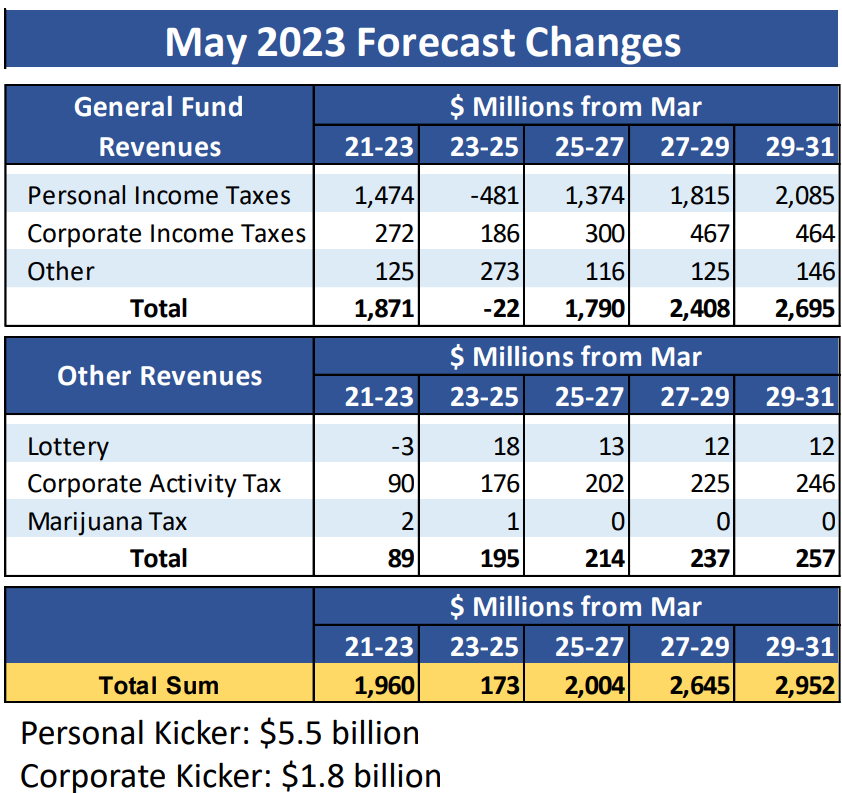
As you’ve probably heard already, what we learned on Wednesday is that we can once again expect record revenue increases in this biennium (nearly $2 billion more than we thought we’d have in February) and continued increases in the next. We can also expect record kicker payments of $5.5 billion going to Oregon households (more on that below) and a record $1.5 billion in corporate kicker payments going to K-12 education.
And yes, funding our consensus budget priorities (assuming that we can complete this legislative session) became much easier.
Why did the forecast again come out much higher than anticipated? According to Mark McMullen and Josh Lehner from the Office of Economic Analysis, there were largely two reasons:
First, so far the Federal Reserve’s efforts to slow down inflation while avoiding big unemployment and a recession appear to be working. Here in Oregon, the economic recovery from the pandemic has been faster, more complete, and more inclusive than any in recent memory. Employment across Oregon has never been higher across all categories, when analyzing based on educational attainment, gender, geographic location, or race and ethnicity. Household incomes and finances are likewise in a stronger position today than pre-pandemic. Some of these increases in income and tax revenues, however, are due to inflation itself.
Second, the model that the Office of Economic Analysis has been using doesn’t adequately adjust either for inflation or for the fact that more Oregonians are moving into the top income tax bracket ($125K for a single, $250K for a couple). This May forecast does make some assumptions about those increases going forward, which is partly why they’re anticipating higher revenues now. The new model also does a better job of including the effects of the federal business tax cuts that went into effect in 2018-19.
If this new model does a better job of projecting the revenues that will actually come into the state’s coffers, we should see more accurate revenue projections and thereby prevent such large kicker rebates in the future.
For more on the phenomenon of the increasing numbers of those at the top rate, check out this excellent story by the Oregonian’s Mike Rogoway.
For a good overview of the forecast, I’d recommend Peter Wong's reporting in the Capital Insider.
If you’d like to watch the presentation itself, you can watch it here.
Here are the PowerPoint slides from the presentation.
And for those of you who really want to dig in, here is the complete revenue forecast document.
Here are some of the other highlights from the presentation:
- Oregon is currently in the middle of the pack among all states in terms of economic growth.
- We are usually ahead of the national average in population growth and employment growth. This time we’re not.
- We’re currently 1% lower than average in employment growth, 1% higher in income, and much higher than average in GDP.
- We are seeing record employment levels, where nearly everyone who wants a job has a job.
- However, this is a mixed blessing. We will start to see slower growth because we’re getting close to full employment. We don’t have an army of workers looking for work. The forecast is for annual employment growth to be under 1% for the next decade.
- Growth could still occur as a result of increasing business investments and efforts to raise worker skill levels.
- Partly due to worker shortages, we can anticipate declines in construction, manufacturing, and distribution, all of which boomed during the pandemic.
- The same with brick-and-mortar retail, for long-term structural reasons.
- The same for education, as we anticipate fewer children in Oregon over the next decade.
- During recessions we always see a slowdown in in-migration, then a bounce back. This time we are not yet seeing the bounce-back.
- A recession in the near term is not likely. A mild recession is still possible, but not in the next year or two.
- In 2021 we saw a big jump in the number of Oregon households earning more than $250K and thus being taxed at the highest rate (9.9%).
- The Trump-era federal tax cuts made it less attractive for corporations to offshore their revenues. Bringing them back into the U.S. means that they’re more accessible to state taxes.
- As a result of higher interest rates and more money in our reserves, we’re seeing an unexpected new revenue source: interest earnings. Interest earnings on state funds have traditionally been $20-$30 million per year. We are now earning that much in a month. The forecast in total interest earnings this year is now $270 million in forecast for this year. It is $350 million for next year. (After the record $5.5 BILLION in kicker dollars are distributed next year, these record interest earnings should go down.)
- The record kicker means that about 50% of the taxes people paid this year will come back to them in kicker payments that come in the form of tax credits on their taxes next year.
- Our steady increase in state revenues this year and in future biennia will be interrupted next year. As a result of the big kicker payout next year, we’ll see an overall modest decline in state revenues. You’ll see that reflected in the chart below.
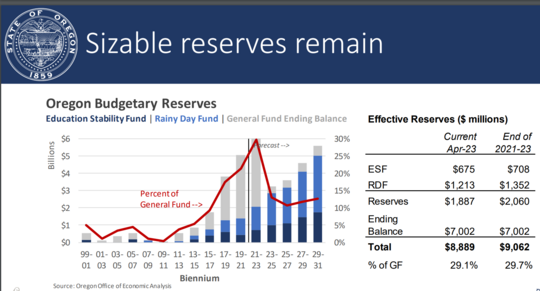
- Our reserves are now at the highest level than they have ever been in Oregon’s history. They will soon be hitting their statutory caps.
Over the next few weeks we’ll be sorting out the impacts of these higher-than-anticipated revenues in the Ways and Means process. We now anticipate being able to fully fund current K-12 programs and add significantly to community college, university, and financial aid budgets.
Please let me know if you have any questions.
ON THE COVID FRONT
Weekly Data Report:
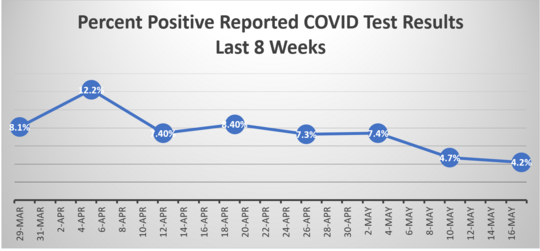
OHA is no longer providing updates on COVID test results each week (because most tests are being done at home and not reported), but it is reporting on the other metrics. Here is the most recent set of results, for this past week from 5/11/23 through 5/17/23.
This week’s report shows overall stability for the COVID metrics in Oregon.
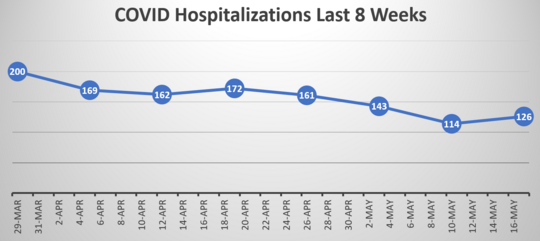
- On Wednesday there were 126 COVID hospitalizations, a small increase from the previous week’s 114 COVID-19-related hospitalizations statewide. Hospitalizations are now our best indicator of disease spread. Again, however, most of these hospitalizations are not in and of themselves due to COVID—most are those who tested positive after having been admitted for other reasons.
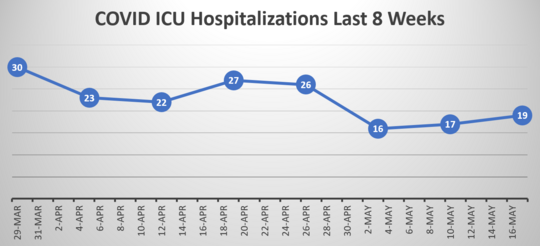
- On Wednesday there were 19 COVID patients in intensive care, a slight increase from last week’s 17. These are the most serious cases.
- Testing percent positive was reported at 4.2%, a small decline from the previous week’s 4.7%. Test positivity is a function of those who are tested in medical facilities and other testing sites.
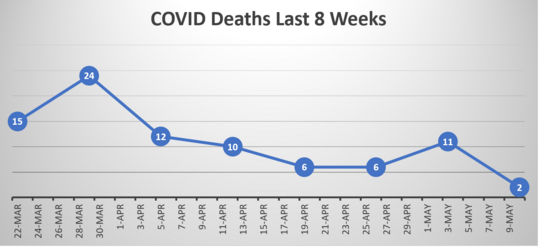
- There were just 2 COVID-19-related deaths in Oregon during the reported week, a decline from the previous week’s 11. That number could rise, however, as there is often a delay in deaths being reported.
Weekly County Report: All Oregon Counties Remain at Low Risk for Hospitalization
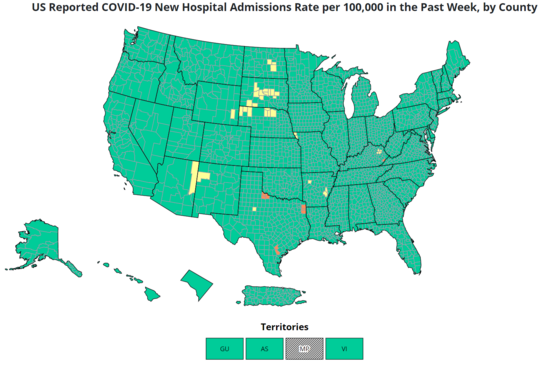
The CDC is continuing to assign risk levels based the number of people in hospital for COVID.
According to the CDC Daily Counter (updated each Thursday), all 36 Oregon counties are again at Low Risk for hospitalization.
Here’s a national map of all counties. As you’ll see, Oregon’s experience is currently being replicated in nearly all the states. (98.8% of Oregon counties are showing low levels of COVID hospitalization.
This Week’s Wastewater Monitoring Report: Increased Levels Last Week
With testing reports giving us just a fraction of infections out there, wastewater monitoring has become a more reliable indicator of the amount of virus in cities around the state. That report is updated each week.
This week’s report, updated on Wednesday, reveals that 22% of the cities tested showed increases or sustained increases last week (a jump from 9% the previous week). Nine percent showed declines or sustained declines (down from 15%).
Overall, though, most cities showed little change one way or the other: the remaining 69% (down from 76%) report being at a plateau.
Corvallis, Dallas, Florence, Hermiston, Newport, and Tillamook, reported sustained increases last week. Though it is officially listed as at Plateau, Portland is showing relatively high levels of concentration right now.
Additional COVID Updates and Links
Here again are some COVID resources that you will find useful:
If the above links are not providing you with answers to your questions or directing you to the help that you need, please consider me and my office to be a resource. We’ll do our best to assist you or steer you in the right direction.
Sincerely,
 Senator Michael Dembrow
District 23
email: Sen.MichaelDembrow@oregonlegislature.gov
web: www.senatordembrow.com
phone: 503-281-0608
mail: 900 Court St NE, S-407, Salem, OR, 97301
| 

