|
April 30, 2023
Dear Neighbors and Friends,
I hope that you and your loved ones are doing well, staying healthy, and looking out for your neighbors and friends during this past week.
In tonight’s newsletter I’ll give you a sense of the week ahead this coming first week of May. The week begins with some very controversial bills on the docket and ends with another important session deadline.
You’ll also get a report on this past weekend’s Ways and Means “Road Show” in Ontario, with its hearing on Friday evening and its community tours on Friday and Saturday. This was the last of our “traveling” road shows. Our final one, this Wednesday evening, will be virtual and open to testimony from all over the state.
I'll also be sharing some information about Washington's just-completed session.
On the COVID front, the overall metrics remain relatively low and in decline. All 36 Oregon counties are now reported to be at Low Risk, and wastewater analysis again shows a stable level of virus. Based on the OHSU forecast from two weeks ago, we will see the declines begin to reverse, as the latest virus variant (the “Arcturus”) begins to hit Oregon. More on that in the links section below.
Until next week, please do your best to stay happy, healthy and safe. And let me know if you have any questions or thoughts about anything in this week’s newsletter.
The Week Ahead in the Legislature
As a result of spending many hours on the Senate floor, we have been able to clear the backlog of Senate bills and get them over to the House for action. With another Monday evening floor session on the schedule for tomorrow, we should also be able to finish the House bills that have made it out of committee so far. We’re pretty much where we would normally be at this point in the session.
The House will be spending an unusual amount of time in floor session Monday and Tuesday this week. That’s because the next two days will be spent on two of the most controversial bills that the Legislature will be addressing this session: HB 2002 (Ensuring Reproductive and Gender-Affirming Rights) and HB 2005, the House’s firearms safety package. It is expected that the floor debate on those bills, accompanied by a variety of parliamentary efforts to obstruct or at least delay the vote, will last all day each day. As a result, all House committees and all joint committees are canceled for the next two days.
These bills are major priorities for the majority Democrats (and for the great majority of those those who elected them), so it seems likely that they will pass in the end. They'll then head over to the Senate for action in our chamber.
Both chambers face another one of those crucial session deadlines this week. The deadline for posting work sessions on all bills that are in committee is this Friday. For example, if by the end of Friday, May 5th, a House bill that passed the House and is now in the Education Committee does not get scheduled for a work session (i.e., a committee vote) sometime in the next two weeks (by May 19th), it is dead for this session. I’m already being inundated with requests from sponsors to get their priority bills scheduled.
My sense at this point is that all, or nearly all, of the House bills that have come to Senate Education will in fact get both a hearing and a vote. That tends to be the case once a bill gets out of its first chamber. However, as I’ve mentioned before, opponents of a bill often choose to wait until the second chamber to raise their concerns and try to run out the clock. So far I haven’t heard any major concerns about the House bills in Senate Ed, but we still have a few more days for that!
I’ll let you know in next week’s newsletter how things are looking.
By the way, the House and Senate Rules Committees are still considering first-chamber bills that were late in being introduced or for whatever reason were not yet ready to go from their first committee to their first floor vote. (The deadlines don't apply to the Rules Committee.) Many of those will be voted out of the Rules Committees over the next couple of weeks. Because of the requirement to post final work sessions this Friday, these bills will likely not be able to be assigned to a policy committee in the other chamber; they'll need to go to the Rules Committee in that other chamber, hopefully leading up to a floor vote. But maybe not.
We're getting to the point in session where the calendar begins to determine the ultimate fate of bills. It's definitely not too late for most bills, but at some point it will be.
Ways and Means Road Show Goes to Ontario
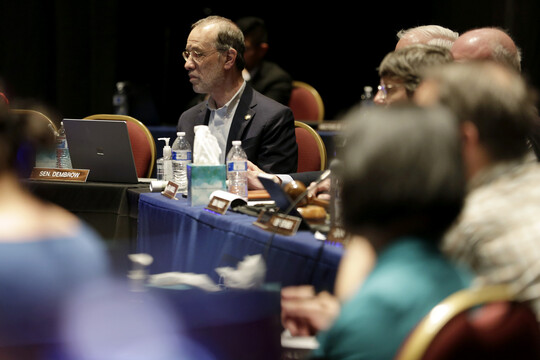
The fourth Ways and Means road show took place on Friday evening at the Four Rivers Community Center on the campus of Treasure Valley Community College in Ontario, on the eastern edge of Oregon. Despite the substantial distance that legislators had to travel, I’m proud to say that all six Senate Democrats on Ways and Means made the journey to meet with local residents. We were joined by the two of the five Republican senators (those from eastern Oregon), five of the seven House Democrats and two of the five Republicans. I can tell you that we were received with a great deal of appreciation by the residents of Malheur County..
Those testifying came from counties all over central, eastern, and southeastern Oregon, and they included a number of mayors and county commissioners. There again wasn’t enough time for the legislators to hear from everyone, but we once again got to hear from 62 individuals, each of whom made their request in two minutes or less.
There was again some overlap in the topics covered with those we heard about in the last three weeks, but again there were differences. Each of the elected officials had a request for financial support for one or more capital construction projects. Not surprisingly, given the geography, there were many calls for support for farming and ranching. We heard multiple pieces of testimony about the needs of college and university students.
Here are my notes on the 62 pieces of testimony.
There’s just one more hearing left. It will be this coming Wednesday evening from 5 pm to 7 pm. It will be a virtual hearing, via Microsoft Teams, with members in Hearing Room F at the Capitol and those testifying coming from all over the state.
If you’re interested in providing testimony, you can sign up here to provide remote or written testimony for the May 3 hearing.

Roadshow Redux
As I mentioned last week, we tend to accompany these roadshow hearings with visits to local sites and discussions with local leaders. The Ontario tour involved three major stops on Friday and Saturday:
- Prior to the hearing Friday evening, five of us legislators spent a few hours at the Snake River Correctional Institution just outside of Ontario. SRCI is a very large institution, built in the 1990s (at the time it was the state’s largest capital construction investment). We visited their educational facilities and discussed the roll-out of remote learning made possible by investments made in the 2022 session in SB 1522. We spent a good deal of time meeting with staff and peer mentors in the “prison within a prison” that is the segregation/disciplinary unit. That’s where adults in custody are placed for varying periods of time for disciplinary and safety reasons. This was particularly important for me, as I’ve been involved in a work group seeking to reduce the amount of time individuals are placed in isolation for disciplinary reasons. I know that we were all particularly impressed with the courage and commitment of the 2 AICs who are working there as peer mentors. One had himself spent extended periods of time in isolation during his initial years in prison. He volunteered to become a peer mentor after having worked in hospice support. Both of those volunteer assignments have been crucial steps in his efforts to make amends.
- On Saturday morning we met for two hours to discuss the Eastern Oregon Border Economic Development Board, an initiative that has been funded by the Legislature (with leadership from now-Governor Tina Kotek) to increase the competitiveness of Ontario and nearby communities that are located adjacent to the Idaho border. As the Boise suburbs move closer to the Oregon border, more Oregonians who work in Oregon are moving to live in Idaho for various reasons. Grants from the Border Board are creative incentives for residents and businesses to stay in Oregon.
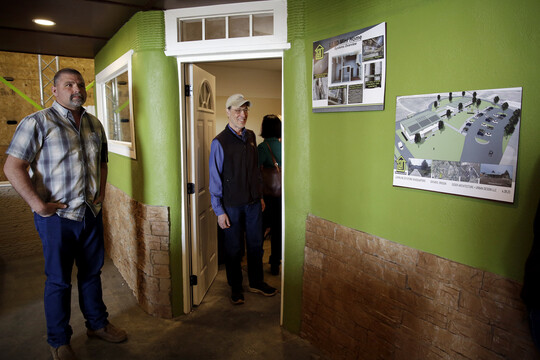
- Finally, we heard a presentation and then visited an operation that is producing homes made of concrete materials, using 3-D printing technology. This technology makes it possible to produce the foundation, exterior walls and interior walls for an 800-1200 sq. ft. home on-site in less than a day. You can see one of the homes in the photos below. It’s a technology that could be deployed to help meet our housing needs, particularly as a source for the “pods” and “tiny homes” that are contemplated as part of the solution to housing the homeless. We can expect that use of this technology will increase around the state in the coming years.


Washington Legislature Completes Its 2023 Session
Unlike the Oregon Legislature, which meets for 160 days in odd-numbered years and 35 days in even-numbered years, the Washington Legislature meets for 105 days in odd-numbered years and 60 days in even-numbered years. Washington’s 105 days came to an end last week. It’s always interesting to compare what’s attempted and what’s accomplished in the two neighboring states.
As has been the case in Oregon, firearms safety and reproductive/transgender rights proved to be the most controversial. Washington passed significant legislation in both areas. Their action on firearms safety included a ban on semi-automatic weapons, along with some of the provisions that Oregon Democrats are attempting.
As has been the case in Oregon, investments in housing proved to be the most bipartisan and the most consequential this year. Washington has generally been a step behind Oregon in terms of land use planning and enacting requirements for more density in cities. They made some progress this session in requiring multiplexes and ADUs as a way to address housing shortages. Other efforts fell short in the final days.
You can read about the end-of-session bills in this summary of the session from OPB.
ON THE COVID FRONT
Weekly Data Report:
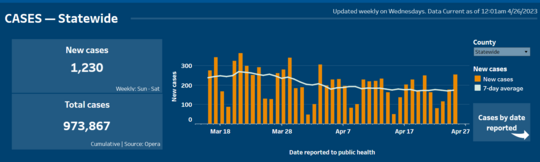
OHA now updates and reports COVID metrics once a week, on Wednesdays. Here are the most recent set of weekly results, for this past week from 4/20/23 through 4/26/23.
This week’s report shows continuing overall declines for the COVID metrics in Oregon.
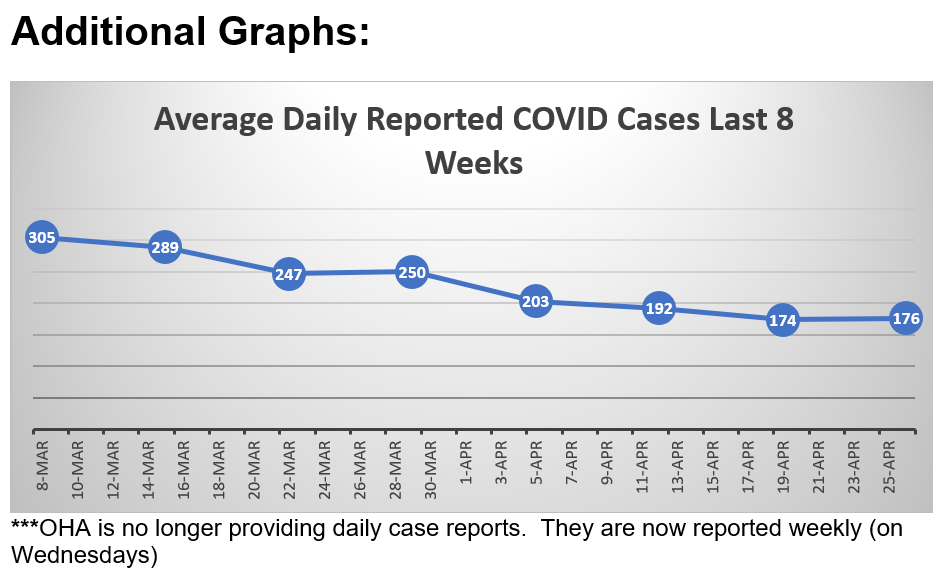
- The 7-day average for newly reported infections is 176 (up very slightly from 174), from per day this last week. The number of new cases is likely an undercount, as many people are using home tests to determine their infection status but are not reporting those results.
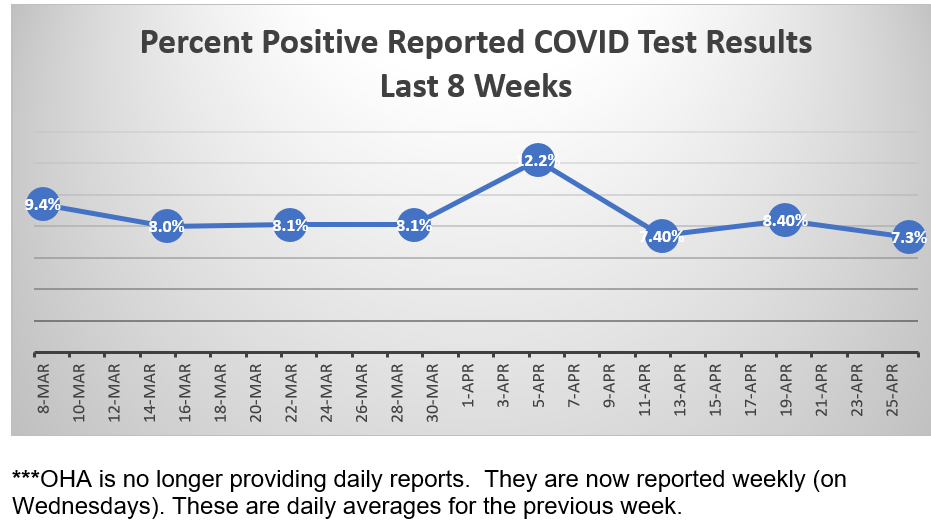
- Average test positivity went down last week from 8.4% to 7.3%. The number probably skews high because it likely reflects a higher proportion of people showing COVID symptoms (and thus reporting or going in for a test, rather than self-testing and never reporting).
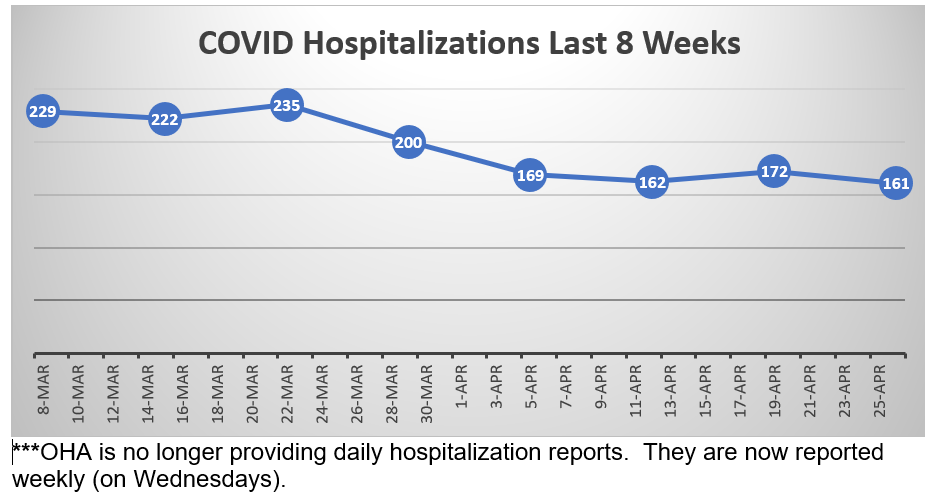
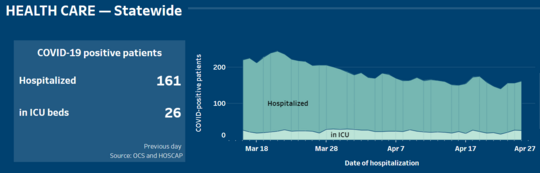
- On Wednesday there were 161 COVID hospitalizations, a further decrease from the previous week’s 172 COVID-19-related hospitalizations statewide. Hospitalizations are now our best indicator of disease spread. Again, however, most of these hospitalizations are not in and of themselves due to COVID—most are those who tested positive after having been admitted for other reasons.
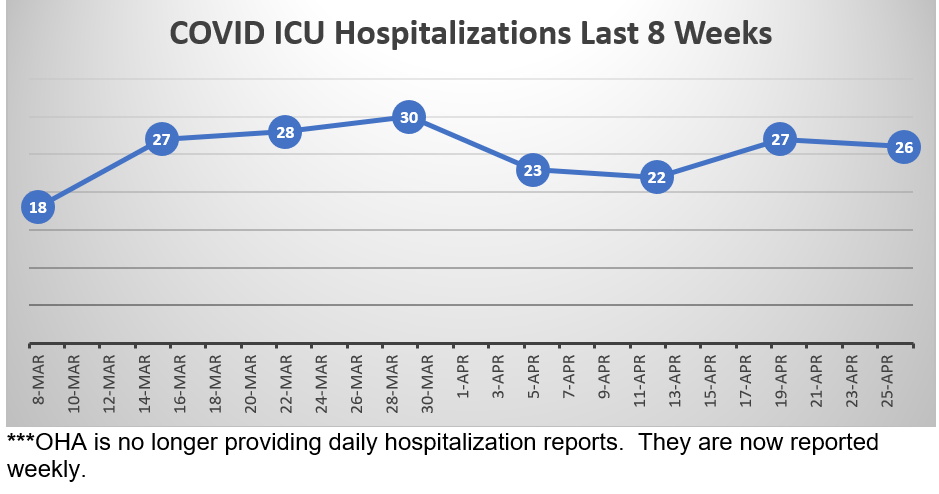
- The number of COVID patients in Oregon’s ICUs on Wednesday went down slightly last week, from 27 to 26 statewide. These are the most serious COVID infections.
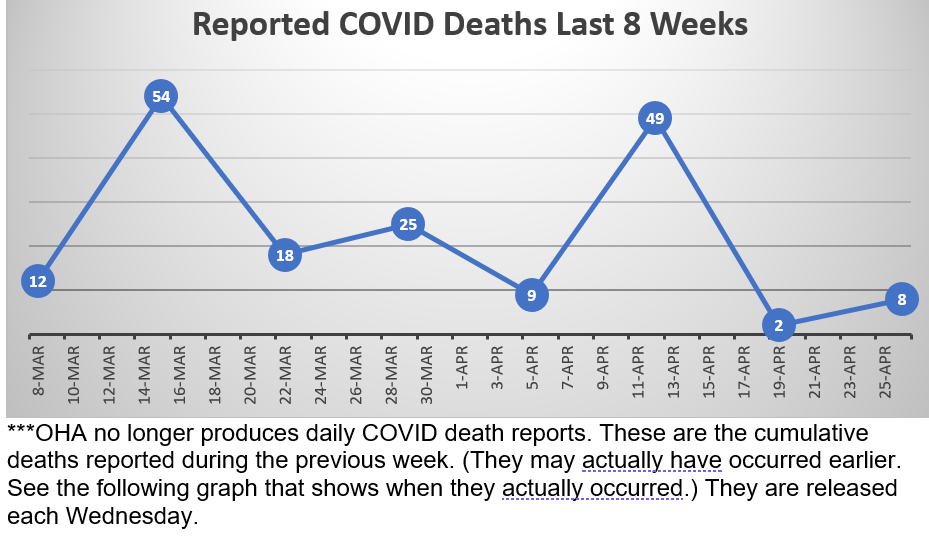
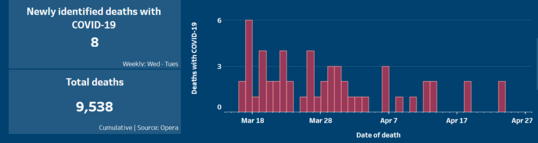
- There were 8 COVID-19-related deaths reported during the last week, up from the previous week’s 2. However, it’s important to remember that many of every week’s reported deaths actually occurred in earlier weeks but were just reported to the state, and others that likely occurred have yet to be reported. The newsletter’s final graph shows when the deaths actually occurred, and you’ll see that the number of COVID deaths each day continues to remain consistently low.
Weekly County Report: All Counties at Low Risk
The CDC assigns risk levels based on a combination of the number of new COVID cases and the number of people in hospital for COVID.
According to the CDC Daily Counter (updated each Thursday), all 36 Oregon counties are at Low Risk.
We can also track the cases, deaths, and test positivity rates for each county at this website.
All three Metro-area counties saw their positivity rates decline last week. Clackamas County is now at 6.6% (down from 8.9% the previous week). Multnomah County is now at 4.5% (down from 5.6%). Washington County is now at 8.3% (down from 9.0%).
Remember, though, that these are all based on reported test results, and so are more likely to be a little higher than the total percent positivity (i.e., if one were to include all tests taken).
This Week’s Wastewater Monitoring Report: Pretty Much the Same
With testing reports giving us just a fraction of infections out there, wastewater monitoring has become a more reliable indicator of the amount of virus in cities around the state. That report is updated each week.
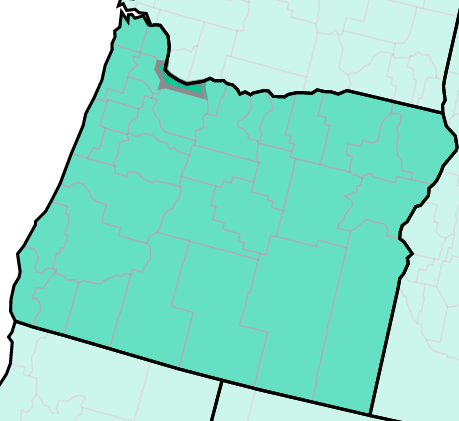
This week’s report, updated on Wednesday, reveals that 9% of the cities tested showed increases or sustained increases last week (up from 0% the previous week). Fifteen percent showed declines or sustained declines (down from 18%). The remaining 76% (down from 82%) showed no change.
McMinnville and Silverton were the cities showing sustained increases last week.
COVID Q & A from OHA (from OHA weekly newsletter)
Dr. Paul Cieslak, OHA senior health advisor and medical director, Communicable Diseases and Immunizations program, answered this week’s questions.
Q: What's the fatality rate for those vaccinated vs. those that are not vaccinated? – Jerry, Salem
A: “The Centers for Disease Control and Prevention (CDC) tracks COVID-19 infections, hospitalizations and deaths by vaccination status. The most recent data show that in February, people ages 18 and older who were unvaccinated against COVID-19 were six times as likely to die from COVID-19 as those who were vaccinated (including with the updated booster). This CDC data tracker is updated monthly.”
Q: I have an underlying medical condition and don't understand why the CDC only authorized people 65 and older get another COVID-19 booster. I am in my 50s, and my husband is not quite 65 yet. When will we be able to get another booster? Why were we not included in this authorization? – Gerry, Cave Junction
A: “The U.S. Food and Drug Administration’s (FDA) recent authorization for a second dose of the bivalent booster applies to all people age 65 and older, as well as people age 6 years and older with certain conditions that compromise their immunity. The CDC affirmed the FDA’s authorization with its recommendation, and CDC offers this guide to qualifying immunocompromising conditions. If your underlying medical condition is not on CDC’s list but you believe you’re immunocompromised, speak to your doctor about whether you should get a second bivalent booster dose. Our blog from last week lays out the details of the FDA and CDC’s decisions about this.”
Additional COVID Updates and Links
Here again are some COVID resources that you will find useful:
If the above links are not providing you with answers to your questions or directing you to the help that you need, please consider me and my office to be a resource. We’ll do our best to assist you or steer you in the right direction.
Sincerely,
 Senator Michael Dembrow
District 23
email: Sen.MichaelDembrow@oregonlegislature.gov
web: www.senatordembrow.com
mail: 900 Court St NE, S-407, Salem, OR, 97301
| 

