|
April 9, 2023
Dear Neighbors and Friends,
I hope that you and your loved ones are doing well, staying healthy, and looking out for your neighbors and friends during this past week.
In tonight’s newsletter you’ll find how the bill deadline turned out, at least for the 160 bills that were assigned to Senate Education. You’ll also get a report on this past weekend’s Ways and Means “Road Show” hearing in Portland, more info about our upcoming Town Hall, something that I left out last week when discussing the Natural Resources subcommittee of Ways and Means, and a little preview of very long days (and nights) ahead of us on the Senate floor.
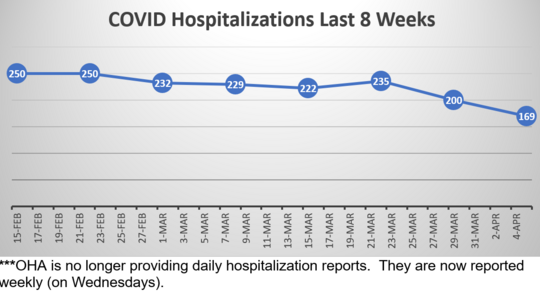
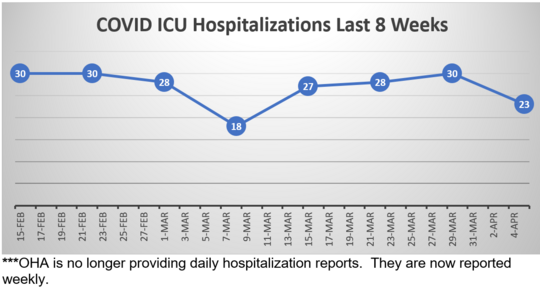
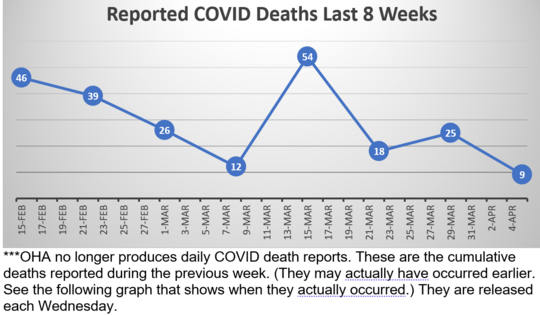
On the COVID front, last week saw some marked improvements in most of the COVID metrics, with the exception (for some reason) of reported COVID test positivity, which took a big jump. I’m happy to report that COVID hospitalizations again went down substantially, and this time ICU hospitalizations also went down. COVID deaths remain low. All counties remain at Low Risk, and wastewater analysis is mixed.
We should be getting the next monthly OHSU forecast report next week, so we’ll see what the forecasters are seeing with respect to longer-term trends.
Until next week, please do your best to stay happy, healthy and safe. And let me know if you have any questions or thoughts about anything in this week’s newsletter.
Coming Up: Long Days on the Floor
As I wrap up tonight’s newsletter, I have two full days (and nights) on the Senate floor to look forward to. If you go to tomorrow's floor schedule, you’ll see that we have a looooong list of bills to get through. And given last week’s first-chamber bill deadline, there are many more waiting in the wings. Given that Senate Republicans are still insisting on slowing things down whenever possible (via bill reading, prepared remonstrances from nearly every Republican member, multiple speeches on most bills), Senate President Rob Wagner has decided to cancel committee meetings tomorrow and Tuesday and have us on the floor from 10:30 a.m. till 9:00 pm or so. It won’t be easy, but we’re determined to get through the many days.
Despite all the speechifying that we can anticipate, I don’t foresee any of the bills on the Senate docket being particularly controversial this week. That won’t be the case in the House, where HB 2005. should be heard on the House floor later in the week, most likely on Wednesday. This is a “Relating to Firearms” bill, bringing together three concepts designed to improve public safety by curbing the misuse of firearms: making “ghost guns” (self-manufactured guns that lack identifying serial numbers) illegal; prohibiting the purchase of guns by young people under the age of 21 (which has been shown to reduce incidence of teen suicide); and allowing local governments to prohibit guns on the premises of public buildings.
Our Republican colleagues are strenuously opposed to HB 2005, as was made evident in last Friday’s Ways and Means Committee meeting, where the bill was voted on before heading to the House floor. (I voted for it.) Actually, there were very strong passions on both sides. Republicans were particularly opposed to the prohibition on the purchasing of rifles (including semi-automatic long guns) by young people, calling it an intrusion on traditional hunting rites of passage (even though the bill actually does allow parents to loan or otherwise transfer weapons to their children for hunting or target shooting). Democrats spoke passionately about the victims of school shootings, mass shootings, and holdups gone wrong. It was a preview of what we’ll be seeing on the House floor this week and the Senate floor next week.
You can read about Friday’s Ways and Means discussion in this reporting from the Oregonian.
Senate Education Committee Completes Round #1
As I’ve mentioned in the past, last Tuesday was the deadline for bills to be voted out of their first committee. If that didn’t happen by the end of the meeting, the bill in question cannot move forward this session. Complicating things was the fact that the Legislative Fiscal Office, which is required to analyze every bill before it’s voted on and assessed for cost, was running very late. When Senate Education began its meeting at 3pm, we had yet to receive “fiscals” on 20 bills. Fortunately, by the time we gaveled out at 5pm, we had received them all and voted out nearly 30 bills. It was quite a remarkable achievement. (I’m blessed with a very high-quality committee and committee staff.)
The first half of the session is now officially ended, and when we start up again this week, we’ll start hearing bills coming from House Education and House Higher Education, and which have already had a successful House floor vote.
Here are the statistics for this first-chamber period for Senate Education:
- 160 bills were assigned to Senate Education,
- 12 bills had public hearings but were not voted out.
- 58 had public hearings and WERE voted out:
- 18 have gone or will go to House Education (12 are still awaiting Senate floor votes, while one has already been passed by the House and signed by the Governor)
- 9 have gone or will go to House Higher Education
- 2 have gone to Senate Rules (one has already passed out of Senate Rules and is headed to the Senate floor)
- 2 have gone to Senate Revenue
- 1 has gone to Joint Tax Credits
- 1 has passed the Senate and gone to House Early Childhood and Human Services
- 1 has passed the Senate and gone to House Behavioral Health and Health Care
- 24 have gone to Ways and Means.
The twelve that never received votes involved some difficult decisions on my part. In some cases they were among my own personal favorites, but the timing wasn’t right or more work needed to be done on them. In at least one case (SB 1066) a task force will be replaced by a more flexible and less expensive work group. In others, rather than direct every school district to do something, we’re going to be looking for individual districts to step up and serve as pilot projects. I’m committed to continuing work on some of these during the interim.
For more details, here's a link to a list of all the bills that had hearings in Senate Ed. You can click on each bill number for more information.
You’ll see that for the bills that are now in Ways and Means, there’s either a dollar amount listed or something called “Lite.” “Lite” is short for “Fiscal Lite,” a term used for a fiscal impact statement that has not yet been finished, but enough has been done to know that there will be some cost involved.
Many thanks to Ellen O’Brien, one of our Legislative Policy and Research Office (LPRO) Education analysts. She compiled the first version of this list for me.
Please let me know if you’d like more information about any of the bills.
Ways and Means Road Show #1 Report
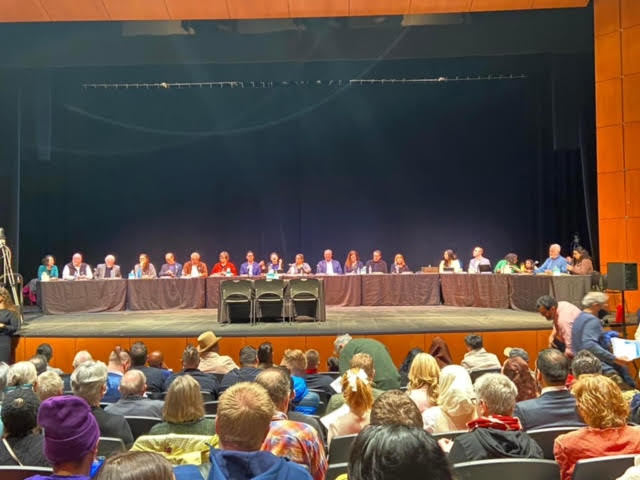
The first Ways and Means road show took place on Saturday in the Performing Arts Center at PCC-Sylvania. The auditorium was packed. There wasn’t enough time for the legislators to hear from everyone, but we did get to hear from 57 individuals, each trying hard to tell their stories and communicate their passionate pleas in 2 minutes or less.
Wonder what was on their minds? Here are my notes for each of the 57.
People were asked to cede their time if someone else had already conveyed their message, and for the most part they did. If that was the case, they were encouraged to submit their testimony in writing. You can find all the written testimony under Meeting Materials at Ways and Means webpage for Saturday's hearing. It’s not posted yet (written testimony will still be accepted up to Monday morning, 48 hours after the hearing), but it should be soon.
Here's the schedule for the remaining hearings:
Friday, April 14 (5:00 - 7:00pm) - Newport
- Location: Newport Performing Arts Center
- 777 W Olive St, Newport, OR 97365
Friday, April 21 (5:00 - 7:00pm) - Roseburg
- Location: Umpqua Community College
- 1140 Umpqua College Rd, Roseburg, OR 9747
Friday, April 28 (5:00 - 7:00pm) - Ontario
- Location: Four Rivers Cultural Center
- 676 SW 5th Ave, Ontario, OR 97914
- Note: Ontario, Oregon is in the Mountain Time Zone
Wednesday, May 3rd (5:00-7:00pm) - Remote
There won't be a remote option for the first four hearings.
You can sign up to provide in-person testimony (or remote testimony on May 3rd) or submit written testimony on the .Ways and Means webpage.
COMING SOON: SD23 Town Hall
Reps Pham, Tran, and I will be holding another town hall Wednesday evening, April 19th. This will be an opportunity for you to hear what's going on in both the House and the Senate, with info on priority bills, those that won't be moving forward this session and those that will. And of course it will be an opportunity for you to get your questions answered.
This one will at last be in person, at PCC-Southeast Campus, 2305 SE 82nd Avenue, 6-7:30 pm. (We'll have snacks for you.) It will be in the Community Hall Annex.
Here's a Google form that Rep Tran’s office created to help capture any topics that you’d like us to cover and any accessibility requests. If you think you’re going to attend, we’d appreciate your filling it out so that we have a sense of how many people are planning to attend.
See you there!

CORRECTION: I Left Something Out Last Week
Last week I listed the different agencies that come under the purview of the Natural Resources Subcommittee of Ways and Means. I missed one! And it’s an important one: The Department of Land, Conservation, and Development (DLCD), which oversees many aspects of our land-use system. It was one of the first agencies that we heard from this session. It has a particularly important role to play right now: our big housing bill, HB 2001, which we passed a couple of weeks ago, charges DLCD with planning for increased housing production and monitoring progress on meeting our new housing goals. Sorry about that.
So here is the complete list:
- Oregon Parks and Recreation Department
- Oregon State Marine Board
- Oregon Department of Agriculture
- Columbia River Gorge Commission
- Oregon Department of Energy
- Department of Environmental Quality
- Oregon Department of Fish and Wildlife
- Oregon Department of Forestry
- Oregon Department of Geology and Mineral Industries
- Land-Use Board of Appeals
- Department of State Lands
- Water Resources Department
- Oregon Watershed Enhancement Board
- Department of Land, Conservation, and Development
ON THE COVID FRONT
Weekly Data Report:
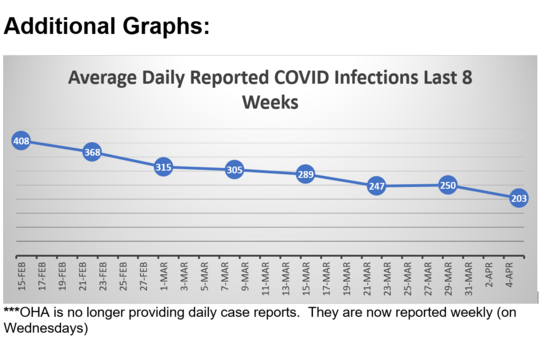
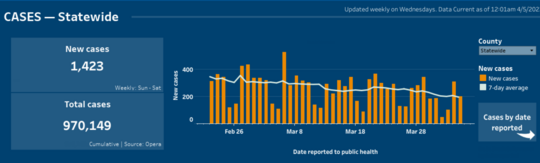
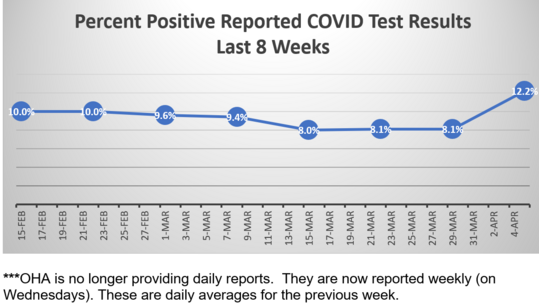
OHA now updates and reports COVID metrics once a week, on Wednesdays. Here are the most recent set of weekly results, for this past week from 3/2923 through 4/5/23.
This week’s report shows marked declines in nearly all the COVID metrics here in Oregon. Test positivity was the only metric to rise (as you'll see below, driven by positivity jumps in the Portland metro region). The overall trajectory remains positive.
- The 7-day average for newly reported infections went back down by quite a lot last week, from 250 to 203 reported infections per day this last week. The number of new cases is likely an undercount, as many people are using home tests to determine their infection status but are not reporting those results.
- Average test positivity jumped last week from 8.1% to 12.2%. The number probably skews high because it likely reflects a higher proportion of people showing COVID symptoms (and thus reporting or going in for a test, rather than self-testing and never reporting).
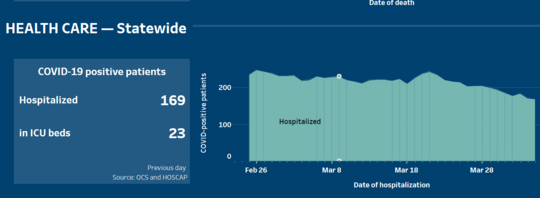
- On Wednesday there were 169 COVID hospitalizations, a big drop from the previous week’s 200 COVID-19-related hospitalizations statewide. Hospitalizations are now our best indicator of disease spread. Again, however, most of these hospitalizations are not in and of themselves due to COVID—most are those who tested positive after having been admitted for other reasons.
- The number of COVID patients in Oregon’s ICUs on Wednesday dropped last week, from 30 to 23 statewide. These are the most serious COVID infections.
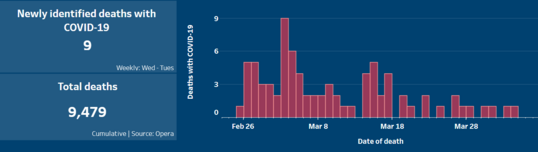
- There were 9 COVID-19-related deaths reported during the last week, down from the previous week’s 25. However, it’s important to remember that many of every week’s reported deaths actually occurred in earlier weeks but were just reported to the state, and others that likely occurred have yet to be reported. The newsletter’s final graph shows when the deaths actually occurred, and you’ll see that the number of COVID deaths each day continues to remain consistently low.
Weekly County Report: All Counties Again at Low Risk
The CDC assigns risk levels based on a combination of the number of new COVID cases and the number of people in hospital for COVID.
According to the CDC Daily Counter (updated each Thursday), all Oregon counties that are reporting are at Low Risk status. One county, Grant County in Eastern Oregon, again did not submit data last week.
We can also track the cases, deaths, and test positivity rates for each county at this website.
Positivity rates for the three Portland-area counties soared last week. Clackamas County in now at 15.2% (up from 8.3% the previous week). Multnomah County has jumped to 15,1% (up from 7.7%). Washington County has also gone up, to 19.4% (up from 8.9%). We’ll see next week if this is an anomaly or the beginning of something serious.
Remember that these are all based on reported test results, and so are more likely to be a little higher than the total percent positivity (i.e., if one were to include all tests taken).
 
This Week’s Wastewater Monitoring Report: Not Much Change
With testing reports giving us just a fraction of infections out there, wastewater monitoring has become a more reliable indicator of the amount of virus in cities around the state. That report is updated each week.
This week’s report, updated on Wednesday, showed twelve percent of cities again showing increases or sustained increases last week (same as last week). Sixteen percent showed declines or sustained declines (up from 9%). The remaining 72% (down from 74%) showed no change.
Hood River, Klamath Falls, and Warm Springs showed sustained increases last week.
COVID Q & A from OHA (from OHA weekly newsletter)
Rebecca Pierce, PhD, MS, BSN and manager of OHA’s Healthcare-Associated Infections (HAI) program, and Measure 110 Program staff answered today’s questions.
Q: My private practice employer says that with the lift on the mask mandate that we are under an OSHA mandate, not OHA. I've never seen an OSHA mask mandate so now I'm confused. Does the OHA lift pertain to all health care settings? – Anndi, Corvallis
A: “Yes, Oregon OSHA COVID-19 workplace rules have been suspended, effective April 3, in alignment with the repeal of OHA’s masking requirements. Therefore, OHA and Oregon OSHA mask requirements in health care settings are both lifted, as of Monday, April 3. Individual facilities, however, may choose to continue requiring masks. Some regulatory agencies, such as Oregon Department of Health and Human Services (ODHS) and Centers for Medicare & Medicaid Services (CMS), will continue to require masking for health care facilities in some situations. Please refer to relevant regulatory agency policy for this information.
“For other masking policy updates for nursing, assisted-living and residential care facilities, check out the masking section that begins on Page 4 of this summary.”
Q: When marijuana was legalized in Oregon, we were told that revenue would go toward expanding our underfunded drug treatment programs. That doesn't appear to have happened, at all. Where is the marijuana tax revenue going, and why is it not going to drug treatment? - Larisa, Portland
A: “I believe you’re referring to Measure 110, which voters approved in 2020. The new law—the Drug Addiction Treatment and Recover Act—decriminalized personal possession of illegal drugs including heroin, cocaine and psilocybin (psychedelic mushrooms). It also calls for taxes and fees collected from Oregon’s legal cannabis industry to help fund drug addiction treatment programs through 42 Behavioral Health Resource Networks that have been established across the state -- at least one network in every county. Those networks provide comprehensive and coordinated services and support to anyone who needs it regardless of their ability to pay. There are seven mandated services that each network must provide including low-barrier drug addiction treatment services. By the end of 2023 the state will have distributed more than $265 million to these service networks, the vast majority (97%) coming directly from cannabis revenues. Learn more about the networks here.”
Additional COVID Updates and Links
Here again are some COVID resources that you will find useful:
If the above links are not providing you with answers to your questions or directing you to the help that you need, please consider me and my office to be a resource. We’ll do our best to assist you or steer you in the right direction.
 Senator Michael Dembrow
District 23
email: Sen.MichaelDembrow@oregonlegislature.gov
web: www.senatordembrow.com
mail: 900 Court St NE, S-407, Salem, OR, 97301
| 

