|
April 2, 2023
Dear Neighbors and Friends,
I hope that you and your loved ones are doing well, staying healthy, and looking out for your neighbors and friends during this past week.
It’s that time of session now, as the first-chamber deadline approaches. If a bill doesn’t make it out of committee on Tuesday, it cannot continue this session. It’s a very stressful time, as advocates are pressing hard on committees and committee chairs to keep their bills alive, while those who want those and other bills to die are pressing for the reverse.
Tomorrow is the last day for MW committees to take action, while Thursday is the last day for those on TTh schedules.
At the same time, we’re still waiting for fiscal analyses to be completed by the Legislative Fiscal Office on each of the remaining bills. And there are still many left to be analyzed. In Senate Education, which I chair, we still have nearly 30 bills awaiting their vote. I’m confident that we’ll get to all of them on Tuesday, but it won’t be easy.
In next week’s newsletter I’ll let you know how it all turned out, including the outcomes for all the education bills and all my own priority bills.
In tonight’s newsletter you’ll find information about our upcoming Town Hall, the Ways and Means road shows that begin next week, life in the Natural Resources subcommittee of Ways and Means, and two of the Senate Education priority subject areas: addressing the educator workforce shortages and making improvements to prison education and creating better pathways to successful reentry.
On the COVID front, last week saw a further stabilization of the COVID metrics. Reported infections and percent positive test results remained exactly or nearly exactly the same as last week. Hospitalizations went down substantially, but ICU hospitalizations increased a bit. COVID deaths remained low. All counties remain at Low Risk, but wastewater analysis now shows more increases in COVID virus around the state. It seems to go back and forth each week.
Meanwhile, starting tomorrow, additional COVID restrictions will be going away here in Oregon. You can read more about that further down in the newsletter.
Until next week, please do your best to stay happy, healthy and safe. And let me know if you have any questions or thoughts about anything in this week’s newsletter.
COMING SOON: SD23 Town Hall
Reps Pham, Tran, and I will be holding another town hall Wednesday evening, April 19th. This will be an opportunity for you to hear what's going on in both the House and the Senate, with info on priority bills, those that won't be moving forward this session and those that will. And of course it will be an opportunity for you to get your questions answered.
This one will at last be in person, at PCC-Southeast Campus, 2305 SE 82nd Avenue, 6-7:30 pm. (We'll have snacks for you.) More info on the specific room in future newsletters.

Coming Up: Ways and Means Travels the State
During each long session, as the budget for the next two years is being developed, legislators who are members of the Joint Committee on Ways and Means participate in town halls in locations around the state. These hearings always come after the Co-Chairs of Ways and Means have released their initial budget, which builds off of the Governor's Recommended Budget that we received at the beginning of February. Now that the Co-Chairs' budget has been released (see last week's newsletter), it's that time again.
These hearings are a chance for Oregonians in those locations to come before the committee and provide two minutes of public testimony on their budget priorities without having to travel to Salem. It’s perhaps less critical this year, since we now are taking remote testimony from people all over the state during the regular Ways and Means subcommittee meetings, but it’s still a significant and exciting ritual. Committee members often also take the opportunity to visit interesting local projects while they’re visiting the different locations. Despite the long travel times, I look forward to both the hearings and the tours.
Here they are:
Saturday, April 8 (10:00am - 12:00pm) - Portland
- Location: Portland Community College - PAC Auditorium, Sylvania Campus
- 12000 SW 49th Ave, Portland, OR 97219
Friday, April 14 (5:00 - 7:00pm) - Newport
- Location: Newport Performing Arts Center
- 777 W Olive St, Newport, OR 97365
Friday, April 21 (5:00 - 7:00pm) - Roseburg
- Location: Umpqua Community College
- 1140 Umpqua College Rd, Roseburg, OR 9747
Friday, April 28 (5:00 - 7:00pm) - Ontario
- Location: Four Rivers Cultural Center
- 676 SW 5th Ave, Ontario, OR 97914
- Note: Ontario, Oregon is in the Mountain Time Zone
Wednesday, May 3rd (5:00-7:00pm) - Remote
There won't be a remote option for the first four hearings.
You can sign up to provide in-person testimony (or remote testimony on May 3rd) or submit written testimony on the .Ways and Means webpage.
More on Ways and Means
We’re also starting to wrap up the first phase of our Ways and Means subcommittee work. During this initial phase the various subcommittees (Education, General Government, Human Services, Natural Resources, Public Safety, and Transportation and Economic Development) have been meeting four days a week, receiving presentations from the various state agencies and commissions. Each agency presentation is followed by a public hearing, where the public can weigh in on priorities and proposed cuts to those agency budgets. We’ll be completing those presentations over the next week or two.
The Natural Resources subcommittee, which I co-chair along with Representative Khanh Pham, oversees thirteen agency budgets:
- Oregon Parks and Recreation Department
- Oregon State Marine Board
- Oregon Department of Agriculture
- Columbia River Gorge Commission
- Oregon Department of Energy
- Department of Environmental Quality
- Oregon Department of Fish and Wildlife
- Oregon Department of Forestry
- Oregon Department of Geology and Mineral Industries
- Land-Use Board of Appeals
- Department of State Lands
- Water Resources Department
- Oregon Watershed Enhancement Board
This week we’ll be hearing the Water Resources Department’s presentation, followed by the Oregon Watershed Enhancement Board’s (OWEB is mainly responsible for disbursing local habitat-improvement grants funded by lottery dollars). Then it’s time to start voting on their budgets, based on what we heard from the agencies and the public.
Rep Pham and I are working with our Legislative Fiscal Office analysts to settle on our recommendations for the agency budgets. We’re looking for reductions and other savings in existing programs that can potentially be used to fund new programs. Agencies had initially been asked to prepare cut lists at 5%, 10%, and 15% levels. Fortunately, at this point, it appears that we can try to go with 2.5% in reductions.
Once our recommendations are cleared by the “Big” Co-Chairs (i.e., Senator Steiner and Representative Sanchez, Co-Chairs of Joint Ways and Means), we can move forward with the votes. We’ll most likely start with the smaller agencies—e.g., Marine Board, Land Use Board of Appeals, Columbia River Gorge Commission.
The Natural Resources subcommittee is unique in that relatively little of our funding comes from the General Fund (i.e., funded by state income taxes). The vast majority of our funding comes from Lottery Funds, Federal Funds, and Other Funds (mainly user and permit fees). On the other hand, nearly all of the budget requests connected to bills coming out of the House and Senate are for General Fund dollars—which are going to be very limited this year. It’s a challenge.
My other Ways and Means subcommittee assignment is the Education subcommittee. We just finished several weeks of presentations and public hearing on the Department of Education. We’re now about to start two weeks with the Higher Education Coordinating Committee.
If you want copies of any of the agency presentations, go to the legislative website (olis.oregonlegislature.gov), go to committees, then Joint Committees, then click on the relevant committee. You’ll find the presentations under Meeting Materials on the day the agency began its presentation. (Let us know if you’re not finding what you’re looking for.)
The Education Workforce Amendments Have Arrived
You may remember that over the last year and a half I’ve been leading a bipartisan, bicameral process to address the shortages in our educator workforce that COVID revealed to us so starkly. We came to understand that we have long-standing and growing weaknesses in our systems that are leading fewer and fewer Oregonians to become educators, and more and more of them leaving the profession early. We were able to send out a sizeable amount of support to districts last year during the short session, using federal COVID relief dollars and other one-time funds, for short-term actions. We then continued to work with a large group of stakeholders (representing teachers, classified workers, administrators, parents, districts, college and university education programs) on longer-term strategies.
On Tuesday’s final meeting of Senate Education prior to the deadline, we’ll be voting on the omnibus bill designed to address various aspects of our recruitment/retention challenges for the educator workforce. It’s SB 283-4, which, as you’ll see, includes a number of sections. Some of them are designed to fix problems right away, while others involve studies, task forces, and processes designed to keep the work going. Here they are:
Section 1: Workforce Data—creates a statewide system allowing us to know where the shortages are;
Section 2: Requires regular satisfaction surveys and exit surveys when educators leave;
Sections 3-4: Pay differential for Special Education—calls for a 20% pay differential for teachers and classified employees whose students are predominantly students with disabilities;
Section 5: Minimum hours for Classified employees;
Sections 6-8: Termination of Classified employees can only be for Just Cause;
Sections 9-13: Improving pay and working conditions for substitute teachers;
Section 14-15: Setting statewide minimum salaries for educators;
Sections 16-17: Studying pay for student teachers;
Sections 18-19: Creating Task Force on Creating Statewide Salary Schedules;
Section 20: Creating new teacher apprenticeship and mentorship grants;
Sections 21-22: Developing and executing a public relations campaign to attract more Oregonians into the educator professions;
Sections 23-25: Automatically providing newly-retired teachers with substitute licenses;
Sections 26-27: Extends to 2029 permission for retired educators (licensed and classified) to continue to work while drawing PERS benefits (currently slated to expire this year);
Sections 28-29: Provides Just Cause protections for ESD superintendents (same as local district superintendents);
Sections 30-31: Technical fix to remove requirements for duplicate background checks for educators working in special education and early intervention;
Section 32: Captions (clarifies that the explanatory section titles will be dropped when the bill is incorporated into statute;
Section 33: Emergency Clause: Allows these provisions to go into effect right away.
The committee will be voting Tuesday on whether or not to send the bill to Ways and Means. Assuming that (as I hope) it does, the bill will get further analysis there. To be honest, though I hope that we’ll find the dollars to fully fund every part of this bill, there probably have to be some picking and choosing both within and among the different sections. That probably won’t be finalized until we receive our final revenue forecast at the end of May. Stay tuned for that.
And please do let me know your thoughts.
A Great Hearing on Prison Education Programs
During last Tuesday’s Senate Education Committee, we had a hearing on four related bills dealing with improvements to programs providing education and training for Oregonians currently and formerly incarcerated. We had some great testimony from a variety of participants.
Two of the bills were the result of work that I’ve been doing to help prepare us for the advent of the “Second Chance Pell” that’s coming this summer. Adults in custody used to have access to college and university courses for training and college credit via the federal Pell need-based aid program. That went away in the 1980s but was at long last restored by Congress during the final days of the Trump administration. After two and a half years of preparation, AICs will again have access this summer.
We’ve been working hard to make sure that the program is successful when it begins, with Oregon’s colleges and universities working in close coordination to make sure that programming is available throughout the state and AICs get on a pathway that can lead them to success after they are released back into the community.
SB 269 directs the Department of Corrections and the Higher Education Coordinating Commission to enter into a memorandum of understanding to clarify how programming will work in each prison, including the kind of access AICs will be able to receive both in person and through distance education. (Thanks to a bill that we passed last year, they already have access to remote programming at the women’s prison and one of the men’s prisons.) An advisory committee that includes currently- and formerly-incarcerated individuals, teachers, and DOC personnel will oversee the development and implementation of the MOU.
SB 270 will allow the different colleges to partner with one another in delivering instruction. Under current law, only the community college where the prison is located can offer instruction to the AICs there. Now that we’ll be able to offer classes remotely at various prisons simultaneously, that creates unnecessary restrictions. SB 270 will remove those.
SB 1082, which came at the request of three college graduates, all of whom were previously in federal custody at one time and were pushed by federal Judge Ann Aikin through her Reentry Court to seek higher education immediately after their release. They did, and each wound up graduating summa cum laude from their universities. Now they want to pay it forward and help others turn their lives around in a similar way.
SB 1082 follows the example of a program known as Project Rebound, which has been very successful in California and is just getting going at Portland State University. The bill seeks to extend that model to other parts of the state by creating partnerships between community colleges and universities and extending the program to apprenticeships. Several reentry navigators will help reach into the institutions and create seamless pathways for AICs, so that there are no gaps between their release and the beginning of their post-release education. With California’s Project Rebound, the result of this kind of careful hand-off has been close to 0% recidivism (reoffending) rates, a remarkable accomplishment.
The Oregonian ran a wonderful story by Higher Ed reporter Sami Edge this weekend about a few of PSU’s Project Rebound students. Three of them testified at Tuesday’s hearing.
Finally, SB 517 is a bill designed to help AICs know whether or not their prior convictions will prevent them from obtaining a license in the field in which they hope to work. Obviously, it is both frustrating and wasteful (to the individual and the state) for someone to spend time in an educational/training program if they won’t actually be able to work in that field. SB 517 will allow them to get a pre-determination from the licensing board, with an explanation of what it would take for any barriers to be removed. It’s a model that has worked well in a number of other states.
All four bills will be voted on during the final pre-deadline meeting of Senate Education, this coming Tuesday afternoon. We’re still waiting to find out which go straight to the floor and which to Ways and Means first.
ON THE COVID FRONT
Weekly Data Report:
OHA now updates and reports COVID metrics once a week, on Wednesdays. Here are the most recent set of weekly results, for this past week from 3/16/23 through 3/22/23.
This week’s report shows stable, but mixed results in COVID metrics here in Oregon, with slight increases in cases and reported deaths, and decreases in hospitalizations. The overall trajectory remains positive.
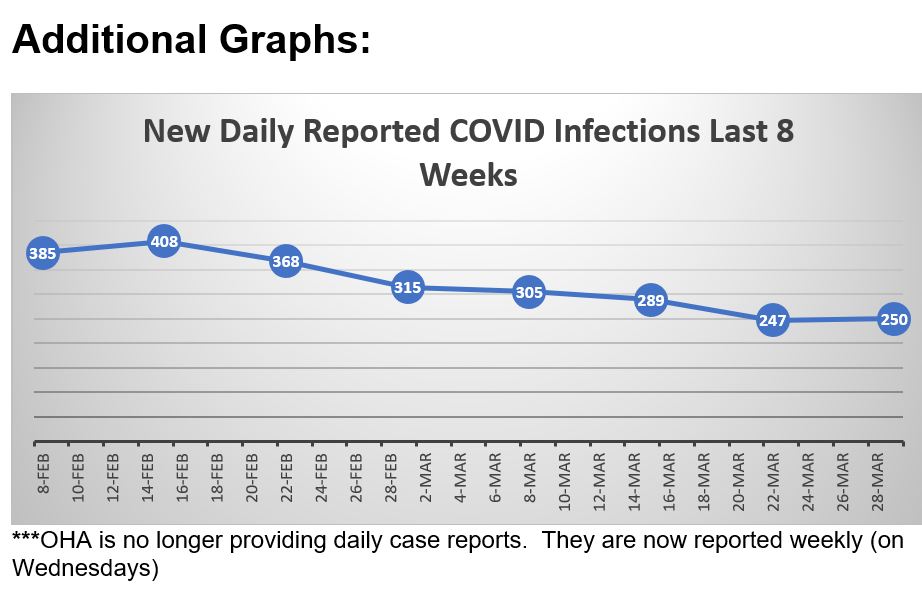
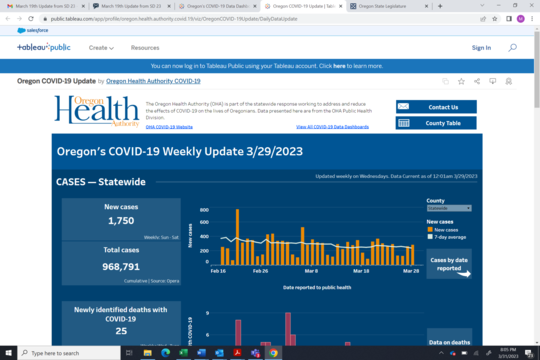
- The 7-day average for newly reported infections went up slightly last week, from 247 to 250 reported infections per day this last week. The number of new cases is likely an undercount, as many people are using home tests to determine their infection status but are not reporting those results.
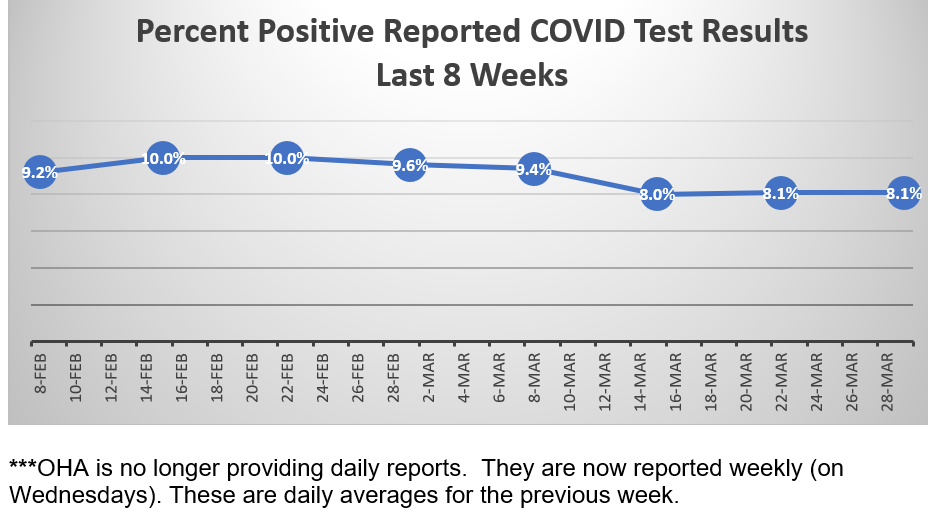
- Average test positivity stayed the same last week at 8.1%. The number probably skews high because it likely reflects a higher proportion of people showing COVID symptoms (and thus reporting or going in for a test, rather than self-testing and never reporting).
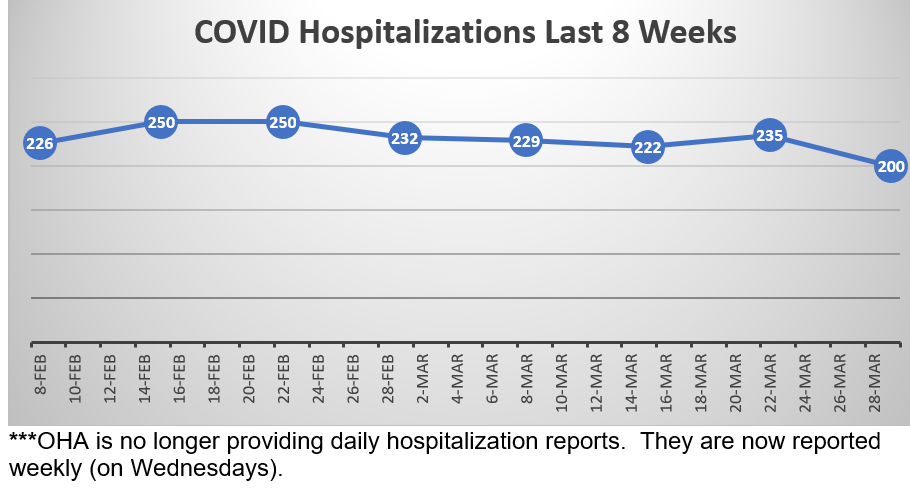
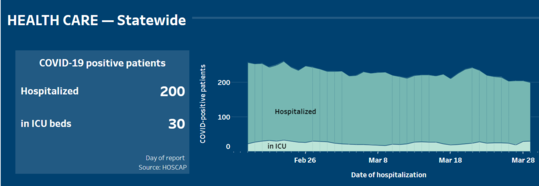
- On Wednesday there were 200 COVID hospitalizations, down from the previous week’s 235 COVID-19-related hospitalizations statewide. Hospitalizations are now our best indicator of disease spread. Again, however, most of these hospitalizations are not in and of themselves due to COVID—most are those who tested positive after having been admitted for other reasons.
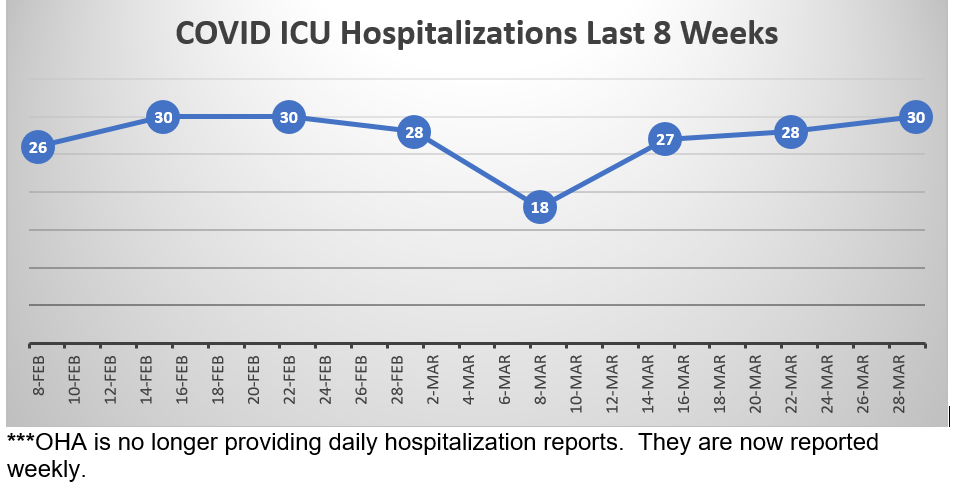
- The number of COVID patients in Oregon’s ICUs on Wednesday rose slightly last week, from 28 to 30 statewide. These are the most serious COVID infections.
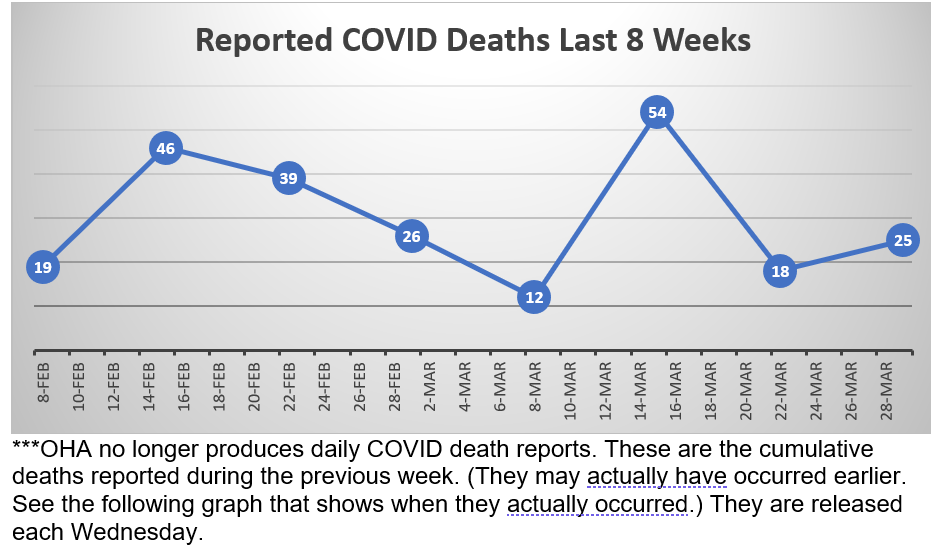
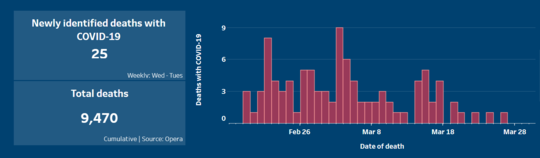
- There were 25 COVID-19-related deaths reported during the last week, up from the previous week’s 18. However, it’s important to remember that many of every week’s reported deaths actually occurred in earlier weeks but were just reported to the state, and others that likely occurred have yet to be reported. The newsletter’s final graph shows when the deaths actually occurred, and you’ll see that the number of COVID deaths each day continues to remain relatively low.
Weekly County Report: All Counties Again at Low Risk
The CDC assigns risk levels based on a combination of the number of new COVID cases and the number of people in hospital for COVID.
According to the CDC Daily Counter (updated each Thursday), all Oregon counties that are reporting are at Low Risk status. One county, Grant County in Eastern Oregon, did not submit data last week.
We can also track the cases, deaths, and test positivity rates for each county at this website.
Positivity rates for the three Portland-area counties rose again last week. Clackamas County in now at 8.3% (up from 7.7% the previous week). Multnomah County has jumped to 7.7% (up from 5.5%). Washington County has also gone up, to 8.9% (up from 8.6%).
Remember that these are all based on reported test results, and so are more likely to be a little higher than the total percent positivity (i.e., if one were to include all tests taken).
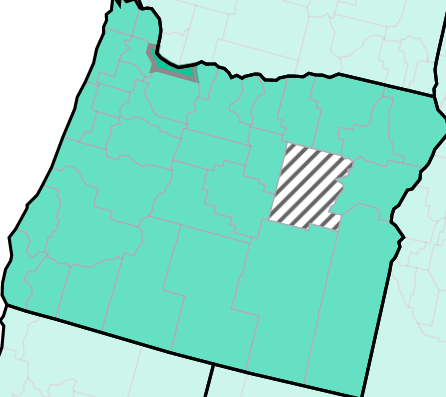 
This Week’s Wastewater Monitoring Report: More Increases
With testing reports giving us just a fraction of infections out there, wastewater monitoring has become a more reliable indicator of the amount of virus in cities around the state. That report is updated each week.
This week’s report, updated on Wednesday, showed more increases than decreases after a week of decreases. Sixteen percent of cities again showed increases or sustained increases last week (same as last week). Just 9% showed declines or sustained declines (down from 25%). The remaining 74% (up from 59%) showed no change.
Hermiston, Medford, and Warm Springs showed sustained increases last week.
Changes Coming Tomorrow
As we approach the end of the national health emergency in May, two important changes come to Oregon this week:
First, the masking requirement in health care setting ends on Monday. Here’s more from OHA: Starting Monday, April 3, workers, patients and visitors in Oregon health care settings will not be required to wear masks. This includes hospitals, mobile clinics, ambulances, outpatient facilities, dental offices, urgent care centers, long term care facilities, counseling offices, school-based health centers, and complementary and alternative medicine locations. The statewide requirement has been in effect since August 2021.
Note: some health care settings may decide to continue requiring masks even after the statewide requirement is lifted. Wearing a mask remains an effective way to reduce transmission of respiratory viruses. We encourage you to wear a mask in any setting, including health care settings, if you are sick, have a health condition that puts you at high risk for severe illness from a respiratory virus exposure (or you live with someone at high risk), or at any time wearing a mask makes you feel more comfortable.
Also on Monday, the Oregon Occupational Safety and Health Administration will rescind its COVID-19 requirements for all workplaces and employer-provided housing beginning on Monday as well. Here are details from Oregon OSHA.
COVID Q & A from OHA (from OHA weekly newsletter)
Dr. Melissa Sutton, OHA medical director of respiratory viral pathogens, answered this week’s questions.
Q: The expiration date on the box of my COVID-19 tests and on the test liquid inside are very different. Which one should I follow? – Anonymous, Independence
A: “The short answer is follow the expiration date on the box. Most brands of COVID-19 test kits are made up of individual components: the test card, the reagent/dropper bottle and the swab. Each of these components has its own manufacture date, expiration date and lot number. However, when they are assembled into a test kit, that test kit gets its own lot number and expiration date that applies to the kit as a whole. The expiration dates of the kit’s components are then overruled by the lot expiration date on the exterior of the kit.
“Continued product testing by manufacturers can often result in extending the expiration dates on the box, which means that every component of the test kit is effective and usable until the new date. The individual lot numbers and expiration dates on the liquid and other components are still used for quality assurance purposes and traceability by laboratories, distributers or manufacturers, but they are of no concern to you, the consumer.”
Q: I am getting repeat emails from "Free Covid Test" [from strange email addresses]. Is this spam or a legitimate source for COVID-19 tests? – Jeannette, Portland
A: “It is most likely spam, and it is unfortunately common. I receive similar emails, most of which land in my spam folder. The COVID-19 pandemic has sparked a great deal of fraud, perpetrated by scammers offering COVID-19 services in exchange for personal details, including Medicare information. The U.S. Department of Health and Human Services Office of Inspector General (OIG) offers tips on what to look out for, including:
Scammers are selling fake and unauthorized at-home COVID-19 test kits in exchange for your personal or medical information. Make sure to purchase FDA-authorized or approved COVID-19 test kits from legitimate providers.
Scammers are sending COVID-19 at home test kits to Medicare beneficiaries and then billing Medicare for reimbursement. If you received COVID-19 test kits that you did not order, please report it.
“If you feel you’re being scammed, you can report it to OIG’s hotline at 800-447-8477. OHA is unaware of any legitimate sources of free COVID-19 tests other than the federal government’s program which sends four free COVID-19 tests to each residential address in the United States. Those can be ordered here and are delivered by U.S. mail to your home.”
Additional COVID Updates and Links
Here again are some COVID resources that you will find useful:
If the above links are not providing you with answers to your questions or directing you to the help that you need, please consider me and my office to be a resource. We’ll do our best to assist you or steer you in the right direction.
 Senator Michael Dembrow
District 23
email: Sen.MichaelDembrow@oregonlegislature.gov
web: www.senatordembrow.com
mail: 900 Court St NE, S-407, Salem, OR, 97301
| 

