|
Friends and neighbors,
We have been slowly working through bills on the House Floor - some might call them the "Dog Days." This week, we have been voting nearly all day, every day. This has delayed votes on House Bills 2002 and 2005 to the beginning of May. This gives us more time for leadership to negotiate and hopefully minimize the damage of these bills.
The Oregonian Editorial Board hit the nail on the head this week when writing about the recent population decline in Oregon. They wrote: "As much as Oregon has to offer, our housing unaffordability, homelessness, increasing taxation, drug addiction crisis, untreated mental illness, gun violence, traffic deaths, and educational mediocrity are changing the calculus for many about where to live, raise a family or retire."
As always, please don't hesitate to contact me with comments, questions, or concerns at 503-986-1422 or Rep.TracyCramer@oregonlegislature.gov.
Best,

Tracy
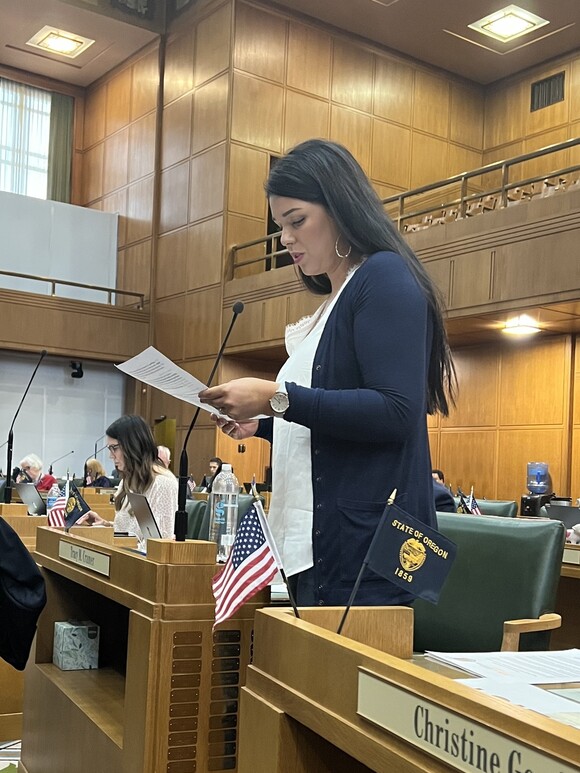
This week, I carried HB 3204 on the House Floor. It passed 47-8 with some members being excused. The bill would speed up timelines for transferring students to virtual charter schools.
Students who transfer to virtual charter schools are doing so for a reason. Typically, they have already fallen behind in a traditional school setting or have additional challenges they are working to overcome. HB 3204 makes it easier to make the switch.
Currently, a school district has up to 14 days to accept or reject that student’s enrolment in a virtual charter school. During that two-week timeframe, that student can go from disengaged to potentially lost. HB 3204 would speed up this timeline to 10 days to cut down on bureaucratic delays that compound the issues that lead a student to enroll in a virtual charter school in the first place.
In the case of a rejection, the timeline of the appeal would be shortened from 30 to 14 days. These will reduce missed school and missed learning. If all these things go wrong, a student can be out of school for nearly a month and a half. Under HB 3204, it would only be 24 days.
The bill also requires additional transparency by providing parents and families with the most up-to-date data when school districts approve or deny a virtual charter school application. This is data that districts are collecting and simply makes it more accessible to parents.
Perhaps my favorite part of this bill is that it gives families a choice to stay enrolled in their virtual charter school, even if they move outside the sponsoring district’s boundaries. I hope this is just the beginning of the conversation around expanding choices for families.
Watch my full carry speech here.
Holding Government Accountable
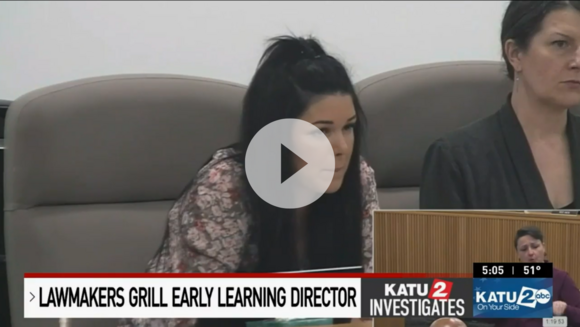
Government waste is serious, especially when tax dollars are supposed to pay for something as important as early learning for struggling families. KATU recently covered a committee hearing in which I questioned the Early Learning Director. Read more here.
The Department of Early Learning and Care (DELC) is set to finalize its independence from the state's Department of Education this summer. DELC runs Oregon's Preschool Promise Program, which offers free preschool to low-income families.
In September 2022, KATU News uncovered the department had spent roughly $26 million in taxpayer funds between 2020 and 2022 on preschool slots for low-income families that were never filled. In March, a follow-up investigation found the department was still paying between $16.5 million and $20 million on unfilled slots.
As of March 24, 2023, there were 874 open slots costing taxpayers about $14,476 apiece. This adds up to roughly $12.6 million currently being spent on open slots.
Expense reports for all grantees filed for the 2020-21 and 2021-2022 school years revealed some questionable spending habits for certain grantees. One Portland daycare, for example, had claimed $4,000 a month in rent one month and $8,000 another month. When comparing the daycare's location with property tax records, the same owner of the daycare had purchased the home in 2000 for $200,000.
The expense reports revealed other questionable spending items, such as one center spending $50,000 on materials over the two years with no Preschool Promise students enrolled the first year and only one enrolled the next year. Apparently, grant recipients are not required to submit receipts of their spending.
I will be meeting with the DELC Director next week to continue seeking answers to these issues.
Early Literacy Investments
I recently supported the Governor's early literacy package, HB 3198 as it came out of the House Education Committee. I will likely have another chance to vote on it, as the Education budget committee must approve the spending in the bill.
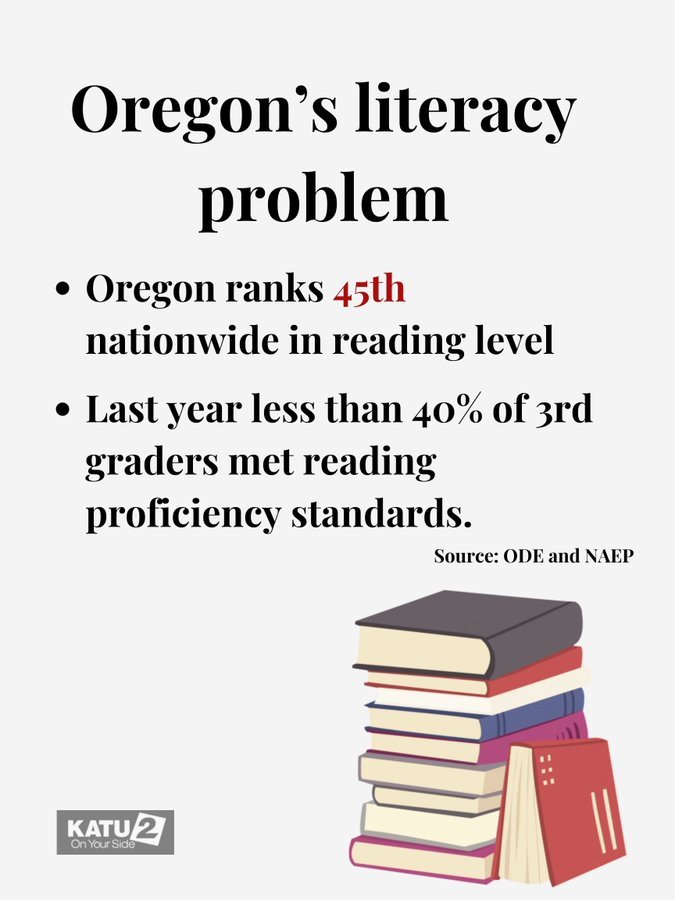
It's not a secret that Oregon's education outcomes are dismal. Oregon ranks 45th in the nation in reading, and only 40% of our 3rd graders are reading at grade level. That’s unacceptable. This package will dedicate funding to help train teachers and boost intensive tutoring to teach our students better how to read.
Mississippi provides Oregon with a roadmap on how to improve education outcomes. What has become known as the “Mississippi Miracle" began in the 2010s when their Superintendent of Education, Carey Wright, instituted serious reforms, including mandatory phonics teaching. They spent time and resources training teachers in the “science of reading.”
In 2013, Mississippi was 50th in the nation for K-12 achievement, according to Education Week’s annual Quality Counts Report. In 2021, they ranked 35th. By way of comparison, Oregon ranked 42nd in 2021, and in 2013, we ranked 46th.
Gervais School District Sues Social Media
It is evident that social media is harming kids' mental health. That is why I sponsored HB 3071, legislation that would have helped us better understand its impact on learning and schools.
Gervais School District has upped the ante by suing social media companies Facebook and Instagram (as well as their parent company Meta), Snapchat, TikTok, Google, and YouTube on behalf of their 1,500 students and others.
Opportunity for Public Comment
National Health Education Standards Public Comment
I was reading through the Oregon Department of Education Sexuality Education Newsletter and came across an opportunity to weigh in on a draft of the National Health Education Standards.
Join Shape America for a virtual town hall on April 17th at 11 AM PT. Register now for this online event, where you'll hear more about the revision process from members of the NHES Task Force.
Even if you can't make it to the town hall, you can still review the proposed standards and share your thoughts via this survey.
You can sign up for ODE's sexuality newsletter here.
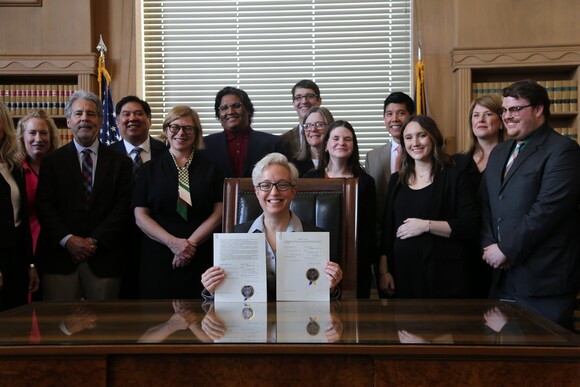
After signing House Bills 2001 and 5019, Governor Kotek has announced funding and the specific goals for the homelessness package. Salem and Marion Counties will get $10.4 million to rehouse 158 households and create 79 new shelter beds!
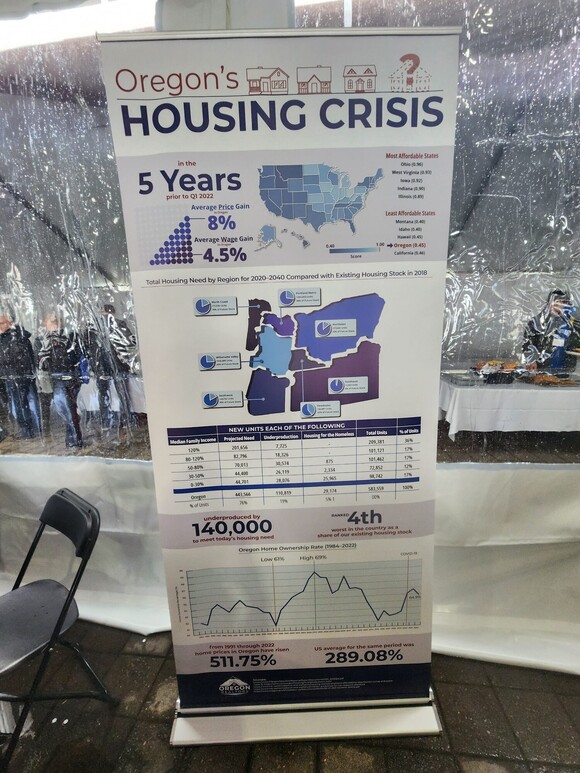
Below is an infographic from the recent lobby day held by the Oregon Association of Realtors. It clearly shows that Oregon is unaffordable because we aren't building enough homes. This homelessness package won't do much to ease the cost of housing, but it will get some homeless people off the streets.
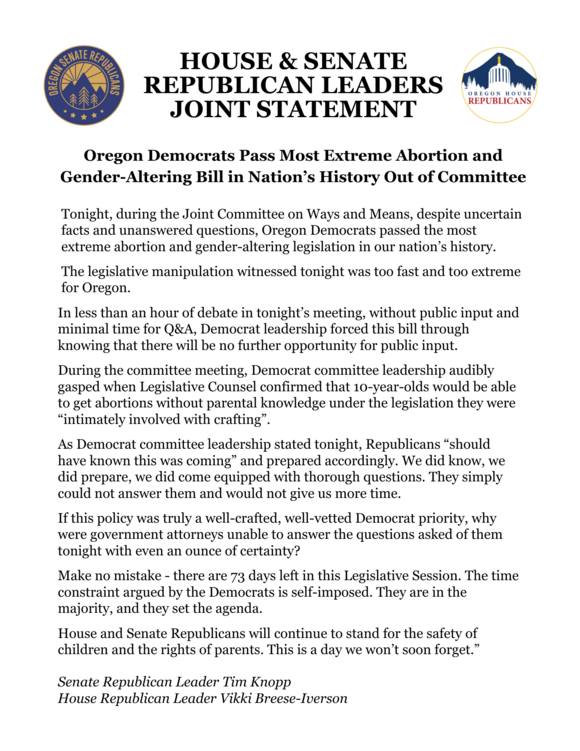
This week, the Ways and Means budget committee advanced HB 2002 to the House Floor. We will likely vote on the House Floor at the beginning of May.
I was surprised to see that both of the committee chairs, who supported the bill, gasped when the lawyers confirmed that the bill would allow 10-year-olds to get an abortion without parental consent. Watch that exchange here.

This week was National Public Safety Telecommunicators Week, an annual event that honors the critical role emergency response coordination professionals play in keeping the nation’s communities safe and secure.
|
Oregon has 43 standalone 911 centers known as Public Safety Answering Points (PSAPs) that serve as the first and single point of contact for people seeking immediate relief during an emergency. Nearly 800 dedicated telecommunicators across the state answer at least 2 million emergency calls annually for law enforcement, fire and emergency medical services. These 911 professionals respond to emergency calls, dispatch emergency professionals and equipment, and render life-saving assistance in times of intense personal crises and community-wide disasters.
Some 911 professionals are certified as emergency medical dispatchers (EMDs), emergency fire dispatchers (EFDs) or emergency police dispatchers (EPDs). All 911 professionals work diligently behind the scenes to help citizens during emergencies ranging from mental health crises, car accidents, missing person reports, burglaries and domestic violence disturbances. Since early 2020, Oregon’s public safety telecommunicators have had the added responsibility of serving throughout a pandemic, historic wildfires, heatwaves, winter storms, floods and severe staffing shortages.
The critical work of Oregon’s public safety telecommunicators directly supports the operations of federal, state and local government agencies, including emergency management, highway safety, and search and rescue. Oregon’s 911 program was established by the 1981 Oregon Legislature and is managed by the Oregon Department of Emergency Management. Learn more at Oregon.gov/OEM.
|
The Oregon Health Authority is reviewing income eligibility for approximately 1.5 million Oregon Health Plan (OHP) and Medicare Savings Program (MSP) members starting after COVID policies begin to expire. State health officials urge OHP members to review any notices they receive from OHA about their health benefits and respond promptly with any requested information. More here.
If you need help navigating a loss of benefits, you can call 211 or visit 211.org for assistance.
BottleDrop and the Oregon College Savings Plan have announced that $1 million has been saved for higher education through their partnership program that allows individuals and families from across the state to leverage their Oregon Bottle Bill container redemptions to save for future education expenses. The program started just three years ago.
Participants can set up automatic fund transfers from their BottleDrop account to one or more Oregon College Savings Plan (OCSP) accounts. To date, 10 million beverage containers have been redeemed and recycled through the partnership, with the funds being transferred to OCSP accounts, to the benefit of more than 5,000 Oregonians saving for higher education expenses.
 |
|
I recently got to visit with the Independent Adult Home Care Association in Woodburn! Thank you to Petronella Donovan for hosting the meeting and helping facilitate a great conversation about the needs of the adult home care industry!
|
|
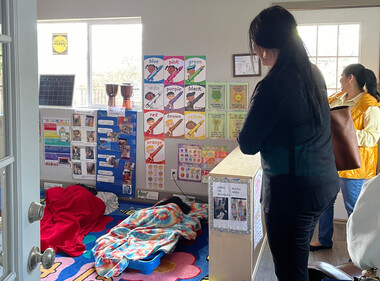
In this newsletter, you read about the issues with waste in the Preschool Promise program, but it is important to remember that many facilities are doing great work and using money responsibly. I was able to tour one such facility, Gervais Daycare & Preschool, and was impressed with their work!
Thank you to Maria for opening your home and facility to us!
|
|
 |
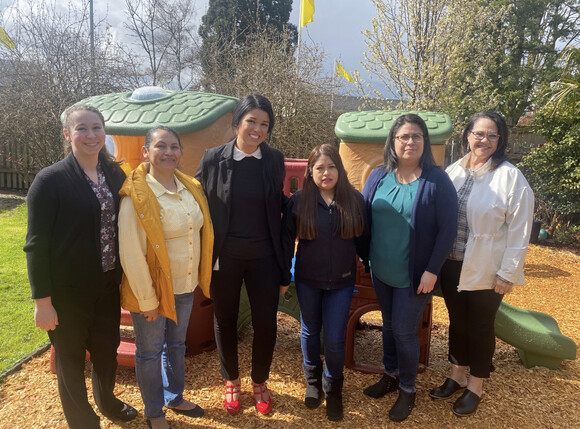
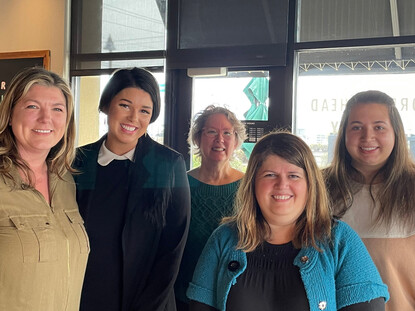
Rep. Cramer with Jessica, Maria (owner of Gervais Daycare and Preschool), and her two staff, and Lisa Harnisch, the Executive Director of Marion & Polk Early Learning Hub
Capitol Phone: 503-986-1422
Capitol Address: 900 Court St. NE, H-376, Salem, Oregon 97301
Email: Rep.TracyCramer@oregonlegislature.gov
Website: https://www.oregonlegislature.gov/cramer
|