|
March 26, 2023
Dear Neighbors and Friends,
I hope that you and your loved ones are doing well, staying healthy, and looking out for your neighbors and friends during this past week.
In tonight’s newsletter you’ll find information about our upcoming constituent coffee and subsequent Town Hall, the successful passing of the Motorcycle Lane Filtering bill on the Senate floor, stressful days in committees, and the release of the Co-Chairs budget on Thursday.
This last week saw another round of controversial, highly partisan bills (yes, it’s that time now). This time it was the House firearms package. Here's reporting on it from the Oregon Capital Chronicle. I will say that those hearings—while well attended—did not attract the huge audiences that we’ve seen in the past. Most of those attending were in support of additional regulation of gun purchases and locations that can prohibit them. Also, now that we have successfully barred firearms from coming into the Capitol (and now have metal detectors in place to enforce that prohibition), we no longer are seeing individuals asserting their presumed Second Amendment rights by openly carrying handguns and semi-automatic rifles inside our hallways, committee rooms, and office areas. For many of us, that’s a real relief.
On the COVID front, last week saw a stabilization of the COVID metrics. There doesn’t appear to be any indication of COVID spikes anytime soon. Hospitalizations went up a little, but reported cases went down, as did reported COVID deaths. Wastewater analysis also shows overall declines in COVID virus around the state.
Until next week, please do your best to stay happy, healthy and safe. And let me know if you have any questions or thoughts about anything in this week’s newsletter.
COMING ON SATURDAY: April Constituent Coffee!!!
No joke, but April is around the corner. Next Saturday, April 1st, is the first Saturday of the month, which means another monthly constituent coffee from 9 am to 10:30 am. We’ll be returning to Zoom for this meeting.
It will be a chance for me to share behind-the-scenes info on where we are in the 2023 session, provide some thoughts on the Co-Chairs Budget (see below), and hopefully provide answers to your questions about the bills and initiatives that are priorities for you.
You can register for the April 1st coffee here.
See you there!
Mark Your Calendars. Coming in April: Joint Town Hall. Reps Pham, Tran, and I will be holding a town hall Wednesday evening, April 19th, at PCC-Southeast. More info in future newsletters.

Ways and Means Co-Chairs Unveil Their Framework Budget
As I mentioned last week, the next step in budget development was the release of the high-level framework budget proposed by the Co-Chairs of Joint Ways and Means, Senator Steiner and Rep Sanchez. It takes a different approach in many areas from the budget proposed by the Governor at the beginning of the year. It’s now up to the Ways and Means process via its subcommittees, along with discussions between the Governor and the Presiding Officers (Senate President and Speaker of the House).
Here's the Executive Summary of the framework. You’ll see that the Co-Chairs’ budget is quite conservative in a number of ways. It is focused on funding existing programs but not leaving much if anything for new initiatives. It calls for 2.5% reductions in all existing state programs, mainly by eliminating vacant positions. It’s looking to the subcommittee chairs for help identifying further savings in the agency budgets—which can potentially be used to fund important new programs
Unlike Governor Kotek’s budget, it plans to put 1% of the 23-25 budget into the Rainy Day Fund, whereas Governor Kotek chose to keep that for needed new programs.
Here’s a more detailed version of the proposal.
I’ll have more to say about it after I’ve had more time to study the proposals. Once the April 4th deadline for passing new bills out of committee has passed, we’ll have a better sense of the policy bills that will be referred to Ways and Means for potential funding. Then we’ll have a better sense of the needs we face.
Here’s reporting on the budget from OPB.
And here’s reporting from the Oregon Capital Chronicle.
The Deadline Cometh
This is the last full week before the arrival of the first-chamber deadline on April 4th. That's the last day for a bill to be sent out of committee (either to the floor for a vote or to another committee for further consideration) or else it is dead. That means that most committee agendas for the week are full of public hearings and especially work sessions (i.e., committee votes).
As I mentioned in last week's newsletter, the Friday before was the last day for a bill to be scheduled for a work session, so that means that those that were successfully scheduled are stacked up in the queue, hoping to get their day in the sun. They can't be worked until all their final amendments are ready and they've had their fiscal analysis. The latter has been a real problem this year because the release of the Co-Chairs budget came just before the deadline. Legislative Fiscal Office have been so busy working on the Co-Chairs budget that they're way behind on their analyses of the policy bills awaiting their votes. But Legislative Counsel is also swamped with last-minute amendment requests. It's stressful.
It's going to be a busy, busy week, as we continue to wait for "the paperwork"--i.e., the completed amendments and fiscal analyses. If absolutely necessary, a bill can be sent to the Rules Committee next week (Rules has no deadlines) while it's waiting for its paperwork. But that's generally to be avoided.
I'll give you a status report on all my priority bills next week.
Motorcycle Lane Filtering Moves to the House
SB 422, https://olis.oregonlegislature.gov/liz/2023R1/Measures/Overview/SB422 the bill that will allow motorcyclists to enter a lane already occupied by another vehicle when traffic has stopped or is going no more than 10 mph, had its Senate floor vote this past week. The results were overwhelmingly positive: 27 aye, 2 nay, 1 absent.
If you’d like more information about it, here's a PowerPoint on it that I presented to the Governor’s Motorcycle Safety Advisory Committee in February.
And here's reporting on it from OPB’s Dirk Vanderhart.
ON THE COVID FRONT
Weekly Data Report:
OHA now updates and reports COVID metrics once a week, on Wednesdays. Here are the most recent set of weekly results, for this past week from 3/16/23 through 3/22/23.
This week’s report shows mixed results in COVID metrics here in Oregon, with reductions in cases and deaths, and increases in hospitalizations. The overall trajectory remains positive.
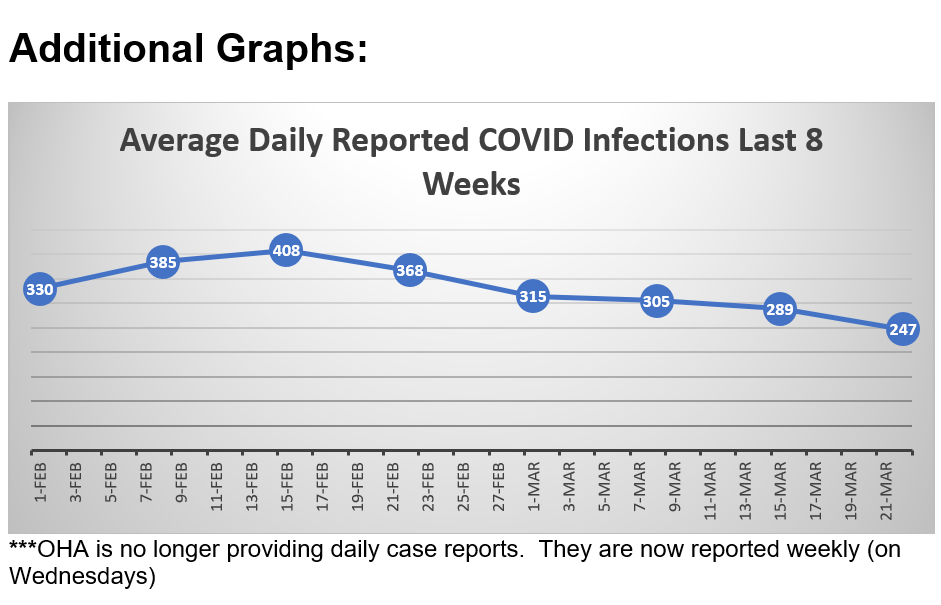
- The 7-day average for newly reported infections went down again last week, from 289 to 247 reported infections per day this last week. The number of new cases is likely an undercount, as many people are using home tests to determine their infection status but are not reporting those results.
- Average test positivity also went up very slightly last week, from 8.0% to 8.1%. The number probably skews high because it likely reflects a higher proportion of people showing COVID symptoms (and thus reporting or going in for a test, rather than self-testing and never reporting).
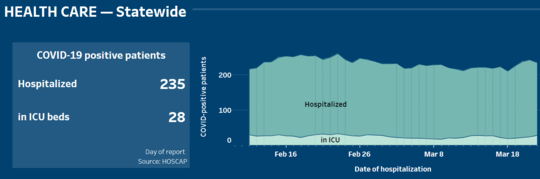
- On Wednesday there were 235 COVID hospitalizations, up from the previous week’s 222 COVID-19-related hospitalizations statewide. Hospitalizations are now our best indicator of disease spread. Again, however, most of these hospitalizations are not in and of themselves due to COVID—most are those who tested positive after having been admitted for other reasons.
- The number of COVID patients in Oregon’s ICUs on Wednesday rose slightly last week, from 27 to 28 statewide. These are the most serious COVID infections.
- There were 18 COVID-19-related deaths reported during the last week, down from the previous week’s 54. However, it’s important to remember that many of every week’s reported deaths actually occurred in earlier weeks but were just reported to the state, and others that likely occurred have yet to be reported. The newsletter’s final graph shows when the deaths actually occurred, and you’ll see that the number of COVID deaths each day continues to remain relatively low.
Weekly County Report: All Counties But One Reporting at Low Risk
The CDC assigns risk levels based on a combination of the number of new COVID cases and the number of people in hospital for COVID.
According to the CDC Daily Counter (updated each Thursday), one county (Malheur in Southeast Oregon) is rated as Medium Risk, while all the rest of Oregon’s counties are at Low Risk. The two counties that had been slow to report data are now classified as Low Risk.
We can also track the cases, deaths, and test positivity rates for each county at this website.
Positivity rates for the three Portland-area counties rose last week, following a week of significant reductions. Clackamas County in now at 7.7% (up from 6.5% the previous week). Multnomah County has risen very slightly to 5.5% (up from 5.4%). Washington County has also gone up, to 8.6% (up from 7.0%).
Remember that these are all based on reported test results, and so are more likely to be a little higher than the total percent positivity (i.e., if one were to include all tests taken).
 
This Week’s Wastewater Monitoring Report: Significant Decreases
With testing reports giving us just a fraction of infections out there, wastewater monitoring has become a more reliable indicator of the amount of virus in cities around the state. That report is updated each week.
This week’s report, updated on Wednesday, showed slightly more reductions than increases after a week of increases. Twenty-five percent showed declines or sustained declines (up from 13%). Sixteen percent of cities showed increases or sustained increases last week (same as last week). The remaining 59% (down from 71%) showed no change.
Gold Beach, Medford, Pendleton, and Warm Springs showed sustained increases last week.
COVID Q & A from OHA (from OHA weekly newsletter)
Dr. Dean Sidelinger, OHA state health officer and state epidemiologist, and Dr. Melissa Sutton, OHA medical director of respiratory viral pathogens, answered today’s questions.
Q: Dr. Dean Sidelinger stated at the March 9 press conference that, "Wearing a mask offers significant protection." Please explain the protection wearing a mask provides in light of the study published in Cochrane in January titled "Physical interventions to interrupt or reduce the spread of respiratory viruses." – Kelley, Scappoose
A: “There is overwhelming evidence that masking is associated with a reduced risk of respiratory virus transmission. Please see the following studies, but note that they are only a fraction of the public health literature demonstrating the benefit of masking:
Science Direct: Efficacy of face mask in preventing respiratory virus transmission: A systematic review and meta-analysis
July 17, 2020 - CDC’s Morbidity and Mortality Weekly Report
19, 2021 - CDC’s Morbidity and Mortality Weekly Report
“The Cochrane review that you cite is currently being criticized by subject matter experts for presenting heavily biased data in an incomplete way. In examining the totality of evidence, masks work.”
Q: From where may I receive COVID-19 home tests mailed to me? – Rachel, Rockaway Beach
A: “The federal government continues to offer each residential address in the United States four at-home COVID-19 tests, at no cost. Place your order here, and the tests will arrive through the U.S. Postal Service. Additionally, while the federal public health emergency is still in effect, health insurance will cover the cost of up to eight at-home tests per covered person, per month. The tests will either be free directly at the point of sale, or your insurance company will reimburse you (and you should save your receipts). After the public health emergency ends May 11, some insurance policies may no longer cover the cost of COVID-19 tests.”
Additional COVID Updates and Links




Here again are some COVID resources that you will find useful:
If the above links are not providing you with answers to your questions or directing you to the help that you need, please consider me and my office to be a resource. We’ll do our best to assist you or steer you in the right direction.
 Senator Michael Dembrow
District 23
email: Sen.MichaelDembrow@oregonlegislature.gov
web: www.senatordembrow.com
mail: 900 Court St NE, S-407, Salem, OR, 97301
| 

