|
Dear Friends and Neighbors,
Tomorrow begins a new year, and I am reflecting on the events and trials of the last year and trying to make sense of everything we have been through. This year served as a mirror in many ways and reflected our society’s best and worst features. Twenty-twenty forced us to confront who we are as a community, a state, and a nation, and in doing so, 2020 also gave us the opportunity to reimagine who we can become.
This past year taught us tough, necessary lessons, and they came at an extraordinary cost. This year, we lost George Floyd, Breonna Taylor, and too many other Black lives. The coronavirus pandemic exposed the deadly impacts of systemic racism and the resulting health disparities. Everyone experienced some type of loss whether that was a job loss, the small business your family built, shelter, time spent in-person with family and friends, or a sense of security. Moreover, too many Oregonians are experiencing the irreparable, devastating grief of losing a loved one.
But in this year of compounding tragedies, we also found hope, generosity, and kindness. Oregonians and small businesses, oftentimes struggling themselves, did not hesitate to donate food, shelter, and supplies to their neighbors in need. Oregonians stayed home and saved lives to protect our essential workers and health care heroes. Teachers went to great lengths to create engaging and enlightening lessons despite the challenging circumstances, and across the state, Oregonians called for racial justice.
The past year challenged me, but I remain the optimist I was before this all began, because Oregonians upheld my belief that people on the whole are genuinely kind and giving in nature. Throughout 2020, we all made sacrifices out of a strong commitment to protect each other and our communities, and it is that spirit we need to carry into 2021 as we begin rebuilding our society into one where everyone can thrive. Together, we can learn from 2020 and work to ensure the tragedies of this year are an anomaly instead of the start of a new normal.
Thank you for sharing your views and concerns with me throughout the year.
As always, if there is any assistance I can provide, please do not hesitate to contact me. I wish you and your family a healthy and safe new year.
Warmly,
 Andrea Salinas, State Representative
COVID-19 Update
On Wednesday, the Oregon Health Authority (OHA) released their COVID-19 weekly report. For the third week in a row, case counts, hospitalizations, and deaths declined. This is a positive development and shows that the majority of Oregonians continue to take seriously the public health guidance.
Although we are experiencing encouraging signs of improvement, we are still in the midst of a dangerous, global pandemic. Earlier this week, Governor Brown announced that after reviewing the data, Multnomah and Clackamas counties will remain in the Extreme Risk category.
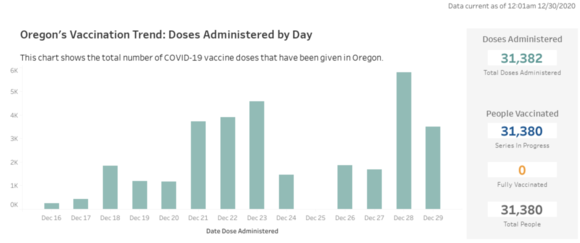
Like many of you, I am following vaccine distribution closely. We are still in the early stages of distribution, and health care workers and residents in long-term care settings are being prioritized now. I am disappointed that the pace of vaccine rollout is slower than many had hoped, and I will continue to engage regularly with local public health departments, OHA, and the Governor’s office to help ensure distribution is prompt, equitable, and accessible. You can follow the vaccine distribution and progress yourself on OHA’s vaccination website.
Third Special Session of 2020
Last week, the Oregon Legislature wrapped up the third and final special session of the year. We came together to address urgent issues with proposals that will keep people in their homes, support independent restaurants, and provide ongoing funding for critical pandemic-related programs.
Eviction Moratorium and Landlord Compensation Fund (HB 4401)
Earlier this year, I was proud to vote yes on legislation that protected tenants by creating the eviction moratorium. Unfortunately, this mortarium was set to expire at the end of 2020. With the state of our economy, our unemployment system, and the pandemic, I knew there was no way families would be able to pay back rent when this critical protection expired. In fact, recent data from the National Council of State Housing Agencies estimated that anywhere from 27,700 to 56,100 Oregon households would have been at risk of eviction on January 1st without the extension of the eviction moratorium statewide. So, I, along with many of my colleagues in the House, advocated for a special session to address this pressing issue.
During the Third Special Session, I voted yes on HB 4401, which ensures that renters across the state cannot be evicted through June 30, 2021 if they cannot pay their rent during the COVID-19 pandemic. It also establishes a $150 million fund to cover overdue rent payments, which will help eligible renters avoid falling further behind, while also ensuring landlords have a voluntary way to recover payments they were counting on.
If you are a tenant, it is critical to note that these protections are not automatic. To be protected from eviction for nonpayment after December 31, 2020, renters must fill out and sign a sworn declaration of financial hardship and give it to their landlords. A FAQ and the documents you need are available on the Oregon Law Center website. Additionally, more funding for rental assistance will be available, which you will be able to access via calling 2-1-1 or visiting 211info.org.
If you are a landlord, you will have the option of applying to the landlord compensation fund to cover the back rent you’re missing from tenants. You will be eligible to receive 80% of the amount you’re missing – the remaining 20% that is owed must be forgiven. Applying for this funding source will be voluntary, and landlords will be able to apply more than once over the course of the rest of the emergency period. The Oregon Housing and Community Services (OHCS) office will be developing program materials in the coming weeks as they prepare to launch the Landlord Compensation Fund in late-January. You can sign-up for the OHCS email list to receive the latest updates.
The legislature also took action on several other policies last week:
-
Funding for relief and recovery (SB 5731): A large portion of the federal CARES Act funding expires at the end of 2020, so legislative action was necessary to ensure critical pandemic-related programs could continue. SB 5731 includes $600 million in funding for programs that will support Oregonians in the first few months of 2021, as well as provide more support for Oregonians impacted by the Labor Day wildfires. It also includes $150 million for the Landlord Compensation Fund and $50 million for rental assistance.
-
Help for restaurants (SB 1801): For the duration of the emergency period, licensed restaurants can sell cocktails or single servings of wine “to go.” The bill also caps fees that third-party delivery providers can issue at 15%. Local governments with already-existing third-party fee caps can maintain their own lower limits.
-
Liability protections for school districts (HB 4402): This bill provides temporary liability protections to schools that are complying with COVID-19 emergency rules. To be clear, schools are not protected if they are not following Oregon Occupational Safety & Health (OSHA) and Oregon Health Authority (OHA) rules. Furthermore, HB 4402 provides additional incentives for schools, administrators, and teachers to follow health directives and best practices. Importantly, the measure provides whistleblower protections to third party contractors, such as janitorial service providers, bus drivers, and food service providers.
While I am glad the Legislature was able to provide some relief, I am under no illusions that these handful of bills fully address the extreme need Oregonians are facing. For instance, I remain disappointed that we did not address the mortgage moratorium and help homeowners who are also in dire straits. My colleague Rep. Holvey worked for months to develop legislation to help homeowners avoid foreclosure, and amongst Democrats in the House, we were ready to support this critical legislation. Unfortunately, our sense of urgency was not shared by everyone in the Capitol. I look forward to the legislature reconvening in January so we can make more progress to provide relief to Oregon workers, families, and businesses.
Federal Coronavirus Package
Congress recently passed a coronavirus relief package worth around $900 billion. The package includes another round of direct payments to Americans, an extension of unemployment programs, financial assistance for renters, forgivable loans to small businesses through the Paycheck Protection Program (PPP), money to help with the purchase and distribution of the COVID-19 vaccine, and more.
This NPR article contains more information on the details of the package, as well as a copy of the bill in its entirety.
Oregon Employment Department Update (OED)
Unemployment Insurance Programs Extended
One of the most important elements of the new coronavirus relief package is an extension of two crucial unemployment insurance programs for another 11 weeks, through March 14, 2021: Pandemic Unemployment Assistance (PUA), which allows gig workers and those who are self-employed to receive unemployment benefits, and Pandemic Emergency Unemployment Compensation (PEUC), which provides an extension of unemployment benefits to those who have exhausted all state or federal benefits.
Both of these programs were a part of the CARES Act and expired on December 26, 2020. Had they not been extended, an estimated 70,000 Oregonians were expected to lose their weekly benefits.
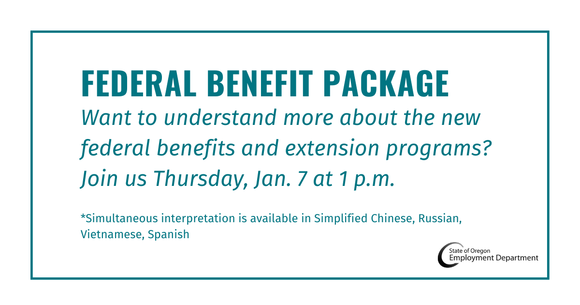
OED is still waiting on guidance from the U.S. Department of Labor on how to implement the new legislation, but they hope to begin issuing payments next week. In addition, OED stated that Oregonians will not miss out on a week of benefits even though the new legislation was signed by the President after the December 26, 2020 end date. To help explain these new developments and to share more information, OED is hosting a webinar on Thursday, January 7 at 1 p.m. Simultaneous interpretation is available in Simplified Chinese, Russian, Vietnamese, and Spanish. You can register here.
 $300 Enhanced Benefits
As part of the coronavirus relief package, everyone who qualifies for state unemployment programs or PUA will receive an extra $300 per week in enhanced benefits on top of their weekly state or PUA benefit amount. The enhanced benefit is in effect through March 14, 2021.
Like the PUA and PEUC payments, OED hopes to begin sending these payments to eligible Oregonians next week. To receive the extended benefit, continue to file weekly claims as you would do normally. You do not need to fill out any additional applications.
Mixed Earner Unemployment Compensation (MEUC)
The coronavirus relief package also creates a new program that will give an extra $100 per week to individuals who earned at least $5,000 in 2019 from self-employment income. This is in addition to the $300 enhanced benefit, and is in effect through March 14, 2021.
Mixed earners, whose income comes from a combination of traditional (W-2) and self-employment (e.g. 1099) wages, are not eligible for PUA benefits if they receive some regular state benefits for their traditional income. Because state law does not consider self-employment income when calculating total earnings, mixed earners end up receiving a weekly benefit amount that is not proportionate to their true earnings. The extra $100 seeks to make up for this gap and provide these individuals with a weekly benefit that is more reflective of their total earnings.
According to OED, the MEUC program will be a challenge to implement and they don’t know yet when they will be able to begin to issue payments to eligible Oregonians. OED says that it might be as late as March before the extra $100 is sent to mixed-earners. That being said, eligible applicants will receive these benefits, and OED will pay people retroactively if necessary.
Oregon DMV
Grace Period Extended
Due to a limited number of available DMV appointments, and a backlog caused by COVID-19, many Oregonians have not been able to renew their driver license, driver permit, identification card, vehicle registration, trip permit, or disabled person parking placard, prior to the expiration of the citation moratorium on December 31, 2020.
To offer leniency to these Oregonians, law enforcement agencies have agreed to a rolling citation moratorium. Under this agreement, Oregon law enforcement agencies will exercise more discretion when determining if they will issue a ticket for an expired driver license, driver permit, identification card, vehicle registration, trip permit, and disabled person parking placard, that expire between November 1, 2020 and April 30, 2021, and that have been expired for fewer than three months.
Law enforcement officers will be able to verify the status of a driver or vehicle registration electronically during a traffic stop.
DMV Offices Open By Appointment
For services that require in-person visits, like a driver license and other identification card related matters, you must make an appointment online by visiting the reservation portal here. The first available appointment at certain DMVs may not be for another two months, so it is recommended that you make a reservation as quickly as possible.
Online DMV Services
That being said, some services do not require you to visit the DMV in-person. By following this link here, you can:
- Renew your vehicle registration
- Access your DMV profile
- Schedule an appointment
- Replace a lost, damaged or stolen license or ID card
- Pay a reinstatement fee
- Report your change of address
- Report the sale of your car
- Calculate vehicles fees to mail in title and registration applications
You can also download a number of forms and complete certain transactions by mail, including vehicle title transfers. Further information and instructions can be found on the DMV’s website here.
email: Rep.AndreaSalinas@oregonlegislature.gov I phone: 503-986-1438
address: 900 Court St NE, H-485, Salem, OR, 97301
website: http://www.oregonlegislature.gov/salinas
| 

