|
Dear Friends and Neighbors,
Today, Governor Brown and public health officials announced that Oregon will be receiving 60,000 to 80,000 rapid antigen tests per week through the end of the year from the federal government. This will roughly double our state’s current testing capacity.
As Oregon Public Broadcasting reports here, the goal is to “reduce the number of undetected cases in the community” in order to reopen schools for in-person learning. The hope is that this will help diagnose Oregonians more quickly, allowing for faster access to treatment and better containment of the virus.
The Oregon Health Authority is also expanding their testing guidelines to include all close contacts of people who have been infected, regardless of whether or not they are showing symptoms. This again highlights why it’s so important to take contact tracing calls when they come.

This new level of testing capacity is welcome news – and it’s not reason to let your guard down.
Tests have strengths and limitations. While these tests can produce results in 15 minutes, they are imperfect and there is still a risk of false negatives. No existing testing system is 100% accurate, and you should still take maximum precaution even if you have recently received a negative test.
Our statewide test positivity has increased over the past four consecutive weeks and has been 5% or above each of those weeks. Here are the latest numbers since my last newsletter. We have averaged over 300 cases and four deaths per day in that span.
- Friday, October 2: 314 cases, 3 deaths
- Saturday, October 3: 360 cases, 8 deaths
- Sunday, October 4: 260 cases, 1 death
- Monday, October 5: 288 cases, 0 deaths
- Tuesday, October 6: 301 cases, 9 deaths
The latest “COVID-19 Epidemic Trends And Projections” from the Institute for Disease Modeling, which can be read in full here, notes that transmission increased substantially during May, then decreased in late-June through late-July. However, transmission appeared to increase again around Labor Day weekend, and the numbers in the last month made this clear, frustratingly reversing the progress we made during the late summer.
State epidemiologist Dr. Dean Sidelinger told The Oregonian here that the modeling was discouraging. Also, on Friday, Governor Brown announced that Benton and Clatsop counties were being put on the County Watch List.

The report notes that Oregonians can reduce transmission if we redouble our prevention efforts. This means wearing face coverings, not attending large gatherings, watching our physical distance from others, and washing our hands.
Just because we’re getting used to living with this virus, we’re always learning more.
The Centers for Disease Control and Prevention updated its guidance, noting that COVID-19 can sometimes be spread by airborne transmission, in addition to spreading very easily from person to person in close contact. This means the virus in some instances can infect people who are further than six feet away from an infected person, even after they’ve left the space. This is especially a concern in enclosed spaces with poor ventilation.
This doesn’t bode well for the colder months ahead, which is all the more reason to work harder now to contain the spread.
Manufactured home parks provide some of the most affordable housing available in Oregon. In all parts of the state – urban, suburban, and rural – these parks are often tight-knit communities of working families, seniors, and individuals with limited incomes. When they are lost to redevelopment or disaster, it’s an incredible loss for the residents, both financially and emotionally.
Rep. Pam Marsh, my colleague from Ashland, has been doing incredible work over the last month to help victims of the recent wildfires. Her district includes the towns of Phoenix and Talent, which were devastated by the Alameda fire. Many of the homes destroyed were in manufactured home park communities. These stories from The Oregonian here and here describe how the fires damaged these communities and exacerbated the housing crisis in southern Oregon.
Rep. Marsh recently held a webinar for manufactured home park residents to help them understand the processes for clean up, FEMA assistance, and other top-of-mind issues. Below are some of the essential resources she highlighted during the webinar. The Oregonian has some additional ways to help here.
Replacing Important Paperwork to Prove Ownership
- A step-by-step guide to retrieving paperwork lost in the fires to prove ownership of a manufactured housing unit can be found here on the Department of Consumer and Business Services website.
- If you have any challenges, contact Warren Jackson at the Building Codes Division: 503-373-7755 or Warren.D.Jackson@oregon.gov.
- The Oregon Division of Financial Regulation advocacy team is available at this number: 888-877-4894.
Insurance: Filing Your Claim
- Document everything: Whenever you speak to your adjuster, write it all down.
- Any receipts of purchases you have can help generate proof of losses.
FEMA: How to Apply
- You can apply by calling 1-800-621-3362 or visiting www.disasterassistance.gov.
- A letter declaring ineligibility usually means that more information is needed.
- The Center for Nonprofit Legal Services is taking calls for help with FEMA appeals for low-income residents in Jackson County: 541-779-7291 or 541-779-7000 (for seniors)
-
OregonLawHelp.org can also help with FEMA appeals.
- Visit https://www.disasterlegalaid.org/femaappeals/ for an online tutorial on the process of creating a FEMA appeal letter.
- You can also go to the Oregon Employment Department’s page on Oregon Disaster Unemployment Assistance here.
By law, FEMA can’t duplicate relief funds for individuals whose damages are covered by insurance. But if insurance doesn’t cover the entire loss, then FEMA can determine additional assistance that can be provided.
To be eligible for FEMA's Individuals and Households Program (IHP) assistance, disaster survivors must be U.S. citizens, non-citizen nationals, or meet the following qualifications for immigration status found here.
Oregon Wildfire Housing Damage Relief Fund
- There is a very brief application, which you can find here. Renters are not eligible at this time, but changes are being made to the program, for which the Legislative Emergency Board recently allocated additional funding.
- This program is not tied to citizenship, so undocumented people are eligible.
Clean Up Responsibilities
- Don’t start cleaning up property yet! There needs to be risk assessments because much of the debris is hazardous. Don’t bring debris to the dump either.
- If a resident didn’t have insurance coverage (or enough coverage), clean up should still not mean any out-of-pocket expenses. Coordinated local clean up will utilize coverage people have and keep them from incurring additional costs.
Landlord/Tenant Issues
- If you were a tenant of a property destroyed by fire, the Oregon Law Center says that means the tenancy ended when the fire destroyed the property. You should not owe rent beyond that date.
- This also means you are not entitled to get back into the park after rebuilding and will need to establish a new tenancy.
- The Oregon State Tenants Association has a call-in line for support: 1-800-423-9371.
The Oregon Health Authority (OHA) launched a new behavioral health outreach and education effort to help Oregonians. These new resources will support increased behavioral health needs in our communities due to the broad impacts of the pandemic and historic wildfires.
Portland-based nonprofit Lines for Life and OHA have launched the Safe + Strong Helpline at 800-923-4357 (800-923-HELP). The line offers free, 24-7 emotional support and resource referral to anyone who needs it – not only those experiencing a mental health crisis. Callers are routed to a counselor who can provide emotional support, mental health triage, drug and alcohol counseling, crisis counseling or just human connection.
Here are specific resources:
If you’ve been receiving Pandemic Unemployment Assistance (PUA), your benefits have now been extended from 39 weeks to 46 weeks. Oregon's high unemployment rate has triggered these extended benefits. As long as you are still eligible, you can get PUA benefits until the program ends on Dec. 26, 2020.
- Governor Brown said today that the state will be reevaluating the public health benchmarks for resuming in-person school instruction. Oregon Public Broadcasting has more details here.
- Significant job losses over the last year have been clustered on the Coast, in the Portland Metro area, and in Central Oregon, while southern and eastern Oregon have seen less severe job loss, as The Oregonian reports on here.
- If you need to take a driving test to get your license, you’ll have to test with a third party company since the DMV’s services are limited due to the pandemic. The Oregonian has more information here, and the DMW has additional details here.
- The Portland Bureau of Transportation has created a Winter Healthy Business Program so restaurants and bars can continue serving on pop-up patios during the winter. Willamette Week has details here.
- The Oregon Health Authority reported 301 new confirmed cases of coronavirus, bringing the statewide total of new and presumptive cases to 35,340. The OHA also reported nine more deaths, meaning 581 Oregonians have died of the coronavirus. You can click the images below for links to interactive data tables about coronavirus in Oregon.

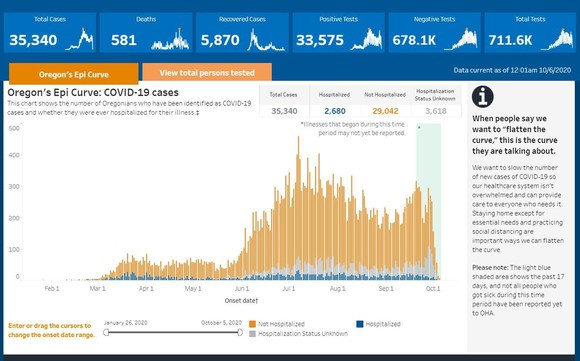

To read past newsletters, you can go to this link. For up to date information, please check this link to the Oregon Health Authority where regular updates are posted: https://www.oregon.gov/oha/ERD/Pages/News-Releases.aspx
Please email me at Rep.TinaKotek@oregonlegislature.gov if you have specific concerns that have not been addressed by the OHA. Our office will do all we can to help and protect all Oregonians.
Thank you for reading! We will get through this together.
Best,

Tina Kotek
State Representative
House District 44
Speaker of the House
email: Rep.TinaKotek@oregonlegislature.gov I phone: 503-986-1200
address: 900 Court St NE, H-269, Salem, OR 97301
website: http://www.oregonlegislature.gov/kotek
| 

