|
Greetings:
Our state is contending with one of the most explosive fire seasons on record.The latest news is that firefighting crews are making good headway against many of the fires. Much of Clackamas County has been downgraded from their evacuation orders, and officials had cautiously optimistic things to say about their progress against the Beachie Creek and Riverside fires near Salem, as well as the Almeda and Holiday Farm fires in Southern Oregon. But there are still dangers ahead.
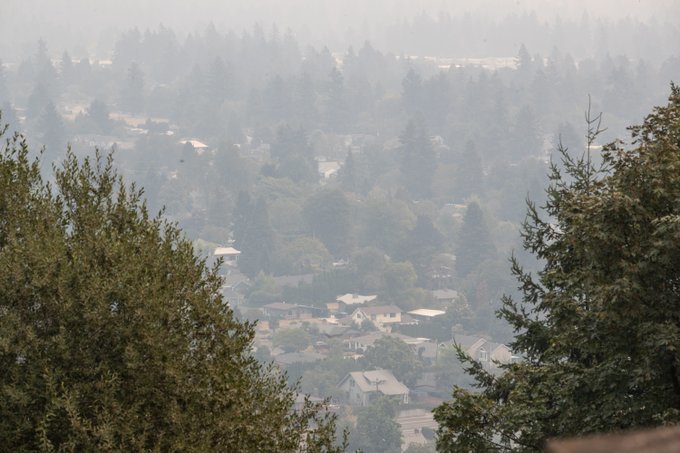 Smoky air is dangerous to your health. https://twitter.com/multco/status/1305602192091435008
Here in Gresham, our most direct impact has been the smoke hanging over our area like a toxic cloud. Portland now has the worst air quality of any large city in the world, and many of the small towns closer to the fires are seeing air quality index numbers that are simply off the charts.
That’s why health officials are pleading that you DON’T GO OUTSIDE if at all possible. According to Multnomah County Health, someone who spent the last day outside in Portland would have inhaled the equivalent of 15 cigarettes. Close your windows and doors, seal your home to the extent you can, and follow some of these tips for increasing circulation and purifying your air. If you're planning an event or managing employees, think about postponing nonessential activities until after the air clears.
Smoky conditions are expected to persist until Thursday or Friday. Our courageous first responders are still out there fighting fires. And in the coming weeks, we’ll learn more about what has been lost and what will be needed to rebuild. In the meantime, please hang in there—we will get through this. If you are struggling with the stress and anxiety of living through these times, don’t be afraid to ask for help. Multnomah County has some excellent information and resources, including a 24-hour mental health crisis line.
I've compiled a list of helpful resources to help you navigate the storm of information that accompanies a crisis like this. Please don't hesitate to reach out to my office if there is additional information you need or questions you want answered.
General information
-
Sign up for public alerts for our region at www.publicalerts.org/. It’s easy to opt into text or email alerts with critical public safety and emergency information based on your location. Public Alerts also has helpful information about wildfire and smoke on their Wildfires 2020 page.
-
The State of Oregon’s wildfire information website includes comprehensive information about the state of the fires, how to prepare, how to deal with smoky air, and what to do if you have been evacuated and need shelter, documents, or other assistance.
-
Multnomah County’s wildfire information website includes information about evacuations (there are no evacuations expected in Multnomah County), air quality, shelter for our houseless neighbors, and more. Also in Spanish.
Fire updates
Smoke and air quality
- The Oregon Smoke Information Blog from the Department of Environmental Quality has accurate and up-to-date information about air quality across the state. You can also download the DEQ’s Oregon Air Quality App here.
- The Oregon Health Authority put together these wildfire and smoke fact sheet and FAQ in multiple languages.
- Multnomah County has some helpful tips about how to protect yourself (#1: don’t go outside).
- The Joint Office of Homeless Services has opened several emergency shelters for our houseless neighbors to get respite from the smoke. They recommend calling 2-1-1 to see where space is available and arrange transportation.
Local closures
Oregon is hurting right now, but it's a testament to Oregonians' generosity that one of the first questions we hear in a crisis like this is How can I help? Here are the tips we have gotten from officials.
1. First, keep yourself and your neighbors safe. If home is a safe place right now, stay there. Sign up for emergency alerts and avoid going out in hazardous air. Just like with COVID, call your neighbors to make sure their needs are met, especially if they are older or vulnerable to smoke. You can call 2-1-1 for information about shelters and other assistance if you or people in your area need help.
2. Be responsible. As much as possible, avoid putting another issue on first responders’ plates. Even far away from the fires, hospitals and emergency personnel are busy taking care of people who are sick from the smoke, evacuated from their homes, or dealing with COVID. Don’t call 9-1-1 unless you are in an emergency. Don't spread bad information, and think twice about what you see on social media. If possible, avoid traveling outside your area and check before you go: many roads in Oregon are still closed or hazardous due to smoke.
3. Be smart about how you give. Most organizations don't have the capacity to sort through item donations right now. That means that you should not bring donated clothes, food, or toys to evacuation centers or fire stations unless they are requested. The best way to contribute is to give monetary donations to reputable non-profits who can purchase the supplies they need when they need them.
If you’re able to give money or time, there are great ideas about how best to contribute in these articles from Multnomah County, OPB, the Portland Mercury, and the Oregonian. Remember, there will be many needs in the weeks and months ahead as we rebuild, and communities are just beginning to identify the help they will need.
My COVID update is shorter this week, but we can’t forget that we are still in a deadly pandemic, even as our attention has been elsewhere. Over the weekend, Oregon recorded its 500th death due to COVID, a 49-year-old woman in Umatilla County.
The wildfire surge of the last week may throw a wrench in our response to coronavirus, or it may have little effect—it is simply too early to tell. The Office of Emergency Management and organizations like the Red Cross have been working overtime to set up evacuation centers that allow for social distancing and prevent further spread of the disease. While we continue to see slow improvements to the number of new COVID cases in Oregon, we are not sure of what effect the fires and smoke will have on COVID testing and diagnosis.
Masks: What with the wildfire smoke and the airborne disease, masks are an increasingly important accessory this year. This article from OPB has some helpful information. The upshot: cloth masks are generally effective against spreading COVID, but they have less effect again tiny smoke particles. If you don’t have a tight-fitted K-95 mask available to you, a cloth mask is better than nothing.
Symptoms: A question Oregonians may be asking themselves: is this pain in my chest COVID, or is it “just” the wildfire smoke? Health officials encourage you to listen to your body. If you’re experiencing a fever or chills in addition to coughing and shortness of breath, that’s a sign that you should contact your medical provider. The CDC’s coronavirus self-checker can help you work through your symptoms and decide your best course of action.
Thank you for your patience, bravery, and kindness in this time of great need for our state and community. Please do not hesitate to reach out to my office for information or assistance. We will get through this.
Sincerely,
 Carla C. Piluso
State Representative
House District 50, the great city of Gresham
email: Rep.CarlaPiluso@oregonlegislature.gov I phone: 503-986-1450
address: 900 Court St NE, H-491, Salem, OR 97301
website: http://www.oregonlegislature.gov/piluso
| 

